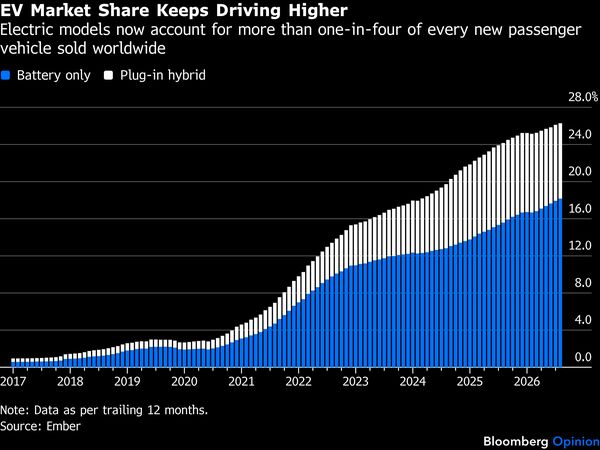
尽管被称为“特朗普第二任期”的大规模灭绝事件正在发生,清洁技术依然存活。可再生能源部署正在创下纪录,即使在美国也是如此,全球每四辆新乘用车中就有一辆配有插座。这反映了两点。第一,无论特朗普总统还是美国,尽管强大,都无法否定基本的科学和经济力量。第二,特朗普本人的行为反而强化了这些力量。
Despite the mass extinction event known as the second Trump administration, cleantech lives. Renewable energy deployment is breaking records, even in the US, and more than one-in-four of every new passenger vehicle sold worldwide now sports a socket. This reflects two things. First, neither President Donald Trump nor the US, powerful as they are, can negate basic scientific and economic forces. Second, Trump’s own actions have strengthened those forces.
结果不仅是清洁技术表现出蟑螂般的求生意志,它还正在扼杀那些关于未来化石燃料需求增长预测的底层假设,而这些预测涉及的国家正是对该需求最为重要的新兴市场。
The result is not merely that cleantech displays a cockroach-like will to live. It is also killing off the assumptions underlying projections of future fossil fuel demand growth in the countries that matter most for that, emerging markets.
特朗普强化了一种更广泛的氛围转变,即远离气候行动,因为通胀、战争和数据中心重塑了能源叙事。在最近的纽约气候周上,与一位清洁技术风险投资基金创始人追赶时,他们表示几乎没听到“气候”这个词,“韧性”和“安全”等热门词汇要突出得多。
Trump reinforced a broader vibe shift away from climate action as inflation, war and data centers reoriented energy narratives. Catching up with a cleantech venture fund founder at the recent New York Climate Week, they remarked how little they had heard the word “climate,” with buzzwords like “resilience” and “security” far more prominent.
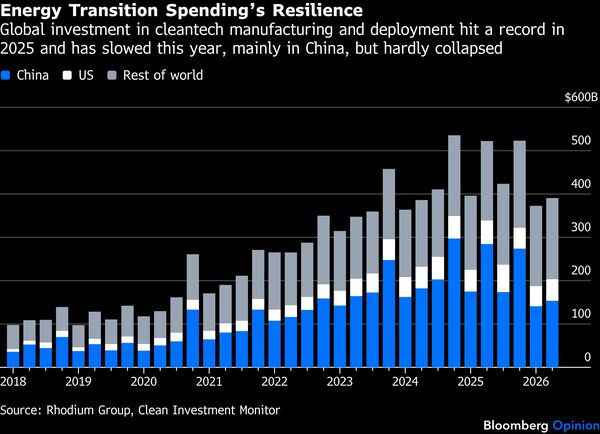
需要澄清的是,那些忽视日益累积的延迟气候成本、呼吁能源“务实”的声音,充其量是近视的。幸运的是,清洁技术已摆脱了这种新氛围。黑石集团刚刚募集了一个87亿美元的能源转型基金,比上一支基金大55%。全球范围内,清洁技术投资已从2025年的纪录高位回落,这反映了补贴到期前提前释放的需求,但仍然强劲。在美国,它表现得异常稳定。
To be clear, proliferating calls for energy “pragmatism” that ignore mounting deferred climate costs are, at best, myopic. Cleantech has, thankfully, bucked the new vibes. Blackstone Inc. just raised an $8.7 billion energy transition fund, 55% larger than the prior one. Globally, cleantech investment has retreated from its record in 2025, which reflected pulled-forward demand ahead of subsidies expiring anyway, but remains strong. It has been remarkably stable in the US.
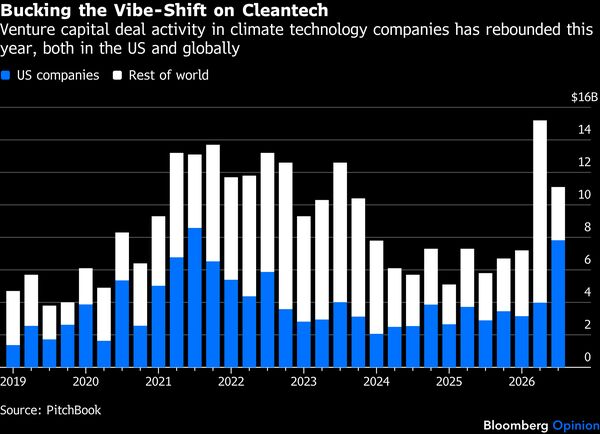
即使是在迄今今年融资举步维艰的清洁技术风险投资领域,根据数据提供商PitchBook的数据,交易量在美国和全球都有所上升。
Even in cleantech venture capital, where fundraising has struggled so far this year, deal volume has risen both in the US and globally, according to PitchBook, a data provider.
部署同样具有韧性。据彭博新能源财经(BloombergNEF)称,2025年太阳能和风能占全球新增发电装机容量的85%,并且,在一个引人注目的里程碑中,它们今年将超过全球化石燃料发电厂的现有装机基数。与此同时,美国太阳能、风能和电池部署预计今年将创下纪录,明年将再次打破该纪录。此外,美国在电动汽车领域的退缩是个例,而非世界其他地区的效仿模板。
Deployment is also resilient. Solar and wind accounted for 85% of the world’s net new electricity generation capacity in 2025 and, in a remarkable milestone, they will surpass the world’s installed base of fossil-fuel power plants this year, according to BloombergNEF. US solar, wind and battery deployments, meanwhile, are projected to hit a record this year and then break that record next year. Plus, the US retreat on electric vehicles is an anomaly, not a template for the rest of the world.
这一切的主要原因在于成本:据拉扎德(Lazard)最新的基准分析称,“无补贴的可再生能源仍然是最具成本竞争力的新建发电形式。”燃气涡轮机具有可调度的优势——即不依赖天气或一天中的时间——但它们存在瓶颈,推高了成本和交付进度。电网储能也在放大间歇性可再生能源的价值——看看德克萨斯州。涵盖电力、交通和国防应用的电池,正迅速成为本世纪的基础技术,类似于上世纪的内燃机。
The primary reason for all this concerns cost: “Unsubsidized renewable energy remains the most cost competitive form of new-build generation,” according to Lazard’s latest benchmarking analysis. Gas turbines have the advantage of being dispatchable — that is, not dependent on weather or time of day — but they are bottlenecked, driving up costs and delivery schedules. Grid storage is also amplifying the value of intermittent renewable energy — look at Texas. Batteries, spanning power, transportation and defense applications, are fast becoming a foundational technology for this century, similar to internal combustion engines in the last one.
当前最深远的发展涉及清洁技术的扩散。一个引人注目的例子是,英国清洁能源智库Ember的新数据显示,电池电动汽车现在占印度新车市场的近9%。这一比例仅两年前为2%,而且值得注意的是,印度已领先于美国的6%。
The most profound development underway concerns the diffusion of cleantech. In a striking example, new data from Ember, a UK-based clean energy think tank, show that battery EVs now account for almost 9% of the new vehicle market in India. That is up from only 2% two years ago and, notably, puts India ahead of the US at 6%.
这种新技术通常先在发达经济体饱和,然后再从那里扩散的常规轨迹出现的这种奇特反转,部分归因于美国特有的两极分化的气候政治和对皮卡的偏爱。但更多归因于清洁技术价格的下降,以及燃料进口国经济和战略成本的上升。
This odd flipping of the usual trajectory whereby new technologies saturate advanced economies and spread from there owes something to America’s peculiarly divisive climate politics and attachment to trucks. But it owes more to falling prices for cleantech, and increased economic and strategic costs for fuel-importing nations.
印度在收入和燃油使用水平远低于全球车辆电动化领跑者中国的情况下,已达到类似的电动汽车渗透率。伊朗战争的冲击和贸易壁垒的上升进一步增添了动力。或许并非巧合,据彭博新能源财经数据,中国清洁技术出口在2月后激增,7月创下210亿美元的纪录高位。
India has reached a level of EV penetration at income and fuel-usage levels far below where the world leader in vehicle electrification, China, did so. The dislocations of the Iran war and rising trade barriers add further impetus. It is perhaps no accident that China’s cleantech exports surged after February, hitting a record $21 billion in July, according to BloombergNEF.
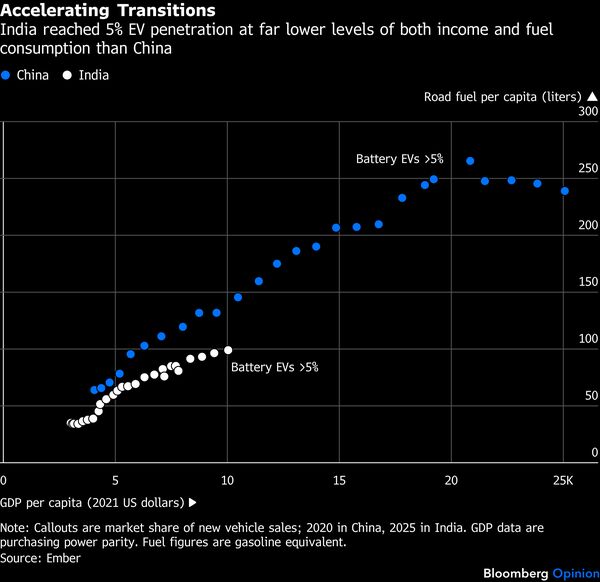
其影响深远。就未来化石燃料需求增长而言,新兴市场是全部看点。在国际能源署较为保守的气候政策情景中,印度占全球石油需求至2035年预计增量的近一半,至2050年占40%。
The implications are profound. When it comes to future fossil fuel demand growth, emerging markets are the entire ballgame. India accounts for almost half the projected growth in global oil demand through 2035, and 40% through 2050, in the International Energy Agency’s more conservative climate-policy scenario.
然而,清洁技术竞争力的增强已削弱了繁荣与化石燃料消费之间的传统关系,国际能源署长期低估太阳能发电便证明了这一点。巴基斯坦屋顶太阳能的意外繁荣,或非洲国家跳过固定电话网络直接跨越至移动通信,均显示新技术如何冲破关于发展路径的旧有假设。
Yet, cleantech’s increasing competitiveness has weakened the traditional relationship between prosperity and fossil-fuel consumption, as the IEA’s persistent underestimation of solar power has demonstrated. The recent unexpected boom in rooftop solar energy in Pakistan or, analogously, African nations leap-frogging straight to mobile telephony rather than fixed line networks show how new technology plows through old assumptions about development pathways.
面对成本下降和性能提升,意识形态也显得力不从心。几十年前,太阳能发电还是新鲜事物、电动汽车还是笑谈之时,绿色能源爱好者极易被贴上脱离现实的狂热分子标签。如今清洁技术横扫多个市场,坚称其行不通、或如特朗普所言属于骗局的游说者和政客,反倒听起来像狂热分子。
Ideology also struggles with falling costs and rising performance. Green energy enthusiasts were easily branded as out-of-touch fanatics a couple of decades back, when solar power was still a novelty and EVs a joke. As cleantech rolls across multiple markets today, it is the lobbyists and politicians who insist it can’t work or, per Trump, constitutes a scam who sound like zealots.
这在很大程度上是因为收益已从最初的绿色前提向外扩展。正如我在此撰文所述,经济、安全和地缘政治构成的“新ESG”正推动各国实现贸易化石燃料的多元化替代,不一定是因为它们零排放,而是因为它们“零麻烦”。我交谈的那位风投投资者补充道,只要清洁技术机遇持续涌现,“我不在乎他们怎么称呼它。”
This is, in large part, because the benefits have expanded outward from the original green premise. As I wrote here, the new ESG of economics, security and geopolitics are pushing nations to diversify away from traded fossil fuels for alternatives, not necessarily because they are zero-emissions but because they are zero-drama. That same venture investor I spoke with added, as long as cleantech opportunities keep coming, “I don’t care what they call it.”