作为华盛顿最亲密的合作伙伴之一,不再意味着可靠地为美国赤字融资。
Being one of Washington’s closest partners no longer means reliably funding the US deficit.
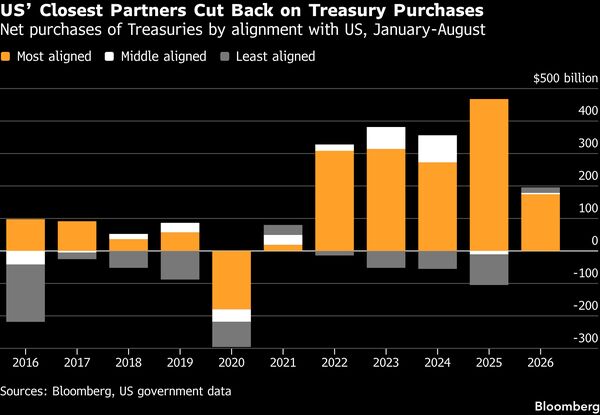
根据对财政部和国务院数据的分析,与美国关系最紧密的国家和地区在2026年前八个月净买入1743亿美元美国国债(不含短期国库券)。这是自2021年以来同期的最低水平,较去年同期下降逾60%。
Countries and regions most aligned with the US bought a net $174.3 billion of Treasuries, excluding bills, in the first eight months of 2026, according to an analysis of Treasury and State Department data. That was the lowest for the period since 2021 and down more than 60% from a year earlier.
这一转变在亚洲尤为显著,运行大额顺差的经济体将较少资金投入美国债务。作为最大海外美债持有国,日本前八个月仅净买入3.89亿美元,较去年同期暴跌99%。韩国净卖出238亿美元,为1977年有记录以来同期最多。台湾地区也是净卖出方。
The shift is noteworthy in Asia, where economies running large surpluses are putting less of that money into US debt. Japan, the biggest foreign holder of Treasuries, bought just $389 million in the first eight months — down 99% from a year earlier. South Korea sold $23.8 billion, the most for the period in records going back to 1977. Taiwan was also a net seller.
这种转变没有单一解释。各国政府鲜有表态说明是否计划减持美债,且数据未在国家层面区分政府购买与私人投资。多重因素可能在起作用,包括本币疲软、本国收益率上升、股票需求增长以及对美国政策的不安。
There’s no single explanation for the shift. Governments have said little about any plans to move away from Treasuries, and the data don’t separate government buying from private investment at the country level. Several factors may be contributing, including weak currencies, rising yields at home, growing demand for stocks and unease over US policy.
“美债市场失去的不是外国买家,而是‘自动买家’,”道富投资管理公司高级固定收益策略师Masahiko Loo表示,该公司管理资产逾6万亿美元。“一个日益难以预测的美国,让大规模结构性超配和资本自动再循环流入美债更难以证明合理性。”美国政府债务堆已攀升至40万亿美元以上,令全球最大经济体更依赖投资者为其开支融资。
“The Treasury market isn’t losing foreign buyers — it’s losing automatic buyers,” said Masahiko Loo, a senior fixed-income strategist at State Street Investment Management, which oversees over $6 trillion. “An increasingly unpredictable US makes large structural overweights and the automatic recycling of capital into Treasuries harder to justify.”The US government’s debt pile has climbed past $40 trillion, leaving the world’s largest economy more reliant on investors to fund its spending.
与此同时,特朗普总统的关税政策及美国政策的不确定性,引发了对美元长期前景的担忧。加之从日本到欧洲等市场收益率上升,全球投资者拥有的美债替代品比以往更多。
At the same time, President Donald Trump’s tariffs and uncertainty over US policy have spurred concerns about the dollar’s longer-term outlook. And with yields rising in markets from Japan to Europe, global investors have more alternatives to Treasuries than they once did.
亚洲的大额储蓄国通常将其盈余换成美元,并将资金存放在美国国债中。今年,货币贬值削弱了它们的购买力,迫使各国政府动用储备。
Asia’s big savers have typically converted their surpluses into dollars and parked the money in Treasuries. This year, weakening currencies eroded their buying power and pushed governments to dip into reserves.
日元跌至四十年来最低水平,数据显示,东京曾在夏季抛售部分美国国债和其他证券,以支撑汇率。韩元跌至2009年以来最低点,随后有所回升。
The yen sank to its weakest level in four decades, and data suggested Tokyo sold some of its Treasuries and other securities over the summer as it sought to support the currency. The won fell to its lowest since 2009 before recovering.
各国政府对其做法鲜有透露。5月,日本财务省一位高级官员表示,抛售美债支撑日元适得其反,称当局注意到抛售持仓的风险。韩国银行9月表示,计划将由国内资产管理公司管理的部分储备投资范围拓展至美国债券之外。
Governments haven’t shed much light on their approach. In May, a senior Japanese Finance Ministry official suggested that selling Treasuries to prop up the yen is counterproductive, saying authorities are mindful of the risks of selling their holdings. The Bank of Korea said in September it plans to broaden investments beyond US bonds for a portion of its reserves managed by domestic asset managers.
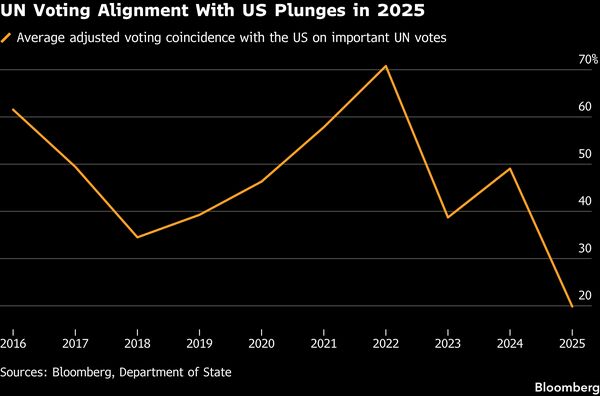
立场判定具有主观性。本分析是对2月首次发布分析的更新,依据各国在关键联合国决议上的投票与美国一致的频率,利用国务院数据,将国家分为最一致、最不一致和中立三类。这种方法在学界常用于判定盟友与对手。
Alignment can be subjective. This analysis, an update of one first published in February, classifies countries as most-, least- and neutrally-aligned by how often their votes on key United Nations resolutions match those of the US, using State Department data. The approach is commonly used in academia to determine allies and adversaries.
例如,长期军事盟友澳大利亚被归为最一致,中国为最不一致,而美国邻国墨西哥则落入中立类别。
For example, longtime military ally Australia was classified as most-aligned, China as least, with America’s neighbor Mexico falling into the neutral bucket.
数据为净买入额——即买入减去卖出——针对原始期限超过一年的美国国债。涵盖57个国家和地区,包括官方和私人投资者。
The figures are net purchases — buying minus selling — of Treasuries with an original maturity of more than one year. They cover 57 countries and regions and include both official and private investors.
美国财政部数据可能将证券归属于通过托管人或中介持有证券的国家,而非最终持有人所在国。因此,归属于英国、比利时等金融中心的持仓和买入,可能部分反映了其他地区投资者的行为。即使亚洲资金流向海外,美国国债也未必是首选默认选项。
The Treasury data may attribute securities to the country where they are held through custodians or intermediaries, rather than to the nation of the ultimate owner. Holdings and purchases attributed to financial centers such as the UK and Belgium may therefore partly reflect investors elsewhere. Even when Asian money is flowing overseas, Treasuries aren’t necessarily the default first choice.
据外交关系委员会高级研究员、前美国财政部官员布拉德·塞特瑟(Brad Setser)称,韩国投资者偏好股票,而台湾的资金已转向股票和存款。“所以一些拥有巨额顺差的朋友并没有成为大量净买家,”他说。
Korean investors prefer stocks, while Taiwan’s money has shifted toward equities and deposits, according to Brad Setser, a senior fellow at the Council on Foreign Relations and a former US Treasury official. “So some friends with big surpluses haven’t been big net buyers,” he said.
塞特瑟认为,这是更广泛的“去储备化”趋势的一部分,即更多外国资产不再持有于传统的央行储备中,而是通过养老基金、国有银行和其他大型机构流动。塞特瑟表示,这不等于去美元化,但可能意味着对美国国债的“官方需求”减少。
Setser sees this as part of a broader “dereservification” trend, in which more foreign assets are held outside traditional central-bank reserves and instead flow through pension funds, state banks and other large institutions. That doesn’t amount to de-dollarization, but can mean less “official demand” for Treasuries, according to Setser.
彭博策略师观点……美元融资利率居高不下,持续侵蚀美国国债收益,而国内收益率上升改善了日本国债的投资机会。——安德烈·德西尔瓦(Andre de Silva),Markets Live策略师。
What Bloomberg Strategists Say... Elevated dollar funding rates continue to erode returns on Treasuries just as rising domestic yields have improved opportunities in JGBs.— Andre de Silva, Markets Live strategist.
其他地方的较高收益率也给投资者提供了选择。Kiwoom Asset Management全球固定收益主管杨珠京(Yang Joo Kyung,音译)表示,该公司对美国国债保持谨慎,并认为日本国债相对更具吸引力。
Higher yields elsewhere are also giving investors options. Korea’s Kiwoom Asset Management remains cautious on Treasuries and sees Japanese government bonds as relatively attractive, said Yang Joo Kyung, head of global fixed income.
日本投资者也有更多理由将资金留在国内。随着国内收益率升至数十年高位,他们从海外投资中获得的额外收益已收窄。
Japanese investors have more reason to keep their money at home too. With domestic yields at multi-decade highs, the extra return they can earn from investing overseas has narrowed.
“日本是美国的盟友,我们当然已经看到一些迹象表明,存在一种套息交易逐步平仓的情况,”美国银行证券(BofA Securities)G-10外汇和利率策略师奥利弗·莱文斯顿(Oliver Levingston)表示,指的是借入低息日元投资于其他高收益资产的做法。
“Japan is a US ally, and we’ve certainly seen some signs that there is a kind of gradual unwind of the carry trade,” said Oliver Levingston, G-10 foreign-exchange and rates strategist at BofA Securities, referring to the practice of borrowing cheaply in yen to invest in higher-yielding assets elsewhere.
这并不意味着美国正在失去买家。包括对冲基金、银行和共同基金在内的私人投资者已介入,将其持有的联邦债务占比提升至约70%,接近1990年以来的最高水平。
That doesn’t mean the US is running out of buyers. Private investors, including hedge funds, banks and mutual funds, have stepped in, boosting their share of federal debt to about 70%, near the highest since 1990.
但他们对价格更为敏感。对于财政部长斯科特·贝森特和美联储主席凯文·沃什而言,这意味着如果投资者对货币政策、经济、美国赤字扩大或白宫发出的信号感到不安,市场可能会出现剧烈反应。
But they’re more sensitive to price. For Treasury Secretary Scott Bessent and Federal Reserve Chairman Kevin Warsh, that means markets can react sharply if investors grow uneasy about monetary policy, the economy, widening US deficits or signals coming from the White House.
这种敏感性导致基准10年期国债收益率今年升至5%以上。截止本周三亚洲交易时段,收益率维持在约5.01%。
That sensitivity contributed to benchmark 10-year yields rising above 5% this year. They’re holding at around 5.01% as of Wednesday in Asia.
与华盛顿关系最不紧密的国家在1月至8月期间购买了171亿美元的美国国债,扭转了同期连续四年净卖出的局面。这一数额仅为与美国结盟国家购买额的十分之一。
The countries least aligned with Washington bought $17.1 billion of Treasuries from January through August, reversing four straight years of selling over the same period. That’s a tenth of what US-aligned countries bought.
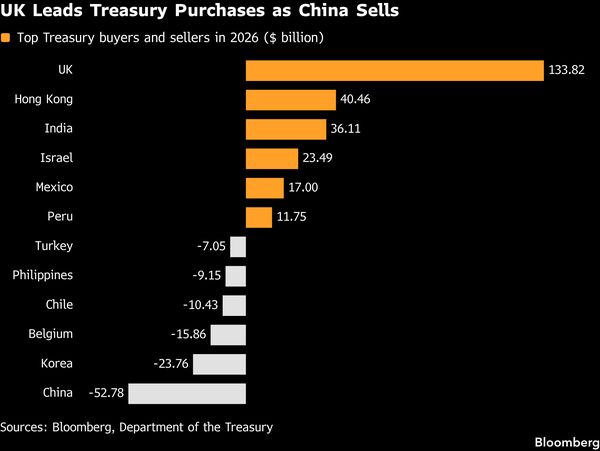
中国仍是最大卖家,位居韩国之前,尽管有分析人士认为北京可能通过包括加拿大在内的其他国家进行部分交易。比利时——其持有量被认为包括一些中国账户——排名第三。英国、香港和印度是最大的买家。
China remains the biggest seller, ahead of Korea, though some analysts believe Beijing might have channeled some transactions through other nations, including Canada. Belgium — whose holdings are thought to include some Chinese accounts — ranked third. The UK, Hong Kong and India were the biggest buyers.
“即使背后的动机更难界定,中国持续的减持仍符合长期多元化的趋势,”Nuveen驻伦敦宏观信贷主管劳拉·库珀表示。
“China’s continued reductions are consistent with a longer-term diversification trend, even as the underlying motivations are harder to establish,” said Laura Cooper, London-based head of macro credit at Nuveen.
这并非美国结盟国家首次从国债市场撤出。2020年疫情爆发导致全球争夺流动性时,它们曾大幅抛售。
This isn’t the first time US-aligned countries have pulled back from Treasuries. They sold sharply in 2020, when the Covid-19 pandemic triggered a global scramble for liquidity.
即便如此,规模达32万亿美元的美国国债市场在深度、流动性以及几乎全天候的交易方面仍无可匹敌,而美元仍保持世界主要储备货币的地位。
Even so, the $32 trillion Treasury market remains unmatched in its depth, liquidity and near round-the-clock trading, while the dollar retains its role as the world’s dominant reserve currency.
截至8月,外国人仍持有7.85万亿美元的美国国债,接近历史最高水平,尽管其在市场中的份额已从2012年最高的52%缩减至不足三分之一。
Foreigners still owned $7.85 trillion of Treasuries as of August, near an all-time high, though their share of the market has shrunk to less than a third from a peak of 52% in 2012.
“看看替代选择,寥寥无几,”PGIM全球债券主管罗伯特·蒂普(Robert Tipp)表示。“因此,你确实看到了再平衡,以及部分国家持续减持,但这被其他国家吸收了。”外国投资者也并未抛弃美国资产。部分资金正转向美国股票和企业债,显示投资者依然青睐美国企业,即便对政府债券的胃口降温。
“When you look at the alternatives, they’re pretty few and far between,” said Robert Tipp, head of global bonds at PGIM. “So you have had a rebalancing and consistent runoff from some countries, but it’s been absorbed by others.”Foreign investors aren’t abandoning US assets either. Some of that money is shifting into American equities and corporate debt, suggesting investors remain keen on US companies even as appetite for government debt cools.
而填补空缺的买家,恐怕会比过去那些毫不费力为华盛顿输血的友好国家索要更高的补偿。
And the buyers filling the gap are likely to demand more compensation than the friendly nations that used to fund Washington with little fuss.
“美国财政部能为自己融资——问题在于价格和价格的波动性,”德国银行(Deutsche Bank AG)日本首席固定收益策略师大森章贵(Shoki Omori)表示。“盟友过去提供的那种耐心、不计价格的资金,是利率水平买不回来的。”
“The Treasury will fund itself — the question is the price and the volatility of the price,” said Shoki Omori, Deutsche Bank AG’s chief fixed-income strategist for Japan. “What the level cannot buy back is the patient, price-insensitive money the allies used to supply.”