
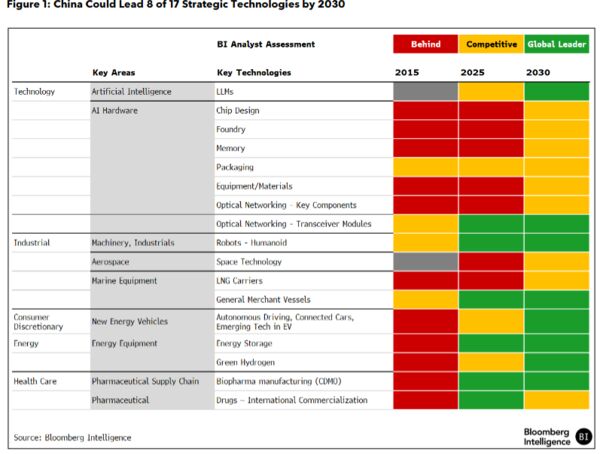
根据彭博行业研究(Bloomberg Intelligence)的一份新报告,中国完全有能力在2030年之前在作为人工智能核心的大语言模型领域领先全球,并且在其他每一个具有战略重要性的技术领域都至少具备竞争力。
China is well placed to lead the world by 2030 in the large language models at the core of artificial intelligence, and will be at least competitive in every other strategically important technology, according to a new Bloomberg Intelligence report.
该研究预测,在该时期结束时,中国将在17个关键行业中的8个行业处于领先地位,其中包括大语言模型。由弗朗西斯·陈(Francis Chan)领导的彭博行业研究分析师在周三发布的报告中写道,在人工智能竞赛中至关重要的其他类别——即生产运行人工智能所需的硬件,从芯片到光网络组件——中国企业目前大多落后,但到2030年将具备竞争力。可在彭博终端上阅读完整的彭博行业研究报告。
The study predicts that China will be ahead in eight out of 17 key industries at the end of that period, including LLMs . In the other categories that are crucial to the AI race — producing the hardware needed to run it, from chips to optical networking components — Chinese firms are mostly behind now but will be competitive by 2030, the BI analysts led by Francis Chan wrote in the report published on Wednesday. Read the full BI report on the Bloomberg terminal.
报告称:“中美两国正走在2030年共同主导人工智能技术的轨道上,两国都不大可能获得全面的绝对优势。”报告指出,美国模型可能会在前沿领域保持微弱领先,而“中国在软件优化方面的专业知识使其在低成本人工智能落地方面处于有利地位”。中国可能会缩小半导体技术的差距,但无法实现完全自给自足。
“The US and China are on track for joint technology leadership in AI by 2030, with neither country likely to achieve overall supremacy,” according to the report. American models may maintain a narrow lead at the frontier, while “China’s expertise in software optimization leaves it well positioned in lower-cost AI implementation,” it said. China will likely close the gap in semiconductor tech without achieving full self-sufficiency.
全球两大经济体之间日益激烈的技术竞争,只是中国工业进步在竞争对手和合作伙伴中引发不安的一个例子。由于担心中国企业将主导新一代清洁能源汽车,欧盟最近通过谈判对汽车进口设定了上限。在世界各地,制药或工业机械等领域的生产商也面临着类似压力。
Intensifying competition over AI between the world’s two biggest economies is just one example of the unease that China’s industrial advance is generating among rivals and partners. The European Union recently negotiated a cap on auto imports, amid concern that Chinese firms will dominate the new generation of clean-energy vehicles. Around the world, producers in areas like pharmaceuticals or industrial machinery are under similar pressure.
彭博行业研究预测,中国将在包括电动汽车和储能学在内的全部三个新能源领域以及生物制药制造领域跻身全球领导者行列。中国已经在人形机器人生产和造船的某些方面处于领先地位,并且在研发支出的投入上已经赶上了美国。
The BI study predicts that China will rank as global leader in all three of its new-energy categories, including EVs and energy storage, and also in biopharma manufacturing. It’s already ahead in production of humanoid robots and in some aspects of shipbuilding, and has caught up with the US in spending on research and development.
根据彭博行业研究,这些实力都无法将中国的经济从放缓中拯救出来。彭博经济研究预测,未来十年的国内生产总值(GDP)增长率平均为3.6%——低于过去三年的5.2%。
None of this prowess is going to rescue China’s economy from a slowdown, according to the BI study. Bloomberg Economics predicts GDP growth will average 3.6% over the coming decade — down from 5.2% in the last three years.
分析师写道:“人工智能和自动化可以缓解劳动力收缩和房地产活动疲软带来的压力,但仅凭它们不太可能扭转长期的经济增长放缓。”N此外,中国的AI企业——与其他地方的同行一样——正在艰难摸索如何从其创新中赚钱。根据彭博行业研究,它们“仍然陷入价格战的恶性竞争中,在企业采取更理性的定价方法之前,利润恐怕仍将遥不可及”。
“AI and automation can mitigate pressure from a shrinking workforce and weaker property activity but are unlikely to reverse the long-term slowdown on their own,” the analysts wrote. What’s more, China’s AI firms — like peers elsewhere — are struggling to figure out how to make money out of their innovations. They “remain locked in a race to the bottom, with profit set to remain elusive until companies adopt a more rational approach to pricing,” according to BI.
不过,彭博行业研究写道,即将对恒生科技指数等基准股票指标进行的改革——该指数一直落后于全球人工智能交易——将有助于它们获取中国高科技产业其他地方正在产生的价值。“这些变化可能会实质性地改善该指数的增长格局,并扩大对先进硬件、人工智能和机器人的投资敞口。”与此同时,与美国、欧洲和其他贸易伙伴的摩擦将继续成为中国科技巨头前进的障碍——将中国企业挡在利润丰厚的市场之外,或者通过出口限制剥夺它们获得尖端组件的机会。
Still, upcoming overhauls of benchmark stock gauges like the Hang Seng Tech Index — which has lagged behind the global AI trade — will help them capture value being generated elsewhere in China’s high-tech industries, BI wrote. “The changes could materially improve the index’s growth profile and broaden exposure toward advanced hardware, AI and robotics.”Meanwhile frictions with the US, Europe and other trade partners will continue to be an obstacle for the Chinese tech juggernaut — shutting China’s firms out of lucrative markets, or depriving them of cutting-edge components via export curbs.
但彭博行业研究写道:“这些限制更有可能令其产业扩张的地理格局碎片化,而不是彻底阻止它。”
But “those restrictions are more likely to fragment the geography of its industrial expansion than stop it outright,” BI wrote.