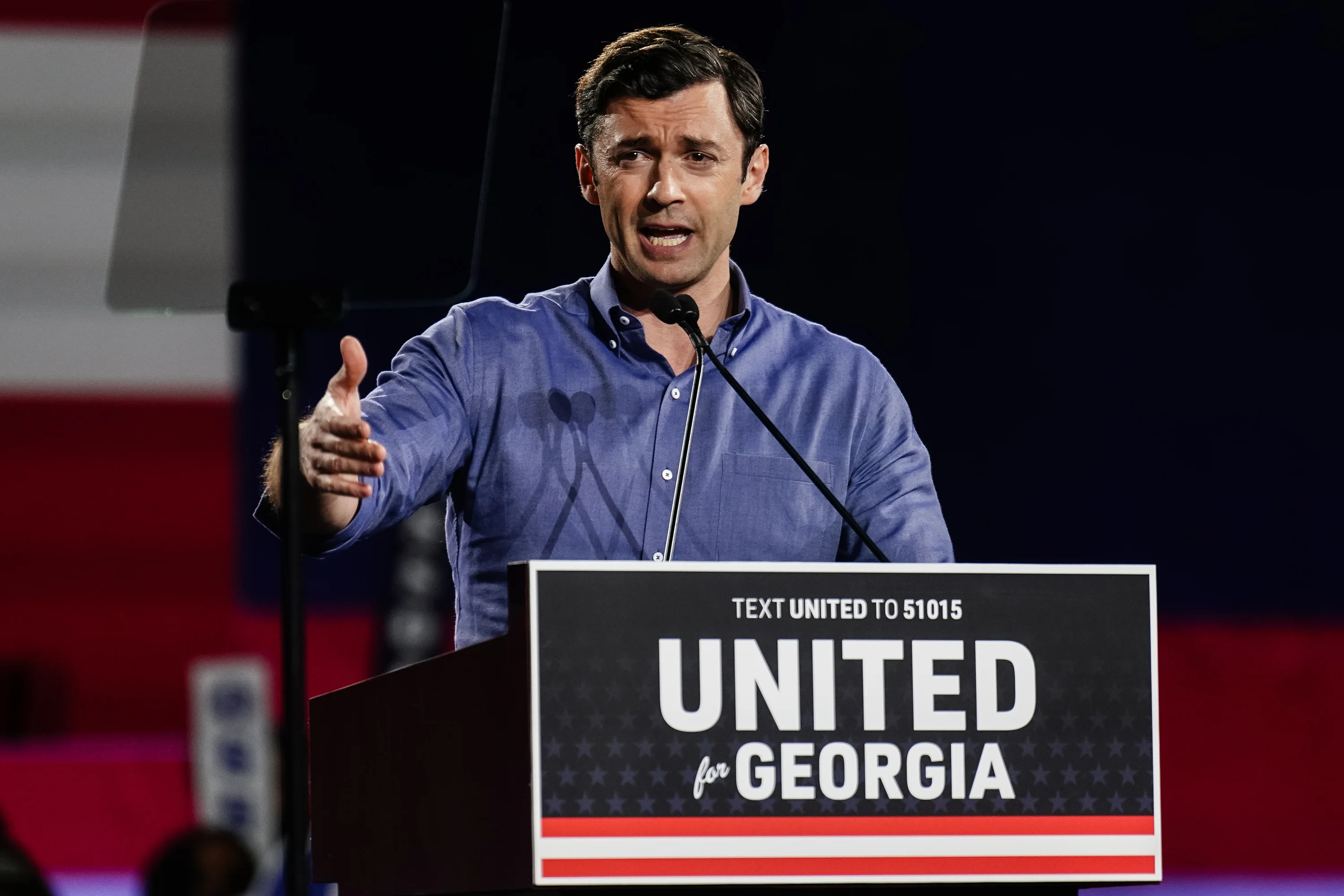
佐治亚州民主党联邦参议员乔·奥索夫于2026年10月17日在佐治亚州玛丽埃塔的一场竞选活动中发表讲话。
Sen. Jon Ossoff, D-Ga., speaks during a campaign event on October 17, 2026 in Marietta, Georgia.
埃利亚·努维拉奇/盖蒂图片社 在NPR应用程序中获取期中选举及更多内容的最新动态 在今年美国几场关键的联邦参议院选战中,候选人正向其本州以外的地区寻求捐赠,而他们针对州外受众的信息传递方式与本地竞选时有所不同。
Elijah Nouvelage/Getty Images Get the latest on the midterms & more in the NPR App In key U.S. Senate races this year, candidates are soliciting donations from outside of their home states, and their out-of-state messaging is different from what they're running locally.
NPR对艾奥瓦州、佐治亚州、俄亥俄州和得克萨斯州这四个主要参议院选战的谷歌广告进行的一项分析发现,在2025至2026年选举周期中,民主党和共和党候选人在筹款相关广告上的花费超过了1500万美元。其中约四分之三用于在全国播出的广告。
An NPR analysis of Google Ads for four major Senate races — Iowa, Georgia, Ohio and Texas — found that the Democratic and Republican candidates spent more than $15 million on advertising related to fundraising in the 2025-26 election cycle. About three quarters of that went to ads that ran nationally.
这些广告往往聚焦于全国性的政治谈资——例如攻击或捍卫特朗普总统,或是让参议院变蓝或变红——而非地方议题。对于像佐治亚州联邦参议员乔·奥索夫和艾奥瓦州民主党被提名人乔什·图雷克这样的候选人来说,他们超过80%的逐项列出的个人捐款都来自外州。
Often, these ads focus on national talking points — such as attacking or defending President Trump, or turning the Senate blue or red — rather than local issues. For candidates like Georgia Sen. Jon Ossoff and Iowa Democratic nominee Josh Turek, more than 80% of their itemized individual contributions have come from out of state.
资金的这种汇集已经影响了至少四场竞争激烈的参议院选战,在这些选战中,大部分资金都来自州外。“蓝州行动”和“红州胜出”这两个主要的基层筹款平台,是州外筹款的主要催化剂。
The funneling of funds has affected at least four of the competitive Senate races, where a majority of the money is coming from outside the state. ActBlue and WinRed, two major grassroots fundraising platforms, are a major catalyst for out-of-state fundraising.
布兰代斯大学政治学教授扎卡里·艾尔伯特表示,由于这项技术的运营成本低廉,它激励了候选人依赖数字广告。
Because this technology is inexpensive to run, it incentivizes candidates to rely on digital ads, according to Zachary Albert, a professor of politics at Brandeis University.
艾尔伯特说:“‘蓝州行动’和‘红州胜出’确实降低了捐款的交易成本。即使你从某个人身上只能获得5美元或10美元左右的捐款,由于拉赞助的成本比过去低得多,这仍然使得这一切是值得的。”随着两党以及每位候选人都拥有了筹款平台,政治希望之星们越来越需要从人群中脱颖而出,并且往往将他们的信息传递转向更广泛的受众,这可能会导致使用极化的信息来寻求资金。
"ActBlue and WinRed really reduced the transaction costs for contributing," Albert said. "Even if you're only yielding like a $5 or $10 contribution from someone like the costs of soliciting that are so much lower than they used to be, that it makes it worthwhile." With both parties — and each candidate — now having fundraising platforms, political hopefuls increasingly need to stand out from the crowd and are often shifting their messaging to a broader audience, which can result in using polarizing messaging to solicit funds.
全国化的口径 卫斯理媒体项目(Wesleyan Media Project)的迈克尔·弗朗茨(Michael Franz)表示,对于州内和州外广告,候选人往往有两套不同的宣传口径。
Nationalized talking points For in-state and out-of-state ads, candidates tend to have two different sets of talking points, according to Wesleyan Media Project's Michael Franz.
弗朗茨说:“在一场针对(本地)电视广告的大选竞选活动中,候选人绝不会说‘我是民主党人’,因为他们想要争取温和派和摇摆选民,以及跨党派的选民。但对于在你的州之外播出的数字广告而言,党派标签就变得更加重要了。”许多数字广告反映了这一点。正在寻求重返参议院的前俄亥俄州民主党参议员谢罗德·布朗(Sherrod Brown)呼吁将他的州变成蓝色,而佐治亚州共和党众议员迈克·柯林斯(Mike Collins)则请求人们帮助将他所在州的参议院席位变成红色。共和党目前控制着参议院,但有多场胜负难料的竞选,给民主党留下了夺回该院的途径。
"In a general election campaign for a [local] TV ad, a candidate will never say, 'I'm the Democrat,' because they want to appeal to moderates and swing voters and they want voters across the aisle," Franz said. "But with a digital ad that's airing outside of your state, the party label becomes more important." This is reflected in many digital ads. Former Ohio Democratic Sen. Sherrod Brown — who is seeking to regain a place in the Senate — calls to turn his state blue while Georgia Republican Rep. Mike Collins asks people to help turn his state's Senate seat red. Republicans currently control the Senate but there are a number of toss-up races giving Democrats a path to taking back the chamber.
爱荷华州共和党参议员候选人、众议员阿什利·欣森于2026年10月22日在爱荷华州苏城的一场集会上发表讲话,总统特朗普在一旁观看。
Iowa Republican Senate candidate, Rep. Ashley Hinson speaks at a rally on October 22, 2026 in Sioux City, Iowa as President Trump looks on.
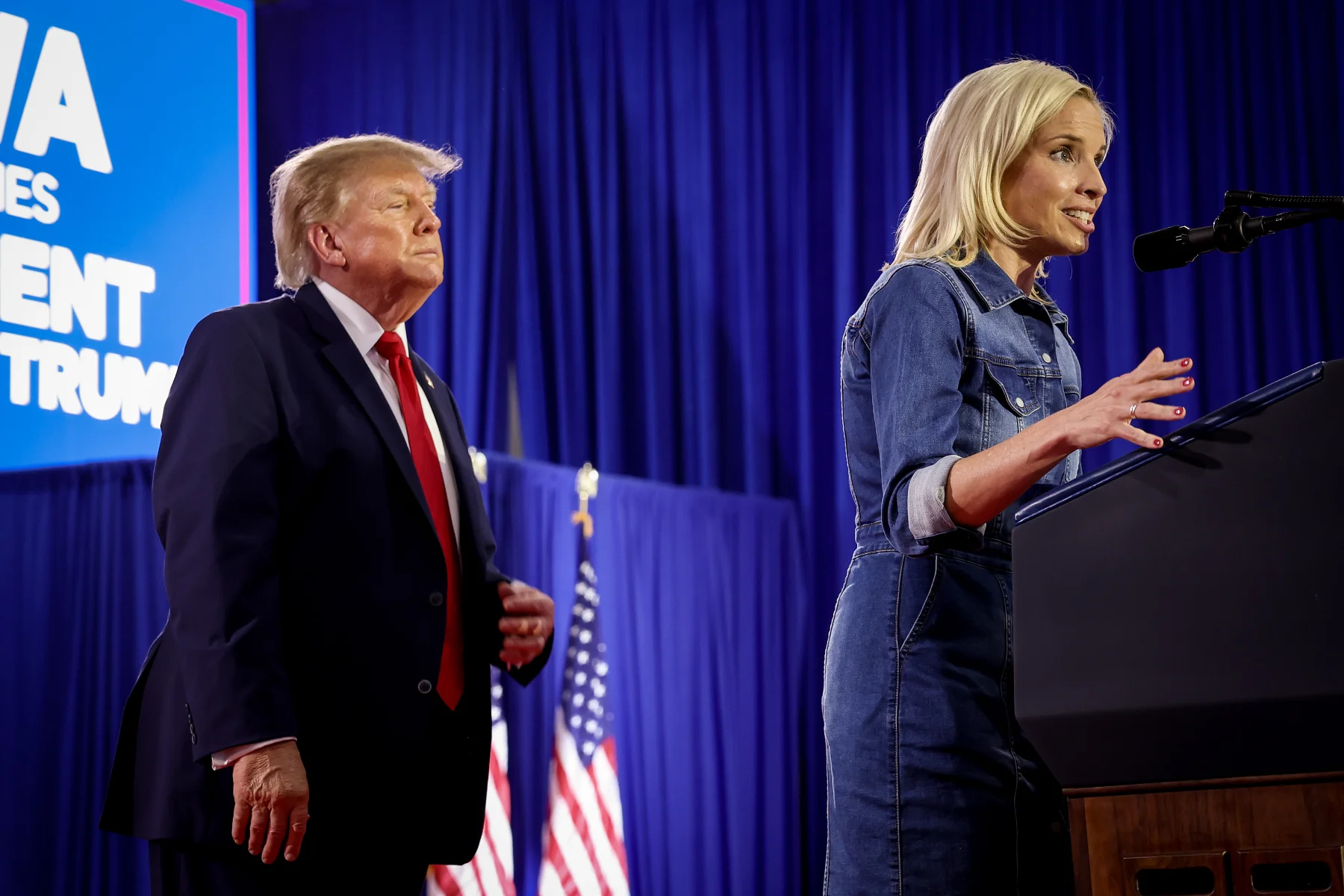
安娜·莫尼迈克尔/盖蒂图片社 爱荷华州共和党众议员阿什利·欣森(Ashley Hinson)在其参议院竞选广告中标榜自己的“美国优先”资历,称自己是“美国优先”,而佐治亚州的奥索夫则直接攻击特朗普。
Anna Moneymaker/Getty Images Iowa Republican Rep. Ashley Hinson touts her America First credentials in ads for her Senate race, saying she's "America First," while Ossoff in Georgia attacks Trump directly.
研究国会议员如何使用社交媒体进行沟通的牛津大学研究员迈克尔·赫瑟尔廷(Michael Heseltine)表示,尽管有大量以地方为中心的信息传递,但候选人正日益将更多的时间和精力花在全国性的口径上。
According to Michael Heseltine, a researcher at Oxford University who studies how members of congress use social media to communicate says while there is a large amount of locally-focused messaging, candidates are increasingly spending more time and energy on national talking points.
他说:“[如果我们]延续这种趋势,你可能会发现越来越多的议员忽视了他们的选区,或者至少没有将自己表现为他们选区的代表。”
"[If] we continue on that trend, you'll probably find more and more members who have neglected their constituencies or at least not presented themselves as representatives of their constituencies," he said.
奥索夫竞选团队在向美国全国公共广播电台(NPR)发表的一份声明中否认按地理位置定位受众,并表示该竞选团队“由小额捐赠者提供支持,因为这位参议员拒绝接受企业政治行动委员会(PAC)和联邦说客的捐款”。其他竞选团队则拒绝置评或未回应采访请求。
In a statement to NPR, the Ossoff campaign denied targeting audiences by location, and says the campaign "is powered by small-dollar donors because the Senator refuses donations from corporate PACs and federal lobbyists." The other campaigns declined to comment or did not respond to interview requests.
宾夕法尼亚大学政治学教授丹尼尔·霍普金斯认为,我们正处于竞选的新时代,候选人如今需要吸引两类主要的利益相关者:一个是地方上的选民基础,另一个通常是规模更大、全国范围的捐赠者基础。
Daniel Hopkins, a political science professor at the University of Pennsylvania, believes we're in a new era of campaigning, where candidates now have two major stakeholders to appeal to: a voter base which is local, and a donor base which is often larger and nationwide.
霍普金斯说:“当乔恩·奥索夫试图争夺选票时,他的竞争对手是佐治亚州的共和党人。但当乔恩·奥索夫试图争夺资金时,他在注意力以及捐赠方面竞争的对象,归根结底是其他杰出的民主党候选人。”外州资金的增加。根据OpenSecrets的数据,国会竞选的外州资金数额在每一个选举周期都在增加。为了获得这些资金,候选人被敦促宣传党的纲领。霍普金斯将此归因于两个原因:政党纲领日趋同质化以及竞选财务法律的变化。
"When Jon Ossoff is trying to compete for votes, he's competing against Georgia Republicans," Hopkins said. "But when Jon Ossoff is trying to compete for dollars, he's competing for attention and for donations, ultimately with other prominent Democratic candidates." The rise of out of state funds The amount of out-of-state funds for congressional campaigns has been rising each election cycle, according to OpenSecrets In order to get these funds, candidates are urged to promote the party platform. Hopkins attributes this to two causes; the party platforms becoming more homogenous and changes in campaign finance laws.
他说:“过去,通往成功的途径是通过地方政党一步步晋升,建立社区中地方精英的支持。”
"It used to be that the pathway to success was to rise up through your local party, building the support of local elites in your community," he said.
霍普金斯解释说:“通往政治成功的道路越来越多地穿过全国各地的一系列‘自动取款机选区’,这些选区以为民主党或共和党提供大量资金而闻名。”
"The path to political success increasingly goes through a set of, 'ATM districts' around the country that are known to give a lot of money either to Democrats or the Republicans," Hopkins explained.
专注于民主的研究机构“公众议程”研究竞选财务的主管萨拉·布赖纳表示,在由单一政党主导的州,捐赠者可能会选择将资金汇往竞争更激烈的州,以帮助影响选举。
In states that are dominated by one party, donors might elect to send their funds to a more competitive state to help influence elections, according to Sarah Bryner, a director who studies campaign finance at Public Agenda, a research organization focused on democracy.
“来自加利福尼亚州的人真的觉得自己没多少事可做,因为无论如何他们的州都会变成蓝色,”她说。“所以他们去支持佐治亚州或得克萨斯州等地的候选人。”民主党人曾占据领先地位,但共和党人正在迎头赶上。尽管两党现在都受益于州外资金,但由于在俄亥俄州和密歇根州等竞争激烈的州缺乏较强的本地资金筹集系统,民主党人往往更依赖州外资金。因此,民主党人建立了一个基层捐款系统——2004年推出的ActBlue,比2019年推出WinRed的共和党人早了近15年。
"People from California really don't feel like they have much to do because their state's going to go blue regardless," she said. "So they support candidates in states like Georgia or Texas." Democrats took the lead, but Republicans are catching up While both parties now benefit from out-of-state funds, Democrats tended to rely on them, due to weaker local funding systems in competitive states like Ohio and Michigan. As a result, Democrats built a system for grassroots donations — ActBlue which launched in 2004 — nearly 15 years before Republicans, who launched WinRed in 2019.
尽管民主党在州外筹款方面的部分优势可归因于共和党现任官员与本地资金的联系,但部分原因也可归因于民主党多元化的选民基础。
While some of the Democratic advantage in out-of-state fundraising can be attributed to Republican incumbents' connections to local funding, part of it can be attributed to the Democratic Party's diverse base of voters.
布兰代斯大学的扎卡里·阿尔伯特(Zachary Albert)说:“你们不得不将那个多元化的联盟凝聚在一起,不一定是为了某个统一的意识形态议程,而是基于某种宣称代表特定群体的独立政策。”
"You're having to bring together that diverse coalition, not necessarily around some unified ideological agenda, but based on a kind of discrete policy [that] claims to represent particular groups," said Brandeis University's Zachary Albert.
与此同时,直到特朗普出现之前,共和党人起初才缓慢地意识到小额筹款的潜力。
Meanwhile, Republicans were initially slow to realize the potential for small dollar fundraising until Trump.
公共议程组织的萨拉·布赖纳(Sarah Bryner)说:“共和党人意识到,特别是在特朗普时期,他们确实拥有一个全国性的小额捐赠者群体,随时准备在他们支持的候选人身后为他们支持的议程采取行动。”
"The Republicans realized, especially during Trump, that they do have a national audience of small donors ready to activate behind their preferred candidates for their preferred agenda," Public Agenda's Sarah Bryner said.
展望未来,马萨诸塞大学政治学教授雷蒙德·拉·拉贾(Raymond La Raja)表示,尽管一些州正试图限制外部资金——比如夏威夷州将从2027年起对州外捐款实施上限——但在国家层面进行监管是很困难的。
Looking forward While some states are trying to limit outside funds, like Hawaii implementing a cap on out-of-state donations starting in 2027 it's difficult to regulate at a national level, according to University of Massachusetts political science professor Raymond La Raja.
他说:“在宪法层面上这将很难做到,特别是由于最高法院已经裁定,你不能阻止团体在选举中随心所欲地花钱。”
"It's going to be hard to do constitutionally, especially because the Supreme Court has ruled you can't prevent groups from spending as much money as they want in elections," he said.
6月,最高法院对协调竞选开支案作出有利于原告的裁决,允许更多外州资金用于选举。拉贾指出,全国共和党参议员委员会截至目前在选举上的开支是上一次中期选举同期的三倍,并建议采取资金匹配机制,即利用公共资金匹配地方捐款,并以纽约市为例。他认为这将促使候选人更多地关注选民的问题,而不是全国性问题。
In June, the Supreme Court ruled in favor of coordinated campaign spending which allows more out of state funds to be spent in elections. So far, the National Republican Senatorial Committee has spent three times as much on s at this point than in the previous midterms La Raja suggested fund matching, where local donations would be matched with public funds, using New York City as a model He believes this would shift candidates to focus more on their constituents' issues rather than national ones.
布赖纳提到阿拉斯加的主要捐赠者披露法作为将筹款本土化的一个选项。在该州,广告必须列出前三大捐赠者。科罗拉多州和弗吉尼亚州针对网络和广播广告也有类似的法律。虽然资金会影响候选人如何谈论其在地方和全国的选战,但布赖纳并不确信这会彻底左右选举天平。那些凭借外州资金筹得更多款项的候选人——例如在肯塔基州对阵共和党参议员米奇·麦康奈尔的埃米·麦格拉思,以及在得克萨斯州对阵共和党参议员特德·克鲁兹的贝托·奥罗克——往往会在对决中输给对手。她建议不要迎合外州的捐赠者,因为归根结底这无法转化为选票。
Bryner mentioned the Alaska top donor disclosure law as an option to localize fundraising. There, ads have to list the top three donors Colorado and Virginia have similar laws for online and broadcast ads While funding can influence how a candidate talks about their race locally and nationally, Bryner isn't convinced this will completely tip the scale of elections. Candidates who've outraised with out-of-state funds, like Amy McGrath, who ran against Republican Sen. Mitch McConnell in Kentucky and Beto O'Rourke against Republican Sen. Ted Cruz in Texas, often lose against their opponents. She advises against appealing to donors out-of-state because ultimately it doesn't translate into votes.
布赖纳表示:“尽管金钱政治在美国是一个重大因素,但归根结底作出最后决定的仍然是选民。如果你所有的资金都来自外州,那么那些人是无法给你投票的。”
"As much as money in politics is such a factor in America, voters are still ultimately who makes the final decision" Bryner said. "And if you're getting all your money from outside of the state, those people can't vote for you."