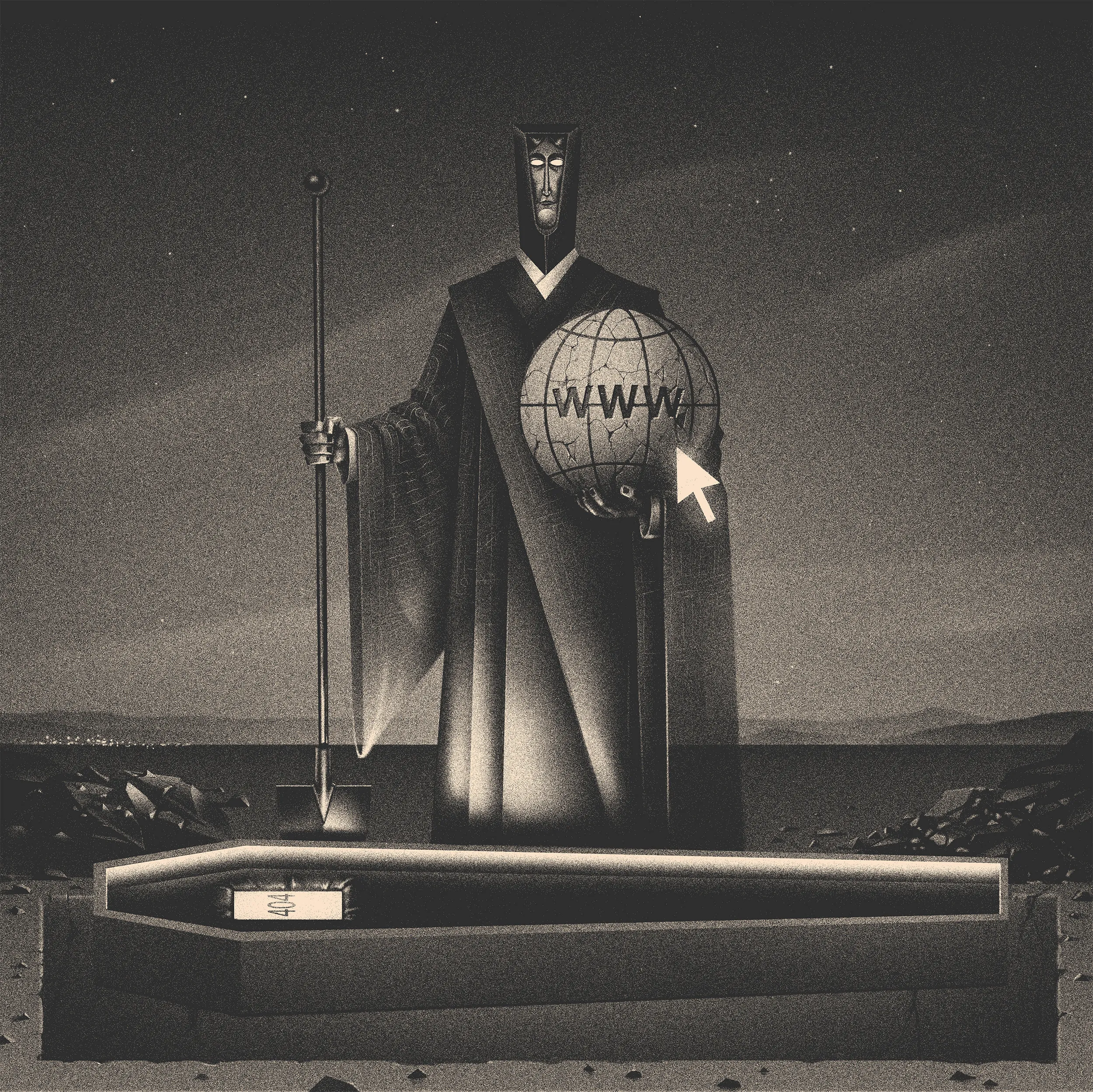
互联网必须被解脱。任何理性的观察者都可以承认,当前的网络迭代——以及在那里编织的社会纽带——并非他们当初所期待的。先进文化腐败的症状已无法再被忽视。这个东西正在自我吞噬。
The internet must be put out of its misery. Any rational observer can admit that the current iteration of the web—and the social fabric woven there—is not what they signed up for. Symptoms of advanced cultural decay can no longer be ignored. This thing is eating itself.
包括Meta和谷歌在内的巨头,已被迫就隐私侵犯以及其平台成瘾机制 allegedly 造成的心理健康危害,支付巨额消费者诉讼和解金。各国学校正在禁止智能手机,多个国家正在为16岁以下未成年人实施社交媒体限制。家长们为孩子渴望成为社交媒体名人、在庞大的在线赌场生态系统中迷失自我,或加入极端主义运动而陷入恐慌。
Giants including Meta and Google have been forced to settle massive consumer lawsuits brought over privacy violations and mental health harms allegedly caused by the addictive mechanisms of their platforms. Schools are banning smartphones as multiple countries institute social media restrictions for under-16s. Parents are in a panic about their kids aspiring to careers as social media celebrities, losing themselves in a vast ecosystem of online casinos, or joining extremist movements.
生成式AI曾一度被视为一种有趣的新奇事物,如今已成为网络上的“加速版垃圾内容生成机”,将信息流和评论区填满无用且令人不适的内容。当人们刷过关于AI抢走工作、将幻想与现实混淆以及导致认知能力下降的新闻标题时,这项技术可能拥有的任何消费吸引力都正在转变为痛苦。为其提供动力的数据中心日益不受欢迎,且政治上极具争议。
Generative AI, briefly considered an amusing novelty, is now a turbocharged slop engine for the web, filling feeds and comment sections with useless, grotesque content. As humans scroll past headlines about AI taking their jobs, confusing fantasy for reality, and contributing to cognitive decline, any consumer appeal the technology might have is turning to anguish. The data centers that power it have become increasingly unpopular, and politically radioactive.
许多人现在承认,上网就是被无休止地操纵和剥削。去年12月,牛津大学出版社将“愤怒诱饵”评为年度词汇,指出该词的使用量在过去12个月中翻了三倍。这种词汇激增反映出一种更高的意识:盈利性社交账号在散布恶意观点和极端主义内容,利用生成式AI自动化这种滥用行为,仅仅是为了从敌对互动中牟利。亿万富翁寡头们通过削减审核,为这种不真实活动、阴谋论和仇恨言论打开了闸门。
To be online, many now admit, is to be endlessly manipulated and exploited. In December, Oxford University Press declared rage bait to be the word of the year, noting that use of the term had tripled over the previous 12 months. The lexical spike represented a heightened awareness that monetized social accounts churn out bad-faith takes and extremist content, automating this abusive behavior with generative AI, simply to profit off hostile engagement. Billionaire oligarchs have opened the floodgates to such inauthentic activity, conspiracy-mongering, and hate speech by rolling back moderation.
简而言之,当你在2026年混迹网络时,你会发现几乎没有什么值得保留的东西。也许十年前,你觉得社区和快乐的微光、艺术与智力的交流,足以抵消那些有毒的垃圾。现在不再如此了。
In short, when you hang around online in 2026, you see little worth saving. Perhaps a decade ago, you felt that the glimmers of community and joy, of artistic and intellectual exchange, were enough to balance out the toxic junk. No longer.
这不一定是因为人变坏了。“互联网死亡理论”——即网络上绝大多数互动都是虚假的、机器人在与机器人对话这一观点——最近获得了更多佐证。一家网络安全公司在今春得出结论,智能体数量已超过人类用户,其流量在2025年激增了8000%。难怪似乎每个人都曾在某个时刻发现自己在脑腐内容的荒原上漫无目的地滑动,并发问:“我到底在看什么鬼?”
It’s not necessarily that people have gotten worse. “Dead Internet Theory”—the proposition that a vast majority of the interactions on the web are fake, bots talking to other bots—has accrued more supporting evidence recently. One cybersecurity firm concluded this spring that agents already outnumber human users, their traffic surging by 8,000 percent through 2025. No wonder seemingly everyone has at some point caught themselves scrolling through a wasteland of brainrot and asked, “What the hell am I even looking at?”
这个问题背后还隐藏着另一个疑问:“会一直这样下去吗?”在这种焦虑日夜敲击我的前额叶皮层之际,技术专家、普利策奖得主约翰·韦斯特的新书《互联网将死,你也将死:论在数字时代学会生存》那绝对化的标题深深吸引了我。在他的深刻论述中,韦斯特证实了许多人已怀疑许久的事实:那些曾被视为知识与交流持久档案库的平台,正被意识形态战争和赤裸裸的贪婪吞噬。
Underlying that question is another: “Is it always going to be like this?”With this anxiety hammering at my prefrontal cortex day in and out, I was more than intrigued by the absolutist title of technologist and Pulitzer-winning journalist John West’s new book, The Internet Will Die, and So Will You: On Learning to Live in Our Digital Age. In his discerning treatise, West confirms what many have suspected for a good while now: The platforms once seen as enduring archives of knowledge and communication are being cannibalized by ideological warfare and basic greed.
但这还不是全部故事。首先,韦斯特认为,人们对互联网“浩瀚”的认知是错觉,它实际上只占“人类经验的一小部分,甚至是一个四舍五入的误差”。此外,它极其脆弱——韦斯特开篇讲述了2001年巴尔的摩隧道列车脱轨事故切断了一大束光纤电缆,导致全国互联网变慢的故事——并因这种天然的不稳定性,不断经历死亡与重生的循环。
But that’s not the whole story. For one, West argues, people misperceive the “vastness” of the internet, which really amounts to “a vanishing fraction, a rounding error, of the human experience.”Moreover, it is remarkably fragile—West opens with the story of how a 2001 train derailment in a Baltimore tunnel took out a major bundle of fiber-optic cables, leading to internet slowdowns nationwide—and continually undergoes cycles of death and rebirth as a result of this natural instability.
如果互联网比想象中小得多、也没那么稳固,韦斯特的书认为,那么认识决定这些消亡如何发生、哪些内容被保留而另一些却崩溃的力量就至关重要。因为市场虚假地将网络兜售为积累智慧的全面图书馆,这个全球网络的每一个短暂阶段都定义了当下,无论好坏。今天,我们目睹一种由算法诱因引发的令人沮丧的瘫痪,算法诱因驱使人们大量生产煽动性垃圾内容:全职网红正与低努力、高产量的频道进行一场注定失败的注意力争夺战,这些频道通过将创作过程交给最前沿的软件来简化制作流程。
If the internet is much smaller and less solid than imagined, West’s book suggests, then it’s crucial to recognize the forces that determine how those deaths unfold, or which pieces are preserved while others crumble. Because the market has falsely sold us the web as a comprehensive library of accumulated wisdom, each transient phase of this global network comes to define the present, for better and worse. Today we witness a dismal paralysis brought on by algorithmic incentives to churn out inflammatory garbage: Full-time influencers are in a losing arms race for attention with low-effort, high-volume channels that streamline production by delegating the creative process to bleeding-edge software.
韦斯特将这种货币化的全息环境与一个充满激情、个性鲜明的互联网形成鲜明对比,后者从原始的GeoCities一直延伸到Tumblr,他描述了这些创新社区是如何被逐渐抹去的。有些以半死不活、高度腐败的形式勉强存续,另一些则已消失。中学时,韦斯特维护着一个专门表达他对动漫热爱的网页;后来,他还开设了一个记录大学岁月的博客。以成年人的身份回首,他对每个网站的命运感到困扰。
West draws a sharp contrast between this holographic environment of monetization and a passionate, personalized internet that spanned from the primordial GeoCities to Tumblr, describing how these innovative communities have been gradually erased. While some endure in half-dead and highly corrupted form, others are lost. In middle school, West maintained a web page devoted to his love of anime; later, he kept a blog documenting his college years. Looking back as an adult, he’s vexed by the fates that have befallen each.
“我真的很想删除我的动漫网站,”韦斯特对《连线》杂志说。“我已经没有AOL账户的访问权限了,也无法删除它。”相反,它以僵尸页面的形式继续存在,页面上堆满了垃圾广告和失效链接。至于大学博客,他在写作接近尾声时忘记支付域名费用,因此最后一年的帖子消失了。“我有点痴迷于这样一个想法:我们想要长久保留的东西往往并不会长久,而我们希望它们消失的东西却往往会拖得太久,”韦斯特说。
“I really wanted to delete my anime site,” West tells WIRED. “I don't have access to the AOL account anymore, and I couldn't do it.”Instead, it lives on as a zombie page, cluttered with spam ads and dead-end links. As for the college blog, he had neglected to pay domain fees toward the end of his time writing it, and so the final year of posts disappeared. “I kind of got obsessed with this idea that the things we want to last really don't, and then oftentimes the things that we kind of wish would go away hang on for way too long,” West says.
这些流动的沙丘与互联网用户最初认为自己正在构建的完美、集体、永久记忆相去甚远。“‘永远’这个词太重了,而且用错了,”韦斯特说。网络空间是死亡的提醒,与那些在其中自我宣传的个人一样(这包括某些痴迷于长寿的生物黑客)。当然,曾经有一段时间,名人因多年后被挖出的品味低劣的帖子而被“取消”,但在2026年,当你在AI驱动的Gmail账户中搜寻特定信息时,情况并不那么容易。
These shifting sands are a far cry from the flawless, collective, permanent memory that internet users originally believed they were building. “‘Forever’ is such a strong word, and it's the wrong word,” West says. Online spaces are memento mori, the same as individuals who self-promote across them (and that includes certain longevity-obsessed biohackers). Sure, there was a time when a celebrity could be “canceled” for tasteless posts unearthed years later, but in 2026, it’s not so easy to surface specific messages when you go hunting for them in your AI-powered Gmail account.
像Vine这样定义时代精神的平台可能瞬间消失,2025年1月,美国人在预期该应用将被美国禁令之前发布告别TikTok视频,这一事实再次印证了这一点。
Zeitgeist-defining platforms like Vine can be vaporized in an instant, a fact reinforced in January 2025, when Americans posted farewell TikTok videos ahead of an expected US ban on the app.
韦斯特指出,这种随机的短暂性侵蚀了人们对于此前由超文本交叉引用所支持的主张的信心,进而也侵蚀了对任何共识性真相的信心。《纽约时报》网站1996年至2019年中期文章中超链接的一项分析发现,25%的链接无法访问。他写道,根据2016年的一项研究,“学术文章中有四分之三的引用已经漂移——它们声称引用的网站不再表达它们曾经表达的内容。皮尤的一项报告发现,维基百科超过一半的条目在参考文献部分至少有一个链接指向虚无。”
This random ephemerality, West points out, has eroded any confidence in claims previously backed up by hypertext cross-references, and thus any kind of consensus truth. An analysis of hyperlinks in articles on The New York Times website between 1996 and mid-2019 found that 25 percent of all links were inaccessible. According to a 2016 study, “three out of four citations in scholarly articles have drifted—the websites they purport to cite no longer say what they once did,” he writes. “Over half of Wikipedia’s entries contain at least one link in its references section that goes nowhere, a Pew report found.”
驱动参与度的冲动也蔓延到了用户自身:例如,韦斯特注意到,当他最近重读一本最喜欢的书——玛丽莲·罗宾逊的《基列》——时,他有一个挥之不去的念头:虽然他喜欢第四五次回到这部小说,但他无法把它计入自己的Goodreads年度统计。韦斯特说,这种对互联网空洞认可的执念,创造了“一个空间被非人之物填补的确切条件”。
The impulse to drive engagement spreads to users themselves: West noticed, for instance, that when he recently reread a favorite book, Marilynne Robinson’s Gilead, he had the nagging thought that while he loved returning to the novel for the fourth or fifth time, he wouldn’t be able to count it toward his annual Goodreads stats. West says this fixation on the internet’s hollow validations creates “the exact conditions for a space to be filled by something that isn't human.”
那么,真正拒绝把我们的注意力给予人造草根式愤怒、被工程化的病毒式传播和网红的赞助内容,难道不会是一种解放吗?让那些由AI驱动的监控所支撑的主流数字经济最终走向毁灭,难道不会是一种解放吗?如果这些行业巨头如今能提供给我们的只是“变态眼镜”和对一部大概并不讨喜的纪录片广告的压制,我们为什么还要帮助他们继续做生意?让他们的平台彻底死掉,或许是大众所能掌握的最后一根权力杠杆。
Wouldn’t it be liberating, then, to actually deny our attention to astroturfed outrage, engineered virality, and influencer sponcon? To let the mainstream digital economies propped up by AI-enabled surveillance finally fall to ruin? If what the titans of the industry have to offer us these days are “pervert glasses” and the suppression of ads for a probably unflattering documentary, why are we helping them stay in business? Leaving their platforms for dead might be the last lever of power available to the masses.
这样做可以让人们自由探索那些沉寂的角落。韦斯特指出,互联网上最有趣的部分往往是那些无人问津的地方,比如通往几乎零观看量的 YouTube 视频流的网页入口。“其中一些他妈的既怪异又阴森,但很多只是人们在唱歌、玩得很开心,”他说。韦斯特还引用了网络期刊中诗歌那种繁忙、零收入的流转,作为“只要没有经济动机,你随时都能在网上找到意义、创造意义”的证明。
Doing so could free people to explore dormant corners. West notes that some of the most interesting parts of the internet are the ones that nobody sees, like web portals to streams of YouTube videos that have almost no views. “Some of it’s fucking weird and creepy, but a lot of it’s just people singing a song and having a blast,” he says. West also cites the bustling, zero-revenue, circulation of poetry in web journals as proof that “you can find meaning and make meaning online all the time,” provided there is no financial motivation.
当你排除平台想让你盯着看的东西时,你就会清楚自己错过了什么,以及是如何被引导远离那些东西的。你的观点在一个气泡里,由从未谋面的头像塑造,并被武器化,用来对抗同样封闭的敌对阵营。互联网其实没有赢家,除非你把那些不惜一切代价追逐关注度、却缺乏判断力的寥寥几人算作赢家。这就是为什么主角们的信仰如此易变;他们从不害怕转向、背叛、抛弃曾经视为身份核心的东西。更何况,他们一开始根本就不代表什么。
When you eliminate what the platforms want you to fixate on, it’s clear what you’ve been missing, and how you were steered away from it. Your opinions are shaped in a bubble by avatars you’ve never met, weaponized against equally hermetic rival camps. The internet doesn’t really have winners, unless you count the few without the sense to stop chasing relevance at any cost. That’s why the main characters are so malleable in their beliefs; never afraid to pivot, betray, and discard what they once held to be the core of their identity. And that’s when they stood for anything to begin with.
除非发生突如其来、持久的瘫痪,由一场全新的严重灾难引发,否则现存的互联网短期内不会消亡。然而,其表面已出现裂痕,这可能为新生的、奇异演化的生命形态腾出空间。没有理由假设当下的科技帝国将统治未来的世纪;有机的、无政府状态的网络有望在它倒塌之时(或一旦倒塌)迎来辉煌的复兴。
Absent a sudden, lasting outage due to a fresh and severe catastrophe, the internet as it exists won’t perish anytime soon. There are, however, splintering cracks in its facade, which may create room for emergent and strangely evolved life-forms. There’s no reason to assume that the present tech empire will rule the century to come; the organic and anarchic web stands to mount a triumphant renaissance if (or when) it falls.
“看,互联网正在腐烂,”韦斯特说。“问题是,我们要把精力放在哪里?”他在书中经常引用的一个隐喻是堆肥。“堆肥不过是被利用起来的腐烂,”他说。一个腐烂的互联网能成为某种更好事物的肥料吗?这是个美好的想法,但作为一个长期堆肥失败者——太恶心了,我也太懒了——我怀疑是否能动员足够多坚韧、耐心的园丁,让我们的数字景观重新绽放。
“Look, the internet is rotting,” West says. “The question is, where are we going to put our energy?”A metaphor he often turns to in his book is compost. “Compost is just rot harnessed for a purpose,” he says. Can a decaying internet be fertilizer for something better? It’s a rosy notion, but speaking as a perennially failed composter—it’s just too gross, and I’m too lazy—I have my doubts about whether enough hardy, patient gardeners can be mobilized to make our digital landscape bloom once more. Then again, as West’s book sought to remind me, I am destined to die as well.
不过,正如韦斯特的书想提醒我的那样,我也注定要死。也许我会混入泥土之中。
Maybe I’ll be mixed in with the soil. Let us know what you think about this article. Submit a letter to the editor at [email protected].