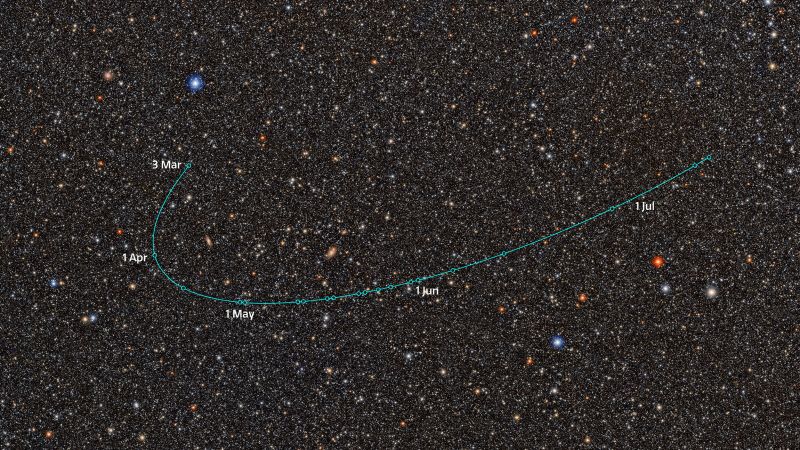
天文学家在太阳系中、冥王星轨道之外发现了一个新的矮行星候选天体,暂时将其命名为ED138。
Astronomers have spotted a new dwarf planet candidate in the solar system, beyond the orbit of Pluto, which they provisionally named ED138.
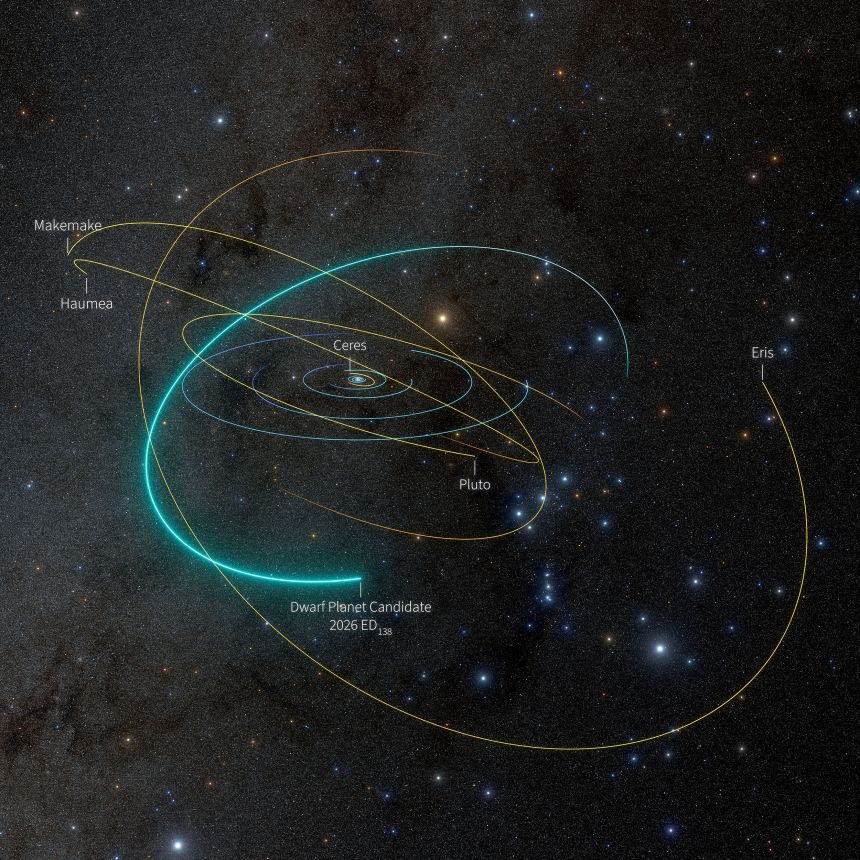
如果未来的观测证实这一发现,ED138将加入目前由国际天文学联合会(IAU)认可的五个矮行星组成的行列:谷神星、冥王星、妊神星、鸟神星和阋神星。
If future observations confirm the discovery, ED138 will join a group currently made up of five dwarf planets that have been recognized by the International Astronomical Union, or IAU: Ceres, Pluto, Haumea, Makemake and Eris.
这一发现源自薇拉·C·鲁宾天文台的探测结果。这台新望远镜位于智利一座海拔2682米(8800英尺)的山顶,配备了世界上最大的数码相机。该望远镜于2025年开始运行,能够每三天对整个天空成像一次。
The finding is the result of detections made by the Vera C. Rubin Observatory, a new telescope that sits atop a 2,682-meter-tall (8,800-foot-tall) mountain in Chile and houses the world’s largest digital camera. The telescope started operating in 2025 and is capable of imaging the entire sky every three days.
史密森学会高级天体物理学家、哈佛大学天文学讲师马修·霍尔曼运行了他参与开发的一个计算机程序,梳理鲁宾天文台在2026年早些时候收集的数据,扫描了数十亿次移动天体的探测记录。当ED138出现时,霍尔曼说他的第一反应是“兴奋得难以置信”,并立即排查是否存在误报或计算机程序出错的情况。
Matthew Holman, a Smithsonian senior astrophysicist and lecturer in astronomy at Harvard University, ran a computer program he codeveloped to comb through data collected by Rubin earlier in 2026, scanning billions of detections of moving objects. When ED138 popped up, Holman said he first reacted with “excited disbelief,” and immediately checked for a false positive or an error with the computer program.
为了确认这一观测结果,同时身为鲁宾天文台运营团队成员之一的霍尔曼与同事马里奥·尤里奇合作。尤里奇是鲁宾天文台太阳系首席科学家、华盛顿大学天文学系教授。尤里奇在鲁宾天文台的星表中查找更多关于ED138的观测记录,又找到了20条可追溯至2026年3月的观测数据。最终,研究人员借助其他来源的数据,得以将该天体的轨道回溯绘制到10年前。
To confirm the observation, Holman, who is also a Rubin Operations team member, worked with his colleague Mario Jurić, the Rubin Solar System lead scientist and a professor in the department of astronomy at the University of Washington. Jurić looked for more observations of ED138 in Rubin’s catalog, and found 20 additional ones dating back to March 2026. Eventually, using other sources, the researchers were able to plot the orbit of the object as far back as 10 years.
然而,霍尔曼警告说,ED138目前还不是官方认定的矮行星:“目前来说,它仍然只是一个候选者。我们确实需要知道它的实际物理大小,而这可能需要几个月的时间。”据估计,ED138的直径在600至1500公里之间,这将使它比已确认矮行星中最小的一颗——谷神星——还要大。它目前以约46个天文单位的距离绕太阳运行,每个天文单位代表地球与太阳之间的平均距离。这意味着ED138比冥王星更远,同时也是一颗海外天体(TNO)——一类在比海王星更远的距离上绕太阳运行的天体。
However, Holman warns, ED138 isn’t officially a dwarf planet yet: “At this point, it’s still a candidate. We really need to know how physically big it is, and that will take a few months, probably.”ED138’s diameter is estimated to be between 600 and 1,500 kilometers (370 and 930 miles), which would make it bigger than the smallest of the recognized dwarf planets, Ceres. It currently orbits the sun at a distance of about 46 astronomical units — with each unit representing the average distance between Earth and the sun. That means ED138 is farther away than Pluto and also a trans-Neptunian object, or TNO — a class of objects that orbit the sun at a distance greater than Neptune’s.
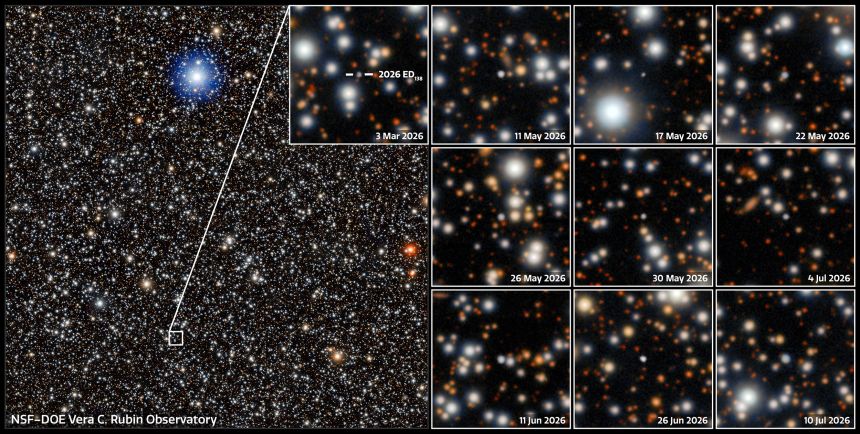
据霍尔曼介绍,在夜空中,ED138无法用肉眼看到,但“它的亮度足够高,真正有能力的业余天文爱好者如果知道该往哪里看,是能看到它的”。
In the night sky, ED138 is not visible with the naked eye but “is bright enough that really capable amateurs can see it if they know where to look,” according to Holman.
霍尔曼指出,科学家此前未能发现ED138的部分原因是它位于南半球,因此从北半球观测非常困难。
Part of the reason scientists hadn’t discovered ED138 before is because it’s in the southern hemisphere, and therefore very difficult to observe from the northern hemisphere, Holman noted.
“这已经排除了许多本可能发现它的望远镜,而且南半球搜寻天空的望远镜也没有那么多,”他说。
“That already rules out whole sets of telescopes that might have found this, and there aren’t as many telescopes searching the sky in the southern hemisphere,” he said.
另一个让ED138一直未被发现的因素是,它与我们的银河系处于同一平面。“从我们的视角来看,在过去20年里,这个天体一直在银河系中穿行,”霍尔曼解释说。“人们通常不会在银河系中搜寻天体,因为那里恒星太多了,很难找到移动的物体。”这颗新的矮行星候选者是鲁宾望远镜不断增加的探测天体清单中的一员——其中主要是小行星和体积小得多的海外天体。据霍尔曼说,可能还有“少数几个”ED138大小的天体,鲁宾望远镜最终应该也能找到它们。
Another factor that kept ED138 hidden is that it is on the same plane as our galaxy. “For the last 20 years, the object has kind of been looping its way across the Milky Way, from our point of view,” Holman explained. “People don’t typically search for things in the Milky Way, because there’s so many stars that it’s really hard to find moving objects.”The new dwarf planet candidate joins the Rubin telescope’s growing list of detected objects — largely asteroids and much smaller TNOs. According to Holman, there might be “a handful” more objects the size of ED138, and Rubin should eventually find those, too.
如果ED138被确认是一颗矮行星,天文学家将首先给它一个永久编号,然后再给它一个正式名称,尽管这一过程可能需要时间,而且究竟由谁来决定名称的细节仍不清楚。
If ED138 is confirmed as a dwarf planet, astronomers will first give it a permanent number and then an actual name, although the process could take time, and the details of who exactly will get to choose the name are still unclear.
“已经有人给我发邮件提出了一些建议,其中一些已经被其他天体占用了,”霍尔曼说。“我不知道。这会很有趣。也许我能提出一些建议,但我不会屏息以待,因为这是一个非常非常大的项目。”新西兰坎特伯雷大学副教授米歇尔·班尼斯特说,这一发现对该领域意义重大。她并未参与ED138的发现。
“People have already emailed me some suggestions, and some of them are already taken by other objects,” Holman said. “I don’t know. It’ll be fun. Maybe I’ll get to suggest something, but I’m not going to hold my breath, because this is a big, big project.”The finding is significant for the field, said Michele Bannister, an associate professor at the University of Canterbury in New Zealand, who was not involved with the discovery of ED138.
该天体“在科学上真的很酷,因为它是一个跨海王星天体,而且它的体积也相当大,但仍然比肉眼能看到的要暗得多,”研究太阳系小天体的班尼斯特说。
The object is “scientifically really cool because it’s a trans-Neptunian object and it’s also physically quite large, but still a lot fainter than you can see with the naked eye,” said Bannister, who studies the small worlds of the solar system.

她补充说,该天体的尺寸刚好处于我们可以开始将其视为一个世界的范围内,其他望远镜现在将接过接力棒,进一步了解它。
The size of the object is just within the range where we can start to think of it as a world, she added, and other telescopes will now pick up the baton to find out more about it.
“也许如果我们有一天向那里发射航天器,我们会发现它有像冥王星一样的氮冰glacier,”班尼斯特说。“那将非常值得一看。但目前我们所知道的只是它很大,其余关于其物理特征究竟是什么的,暂时都只能是推测。”通过新闻探索宇宙,了解引人入胜的发现、科学进展以及更多内容。
“Maybe if we ever fly a spacecraft there, we’ll find it has a nitrogen glacier like Pluto,” Bannister said. “That would be great to see. But at the moment, all we know is that it’s big, and the rest is going to be speculation for a little bit, about what its physical characteristics really are.” . Explore the universe with news on fascinating discoveries, scientific advancements and more.