据北京领先人工智能公司月之暗面(Moonshot AI)称,“真正重要的东西超出了人类视野的触及范围。”这也是其中文名译为“月之暗面”的原因之一。(另一个原因可能是创始人喜爱平克·弗洛伊德乐队。)这家计划明年在香港上市的初创公司,展现了中国人工智能的诸多优势。其创始人才华横溢、全情投入。其刚刚升级的 Kimi K3 模型精简强大。
ACCORDING TO Moonshot AI, a leading artificial-intelligence firm based in Beijing, “What truly matters lies beyond the reach of human sight.”That is one reason why its Chinese name translates as “Dark Side of the Moon”. (Another may be the founder’s love of Pink Floyd.) The startup, which hopes to list in Hong Kong next year, illustrates many of China’s AI strengths. Its founders are talented and dedicated. Its Kimi K3 model, which it has just upgraded, is lean and powerful.
中国决心充分利用这项新技术。与美国、台湾和韩国一样,中国经济稳处全球人工智能热潮的轨道之中。但与那些乐观情绪起伏不定的地方不同,中国股市却变得固执地阴暗。
The country is determined to make the most of the new technology. Its economy, like America’s, Taiwan’s and South Korea’s, lies firmly within the orbit of the global AI boom. But unlike those places, where optimism waxes and wanes, China’s stock market has turned implacably dark.
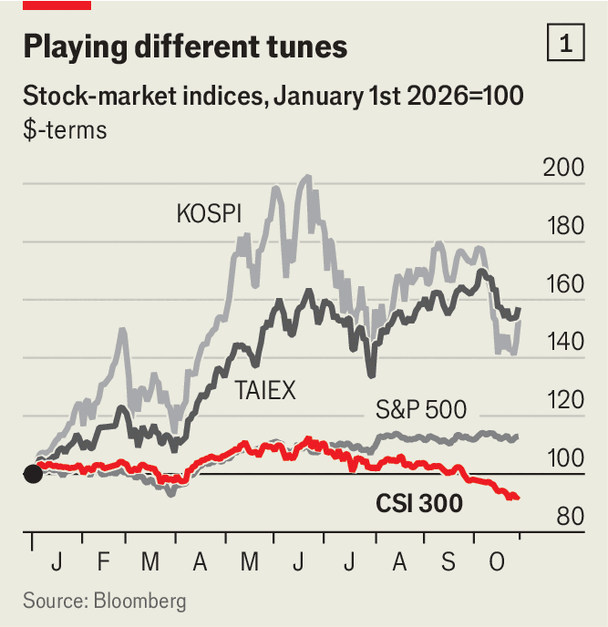
这种悲观情绪在科技股为主的股市基准指数中表现得最为明显,例如深圳的创业板指数。该指数在四个月内下跌了约 40%。看空情绪已蔓延至更宽泛的指数,如沪深 300 指数,该指数追踪在上海和深圳上市的大盘股(见图表 1)。10 月,该指数符合熊市的传统定义,较 6 月高点下跌了 20%。
The pessimism is plainest in tech-heavy stock-market benchmarks, such as the ChiNext index in Shenzhen. It has lost about 40% in four months. The bearishness has spilled over to broader indices, such as the CSI 300, which tracks large-cap firms listed in Shanghai and Shenzhen (see chart 1). In October this index met the conventional definition of a bear market, having fallen by 20% from its June peak.
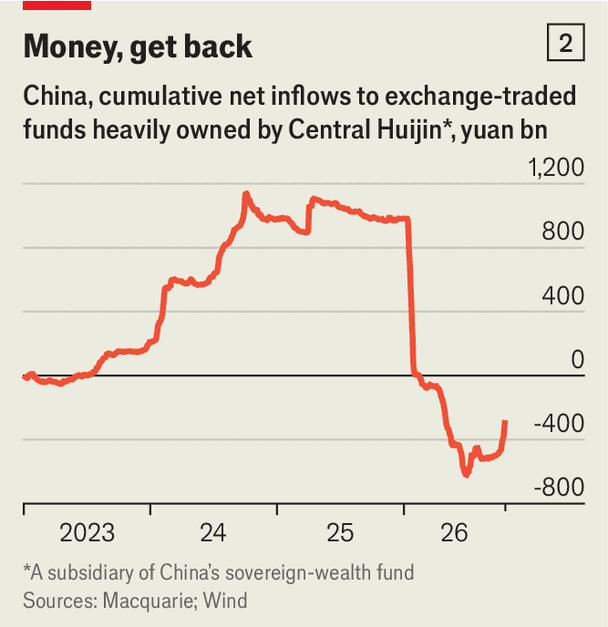
大约十年来,中国监管部门一直致力于培育“慢牛市”,旨在提振消费者信心、为新公司融资,同时避免市场失控。2026 年上半年,他们似乎如愿以偿。沪深 300 指数缓步上扬。芯片制造商长鑫存储(CXMT)于 7 月在上海上市,募资 666 亿元人民币(这个吉利数字价值近 100 亿美元)。中国“国家队”——在需要时托市的国有金融机构——信心充足,抛售了他们在过往危机中买入的部分股票(见图表 2)。
For about a decade China’s regulators have instead sought to cultivate a “slow bull market” that would lift consumer sentiment and raise money for new companies without running wild. In the first half of 2026, they seemed to be getting their wish. The CSI 300 made a slow advance. CXMT, a chipmaker, listed in Shanghai in July, raising 66.6bn yuan (a lucky number worth almost $10bn). China’s “national team”, state-owned financial institutions that prop up the market when required, felt confident enough to offload some of the stocks they had bought in past crises (see chart 2).
情况在年中左右发生了变化。罪魁祸首包括对 AI 的怀疑态度以及地方财政的谨慎。对 AI 最终用户需求的疑虑在中国格外强烈。中国大陆企业以不愿为软件付费而著称。而争夺这些客户的竞争异常激烈。例如,Kimi 的成功对 MiniMax 等上市竞争对手构成了威胁。
Things changed around the middle of the year. The culprits include AI scepticism and local fiscal caution. Doubts about end-user demand for AI apply with extra force in China. Mainland companies are notoriously reluctant to pay for software. And competition for their custom is fierce. Kimi’s success, for example, poses a threat to listed rivals such as MiniMax.
中国股市也因政府的预算克制而受损。许多投资者曾希望今年能出台协同一致的举措,通过基建投资和向居民发放补贴来提振经济。但政府更多依赖外部需求来维持增长。今年的出口繁荣使政府得以将注意力转向财政修复,而非财政扩张。
China’s stocks have also suffered from the government’s budgetary inhibition. Many investors hoped for a concerted effort this year to lift the economy through infrastructure investment and handouts for households. But the government has relied more on foreign demand to keep growth going. This year’s export boom has allowed it to turn its attention to fiscal repair, not fiscal expansion.
讽刺的是,这场繁荣很大程度上与 AI 相关。例如,中国半导体出口额在今年前九个月翻了一倍多。全球在 AI 上的支出支撑了中国的增长,消除了对财政刺激的需求。而这种意外的紧缩压抑了国内需求,拖累了股市。AI 之神给予,也收回。
The irony is that much of that boom has been AI-related. The value of Chinese semiconductor exports, for example, more than doubled in the first nine months of the year. The world’s AI spending has supported Chinese growth, obviating the need for fiscal stimulus. And that unexpected austerity has weighed on domestic demand, depressing the stock market. The AI gods give; they also take away.
近期,“国家队”似乎重返市场,为股市托底。麦格理银行的胡捷(Larry Hu,音译)指出,由中国主权财富基金旗下的中央汇金持有的交易型开放式指数基金(ETF)录得强劲资金流入。政府还在为其所谓的“六大网络”调动投资。这些网络包括 AI 主导的经济所需的电力、算力和通信系统。经济增长有所回升,沪深 300 指数重新站上了具有象征意义的 4000 点关口。
Lately the national team seems to have returned to action, putting a floor under the market. Exchange-traded funds held by Central Huijin, part of China’s sovereign-wealth fund, have recorded strong inflows, notes Larry Hu of Macquarie, a bank. The government is also mobilising investment for what it calls the “six networks”. These include the power, computing and communications systems an AI-led economy will need. Economic growth has picked up and the CSI 300 has climbed back above the symbolic 4,000 mark.
与普遍认知相反,月球的“背面”每月也能获得两周阳光,就像正面一样。中国市场将希望任何新的希望之光能比这持续得更久。■
Contrary to popular belief the “dark” side of the moon gets two weeks of sunlight a month, just like the visible side. China’s markets will hope any new rays of hope last a bit longer than that. ■