随着关键的11月选举迫在眉睫,唐纳德·特朗普总统本月初的支持率跌至其第二任期的最低点——也是几十年来任何总统在进入中期选举时的最低水平。
With the pivotal November elections looming, President Donald Trump’s approval rating earlier this month dropped to the lowest point of his second term—and the lowest level any President’s has reached heading into the midterms in decades.
根据皮尤研究中心的民调,特朗普的支持率在10月初降至30%。上一次美国总统的支持率在如此接近中期选举时降至可比的低点,还是1946年的哈里·杜鲁门。
Trump’s approval rating fell to 30% in early October, according to polling from the Pew Research Center. The last time an American President’s approval rating was at a comparable low this close to the midterms was Harry Truman in 1946.
康奈尔大学政府学系教授、调查研究公司Verasight联合创始人彼得·恩斯表示:“这是总统历史上最低的支持率。”
“This is historically low approval ratings for a President,” says Peter Enns, a professor in the department of government at Cornell University and co-founder of the survey research company Verasight.
数据显示,美国人对特朗普政府的不满在很大程度上是由经济驱动的;根据美联社-NORC公共事务研究中心本月初发布的民调,只有26%的美国成年人表示支持特朗普处理经济问题的方式。
Data indicates that much of Americans’ dissatisfaction with the Trump Administration is being driven by the economy; according to polling from The Associated Press-NORC Center for Public Affairs Research, released earlier this month, only 26% of U.S. adults express support for how Trump is tackling it.
同样,根据美联社-NORC民调,国内仅有17%的成年人表示赞成总统应对生活成本的方式。许多成年人也不同意特朗普政府在伊朗的战争:同一项美联社-NORC民调发现,只有28%的人表示支持特朗普处理该问题的方式。
Similarly, just 17% of adults in the country say they approve of how the President is addressing the cost of living, according to the AP-NORC poll. Many adults also disagree with the Trump Administration’s war in Iran: the same AP-NORC poll found that only 28% expressed support for how Trump is handling the issue.
恩斯表示:“特朗普支持率如此之低,部分原因在于他推行的政策和立场极不受欢迎,伊朗冲突就是一个典型例子;公众明白这是特朗普的决定,也明白这与极高的汽油价格有关。总统把自己置于如此多不受欢迎立场的一方,这非常罕见。”这些问题可能成为选民投票时的关键考量因素。皮尤研究中心发现,绝大多数登记选民——84%——认为经济是他们在中期选举前“非常重要的议题”。57%的较小多数也认为外交政策对他们即将到来的投票“非常重要”。
“Part of the reason Trump’s approval ratings are so low is he’s pushing policies and pushing positions that are very unpopular, and so the conflict in Iran is a great example; the public understands that this was Trump’s decision, and they understand this connects to extremely high gas prices,” Enns says. “It’s very unusual for a President to position himself on the side of so many unpopular positions.”Those issues could be critical ones for voters as they go to the polls. The Pew Research Center found that the vast majority of registered voters—84%—say that the economy is a “very important issue” for them heading into the midterms. A smaller majority of 57% also deemed foreign policy “very important” to their vote in the upcoming elections.
即使没有历史性的低支持率,中期选举对在任总统所属政党来说也是充满挑战的环境。政治专家表示,今年的选举对共和党而言形势严峻。总统所属政党在中期选举中通常表现如何?
Even without a historically low approval rating, midterm elections are a challenging environment for the sitting President’s party. And political experts say that this year’s election looks like a difficult one for Republicans. How does the President’s party typically fare in midterm elections?
通常情况下,执政党在中期选举中会失去国会席位。恩斯称这是一个“众所周知的现象”,这很可能源于总统支持者和非支持者的双重挫败感:支持者可能觉得政府在其期望的政策上进展不够;而未投给总统的人可能更加沮丧,因为他们不同意政府的行动。
Typically, the party in the White House loses congressional seats in the midterms. Enns says this is a “well-known phenomenon” that is likely a result of frustration from both a President’s supporters, who may feel that there hasn’t been enough progress on the policies they wanted to see coming out of the Administration, and those who didn’t vote for the President, who may be even more frustrated because they disagree with the Administration’s actions.
“这并不意味着所有人都会改变投票意向,”恩恩斯指出,“这只是说明,反弹情绪、那股浪潮,正在对现任总统不利。”东北大学政治学教授科斯塔斯·帕纳戈普洛斯表示,对这一历史趋势的一种可能解释是,选民或许在寻求“华盛顿的党派平衡”。帕纳戈普洛斯说,当选民对政府出台的政策不满意时,他们可能会尝试在中期选举中支持反对党——尤其当一党同时掌控白宫和国会两院时,正如共和党目前的处境。
“That doesn’t mean everybody’s changing their vote,” Enns points out. “It just means the backlash, the tides, are working against the incumbent President.”Costas Panagopoulos, a professor of political science at Northeastern University, says that a possible explanation for this historical trend is that voters may be seeking “partisan balance in Washington.”When voters aren’t satisfied by policies coming out of the Administration, they may try supporting the opposition party in the midterms—particularly when one party controls the White House and both chambers of Congress, as is the case with Republicans right now, Panagopoulos says.
“如果选民对政府行为和现行政策不满,[眼下]除了共和党之外,根本没有别人可以责怪,”他继续说道,“[选民]如果对自己看到的情况不满意,很容易把矛头指向共和党。”不过,这一趋势也有例外。2002年,时任总统乔治·W·布什所在的共和党实际上在中期选举中于众议院和参议院都增加了席位。
“There’s simply nobody else to blame for government actions and current policies if voters are unhappy with those besides the Republican Party [right now],” he continues. “It’s very easy for [voters] to point the finger to the Republicans if they’re not happy with what they’re seeing.”There are, though, exceptions to this trend. In 2002, then-President George W. Bush’s Republican Party actually gained seats in both the House and the Senate in the midterm elections.
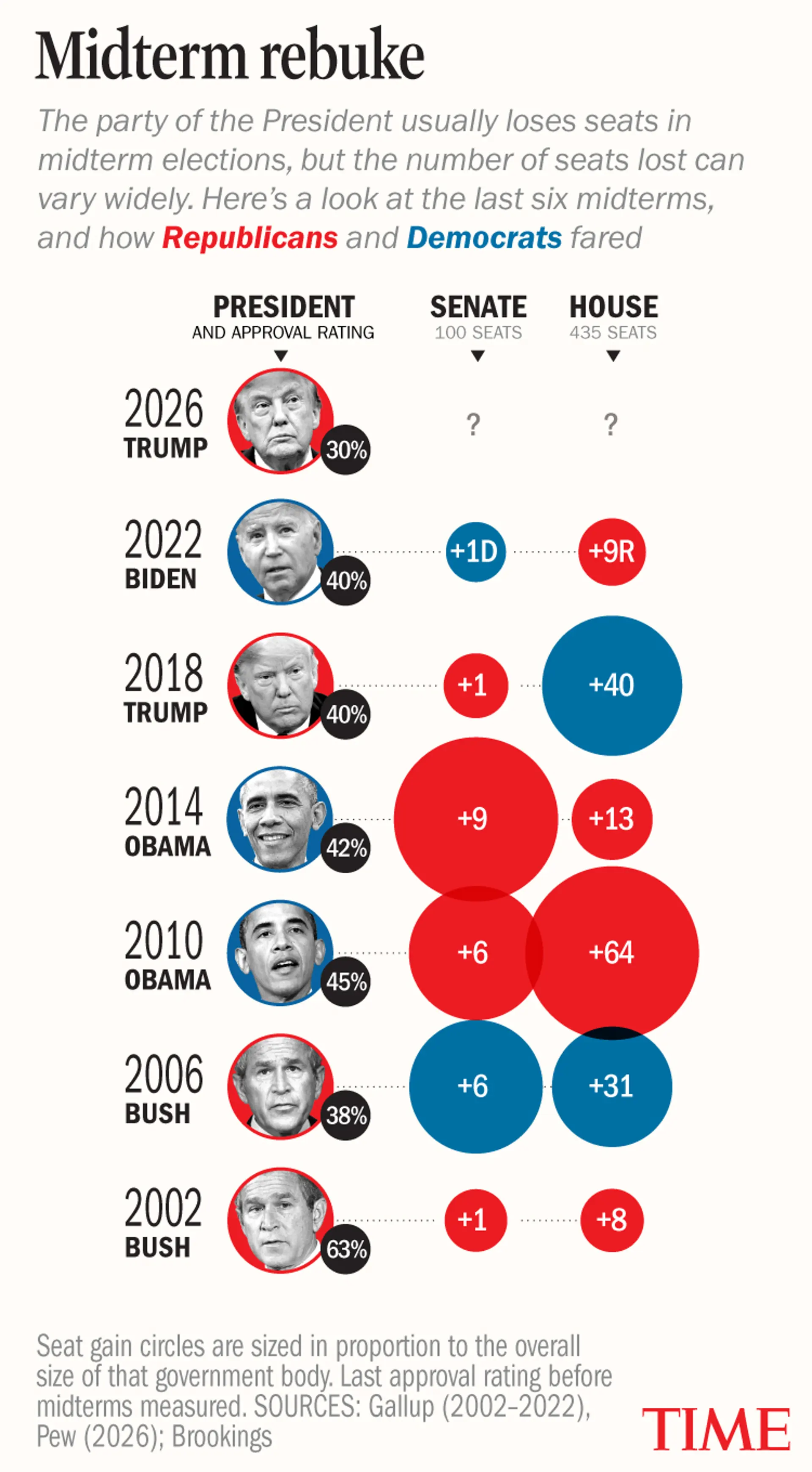
“它打破了历史趋势,”帕纳戈普洛斯说,“这是[此类情况中]罕见的例子之一。”帕纳戈普洛斯等政治专家大多将共和党在2002年中期选举中的成功归因于布什在2001年9月11日恐怖袭击之后的高支持率——根据盖洛普数据,进入中期选举时其支持率为63%。
“It bucked the historical trend,” Panagopoulos says. “It’s one of the rare examples [of that].”Political experts like Panagopoulos largely attribute the GOP’s success in the 2002 midterms to Bush’s high approval rating—63% heading into the midterms, according to Gallup data—in the aftermath of the Sept. 11, 2001, terrorist attacks.
也有一些情况是,反对党原本被预期将在中期选举中大胜,但最终未能达到这些预测。例如,根据盖洛普民调,进入2022年中期选举时,时任总统乔·拜登的支持率为40%,而共和党被广泛预期将在选举中取得重大胜利。尽管共和党在众议院增加了九个席位,但这并不像许多人预测的那样是一场大胜——而民主党实际上在参议院增加了一个席位。
There have also been some instances when the opposition party was expected to win big in the midterms but fell short of those predictions. Going into the 2022 midterms, for instance, then-President Joe Biden’s approval rating sat at 40%, according to Gallup polling, and Republicans were widely expected to see major victories in the election. And while the GOP gained nine seats in the House, that wasn’t as substantial a win as many had predicted—and Democrats actually gained a seat in the Senate.
Panagopoulos 认为,部分原因可能是拜登的支持率并未处于历史低位。他还指出,2022年是新划分选区边界后的首个选举周期,这也可能影响了选举结果。
Panagopoulos suggests that part of the reason for that could be because Biden’s approval rating wasn’t at a historic low. He also points out that 2022 was the first election cycle with newly drawn district lines, which also could have affected the results.
乔治城大学美国政府学教授米歇尔·斯沃斯提出了另一种解释:2022年中期选举发生在最高法院推翻罗诉韦德案仅几个月后,这可能削弱了共和党在选举中的优势。“有时,政治环境会起到干预作用,”斯沃斯说。总统的支持率如何影响中期选举?
Michele Swers, a professor of American government at Georgetown University, puts forth another explanation: the 2022 midterms took place just a few months after the Supreme Court overturned Roe v. Wade, which may have harmed Republicans' advantage in the election. “Sometimes, the political environment can intervene,” Swers says. How can a President’s approval rating affect the midterm elections?
斯沃斯将中期选举比作“对总统执政情况的公投”。“总统是全国每个人都认识的那位人物,”她说。虽然总统本人并不在中期选举的选票上,“但一般来说,总统会失去席位,因为人们对总统感到愤怒,并将这种愤怒发泄到总统所在的政党身上,因为总统也是该党的领导人。”Panagopoulos 表示,总统的支持率是“中期选举周期结果的最佳预测指标之一”,因为它涵盖了“选民对执政党或总统表现的广泛看法”。
Swers likens the midterm elections to “a referendum on how things are going with the presidency.”“The President is the one figure that everybody in the nation knows,” she says. While the President himself isn’t on the ballot in the midterms, “in general, the President loses seats because people are angry with the President, and they take that out on the President’s party because the President is also the leader of their party.”Panagopoulos says that a President’s approval rating is “among the best predictors of outcomes in midterm election cycles” because it encapsulates “a wide range of sentiments about how voters perceive the performance of the incumbent party or president.”
Panagopoulos 还补充说,总统的支持率越低,其所在政党在中期选举中失去更多国会席位的可能性就越大。特朗普的低支持率对共和党在中期选举中的胜算意味着什么?政治专家一致认为,共和党目前正面临艰难的政治环境。
And Panagopoulos adds that the lower the President’s approval rating is, the greater the likelihood that his party will lose more congressional seats in the midterms. What does Trump’s low approval rating mean for Republicans’ chances in the midterms? Political experts agree that Republicans are grappling with a difficult political climate right now.
绝大多数普选民调——即询问受访者在中期选举中会支持哪个党派,或希望哪个党派在选举日后掌握国会多数席位的调查——都显示,民主党领先于共和党。民调还表明,民主党选民对本次中期选举的热情高于共和党选民;据最近一项PBS新闻/NPR/Marist民调显示,约91%的民主党人表示热情,而共和党人为86%。
The vast majority of generic ballot polls—surveys that ask respondents which party they would back in the midterms or which party they would like to hold the majority in Congress after Election Day—show that Democrats are outpacing Republicans. Polling also indicates that Democratic voters are more enthusiastic about this midterm election than Republicans are; about 91% of Democrats compared to 86% of Republicans, according to a recent PBS News/NPR/Marist poll.
共和党甚至在其传统的铁杆红州也难以维持常规优势,包括得克萨斯州,在那里,民主党参议院候选人詹姆斯·塔拉里科在民调中略微领先于其共和党对手肯·帕克斯顿。
Republicans are even struggling to maintain their usual advantage in staunchly red states, including in Texas, where Democratic Senate candidate James Talarico holds a small lead in the polls over his Republican opponent Ken Paxton.
“我们可以预期,共和党在选举中将面临艰难的战斗,”帕纳戈普洛斯说。“我们可以预期,他们很可能会在众议院和参议院都失去席位。问题是,他们是否会失去足够多的席位,从而在其中一院或两院中失去多数席位。这完全在可能性范围之内。这既与特朗普相对较低的支持率有关——从历史角度来看——也与参选的候选人组合有关。”
“I think we can expect Republicans to be facing an uphill battle at the polls,” Panagopoulos says. “We can expect that they will likely lose seats in the House and also the Senate. And the question is will they lose enough seats to lose the majority in either or both those chambers. That is entirely within the realm of possibility. And that has to do both with Trump’s relatively low approval rating, historically speaking, but also the constellation of candidates in the mix.”
帕纳戈普洛斯指出,虽然白宫执政党通常会在中期选举中失去席位,但这不一定意味着在野党能赢得足够席位以在众议院或参议院获得多数席位;在两院同时翻转多数席位可能颇具挑战性。
Panagopoulos points out that, while the party in the White House typically loses seats in the midterms, that doesn’t necessarily mean that the opposition party gains enough seats to win the majority in the House or the Senate; flipping the majority in both chambers can be challenging to do.
恩斯还指出,民调——无论是总统支持率还是投票意向——都是“一个时间点的快照”,也是对可能选民或登记选民的“代表性样本”。
Enns also notes that polling—both presidential approval ratings and vote intentions—is “a snapshot in time” and is “a representative sample” of likely or registered voters.
“在选举日之前,我们无法确定谁肯定会去投票,”恩斯说。“选举结果可能不完全符合民调所显示的预期,因为谁会投票,我们要等到选举日才能知道。”
“We don’t know until Election Day who is for sure going to vote,” Enns says. “The election outcome may not map onto exactly what we’d expect from the polls because who votes, we don’t know until Election Day.”