在未来的战场上,舰艇、车辆和武器可能会部署并携带能随地形——甚至光线和季节——变化的外壳或覆盖层,以增加一层额外的隐蔽手段。
In a future battlespace, boats, vehicles and weapons could deploy and travel with outer shells or coverings that change with the terrain — or even light and time of year — to add an extra layer of concealment.
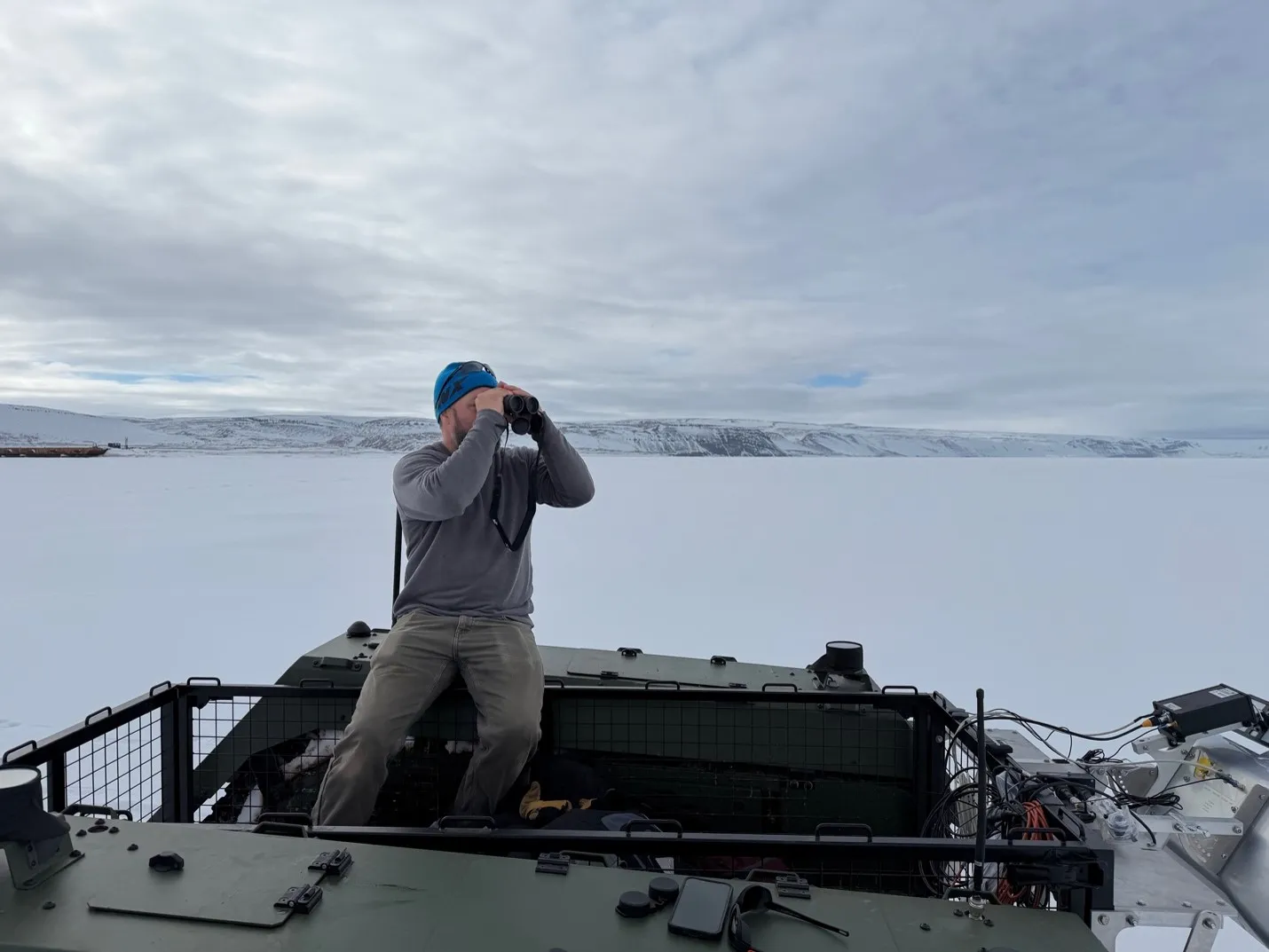
这一概念是美国陆军工程兵团和陆军研究实验室今年早些时候在格陵兰皮图菲克开展的一项实验中的关键测试方向之一。整个项目是“国际极地研究合作接触计划”(ICE-PPR)和海军研究办公室组织的一系列更广泛测试的一部分,这是一项多国合作项目,凸显了北极作为作战领域日益重要的地位。
That concept was one of the key testing lines of effort in an Army Corps of Engineers and Army Research Laboratory experiment in Pituffik, Greenland, earlier this year. The whole endeavor was part of a broader testing series organized by the International Cooperative Engagement Program for Polar Research (ICE-PPR) and the Office of Naval Research, a multi-national endeavor that underscores the ever-increasing importance of the Arctic as a warfighting domain.
这也是一个给伪装带来独特挑战的领域,美国陆军工程兵团冷区研究与工程实验室阿拉斯加研究办公室(位于阿拉斯加费尔班克斯)的研究化学家、高级科学技术经理汤姆·道格拉斯博士表示。
It is also a domain that presents unique challenges for camouflage, said Dr. Tom Douglas, a research chemist and senior scientific technical manager of the Army Corps of Engineers’ Cold Regions Research and Engineering Laboratory Alaska Research Office in Fairbanks, Alaska.
“在某些时段是黑暗的;在其他时段则是光亮的,”道格拉斯在接受《军队时报》采访时说。“日落时分,一切看起来可能都呈现出某种黄色或橙色……你有海冰,看起来可能呈灰色……你可能会在一片没有植被的广阔白色原野上非常显眼,对吧?所以存在这种情况,再考虑到涂层或积雪覆盖物体,可能会让原本不起作用的伪装变得更糟。”
“It’s dark for some periods; it’s light for other periods,” Douglas told Military Times in an interview. “Everything can look kind of yellow or orange when the sun’s setting … you’ve got sea ice, which can look kind of gray … You can stand out pretty blatantly in a vast open white field where there’s no vegetation, right? So there’s that, and then thinking about coatings or snow covering things, and maybe making it worse now that your camo doesn’t work.”
冷区研究与工程实验室的寒区人工智能负责人安东尼·弗拉戈索表示,他的实验室在船岸作业期间与陆军研究实验室人员合作,利用传感器测试了“多种新型涂层”,以评估隐蔽效果。
Anthony Fragoso, a cold regions artificial intelligence lead at CRREL, said that his lab worked with ARL staff during ship-to-shore operations to test “a number of novel coatings,” using sensors to assess the effectiveness of concealment.
“如果你超越可见光范围,而我们的对手可以做到这一点,在某些波长下,雪看起来是黑色的。但在可见光下,它是白色的,”弗拉戈索在另一次采访中对《军队时报》表示。“所以试图匹配这一点是一个挑战。”弗拉戈索说,研究人员从皮图菲克的北极狐身上获得了灵感,这些狐狸一年四季会变色——冬天是白色,夏天是棕色。
“If you go beyond the visible, which our adversaries can do, snow in certain wavelengths looks black. But it’s white in visible,” Fragoso told Military Times in a separate interview. “So trying to match that is a challenge.”Researchers, Fragoso said, were inspired by Arctic foxes in Pituffik, which change colors over the course of the year – from white in the winter to brown in the summer.

“可逆、灵活的东西,大概就是我们追求的目标,”他说,并补充道,研究人员考虑到了驻阿拉斯加的第11空降师等部队,该师也经常部署到太平洋地区。
“Things that are reversible, flexible is kind of what we’re after,” he said, adding that researchers considered units like the Alaska-based 11th Airborne Division, which also regularly deploys to the Pacific.
“他们是‘北极天使’,但也担心在丛林中作战,”他说。“所以他们不想把装备刷成白色,然后又要去台湾。”虽然这项工作仍处于科学研发阶段,但已经开始向作战部队推广,计划近期在阿拉斯加对陆军的寒冷天气全地形车测试一种快速部署涂层系统。
“They’re the Arctic Angels, but they are also worried about fighting in the jungle,” he said. “So they don’t want to paint stuff white, and then it has to go to Taiwan.”While still at the scientific research and development level, the work is making its way to operational units already, with upcoming plans to test a rapidly deployable coating system on the Army’s Cold Weather All-Terrain Vehicles in Alaska.
“阿拉斯加国民警卫队将派直升机飞越该车辆,用热成像设备拍摄,诸如此类,”弗拉戈索说。“现在一切都是反无人机系统,所以要确保装备不会被一架价值1000美元的无人机从空中发现。”美国陆军工程兵团寒区研究与工程实验室(CRREL)寒区机动负责人迈克·帕克强调,测试灵活伪装的这项工作已超越北极范围。
“The Alaska National Guard is going to fly over it with helicopters, film it with thermal, all that stuff,” Fragoso said. “Everything now is counter-[unmanned aerial systems], so it’s making sure stuff isn’t being spotted from above by a $1,000 drone.”Mike Parker, the cold regions mobility lead for CRREL, emphasized that this effort to test flexible camouflage extends beyond the Arctic.
在当代战争中,来自上空的监视基本是既定事实,因此对额外隐蔽层的需求空前高涨,特别是那些能轻松改变以适应不同环境的隐蔽层。
With surveillance from above essentially a given in contemporary warfare, additional layers of concealment, particularly those that can be easily altered to fit changing environments, are in unprecedented demand.
“它必须保持灵活,所有方面都在考虑之中,”帕克说。“它不一定非得是涂层;也可以是织物……任何能给我们带来战术优势的东西都在评估之中。”
“It has to remain flexible, and all aspects of it are on the table,” Parker said. “It doesn’t have to be just a coating; it could be a fabric … anything that can give us the tactical advantage is being evaluated.”