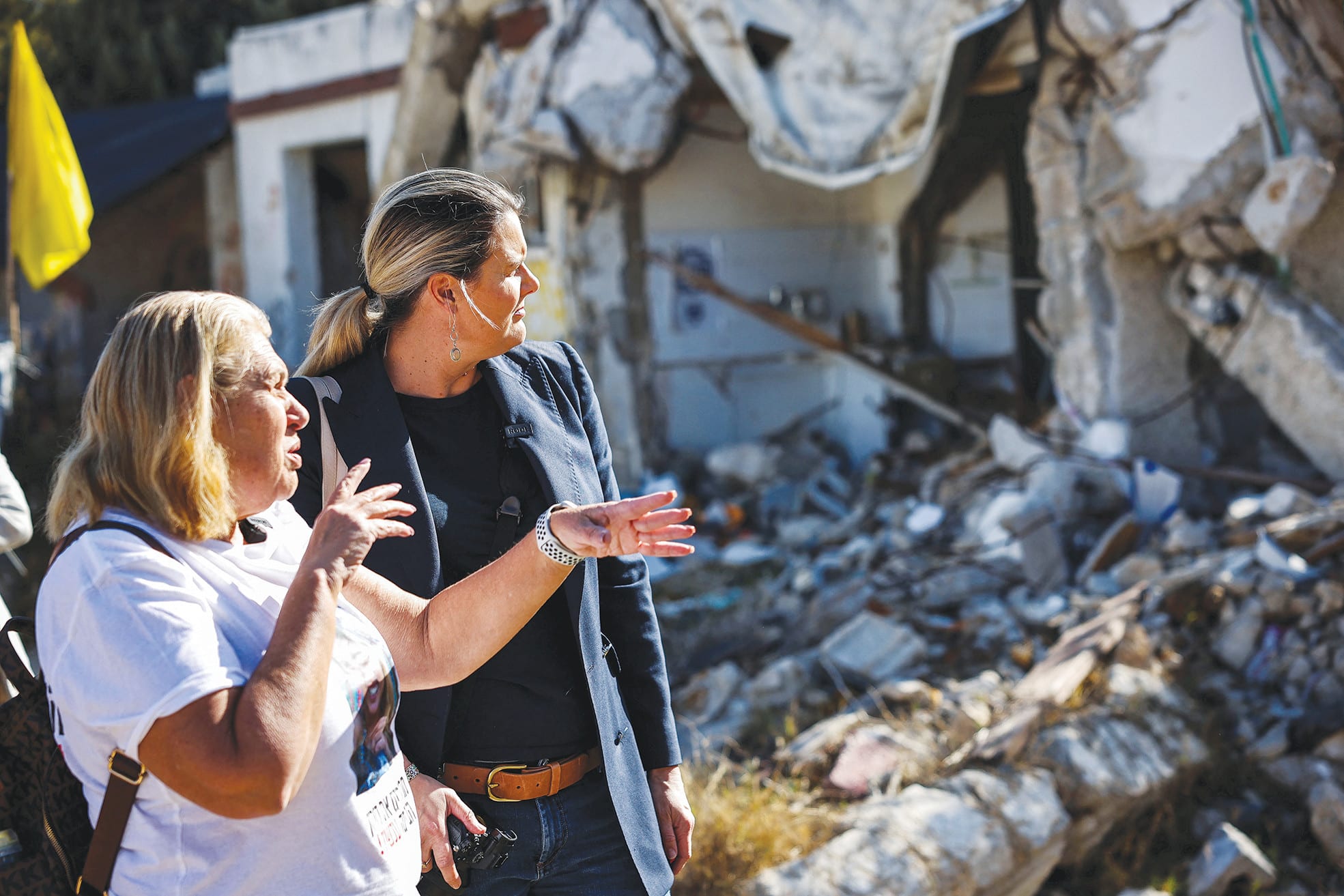
2024年12月,在哈马斯恐怖分子闯入加沙边境地区、在平民家中杀害平民一年多之后,时任联合国酷刑问题特别报告员的艾丽斯·吉尔·爱德华兹博士参观了发生屠杀的基布兹。
“那是一次非常令人毛骨悚然的经历,”爱德华兹回忆道。“那段巨大的苦难已经过去一年多,然而,一些花朵已经开始从瓦砾中绽放出来。那是深深印在我脑海中的画面之一。”
“另一件我无法忘记的事情是普通人家中弹孔之多,”她说。“我走进一些房屋,里面的微波炉或冰箱被子弹打得粉碎。这些都是平民。”
她的结论直言不讳:“我认为,如果人们对此都无法产生同理心,那么我对人类普遍的人性感到担忧。”
爱德华兹曾于2022年至2026年担任联合国酷刑和其他残忍、不人道或有辱人格的待遇或处罚问题特别报告员。这次访问让她得以亲眼目睹2023年10月7日屠杀的后果,也强化了一个信念,而这一信念将日益使她与这一国际组织内的同事产生分歧。
“根据国际法,这完全是非法的,”她在谈到针对平民的袭击时表示。“没有任何借口或例外。国际法不允许对平民发动这类袭击。”
爱德华兹已不再担任联合国酷刑问题特别报告员。她说,与联合国机构的这种距离使她能够更公开地谈论她认为国际社会对10月7日事件反应中令人深感不安的失败。
“你看,我们刚刚迎来袭击三周年,但我的两位同事仍然没有对这些事件进行调查、记录或报告,而我们也看到了相当多关于以色列行动的报告,这是理所应当的,”她说。她的指责并非认为以色列应免于审查。
相反,爱德华兹坚持认为,必须对以色列军队涉嫌的违规行为进行调查。她的异议在于,当受害者是以色列人、施害者是哈马斯或其他巴勒斯坦武装组织时,也应适用同样的标准。爱德华兹确实在10月7日之后的几个月里撰写了一份报告,联合国冲突中性暴力问题特别代表普拉米拉·帕滕也是如此。但在爱德华兹看来,随后出现的是该问题长期未得到足够关注的时期。
“在那之后,出现了很长的滞后,”她说。“偶尔会提到哈马斯在加沙的活动,但次数很少,而且往往被埋没在有关以色列活动的报告中。”“没有真正的借口”她特别指出了两位同事:联合国暴力侵害妇女问题特别报告员和被占领巴勒斯坦领土问题特别报告员。在她看来,尽管两人都有机会,却都未能充分应对10月7日的暴行。
“而且我认为那是有意为之,”爱德华兹说。“我仍然认为现在是有意为之。不这样做没有真正的借口。”当被问及她是否看到同事试图采访性暴力幸存者或其他经历过10月7日暴行的人时,爱德华兹的回答很简单:没有。“他们拥有所有机会,”爱德华兹在谈到她同事的职责时说。“他们被要求提交报告。他们被要求进行沟通。”她说,对于缺乏接触,给出的一个解释是以色列没有提供准入。
爱德华兹对这一论点提出异议,并指出她自己也曾因依赖以色列提供的信息而受到批评,尽管她表示自己的调查结果基于独立信源,而非以色列政府的材料。她说:“说我们没有采取行动的原因是以色列不给我们信息,然后又批评我依赖以色列的信息,这是一种自相矛盾的说法。”对爱德华兹而言,10月7日的后果远不止袭击期间被杀害、受伤或被劫持的人。
它还包括那些不知亲人是否还活着、被关押在哪里、是否还能回家的家属们。她说:“在所有种种情形中,包括10月7日大规模劫持251名人质,家属们突然间被抛入一种不知道亲人下落、得不到他们信息的处境。那种折磨和痛苦正是酷刑的本质——心理酷刑。”“执念”她在特拉维夫与人质家属的会面,让这一论点对她而言格外切身。
“我在特拉维夫与一些人质家属以及这些人质的孩子见面时,我深受触动……四岁的孩子不知道父亲或母亲在哪里,不知道他们什么时候回家,不知道他们是死是活;他们夜里无法入睡。”“这些都是非常创伤性的经历,可能达到心理酷刑的程度,”她补充道。她对联合国的批评不仅限于对10月7日事件的处理。
她认为,该组织对以色列投入了不成比例的注意力,却未能对平民遭受大规模暴力和虐待的其他冲突给予同等程度的审视。当被问及她用“执念”一词来描述这一模式时,她为该词辩护。“是的,我这样说是因为以色列每采取一步行动、做任何事,都会有回应,”她说。她举出苏丹、也门和刚果民主共和国的冲突为例,认为这些地方发生的严重侵权行为理应得到国际社会更多的关注。
“你知道仅去年一年刚果民主共和国就有9万起强奸案,且经联合国记录和核实吗?”她问道。根据她提供的数据,自10月7日以来,涉及以色列的来文约有50份,而涉及苏丹的约为10份。她说,与俄罗斯和乌克兰之间的战争本身相关的来文数量在十几份左右。对爱德华兹来说,这些数字引出了一个问题:国际注意力是如何分配的。
“是的,我们应该点名批评各国政府;我们应该点名批评以色列的侵权行为,”她说。“但我们也应该确保我们保持独立和公正。”爱德华兹说,最令人不安的方面,或许是国际人权官员开展工作的氛围。她描述了同事们如何努力淡化涉及10月7日的来文措辞,随后又有人进一步试图阻止其他人对这些来文表示认可。“有几次,我的同事们,尤其是在10月7日的调查中,试图淡化措辞,”她说。
“曾有过很多很多次试图修改措辞的努力。”她说,即便在做出调整之后,仍有人设法确保其他官员不会签字同意。爱德华兹说:“曾经存在、而且我认为现在仍然存在一种欺凌和恐吓的氛围,那就是你只能持一种观点,你不能也不应该看到以色列-巴勒斯坦冲突的另一面。”她认为,这种环境损害了联合国本应维护的根本原则。
“我们应当能够开展工作,而不必觉得一旦发声就会遭到反弹、遭到报复、承担后果,”她说,“这种氛围让人发声时非常恐惧。”她描述的情形是,专业人士如果被认为立场不正确,可能会被排除在活动之外,或在工作中被边缘化。爱德华兹说:“自从我发表那篇文章以来,我收到了许多善意的邮件,人们感谢我发声。”
她补充说,一些人告诉她,他们已经离开了联合国,因为他们觉得无法在一个他们认为本应以人权为基础的氛围中开展工作。“我认为我们正处于一个黑暗的空间,”她说。一条正直的底线爱德华兹并未将这一局面的主要责任归咎于秘书长安东尼奥·古特雷斯。她说,他对个别报告员行为的的影响力有限,尽管她认为本应欢迎更有力的领导。
“他也说过这不是他能决定的。如果有更多的领导力会更好,”她说。她主张,下一任秘书长应将缔造和平与预防冲突作为核心优先事项,同时努力确保停火和政治解决方案能为经历战争的人们带来更安全的未来。这场争端的后果超出了联合国人权机制的范围。
如果以色列和其他国家对联合国的公正性失去信心,联合国在国际冲突中充当可信调解者的能力可能会受损。她说:“令人遗憾的是,联合国在中东和俄乌战争中被边缘化。这需要在新任秘书长的领导下加以修复。”然而,爱德华兹也认为,以色列在恢复国际信心方面可以发挥作用。她对加沙缺乏国际观察员以及国际社会无法进入监狱表示失望。
她还建议以色列考虑允许国际法官参与相关司法程序,而不将案件移交给国际法院。她说:“如果能以某种方式作出调整,允许国际法官参与,那就更好了。”她建议可以由两名国际法官参与。她说:“我认为以色列的声誉也处于历史最低点,这需要改善,这样他们才有机会参与和平进程。”她拒绝接受这样一种看法,即她对联合国的批评应被理解为支持一方反对另一方。
她说,她的工作包括调查针对以色列当局对待巴勒斯坦囚犯的指控,以及审查其他冲突中的侵权行为。她说:“在我处理的所有冲突中,我们面对的是人,是有家庭、生活在社区中的人。”“我们必须走在我所说的诚信之路上,当我们看到某些事情时,我们就去调查,在可能的情况下予以揭露,我们进行静默外交或其他策略,同样,如果我们看到其他侵权行为,也会这样做。”
她要传达的信息并不是联合国应该放弃对以色列的审查。而是对证据、同理心和问责的同样承诺必须延伸到每一个受害者。她说:“我不偏向任何一方。我希望事情是公平的。”
In December 2024, More than a year after Hamas terrorists stormed the Gaza border area, killing civilians in their homes, Dr. Alice Jill Edwards, who then served as the UN special rapporteur on torture, toured the kibbutzim where the massacre occurred.“It was a very eerie experience,” Edwards recalls.“It was more than a year after that great suffering. And yet some of the flowers had started to emerge out of the rubble. That is one of the images that stays with me very profoundly.“The other thing that I can't forget was the amount of bullet holes in ordinary people's houses,” she says. “I walked into houses where the microwave oven had been shot to pieces or the fridge. These were civilians.”Her conclusion is blunt: “I think if you can't have empathy for this, then I worry about people's general humanity.”For Edwards, who served as the UN special rapporteur on torture and other cruel, inhuman or degrading treatment or punishment from 2022 to 2026, the visit was an opportunity to see the consequences of the October 7, 2023, massacre for herself. It also reinforced a conviction that would increasingly put her at odds with colleagues within the international organization.“This is entirely unlawful under international law,” she says of attacks against civilians. “There are no excuses or exceptions. There are no rights under international law for this type of attack against civilians.”Edwards is no longer serving as the UN's torture rapporteur. That distance from the institution, she says, has allowed her to speak more openly about what she considers a deeply troubling failure in the international response to October 7.“Look, we just had the third anniversary of the attacks, and there was still no investigation or documentation or report on those events by two of my colleagues, yet we have also quite a number of reports, rightly, in relation to Israel's actions,” she says.Her accusation is not that Israel should be exempt from scrutiny. On the contrary, Edwards insists that alleged violations by Israeli forces must be investigated. Her objection is that the same standards should apply when the victims are Israeli, and the perpetrators are Hamas or other Palestinian armed groups.Edwards did produce a report in the months after October 7, as did UN Special Representative on Sexual Violence in Conflict Pramila Patten. But what followed, in Edwards's assessment, was a prolonged period in which the issue received insufficient attention.“After that time, there's been a very long lag,” she says. “There have been occasional references to Hamas activities in Gaza, but very few and often buried within reports about Israel's activities.”'No real excuses'She identifies two colleagues in particular: the UN special rapporteur on violence against women and the special rapporteur on the occupied Palestinian territories. In her view, both failed to engage adequately with the October 7 atrocities despite opportunities to do so.“And I think that was deliberate,” Edwards says. “And I still think it is deliberate. There's no real excuses for not having done so.”Asked whether she had seen her colleagues attempt to interview survivors of sexual violence or other people who experienced the October 7 atrocities, Edwards answers simply: No.“They had all the opportunities,” Edwards says of her colleagues' responsibilities. “They are required to produce reports. They are required to engage in communications.”One explanation offered for the lack of engagement, she says, was that Israel had not provided access. Edwards disputes that argument, noting that she herself was criticized for relying on Israeli information, even though she says her findings were based on independent sources rather than Israeli government material.“It's kind of a contradictory statement to say the reason we haven't done it is because Israel wouldn't give us the information and then to criticize me for relying on Israeli information,” she says.For Edwards, the consequences of October 7 extend beyond the people murdered, wounded, or taken captive during the attack. They also include the families who were left wondering whether their loved ones were alive, where they were being held, and whether they would ever return home.“Across all the many circumstances, including the very large-scale taking of 251 hostages on October the 7th, the family members themselves suddenly are launched into a situation of not knowing where their loved ones are, not having information about them,” she says. “That torment and distress is exactly what torture also is, psychological torture.”'Obsession'Her meetings with hostage families in Tel Aviv made that argument especially personal.“It was very compelling to me when I was in Tel Aviv and met with some of the hostage families and the children of these hostages... four-year-olds who don't know where their father is or their mother is, when they're coming home, if they're dead or alive; they can't sleep at night.“These are very traumatic experiences which can rise to the level of psychological torture,” she adds.Her criticism of the UN extends beyond the handling of October 7. She believes the organization devotes disproportionate attention to Israel while failing to give comparable scrutiny to other conflicts in which civilians experience mass violence and abuse.Asked about her use of the word “obsession” to describe the pattern, she defends the term.“Yes, and I say it like this because every time Israel takes a step, does anything, there is a response,” she says.She points to conflicts in Sudan, Yemen, and the Democratic Republic of Congo, arguing that grave violations elsewhere deserve much greater international attention.“Do you know that there were 90,000 rapes in the DRC last year alone, documented and verified by the United Nations?” she asks.According to the numbers she provides, there had been approximately 50 communications concerning Israel since October 7, compared with around 10 concerning Sudan. She says communications related to the war itself between Russia and Ukraine numbered in the mid-teens.For Edwards, the figures raise a question about how international attention is distributed.“Yes, we should be calling out governments; we should be calling out Israel for violations,” she says. “But we should also be making sure that we are being independent and impartial.”The most troubling aspect, Edwards says, may be the atmosphere in which international human rights officials carry out their work.She describes efforts by colleagues to soften the language of communications concerning October 7, followed by further attempts to prevent others from endorsing them.“There were times when my colleagues, especially in the investigation on October the 7th, attempted to water down the language,” she says. “There were many, many efforts to change the language.”Even after adjustments had been made, she says, there were efforts to ensure that other officials would not sign on.“There was, and there is still, I think, an atmosphere of bullying and intimidation that you have one view only, and you cannot and should not be seeing the other side in the Israel-Palestine conflict,” Edwards says.She believes that kind of environment undermines the very principles the UN is supposed to uphold.“We should be able to do our work without feeling like if we speak out, there will be repercussions, there will be retaliation, that there will be consequences,” she says. “The atmosphere is such that it is very frightening to speak out.”She describes a situation in which professionals may be excluded from events or sidelined in their work if they are perceived as holding the wrong position.“Since I put out the article, I've had many lovely emails from people thanking me for speaking out,” Edwards says.Some people, she adds, told her they had left the United Nations because they felt unable to perform their work in an atmosphere they believed should be grounded in human rights.“We are in a dark space, I think,” she says.A line of integrityEdwards does not place primary responsibility for the situation on Secretary-General António Guterres. She says his influence over the conduct of individual rapporteurs was limited, although she believes stronger leadership would have been welcome.“He's also said it's not his call. It would have been good to have more leadership,” she says.She argues that the next secretary-general should make peacemaking and conflict prevention central priorities, alongside efforts to ensure that ceasefires and political settlements lead to a more secure future for people living through war.The consequences of the dispute go beyond the UN's human rights machinery. If Israel and other countries lose confidence in the organization's impartiality, its ability to serve as a credible mediator in international conflicts may suffer.“It's regrettable the United Nations has been sidelined in the Middle East and in the Russia-Ukraine war,” she says. “That needs to be repaired with the new secretary-general.”Yet Edwards also believes Israel has a role to play in restoring international confidence. She expresses disappointment at the lack of international observers in Gaza and at the absence of international access to prisons. She also suggests that Israel consider allowing international judges to participate in relevant judicial proceedings, without transferring the cases to an international court.“It would be even better if that could be somehow adjusted to allow for international judges,” she says, suggesting that two international judges could participate.“I think the reputation of Israel is also at an all-time low, and that needs to be improved so that they have the opening to be able to engage in a peace process,” she says.She rejects the idea that her criticism of the UN should be understood as support for one side against another. Her work, she says, has involved investigating allegations against Israeli authorities over their treatment of Palestinian prisoners as well as examining abuses in other conflicts.“In all the conflicts I deal with, we're dealing with people, human beings who have families, who are living in communities,” she says.“We must walk what I call a line of integrity, that when we see something, we investigate, we call it out when we can, we engage in quiet diplomacy or other strategies, and likewise if we see other violations.”Her message is not that the organization should abandon its scrutiny of Israel. It is that the same commitment to evidence, empathy, and accountability must extend to every victim.“I'm not biased towards one side or another side,” she says. “I want things to be fair.”