英伟达不仅仅是图形和人工智能硬件领域的领导者,它还成为了网络行业的巨头,其数据中心以太网销售额超过了其他任何供应商。第二季度,英伟达的网络业务营收超过175亿美元。为了让大家有个直观的概念,思科在同一时期的全产品线营收为173亿美元。这家GPU巨头作为网络力量的崛起似乎十分突然,但黄仁勋早在2019年就开始为此布局,斥资69亿美元收购了长期网络合作伙伴迈络思(Mellanox)。
Nvidia is more than just a leader in graphics and AI hardware. It has also become a titan of the networking industry with bigger datacenter Ethernet sales than any other vendor. In Q2, Nvidia's networking revenues topped $17.5 billion. To put that in perspective, Cisco's revenue during that same period, across all products, was $17.3 billion.
当时,迈络思在以太网交换机领域并非大名鼎鼎,该公司主要以其ConnectX网卡和InfiniBand交换机而闻名。除了高性能计算(HPC)和超级计算集群,以及微软的大规模部署之外,InfiniBand并未在超大规模数据中心中广泛部署。收购迈络思使英伟达能够将自己重新定位为系统构建商,在分布式计算的语境下,这意味着不同的意义。
GPUzilla's arrival as a networking power feels sudden, yet Jensen Huang started working towards this status in 2019 with the $6.9 billion acquisition of long-time networking partner Mellanox . At the time, Mellanox wasn't a big name in Ethernet switching. The company was mostly known for its ConnectX NICs and InfiniBand switches.
英伟达明白,其数据中心客户对购买GPU甚至服务器并不感兴趣,他们想要的是系统集群。为此,英伟达需要互连技术,而迈络思的InfiniBand正好符合要求。不间断的协同设计多年来,黄仁勋一直谈论协同设计——即设计能够协同工作以完成特定任务的组件和软件,而不是仅仅追求成为最好的GPU、交换机或网卡。它与迈络思的合作就是这种方法的典型例证。
Outside of high-performance computing (HPC) and supercomputing clusters, and a big deployment at Microsoft, InfiniBand wasn't widely deployed in hyperscale datacenters. Buying Mellanox allowed Nvidia to reposition itself as a system builder, which means something different in the context of distributed compute. Nvidia understood its datacenter customers weren't interested in buying GPUs or even servers; they wanted clusters of systems. For that, Nvidia needed interconnect and Mellanox's InfiniBand fit the bill.
据德罗集团(Dell'Oro Group)分析师萨迈赫·布杰尔贝内(Sameh Boujelbene)称,英伟达整合计算与网络的决定成为了该公司成功的关键。她对《The Register》表示:“客户选择英伟达是因为其针对AI工作负载优化的、高度集成的计算和网络架构。”这种集成使部署更加简便,并加快了上市时间。开创性AI与机器学习公司Recursion的首席技术官本·马贝(Ben Mabey)对《The Register》表示,英伟达的集成方案赢得了他的青睐。
Relentless co-design Over the years, Huang has talked about co-design – designing components and software to work together for specific set of jobs rather than to be the best GPU, switch, or NIC. Its work with Mellanox is a prime example of that approach. According to Dell'Oro Group analyst Sameh Boujelbene, Nvidia's decision to integrate compute and networking became key to the company's success. "Customers choose Nvidia for its tightly integrated compute and networking architecture, optimized for AI workloads," she told The.
Recursion成立于2013年,在ChatGPT将人工智能变成餐桌上的热门话题的近十年前,该公司就试图将运行在GPU之上的机器学习应用于药物发现问题。这项工作涉及处理海量数据集。Mabey告诉我们,这些数据集目前的总规模已超过50PB。
That integration makes deployments easier and speeds time to market. Ben Mabey, CTO of pioneering AI and machine learning company Recursion, told The Reg Nvidia's integration schemes won him over. Founded in 2013, nearly a decade before ChatGPT made AI the subject of dinner-table discussion, Recursion sought to apply machine learning running atop GPUs to the problem of drug discovery.
“当你考虑到我们的工作负载时,与必须移动的数据量相比,它让大语言模型(LLM)的工作负载训练显得轻而易举,”他接受《The》采访时表示。“在生物学领域和整个科学界,人们并没有充分认识到数据到底有多大,”他补充道。“互联网很大,但从宏观来看,人们用于训练的文本实际上相当小,相比之下,我们拥有的这些图像数据达到了PB级别。”
This work involved churning through massive datasets which, Mabey tells us, now total more than 50 petabytes in size. "When you think about our workloads, it makes LLMs workload training seem easy compared to the amount of data that has to be moved around," he told The. "In the biological space and sciences in general, it's not well appreciated just how big the data actually is," he added.
Recursion的第一座集群是一个名为BioHive Zero的系统,该系统由原本用于游戏系统的GTX 1080显卡拼凑而成。它使用以太网连接GPU,并遇到了传统网络的极限。因此,对于它的第二座集群——一台拥有约300个加速器、基于A100的机器,Recursion选择了英伟达的Quantum InfiniBand交换机和ConnectX网卡。
"The internet's big, but in the grand scheme of things, the text that people are training on is actually pretty small, versus the petabytes of data that we have of these images." Recursion's first cluster was a system called BioHive Zero which it cobbled together from GTX 1080 graphics cards originally intended for gaming systems. It used Ethernet to connect GPUs and ran into the limits of conventional networking.
正如Mabey所解释的那样,从同一家供应商那里购买计算设备和互连设备,极大地简化了优化和故障排除工作。当Recursion向英伟达寻求帮助以调优该系统时,他们能够将其视为一个单一的系统,而不是离散的计算和网络资源。这种程度的整合以前只有像克雷(Cray)或阿托斯(Atos,埃维登/布尔/随便它接下来被改为什么名字)这样的小众超级计算机制造商才能提供。
So, for its second cluster, an A100-based machine with around 300 accelerators, Recursion went with Nvidia's Quantum InfiniBand switches and ConnectX NICs. As Mabey explains it, buying its compute and interconnects from the same vendor vastly simplified optimization and troubleshooting. When Recursion reached out to Nvidia for help tuning the system, they were able to consider it as a single system, rather than discrete compute and networking resources.
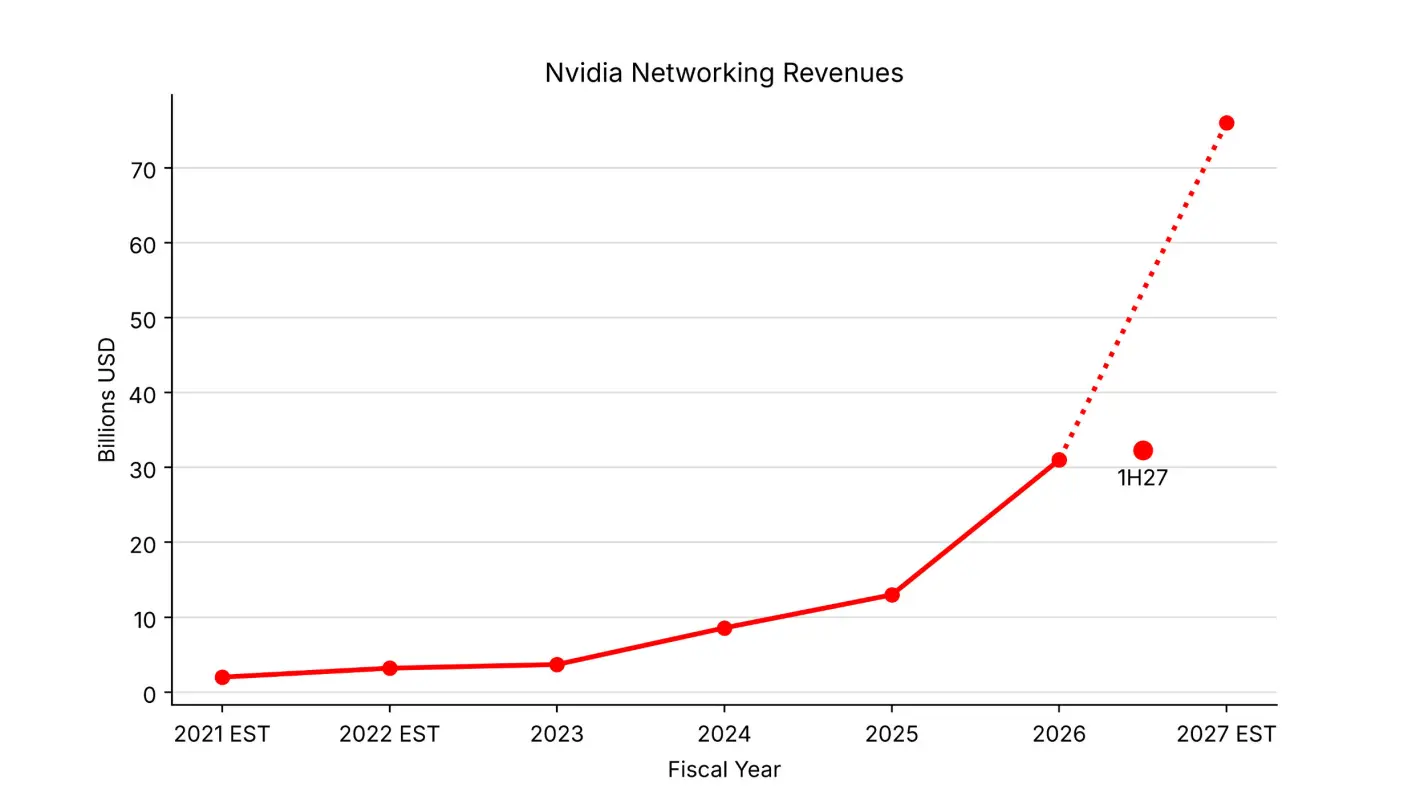
更广阔的光谱 英伟达并不总是在其财务报表中将网络收入列为单独的项目。然而,根据首席财务官的评论和一些简单的粗略计算,我们可以填补空白。自从收购迈络思(Mellanox)以来,英伟达的网络收入一直在稳步增长。在两个时期,其收入出现了突然飙升。
This level of integration had only previously been offered by boutique supercomputer builders like Cray or Atos (Eviden/Bull/whatever it gets renamed next). A wider Spectrum Nvidia hasn't always listed networking revenue as a single line item in its financials. However, based on CFO commentary and a little back of the napkin math we can fill in the blanks. Nvidia's networking revenues have grown steadily since the Mellanox acquisition.
第一次出现在2023日历年度(2024财年),当时OpenAI推出ChatGPT,拉开了人工智能淘金热的序幕。第二次则贯穿2024年和2025年,当时英伟达开始销售Blackwell一代GPU,随后开始大量出货。布热尔本表示:“我看到了两个主要的拐点,两者都与Blackwell平台的产能提升相吻合:一是引入了NVLink交换机,二是随着英伟达GPU集群部署的不断增加以及英伟达交换机、网卡(NIC)、光器件和电缆搭载率的提高,人工智能后端网络对Spectrum-X以太网交换机的采用正在加速。”
At two moments, its revenue shot up suddenly. The first came in the 2023 calendar year (FY24) after OpenAI kicked off the AI gold rush with the launch of ChatGPT. The second spread across 2024 and 2025, when Nvidia started selling Blackwell-generation GPUs and then started to ship them in large quantities.
正是在这段时间里,用户开始在英伟达集群中大量部署以太网交换机。埃隆·马斯克的“巨像”(Colossus)超级计算机就是最早的例子之一。正如我们当时报道的那样,这个由20万枚H100和H200芯片组成的集群的第一半于2024年投入运行,在当时是采用英伟达Spectrum-X以太网交换机部署的规模最大的集群之一。Meta也在其自己的训练集群中广泛使用了英伟达的Spectrum交换机,其中包括位于俄亥俄州新奥尔巴尼拥有100万枚GPU的“普罗米修斯”(Prometheus)站点。
"I see two major inflection points, both coinciding with the Blackwell platform ramp: the introduction of NVLink switches and the accelerating adoption of Spectrum-X Ethernet switches for AI back-end networks, driven by growing deployments of Nvidia GPU clusters and increased attach rates of Nvidia switches, NICs, optics, and cables," Boujelbene said. It was around this time that users started deploy to Ethernet switches in large volume across Nvidia clusters. Elon Musk's Colossus supercomputer was one of the earliest examples. As we reported at the time, the first half of the 200,000-chip H100 and H200-based cluster came online in 2024 and, at the time, was among the largest ever clusters deployed using Nvidia's Spectrum-X Ethernet switches.
英伟达的Spectrum-X产品表现如此之好的原因有几个。首先,通过将Spectrum以太网交换机、超级网卡和一些巧妙的软件优化结合起来,英伟达成功复制了让InfiniBand极具吸引力的许多特性,同时还受益于显著更高的基数(radix)和互操作性。以太网交换机(包括英伟达自己的交换机)历来提供更多的端口。基数越高,在给定的端口速度下支持集群所需的交换机就越少。
Meta has also made extensive use of Nvidia's Spectrum switches in its own training clusters, including at its million-GPU Prometheus site in New Albany, Ohio. There are a couple reasons Nvidia's Spectrum-X offering is doing so well. First, through a combination of Spectrum Ethernet switches, superNICs, and some clever software optimizations, Nvidia was able to replicate many of the qualities that made InfiniBand so attractive while also benefiting from significantly higher radix and interoperability. Ethernet switches, including Nvidia's own, have historically offered more ports.
这经常被误解为InfiniBand无法扩展到超过特定大小的集群,但这并非必然如此。但对于超过特定GPU数量的集群而言,以太网通常更具经济效益,因为它所需的设备更少,同时能实现类似的利用率。
The higher the radix, the fewer switches are necessary to support a cluster at a given port speed. This often gets misconstrued to mean that InfiniBand can't scale beyond clusters of a certain size, which isn't necessarily the case.
尽管如此,英伟达的Spectrum-X并非独一无二。博通、思科、AMD等公司通过对智能网卡和交换机的各种投资,也设法实现了类似于InfiniBand的利用率。正如马贝和布热尔贝恩此前所指出的,英伟达的主要差异化优势在于计算与网络之间的集成水平。下一个前沿随后,Blackwell推向市场,实现了大得多的规模,并推动英伟达的网络业务收入激增。
But for clusters exceeding a certain number of GPUs, Ethernet is often more economical because it requires less equipment while achieving similar utilization. That said, Nvidia's Spectrum-X isn't exactly unique. Broadcom, Cisco, AMD and others have managed to achieve utilization similar to InfiniBand through various investments in smartNICs and switches. Nvidia's main differentiator, as Mabey and Boujelbene noted earlier, is the level of integration between the compute and networking.
在Blackwell问世之前,英伟达的NVLink和NVSwitch互连技术大体上局限于最多包含八个GPU的单系统。随着GB200 NVL72的推出,这些NVSwitch被拆分成了专用设备。(当然,我们还记得GH200 NVL256和NVL32,但据我们所知,这些产品从未实现过真正意义上的出货,即便有过也是如此。)每售出一套NVL72机架系统,英伟达还会售出九个NVSwitch托盘,这使得该系统的七十二个GPU能够作为一个单一的庞大GPU来运行。
The next frontier Then Blackwell hit the market, enabling much greater scale and creating a surge in Nvidia's networking revenue. Prior to Blackwell, Nvidia's NVLink and NVSwitch interconnect tech had largely been limited to single systems with up to eight GPUs. With the launch of the GB200 NVL72, these NVSwitches were broken out into dedicated appliances. (And yes, we remember GH200 NVL256 and NVL32, but from what we can tell these were never shipped in any meaningful volume, if at all.) For every NVL72 rack system sold, Nvidia also sold nine NVSwitch trays, which enabled the system's six dozen GPUs to function as a single enormous GPU.
这实际上保证了网络业务收入的稳步增长:即便客户不购买英伟达的横向扩展交换机,如果他们想要NVL72机架,他们也就自动购买了NVSwitch。
This effectively guaranteed steady networking revenue growth: even if customers didn't buy Nvidia's scale-out switches, if they wanted NVL72 racks, they were automatically buying NVSwitch.
“我们估计,NVSwitch现在约占英伟达网络业务收入的三分之一,而在不到两年前,这一比例几乎为零,”布热尔贝恩对《注册表》杂志表示。“这凸显了NVLink交换技术成为英伟达网络业务主要增长引擎的速度有多快。”
"We estimate that NVSwitch now accounts for roughly one-third of Nvidia’s networking revenue, up from virtually zero less than two years ago," Boujelbene told El Reg. "This underscores how quickly NVLink switching has become a major growth engine for Nvidia’s networking business."
英伟达目前正通过一项新的许可计划,进一步推动其网络业务的发展。直到最近,英伟达的NVSwitch技术还仅限于其自身的加速器。然而,随着去年初NVLink Fusion的推出,英伟达向第三方开放了该互连技术的许可。包括美满电子、高通、安谋、富士通、联发科和d-Matrix在内的许多芯片设计商,已宣布计划使用NVLink Fusion开发CPU和XPU。
Nvidia is now moving to grow its networking business even further with a new licensing program. Until recently, Nvidia's NVSwitch tech was limited to its own accelerators. However, with the introduction of NVLink Fusion early last year, Nvidia opened the interconnect tech up to third parties to license. Many chip designers, including Marvell, Qualcomm, Arm, Fujitsu, MediaTek, and d-Matrix, have announced plans to develop CPUs and XPUs using NVLink Fusion.
采用这种互连芯片为增加NVSwitch的销量打开了大门,因为使用NVLink Fusion的芯片在芯片间通信方面仍然依赖它们,而且没有其他地方可以买到,因为英伟达尚未授权NVSwitch。布热尔本表示:“NVLink Fusion使英伟达能够将其网络业务版图从自身的GPU扩展到快速增长的定制加速器市场。我认为这是一个战略举措,旨在占据更大份额的人工智能网络开支,即使在不使用英伟达GPU的集群中也是如此。”
The adoption of the interconnect opens the door to additional NVSwitch sales, as the chips using NVLink Fusion still rely on them for chip-to-chip communications, and there's no other place to get them, as Nvidia has yet to license out NVSwitch. "NVLink Fusion allows Nvidia to extend its networking footprint beyond its own GPUs into the rapidly growing custom accelerator market.
英伟达在网络领域的野心并未止步于此。布热尔本补充说:“随着网络需求不断演变以跟上日益繁重的人工智能工作负载步伐,英伟达将继续在新兴网络领域寻求机遇。”“最新的例子是纵向扩展网络(scale-in networking),旨在满足智能体人工智能(agentic AI)的新需求,而共封装光学(CPO)等创新则将有助于克服日益严峻的带宽、功耗和可扩展性挑战。”®
I see it as a strategic move to capture a larger share of AI networking spending, even in clusters that do not use Nvidia GPUs," Boujelbene said. Nvidia's networking ambitions don't stop there. "Nvidia continues to pursue opportunities in emerging networking domains as network requirements evolve to keep pace with increasingly demanding AI workloads," Boujelbene added. "The latest example is scale-in networking, designed to address the new requirements of agentic AI, while innovations such as CPO will help overcome growing bandwidth, power, and scalability challenges." ®