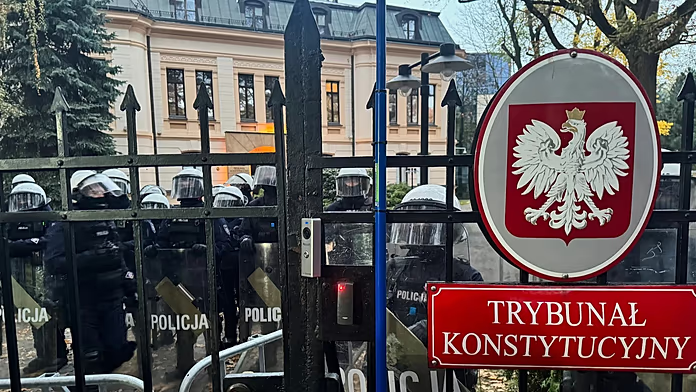
欧盟委员会周六表示,正在密切关注波兰宪法法庭周围的危机,此前周五晚间在法院大楼外发生的对峙通过电视直播播出。这一事件让持续十多年的争端再次受到关注。
“确保宪法法庭能够依据波兰宪法并尊重欧盟法院相关判例法运作,是波兰当局的责任,”欧盟委员会发言人周六对欧洲新闻台表示。
“任命宪法法庭八名新成员属于波兰议会——众议院的宪法权力,”该发言人补充道。
The European Commission said on Saturday it was closely monitoring the crisis surrounding Poland’s Constitutional Tribunal, following a confrontation outside the court building on Friday night that was broadcast live on television. The incident has brought renewed attention to a dispute that has been ongoing for more than a decade.“It is for the Polish authorities to ensure that the Constitutional Tribunal can function in accordance with the Polish constitution and in respect of the relevant case law of the Court of Justice of the European Union,” a Commission spokesperson told Euronews on Saturday.“The appointment of eight new members of the Constitutional Tribunal lies within the constitutional power of the Sejm, Poland’s parliament,” the spokesperson added.
欧盟委员会发言人还指出了欧洲人权法院的一项裁决,该法院于2026年5月5日发布临时措施,要求波兰主管当局“不得阻碍由众议院于2026年3月任命的法官履行和行使司法职责”。图斯克:“恢复平静不意味着接受无法无天”波兰总理唐纳德·图斯克周六晚间通过电视讲话向波兰民众发表讲话,这是他对这场危机作出的首次重大回应。
The Commission spokesperson also pointed to a ruling by the European Court of Human Rights, which on 5 May 2026 issued interim measures requiring the competent Polish authorities “to refrain from hindering the taking up and exercise of judicial duties by judges appointed by the Sejm in March 2026”.Tusk: “Restoring calm does not mean accepting lawlessness”Prime Minister Donald Tusk addressed Poles in a televised speech on Saturday evening, in his first major response to the crisis.
他将周五发生的事件称为“丑闻般的事件”,并表示希望此类场面在波兰永不重演。图斯克表示,恢复平静不能意味着接受无法无天或暴力,并誓言恢复独立司法和法治的条件。“一个民主国家必须强大,并有能力实施正义,”他补充道,誓言法治将战胜暴力。
He described Friday’s events as “scandalous incidents” and said he hoped such scenes would never be repeated in Poland. Restoring calm could not mean accepting lawlessness or violence, Tusk said, as he vowed to restore conditions for independent justice and rule of law.“A democratic state has to be strong and capable of enforcing justice,” he added, vowing that the rule of law would prevail over violence.
危机在周五晚间升级,当时总统卡罗尔·纳夫罗茨基试图在新法官任命僵持不下之际进入法庭大楼。随着对峙在电视上现场直播,警方包围了大楼,凸显了总统与政府在该国最高法院组成问题上日益加剧的对峙。
The crisis escalated on Friday night when President Karol Nawrocki attempted to enter the Tribunal building amid a deadlock over the appointment of new judges. Police surrounded the building as the confrontation unfolded live on television, highlighting the growing stand-off between the president and the government over the composition of the country’s top court.
图斯克政府表示,在法律与公正党多年干预司法之后,正在推进迟来已久的改革以恢复法治。反对派指责图斯克政府企图发动政变。欧洲保守派指责欧盟保持沉默欧洲保守派和改革主义者党团周六的联合主席谴责波兰政府的行动,称其违反法治,并支持纳夫罗茨基总统。
“图斯克政府的行动构成对法治的明显且严重的违反。我们谴责这种对司法独立和波兰宪法保障的攻击。没有任何政府凌驾于法律之上,”欧洲保守派和改革主义者党团联合主席尼古拉·普罗卡奇尼表示。
The Tusk government says it is pushing ahead with long-needed reforms to restore the rule of law after years of what it describes as interference in the judiciary by the Law and Justice (PiS) party. The opposition accuses Tusk’s government of attempting a coup. European conservatives accuse EU of silenceThe co-chairs of the European Conservatives and Reformists (ECR) group on Saturday condemned the Polish government’s actions, describing them as a violation of the rule of law, and backed President Nawrocki.“The Tusk government’s actions constitute a clear and grave violation of the rule of law. We condemn this attack on judicial independence and Poland’s constitutional safeguards. No government stands above the law,” ECR co-chair Nicola Procaccini said.
他补充说,欧洲机构“绝不能视而不见”,并表示尊重国家主权和司法独立必须始终是一项原则,“不受政治联盟影响”。该法庭的合法性已受到争议十余年。
He added that European institutions “must not avert their eyes” and said respect for national sovereignty and judicial independence must remain a matter of principle, “unaffected by political alliances”.The Tribunal’s legitimacy has been contested for more than a decade.
这场争端可追溯至2015年,当时执政的公民纲领党与反对党法律与公正党就任命五名法官一事发生冲突。此后,争端已演变为一场关于司法独立、法庭组成及其裁决效力的更广泛冲突。
The dispute dates back to 2015, when the then-governing Civic Platform and the opposition Law and Justice party clashed over the appointment of five judges. It has since developed into a wider conflict over judicial independence, the Tribunal’s composition and the authority of its rulings.