
日本央行发出信号,日本人口萎缩意味着实现整体消费支出强劲增长变得日益困难,这表明疲软的总消费本身可能并不意味着家庭需求正在恶化。
The Bank of Japan signaled that the shrinking of Japan’s population means that it’s increasingly difficult to achieve robust growth in overall consumer spending, suggesting that weak aggregate consumption by itself might not point to deteriorating household demand.
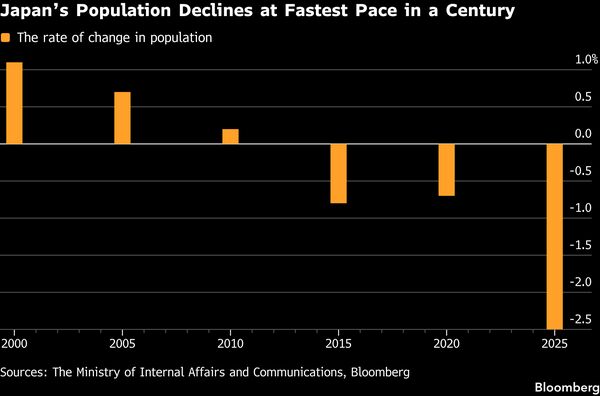
日本央行在周一发布的完整季度展望报告中表示:“从人口结构角度来看,应当注意到,首先,很难指望作为趋势的总私人消费实现强劲增长。具体而言,日本人口的降幅自2020年前后起一直在加速扩大。”总务省9月报告称,2025年日本人口较五年前减少了2.5%。这是自1920年有记录以来降幅最大的一次,速度约为2020年的三倍。
“From a demographic perspective, attention should be paid to the point that, to begin with, it is difficult to expect robust growth in aggregate private consumption as a trend,” the BOJ said in its full quarterly outlook report released Monday. “Specifically, the rate of decline in Japan’s population has been accelerating since around 2020.”Japan’s population fell 2.5% in 2025 from five years earlier, the Ministry of Internal Affairs and Communications reported in September. That was the fastest decline on record going back to 1920 and roughly three times the pace recorded in 2020.
私人消费约占日本经济的一半,其强弱是日本央行在权衡再次加息时的关键考量因素,市场普遍预期将在12月加息。日本央行行长植田和男领导的董事会上周维持利率不变,此前曾在9月加息。
Private consumption accounts for about half of Japan’s economy, making its strength a key consideration for the BOJ as it weighs another interest-rate increase, with a move widely expected in December. Governor Kazuo Ueda’s board stood pat last week after raising borrowing costs in September.
法国巴黎银行和第一生命经济研究所等机构预测,11月16日即将公布的第三季度GDP数据将显示消费支出下降。虽然这将是两年多来的首次下降,但日本央行的分析表明,仅凭这一降幅不一定足以表明疲软到足以阻碍进一步加息。
BNP Paribas and Daiichi Life Research Institute are among those forecasting a decline in consumer spending in third-quarter GDP data due on Nov. 16. While that would mark the first decline in more than two years, the BOJ’s analysis suggests the drop alone may not necessarily signal enough weakness to derail further rate hikes.
得益于持续复苏,日本经济规模已扩大至历史高位,但总消费支出仍低于疫情前水平。日本央行周一发布的估算有助于解释这一分歧:今年早些时候的人均消费比2015年高出约4%,而总消费几乎持平。
The size of Japan’s economy has expanded to a record high thanks to a sustained recovery, but aggregate consumer spending is still below pre-pandemic levels. The BOJ’s estimate released Monday helps explain that divergence: consumption per capita early this year was roughly 4% higher than in 2015, while aggregate consumption was almost flat.
这些数据凸显了在政策制定者评估经济时,区分由家庭需求恶化导致的疲软与仅仅源于人口萎缩导致的迟滞,其重要性日益凸显。日本央行将于12月18日公布下一次货币政策决定。
The figures underscore the growing importance of distinguishing between weakness caused by deteriorating household demand versus sluggishness stemming merely from a shrinking population as policymakers assess the economy. The BOJ delivers its next policy decision on Dec. 18.