
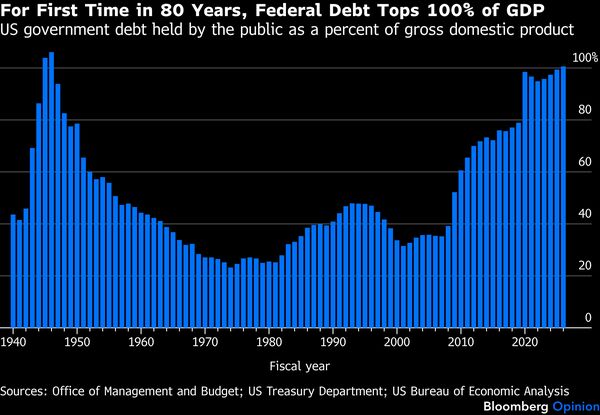
上周的美国国内生产总值报告,让一些本来就很清楚的事情更加明确。其一,联邦公众持有的债务,在刚结束的2026财年达到国内生产总值的100.6%,超过经济总量,这是自1946年以来的第一次。其二,尽管第三季度经济增长有所加快,但要实现减轻债务负担所需的持续增长步伐,还相去甚远,除非大幅增加税收、削减开支,或两者兼施。
Last week’s US gross domestic product report made a couple of things that were already pretty clear even clearer. One is that federal debt held by the public is, at 100.6% of GDP for the recently ended 2026 fiscal year, bigger than economic output for the first time since 1946. The other is that although economic growth picked up in the third quarter, we’re still a long way from the sustained pace required to reduce the debt load without major tax increases, spending cuts or both.
这不应成为绝望的理由——美国此前曾降低过巨额债务负担,尤其是二战结束后最为显著。但要再次做到,和过去一样,不能仅靠对增长的幻想。这种幻想主导了美国过去四分之一个世纪的财政政策,结果也并不意外。
This should not be reason for despair — the US has worked down big debt loads before, most notably following World War II. But doing so again will require, as it has in the past, more than just magical thinking about growth. Such magical thinking has dominated US fiscal policy for most of the past quarter century, with unsurprising results.
联邦债务突破国内生产总值100%这一门槛的意义尚有争议,但如果债务相对于经济规模不断上升,肯定会有一个点,让它对美国构成问题。从某种意义上说,这已经发生了:截至9月结束的财政年度,债务净利息占联邦支出的14%,并超过2万亿美元赤字的一半。
The significance of federal debt breaching the 100%-of-GDP threshold is debatable, but if debt keeps rising relative to the economy there is surely a point at which it becomes problematic for the US. In one sense it already has: net interest on the debt accounted for 14% of federal spending during the fiscal year that ended in September, and more than half the $2 trillion deficit.
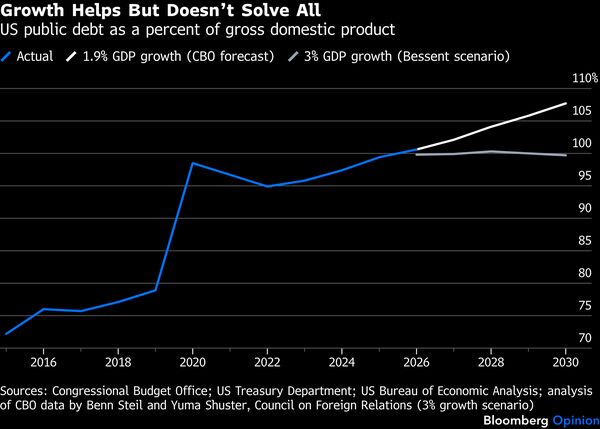
要扭转局面需要什么?“只要3%的增长,我们就能靠增长摆脱困境,”财政部长斯科特·贝森特去年9月表示,但这并不完全正确。受贝森特言论启发,外交关系委员会的本·斯蒂尔和尤马·舒斯特将国会预算办公室预测中使用的1.9%实际增长率替换为3%,发现这会使债务与国内生产总值比率稳定下来,但效果并不大。要真正开始减轻债务负担,需要持续3.5%到4%的增长。
What would it take to turn things around? “With 3% growth, we grow our way out of this,” Treasury Secretary Scott Bessent said in September, but that’s not quite right. Inspired by Bessent’s remark, Benn Steil and Yuma Shuster of the Council on Foreign Relations replaced the 1.9% real growth rate used in Congressional Budget Office projections with 3% and found that it caused the debt-to-GDP ratio to stabilize but not much more than that. It would take sustained growth of 3.5% to 4% to really start to put a dent in the debt burden.
虽然第三季度经济确实以年化3.4%的速度扩张,但这只是一个季度,季度GDP数据往往受到出口和进口等方面的会计特殊因素以及其他偶然事件的影响。衡量过去四个季度的增长能更好地反映趋势,即便在一场历史性的科技投资热潮中,这一数字也仅为2.1%。自唐纳德·特朗普总统第二任期开始以来,增长率要么是年化2.7%,要么是2.3%,具体取决于你是从他上任后的第一个季度还是前一个季度开始计算。
While the economy did expand at a 3.4% annualized pace in the third quarter, that’s just one quarter, and quarterly GDP numbers tend to be affected by accounting quirks around exports and imports and other one-offs. Measuring growth over the past four quarters gives a better sense of the trend, and even amid a technology investment boom of historic proportions it’s just 2.1%. Since the start of President Donald Trump’s second term growth has been either 2.7% or 2.3% annualized, depending whether you measure from his first quarter in office or the quarter before.
长期增长预测还必须考虑拖低平均水平的经济衰退,而在过去10年(包括深度但非常短暂的疫情衰退)中,年化增长率为2.5%。过去25年,这一数字为1%。
Long-run growth projections also have to take into account recessions that drag down the averages, and over the past 10 years, which includes the deep but very brief pandemic downturn, annualized growth was 2.5%. Over the past quarter century it was 1%.
当然,也存在乐观情景,即生成式人工智能提高生产率,从而推动增长加速。但目前这些仍只是情景,任何对人工智能驱动的生产率革命的现实看法都必须包括这样一种可能性:它至少会暂时让大量人失业,导致联邦税收下降、支出增加,并且很可能在某个时点伴随股市崩盘,因为科技投资热潮几乎总是如此。1929年股市崩盘和大萧条发生在美国有史以来最大的生产率繁荣时期。
There are, of course, optimistic scenarios where growth accelerates because generative artificial intelligence makes us more productive. But they are at this point still scenarios and any realistic view of an AI-driven productivity revolution has to include the possibility that it will at least temporarily throw lots of people out of work, causing federal tax revenue to drop and spending to increase, and probably be accompanied at some point by a stock market crash, because tech-investment booms almost always are. The Crash of 1929 and Great Depression came amid the greatest productivity boom the US has ever seen.
从积极的一面来看,在大政府时代(始于第二次世界大战)期间,美国曾有两次成功大幅降低联邦债务占GDP的比重。经济增长在两次中都发挥了重要作用,但财政政策也让收入和支出更加平衡。
On a more positive note, there have been two episodes in the era of big government (which starts with World War II) where the US did succeed in substantially reducing the federal debt as a share of GDP. Economic growth played a big role in both, but so did fiscal policies that brought revenue and spending more closely in line.
二战后的时期算得上是经济增长中削减债务的最佳情景。1946财年(该财年于1946年6月结束;美国直到20世纪70年代才改用目前这种9月结束的财年日历),公众持有的债务达到GDP的106.1%,创下纪录。此后几年,政府实现了巨额盈余,偿还了部分债务,但在20世纪50年代和60年代,多数年份都出现赤字,债务的美元价值随之上升。
The post-World War II era is sort of the best-case scenario for debt reduction in a growing economy. Debt held by the public reached a record 106.1% of GDP in the 1946 fiscal year (which ended in June 1946; US fiscal years switched to their current ending-in-September calendar in the 1970s). For a couple of years after that, the government generated big surpluses and paid down some of the debt, but in the 1950s and 1960s it ran deficits most years and the dollar value of the debt rose.
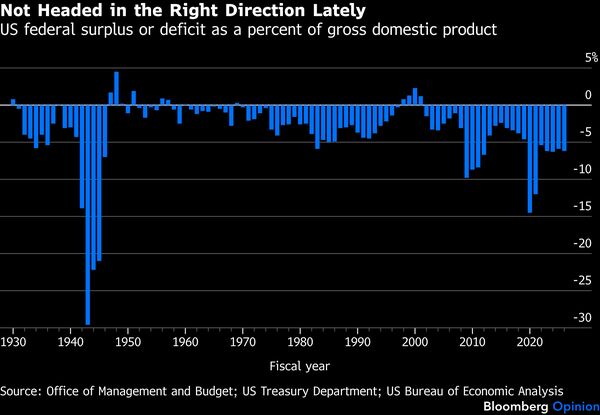
经济快速增长是债务占GDP比重持续下降的关键,但同样关键的是赤字规模并不大——1947年至1974年间,财政收支平均为GDP的-0.4%,债务与GDP之比正是在这一时期触底。而在2026财年,这一比例为-6.2%。
Rapid economic growth was key to the debt’s continued decline as a share of GDP, but so was the fact that the deficits just weren’t very big, with the fiscal balance averaging -0.4% of GDP from 1947 to 1974, when the debt-to-GDP-ratio bottomed out. In fiscal 2026, it was -6.2%.
1947年至1974年间,政府并没有真正收缩——按通胀调整后计算,联邦支出增长了两倍,占GDP的比重从16.1%升至17.8%。但政府收入增长几乎同样快。同样,经济增长是关键,税收政策也是关键。根据财政部2013年对1940年以来重大税收立法的一份极有价值的梳理,1947年至1974年间,增税的次数多于减税。而且随着20世纪60年代通胀开始抬头,政府还从所得税税档未与生活成本挂钩中获益——这是一种变相提高税率的手段,最终随着1981年《经济复苏税法》的出台而(理应)寿终正寝。
The government didn’t exactly shrink from 1947 to 1974 — in inflation-adjusted terms federal spending tripled, and it went from 16.1% of GDP to 17.8%. But government revenue rose almost as fast. Again, economic growth was key, but so was tax policy. The period from 1947 through 1974 saw more tax increases than decreases, according to an invaluable 2013 Treasury Department accounting of major tax legislation since 1940. And as inflation began to pick up in the 1960s the government also reaped the benefits of not having income tax brackets indexed to the cost of living, a surreptitious means of increasing tax rates that finally met its (deserved) demise with the Economic Recovery Tax Act of 1981.
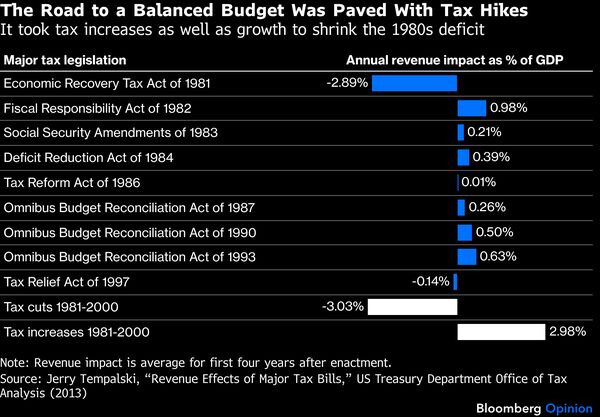
该法又称里根减税法案,人们对它的记忆各不相同:有人视之为破坏预算的灾难,也有人视之为新时代增长的驱动力。两种说法都有一定道理,但很少有人提到的是,1981年减税之后,1982年、1983年、1984年、1986年(勉强算得上;当年的《税制改革法》本应是收入中性的)、1987年、1990年和1993年又相继增税。
That law, also known as the Reagan tax cuts, is remembered variously as a budget-busting disaster and the driver of a new era of growth. There’s some truth to both portrayals, but what doesn’t come up nearly enough is that the 1981 tax cuts were followed by tax increases in 1982, 1983, 1984, 1986 (just barely; that year’s Tax Reform Act was supposed to be revenue-neutral), 1987, 1990 and 1993.
部分得益于冷战结束,国会在20世纪90年代也能够削减支出增长,联邦支出占GDP的比重从1991年的21.7%下降到2000年和2001年的17.7%。结果是:连续四年出现预算盈余,债务与GDP之比从1993年的47.9%降至2001年的31.5%。
Thanks in part to the end of the Cold War, Congress was also able to reduce spending growth in the 1990s, with federal outlays falling from 21.7% of GDP in 1991 to 17.7% in 2000 and 2001. The result: four straight years of budget surpluses, and a debt-to-GDP ratio that fell from 47.9% in 1993 to 31.5% in 2001.
此后,联邦支出占GDP的比重开始再次上升(2026财年为22.9%),而国会开始批准一次又一次的减税。这不可持续。我的同事、彭博社观点专栏作家艾莉森·施雷格上周提出了一些削减支出增长的想法。在税收方面,最具经济合理性的做法将是:对企业和富人实施适度的税率上调和漏洞堵塞,同时引入适度的全国性消费增值税。这在政治上可行吗?类似的事情在本国历史上曾出现过。
After that federal spending’s GDP share began to rise again (it was 22.9% in fiscal 2026), while Congress began approving tax cut after tax cut. That’s not sustainable. My fellow Bloomberg Opinion columnist Allison Schrager offered some ideas last week for reducing spending growth. On taxes, the most economically sensible approach would mix modest rate increases and loophole-elimination for corporations and the wealthy with the introduction of a modest national value-added tax on consumption. Is that politically feasible? Similar things have been in this nation’s past.