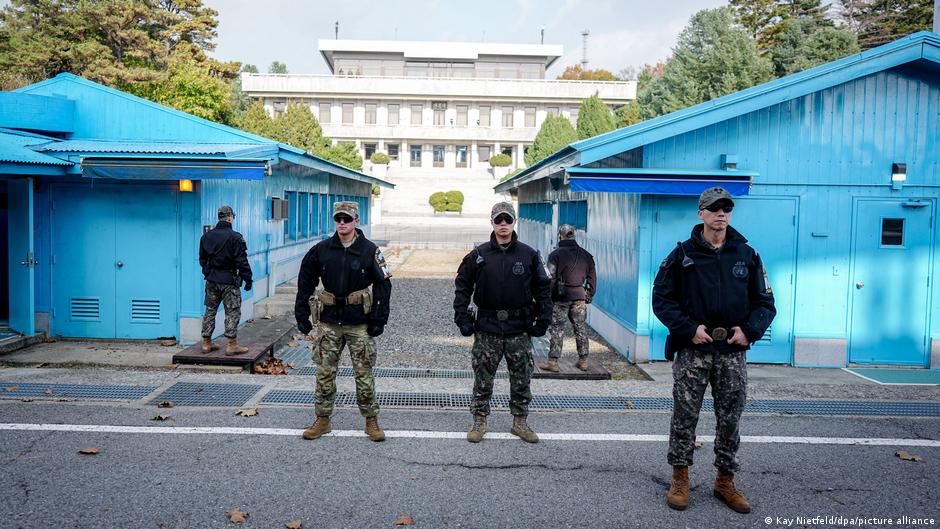
德国与韩国一样,曾是一个因敌对政治制度和世界上防御最严密的边境之一而分裂的国家。默茨总理在最近的访问中表达了对韩国统一的愿望——但这种希望似乎渺茫。
Germany, like Korea, was once a nation divided by rival political systems and by one of the world's most fortified borders.
韩国政府官方仍在追求统一,但年轻一代的态度已发生转变。南北韩的故事——两个拥有共同历史、语言和大部分文化遗产的敌对国家——对德国人来说听起来非常熟悉。他们自己的国家曾因对立政权而分裂数十年,直到地缘政治风向转变,使东西德于1991年和平统一。仅两年后,时任德国总理科尔访问朝鲜半岛的非军事区(DMZ),并表达了希望南北韩也能在本世纪末实现统一的愿望。
Chancellor Merz wished for a united Korea during his recent visit — but such hopes seem faint. Prefer DW on Google The South Korea government officially still pursues reunification, but the younger generations' attitudes have shifted The story of South and North Korea— two rival nations that share history, language and much of their cultural heritage — sounds very familiar to Germans Their own country spent decades divided by opposing regimes until geopolitical winds shifted and allowed East West Germany reunite peacefully in 1991 Just two years later, Germany's then-Chancellor Helmut Kohl visited the Demilitarized Zone (DMZ) on the Korean Peninsula and expressed hope that South North Korea will also be reunited by the end of the decade.
他的愿望从未实现。自德国实现统一梦想以来已过去约35年,首尔和平壤依然因政治制度、经济及其地缘政治同盟关系而深度对立。德国总理和总统访问亚洲 要观看此视频 ,请 在周五眺望将两个韩国国家分隔开的非军事区(DMZ)时,现任总理弗里德里希·默茨只能重申科尔1993年已表达过的愿望。
His hopes never materialized. Some 35 years since Germany achieved its dream of reunification, Seoul and Pyongyang are still bitterly divided by political systems, economy, and their geopolitical alliances German chancellor and president tour Asia To view this video , and Overlooking the Demilitarized Zone (DMZ) that separates the two Korean states on Friday, current Chancellor Friedrich Merz could only rethread the wishes already stated by Kohl in 1993.
“我们德国人知道一个国家分裂是多么痛苦,”默茨在社交媒体分享的留言中表示。“我们也知道,谁坚守价值观并有对话的勇气,就能推倒墙壁。”“我们祝愿韩国人民在自由中实现统一,”默茨补充道。
"We Germans know how painful the division of a country is," Merz stated in a message shared on social media. "We also know that whoever stands firm in their values and has the courage for dialogue can tear down walls." "We wish the people in Korea unity in freedom," Merz added.
对于关注日常朝韩关系的分析人士来说,这听起来像是一个遥远的梦想。
To analysts following the day-to-day inter-Korean politics, this sounds like a distant dream.
年轻韩国人质疑“为何要费心”统一 当两韩继续在非军事区上警惕地注视彼此时,它们在财富和政治自由方面的巨大差异清晰展露无遗。但最大的单一问题可能在于,双方似乎都不想要统一。
Young Koreans ask 'why bother' with reunification As two Koreas continue to eye each other warily over the DMZ, their dramatic differences in wealth and political freedom are clearly on display. But the biggest single issue might be that neither side appears to want reunification.
“过去几十年里,这种感觉发生了变化,”庆熙大学外交政策教授朱在宇(Choo Jae-woo,音译)说。“年轻一代韩国人只是把朝鲜看作碰巧在我们隔壁的另一个国家,又穷又具威胁,他们不像老一辈那样对它有任何感情依恋。”“越来越多的人在问,为什么要费心去管统一,”他补充道。
"The feeling has changed in the last couple of decades," said Choo Jae-woo, a professor of foreign policy at Kyung Hee University. "Younger South Koreans just see the North as another country that happens to be next to us, is poor and threatening and they have no sentimental attachment to it, like older generations do." "More and more people are asking why they should bother about reunification," he added.
首尔国立大学和平与统一研究院9月的一项研究显示,39.1%的韩国人认为统一不可能,这是该调查二十多年前启动以来的最高比例。
Why Kyiv and Seoul are clashing over North Korean POWs A study by Seoul National University's Institute for Peace and reunification in September indicated that 39.1% of South Koreans believed reunification was impossible, the highest proportion since the survey was started some two decades ago.
许多人担心,建设朝鲜的基础设施——包括道路、医院、学校以及一个现代化运转社会所需的一切——将耗费巨额资金。
Many were concerned about the vast amounts of money it would take to build the North's infrastructure, including roads, hospitals, schools and all other requirements for a modern functioning society.
官方层面上,韩国政府并未放弃将统一作为国家目标。其宪法仍要求基于自由和民主实现和平统一,但朱在宇指出,近届政府宣扬这一理念的频率远低于过去。
Officially, the South Korean government has not abandoned reunification as a national objective. Its constitution still calls for peaceful union based on freedom and democracy, but Choo points out recent governments are promoting the idea far less frequently than in the past.
朝鲜明确释放反统一信号 然而,朝鲜在表明立场方面绝不像韩国那样含蓄。
North Korea's clear signal against unity The North, however, has not been nearly so reticent about where it stands on the matter.
“2023年12月,朝鲜领导人金正恩宣布正在修改宪法,和平统一已不再可能,”朱在宇说。“相反,韩国将被视为敌对竞争对手,他不再有任何意图将两国融合在一起。”修订后的朝鲜宪法于2026年3月获批,金正恩政权已大力清除所有关于和解与民族统一的表述。
"In December 2023, North Korean leader Kim Jong Un announced that the constitution was being changed and that peaceful reunification was no longer possible," said Choo. "Instead, South Korea would be seen as a hostile rival and that he no longer had any intention of bringing the two together." The revised North Korean constitution was approved in March 2026 and Kim's regime has moved aggressively to scrub all references to reconciliation and national unity.
“我认为朝鲜不可能再把话说得更清楚了:它无意与韩国走得更近,”首尔韩国外国语大学政治学与国际关系学教授梅森·里奇表示。他补充说,当韩主导的统一议题出现时,韩国的分析人士、官员和普通民众都会“翻白眼”。
"I do not think the North can make it any clearer that it has no intention of getting any closer to South Korea," said Mason Richey, a professor of politics and international relations at Hankuk University of Foreign Studies in Seoul. He added that analysts, officials and ordinary Koreans in the South "roll their eyes" when the issue of Korean reunification crops up.
他还指出,除了双方都缺乏意愿之外,还有一系列额外的挑战需要克服。
Beyond the lack of desire on both sides, there are a number of additional challenges that would need to be overcome, he added.
朝鲜政权希望维护自身的权力和威望,如果为统一国家引入民主制度,这些必然会受到威胁。
The North Korean regime wishes to protect its own power and prestige, which would inevitably be under threat if a democratic system was introduced for a unified nation.
里奇说,弥合巨大的经济发展鸿沟将是一项浩大的工程,即使有外部援助,也会给韩国带来巨大压力。虽然统一后的德国已能使其各地区达到相对可比的水平,但值得注意的是,1990年的东德仍比今天的朝鲜发达得多。德国的Z世代仍感受到东西部鸿沟吗?
Bridging the enormous economic development gap would be a huge undertaking that would put immense pressure on the South, Richey said, even if outside assistance was forthcoming. And while a united Germany has been able to bring its regions to relatively comparable levels it is worth noting that East Germany in 1990 was still substantially more developed than North Korea is today. Does Germany's Gen Z still feel the East-West divide?
统一韩国将给美中带来重大问题 根据韩国央行2024年统计,朝鲜名义国内生产总值(GDP)为每年317亿美元。韩国则为每年1.85万亿美元,规模大58倍。朝鲜人口约为韩国的一半,因此朝鲜人均GDP仅为1230美元(约合1097欧元),而韩国接近3.6万美元。
United Korea would pose major issues for US and China Nominal GDP in North Korea is $31.7 billion a year. In the South, it is $1.85 trillion a year, or 58 times bigger, according to Bank of Korea statistics for 2024. With North Korea having roughly one-half population size of the South, the GDP per capita in the North is just $1,230 (€1,097) against nearly $36,000 in the South.
朱教授指出,统一不仅仅是一个国内问题。这两个国家在战略和安全忠诚上存在分歧,韩国与美国结盟,朝鲜则与中国结盟,并日益与俄罗斯走近。为何一座新的俄朝公路大桥令乌克兰担忧 “这些超级大国不会想为了统一而放弃其盟友,因为这对它们来说也是一个重大的战略问题,”朱教授对德国之声表示。“美国不希望看到一个倾向中国的统一朝鲜,而如果统一意味着美军能部署在目前朝鲜领土上、即中国边境,北京将抵制统一。这对任何一方来说都是无法想象的。”
Professor Choo points out that reunification would not just be a domestic issue. The two nations have divided strategic and security loyalties, with the South allied to the US the North tied to China and increasingly, Russia Why a new Russia-North Korea road bridge worries Ukraine "Those superpowers would not want to give up their ally for reunification as it would be a major strategic issue for them as well," Choo told DW. "The US would not want a united Korea that leaned towards China and Beijing would resist reunification if it meant the US could have its military on the Chinese border in what is presently North Korea. That's just impossible for either side to imagine."
他最终表示,半岛目前的现状或许是一个不完美的解决方案,但却是维护地区稳定的最佳方式。然而,十年后,经济、社会和安全形势可能发生根本性变化,“这就是为什么我们永远不能说‘绝无可能’,”他补充道。
Ultimately, he said, the present status quo on the peninsula may be an imperfect solution, but it is the best way of preserving regional stability. A decade into the future, however, the economic, social and security situations may have radically altered, "and that is why we can never say never," he added.