作者马克·贡戈洛夫(Mark Gongloff)指出,“你可能不相信气候变化,但你的保险公司相信”是关于气候变化的常见笑话。因为显而易见,在气象灾害发生后支付理赔金的公司非常清楚,地球变得越来越热、越来越混乱。遗憾的是,知识并不等同于智慧。
By Mark Gongloff“You might not believe in climate change, but your insurance company does” is a common joke about climate change. Because obviously the companies that pay claims after weather disasters are well aware the planet has grown hotter and more chaotic. Sadly, knowledge isn’t the same thing as wisdom.
在过去几周里,一唱一和的行业内部人士纷纷发出警告:在应对全球变暖的长期后果时,保险公司可能和最懵懂的否定者一样目光短浅。这些吹哨人警告称,为了眼前的短期利润,保险公司正在牺牲其客户、地球乃至最终他们自己的未来福祉,其行为呼应了2008年金融危机前抵押贷款放贷机构的做法。尽管这不会同时再次把所有的钱付之一炬,但其后果依然可能是可怕的。
In the past few weeks, a chorus of industry insiders has gathered to warn that insurers can be just as myopic about the long-term consequences of global heating as the most oblivious denier. For short-term profits, insurance companies are sacrificing the future well-being of their customers, the planet and ultimately themselves, these whistleblowers warn, with behavior echoing that of mortgage lenders before the 2008 financial crisis. Though this won’t simultaneously set all of the money on fire again, the repercussions can still be dire.
“这对保险公司来说或许是一次成功的短期财务操作,但不可持续,”前加利福尼亚州保险专员戴夫·琼斯(Dave Jones)告诉我。“对实体经济和金融部门而言,这是一场灾难。”
“This may be a successful short-term financial play for insurers, but it’s not sustainable,” former California Insurance Commissioner Dave Jones told me. “For the real economy and the financial sector, it’s a disaster.”
这场合唱于10月14日拉开序幕,当时一名“大型保险公司”的风险评估师为《卫报》(Guardian)撰写了一篇匿名评论文章,文中写道:“我面临压力,要削减我对灾害将造成损失的预测,以使保险更负担得起——并让我的雇主获得更多业务。”作者补充道:“如果这种情况发生在我的公司——它正努力与竞争对手的价格抗衡——那么它也正发生在别处。”
The chorus warmed up on Oct. 14, when a risk assessor for a “major insurer” wrote an anonymous op-ed for the Guardian that said, “I am coming under pressure to cut my forecasts for the losses that disasters will cause in order to make insurance more affordable — and get my employer more business.”The writer added, “If this is happening at my firm, which is struggling to compete with rivals’ prices, it’s happening elsewhere.”
同一天,来自欧洲和英国的数十位高级保险高管在非营利组织Inside Track发布的一份报告中警告称:“自然灾害建模师和精算师被要求对未来预测‘砍一刀’或‘压低数字’,以免引起恐慌并维持交易达成。”他们讲述了保险公司对待气候风险采取两极分化做法:在方便招揽业务时无视风险,而在损失开始显现时却以此为借口提高保费或退出市场。在此过程中,他们让客户、投资者和政府对这些风险知之甚少、准备不足。他们也在拉大保险保障与即将到来的灾难性损失之间的差距。
That same day, dozens of high-level insurance executives from Europe and the UK warned in a report published by the nonprofit group Inside Track that “natural catastrophe modelers and actuaries are being asked to give a ‘haircut’ to future projections or ‘manage down the numbers’ in order to avoid causing alarm and to keep getting deals done.”They told of insurers taking an all-or-nothing approach to climate risks, ignoring them when convenient to attract business but using them as an excuse to raise premiums or retreat from markets when the losses start to bite. In the process, they’re leaving customers, investors and governments ill-informed about and ill-prepared for those risks. They’re also widening the gap between insurance coverage and the catastrophic damage to come.
随后,就在上周,《金融时报》采访了五位保险业内人士,他们证实了这些警告,并表示他们经常被迫在模型中篡改数据以维持较低的保费。“有些人认为这些模型很荒谬,”一位“排名前五”的保险经纪公司的匿名“资深专业人士”对该报表示,潜在灾难“不会发生”。“这是一个250年一遇的事件,所以让我们把交易敲定吧。让我们达成短期目标。”
Then, last week, the Financial Times interviewed five insurance insiders who confirmed these warnings, saying they’re often forced to fudge numbers in their models to keep premiums low. “There are some people who think the models are silly,” an unidentified “senior professional” at “top-five” insurance broker told the paper, and potential disasters are “not going to happen.”“It’s a one-in-250-year event, so let’s get the deal done. Let’s hit the short-term targets.”
如果这听起来有点像房地产泡沫时期“只要能喘气就能拿到房贷”的日子——当时长期存在的目光短浅导致世界面临惨烈的崩盘,随之而来的是近十年的经济苦难——好吧,这是有充分理由的。
If this sounds a bit like the “fog a mirror, get a mortgage” days of the housing bubble, when chronic short-termism set the world up for a brutal crash followed by nearly a decade of economic misery, well, there’s good reason.
“如果没有干预,这些实体风险将转化为重大经济风险,”《内幕消息》(Inside Track)的作者们写道。“抵押贷款市场的破坏引发了全球金融危机——随着气候影响加剧,我们担心无保险的高风险物业的大幅增加可能会以类似的方式显现。”
“Without intervention these physical risks will translate into major economic risk,” the Inside Track authors wrote. “The undermining of the mortgage market drove the Global Financial Crisis — we are worried a major increase in uninsured, high-risk properties could manifest in a similar way as climate impacts intensify.”
多年来一直研究保险公司行为的加州西部法学院教授肯尼斯·克莱因(Kenneth Klein)对我说,这些业内人士主要描述的是欧洲和英国的情况,但没有理由怀疑这个问题是全球性的。“没有人向上调整他们的承保预测。他们每个人都在做同样的事情。”这种行为的一个危险后果是,美国各地数百万家庭缺乏针对潜在气候灾难的充足保险。
These insiders were mostly describing conditions in Europe and the UK, but there’s no reason to doubt the issue is global, Kenneth Klein, a professor at California Western School of Law who has studied insurer behavior for many years, told me. “Nobody is adjusting their coverage predictions up. Every one of them is doing the same thing.”One dangerous result of this behavior is that millions of homes across the US lack adequate insurance against potential climate disasters.
在抵押贷款危机期间树立声誉的投资者戴夫·布尔特(Dave Burt)估计,仅野火和洪水的保险缺口就可能高达2.7万亿美元。据保险信息研究所(Insurance Information Institute)的数据,这还不包括强对流风暴(又称雷暴)可能造成的损失,气候变化使这类风暴威力大增,使其成为过去三年中美国最大的保险损失来源。
Investor Dave Burt, who made his reputation during the mortgage crisis, has estimated the insurance gap for wildfires and floods alone could be as wide as $2.7 trillion. That doesn’t include potential losses from severe convective storms, aka thunderstorms, which climate change has put on steroids, making them the biggest source of insured losses in the country for the past three years, according to the Insurance Information Institute.
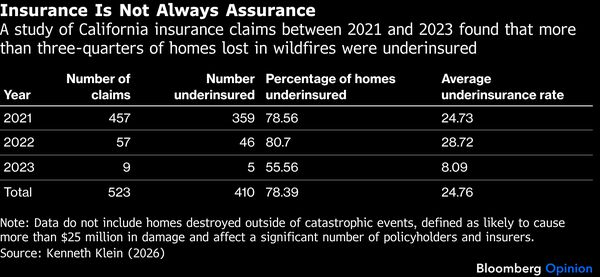
在《刘易斯与克拉克法律评论》近期发表的一篇论文中,克莱因对加利福尼亚州的野火损失数据进行了深入分析,发现该州78%的房屋在遭受灾难时可能会面临保额不足的问题,平均占房屋重置成本的25%。换句话说,一个试图用保险理赔金重建一套价值80万美元的加州房屋的人,很可能会发现自己有20万美元的资金缺口。
In a recent paper in the Lewis & Clark Law Review, Klein crunched California wildfire-loss data and found that 78% of homes in the state could be underinsured in the event of a disaster, by an average of 25% of the home’s replacement cost. Somebody trying to rebuild an $800,000 California home with insurance money could well find themselves $200,000 in the hole, in other words.
克莱因还发现,保险公司的模型和行为是造成这种保额不足的主要推手。如果这种情况正在加州发生,那么它在任何地方也都在发生。事实上,克莱因先前的研究表明,全美80%的房屋可能都存在保额不足的问题。在规模达55万亿美元的房地产市场中,这一比例让人看到了危机爆发的可能。
Klein also found that insurer models and behavior were the primary drivers of this underinsurance. And if it’s happening in California, then it’s happening everywhere. Indeed, Klein’s previous research has suggested 80% of American homes may be underinsured. That percentage of a $55 trillion housing market gives you crisis-level potential.
对金融市场而言的好消息是,并非所有这些房主会同时意识到他们的保险缺口。这种令人不快的发现通常在野火和飓风等灾难发生后,以相对较小的规模分批出现。正是在那个时候,房主们才会发现他们的保险无法涵盖房屋的全部重置成本,从而导致他们要么无家可归,要么不得不自掏腰包承担剩余费用。
The good news for financial markets is that not all of these homeowners will recognize their insurance shortfall at once. This unpleasant discovery usually comes in relatively small batches around catastrophes such as wildfires and hurricanes. That’s when homeowners find out their insurance won’t cover the full replacement cost of their house, leaving them either homeless or on the hook for the rest.
根据费城联邦储备银行2023年针对加州野火的一项研究,对于保险公司而言,这种情况通常结果相当不错,它们压低保额的估算有40%的接受率。对于那些被压低估价的房主来说,结果就没那么美妙了,他们的赔偿金最终比房屋价值少了20万至30万美元。研究还显示,这对抵押贷款放贷机构来说同样不是好消息,受火灾破坏的房产使其抵押贷款逾期率上升了4%,提前还款率上升了16%(从而损失了未来的利息收入)。
This typically works out pretty great for insurance companies, which enjoy a 40% acceptance rate for lowball estimates, according to a 2023 Philadelphia Federal Reserve study of California wildfires. It’s not so great for the lowballed homeowners, who ended up $200,000 to $300,000 short of the value of their homes. It’s also not great for mortgage lenders, who saw 4% higher delinquencies and 16% higher mortgage prepayments (costing them future interest income) on fire-damaged properties, according to the study.
起诉保险公司的房主通常会接受低于其诉求的和解金额。而诉诸法庭的相对少数人也并不总能在法庭上胜诉,法庭往往认定他们未能获得充足的保障应由自身负责。与此同时,佛罗里达州及其他地区的保险公司和同情他们的政客仍在不断试图增加房主起诉的难度。
Homeowners who sue insurers usually settle for less than they demand. And the relative few who go to trial won’t always win in courts, which tend to hold them responsible for not having enough coverage. Meanwhile, insurers and sympathetic politicians in Florida and elsewhere keep trying to make it harder for homeowners to sue.
在另一个极端,尽管保险公司据称在低估灾害模型,但它们也在全国范围内大幅提高保费,这给住房负担能力造成了压力,尤其是在风险较高的地区,或者干脆彻底撤出这些地方。这两种看似矛盾的行为能够共存,部分原因在于保险合同的期限只有一年。保险公司面临着压低保费并尽可能让客户续保的政治和商业压力,但在任何特定年份,它们都可以认定风险已经变得过高并打出灾难牌。
At the other extreme, even as they’re allegedly lowballing catastrophe models, insurers are also jacking up premiums across the country, straining housing affordability, particularly in riskier locales, or abandoning those places altogether. These two seemingly contradictory behaviors can coexist partly because insurance contracts last only a year. Insurers are under political and business pressure to quash premiums and keep customers renewing as long as possible, but in any given year they can decide the risk has become too great and play the disaster card.
再次强调,房主和政府付出了最终代价,这是利润私有化、损失社会化的一个典型例子,也是房地产泡沫的又一个回音。
Again, homeowners and governments pay the ultimate price in a classic example of privatizing profits and socializing losses, another housing-bubble echo.
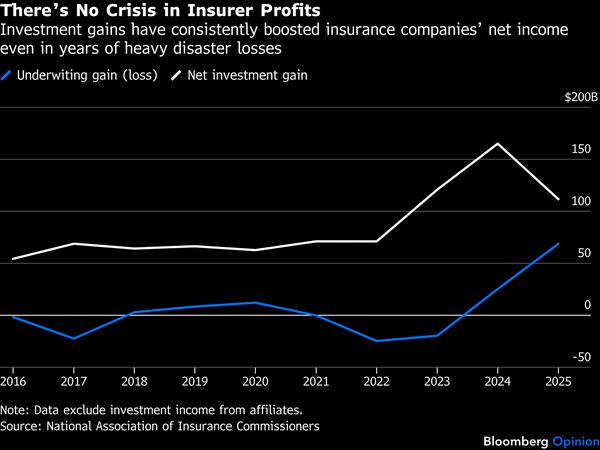
事实上,尽管灾害成本不断上升,但保险行业一直设法获得了巨额利润。即使在某些年份承保亏损严重打击了业绩,投资回报仍然足以抵消这些亏损,从而将净利润推至创纪录水平。根据全美保险监督官协会的数据,仅美国财产和意外险保险公司去年从投资中就净赚了1116亿美元。
In fact, despite rising disaster costs, the insurance industry has consistently managed to rack up big profits. Even when underwriting losses have bitten hard in some years, investment returns have still more than offset them, boosting net income to record levels. US property and casualty insurers alone netted $111.6 billion from investments last year, according to National Association of Insurance Commissioners data.
其中一些投资包括那些主要应为气候变化负责的化石燃料公司,气候变化正以越来越快的速度摧毁受保财产。抛售这些投资,以及任何为石油和天然气开采提供承保的业务,将是解决日益严重的保险危机的一个好的开始。保险公司不应该向最高法院提交法庭之友陈述书来为大石油公司针对气候诉讼进行辩护,而应该起诉这些公司以追回灾难损失。
Some of those investments include the very fossil-fuel companies that are primarily responsible for the climate change destroying insured properties at a quickening pace. Dumping these investments, along with any business underwriting oil and gas extraction, would be a good start toward fixing the growing insurance crisis. Instead of writing amicus briefs to the Supreme Court defending Big Oil against climate lawsuits, insurers should be suing those companies to recoup disaster losses.
保险公司通过投资加固房屋以抵御灾害,也将有助于自身、房主和经济。琼斯指出,北卡罗来纳州的最后手段保险公司(insurer of last resort)树立了一个好榜样,它将部分收益用于加固屋顶。与此同时,如果保险公司的黑箱模型是公开的,被篡改的模型就不会成为问题,加利福尼亚州已经开始努力实现这一点。
Insurers would also help themselves, homeowners and the economy by investing in hardening homes against disasters. North Carolina’s insurer of last resort sets a good example by dedicating some of its earnings to fortifying roofs, Jones noted. Meanwhile, the problem of insurers’ black-box models being fudged wouldn’t be a problem if those models were public, something California has started trying to make happen.
正如科罗拉多州最近所做的那样,可以通过强制提供扩大承保范围的选项来解决保险不足的问题。而且,在未来某个假设的世界里,如果美国政府相信并关心不断加剧的气候破坏,房利美(Fannie Mae)和房地美(Freddie Mac)就可以拒绝为没有足够保障的房产提供抵押贷款担保。
The underinsurance problem could be addressed by mandating extended-coverage options, as Colorado has done recently. And, in a hypothetical future world where the US government believes in and cares about rising climate damage, Fannie Mae and Freddie Mac could refuse to back mortgages on properties that didn’t have enough coverage.
严酷的现实是,在许多地方,随着地球变得越来越热,保险只会变得越来越昂贵。甚至一些行业高管也警告称,营利性保险公司减缓气候风险的传统框架可能已不再适用。取代它既不容易,成本也不低。但用短期的痛苦换取长期的收益是明智的。
The hard truth is that, in many places, insurance will just keep getting more expensive the hotter the planet gets. Even some industry executives have warned that the traditional framework of for-profit insurance companies mitigating climate risks may no longer be fit for purpose. Replacing it won’t be easy or cheap. But there’s wisdom in trading short-term pain for long-term gain.