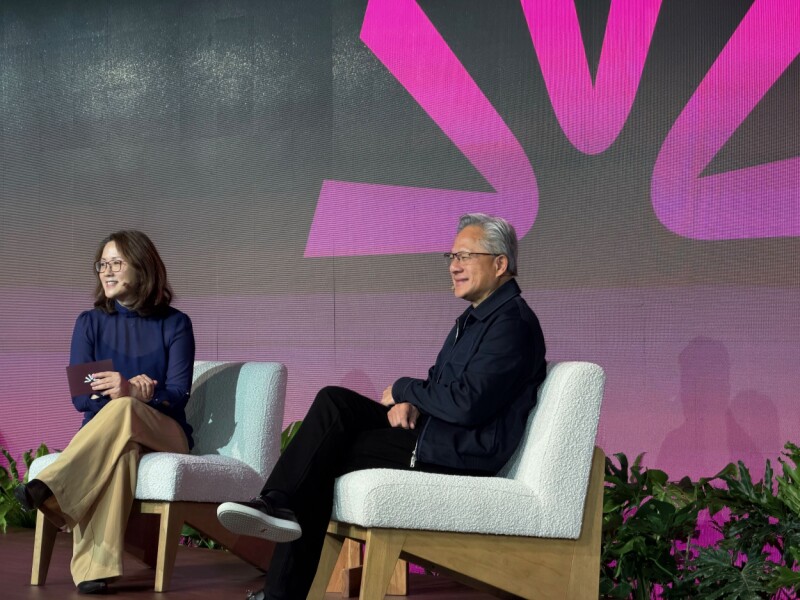
英伟达似乎并不在意开源模型还是闭源模型最终胜出,只要其硬件在为基础设施提供动力即可。“我们喜欢闭源模型,”首席执行官黄仁勋表示。“闭源前沿模型在世界上占有一席之地。但世界上有太多好的想法……认为我们所有人都将基于通用智能这一想法是不合逻辑的。”
Nvidia doesn't seem to care whether open or closed models win out as long as its hardware is powering the infrastructure. "We love closed models," CEO Jensen Huang said. "There's a solid place in the world for closed frontier models.
周二,黄仁勋在旧金山举行的 Fireworks.ai Forge 活动上与该公司首席执行官兼创始人林乔对话。他不愿将英伟达的云客户——这些客户帮助交付 Anthropic 和 OpenAI 的专有 AI——推向即将到来的开源模型浪潮之下。但自 7 月以来,黄仁勋为开放权重模型辩护,以抵制 Anthropic 和 OpenAI 高层的保护主义压力,他认识到更实惠、锁定程度更低的 AI 服务在经济和战略上的吸引力。
But the world has so many good ideas … The idea that all of us would be based on general intelligence is not logical." Speaking with Lin Qiao, CEO and founder of Fireworks.ai, at the company's Forge event in San Francisco on Tuesday, Huang wasn't ready to throw Nvidia's cloud customers, which help deliver the proprietary AI of Anthropic and OpenAI, under the onrushing open model bus. But having come to the defense of open weight models in July to push back against protectionist pressure from the leadership of Anthropic and OpenAI, Huang recognizes the economic and strategic appeal of AI services that are more affordable and less locked-in.
他表示,世界上大部分价值蕴含在专用智能中,即针对特定知识领域训练的 AI 模型。“人工超级智能的机遇已经到来,”他说。“通过采用开源前沿模型,对其进行调整,并提供你的领域知识、你对专用工具的访问权限以及适当的评估,你应该能够创造出本质上的超级智能。”
Most of the value in the world, he said, is captured in specialized intelligence, which is to say AI models trained on specific domains of knowledge. "The opportunity for artificial superintelligence is already here," he said. "By taking an open frontier model, adapting it, and providing it with your domain knowledge, your access to your specialized tools, and the proper evaluation, you should be able to create essentially a superintelligence."
这与 Fireworks 的业务相契合——为企业提供平台,以训练和运行针对其特定需求调整的模型。巧合的是,该平台刚刚获得 2.5 万块英伟达 GPU 的注资,以支持其在欧洲的扩张。
That aligns with Fireworks' business – offering a platform for companies to train and run models tuned to their specific needs. Coincidentally, that platform just received an infusion of 25,000 Nvidia GPUs to support its expansion in Europe.
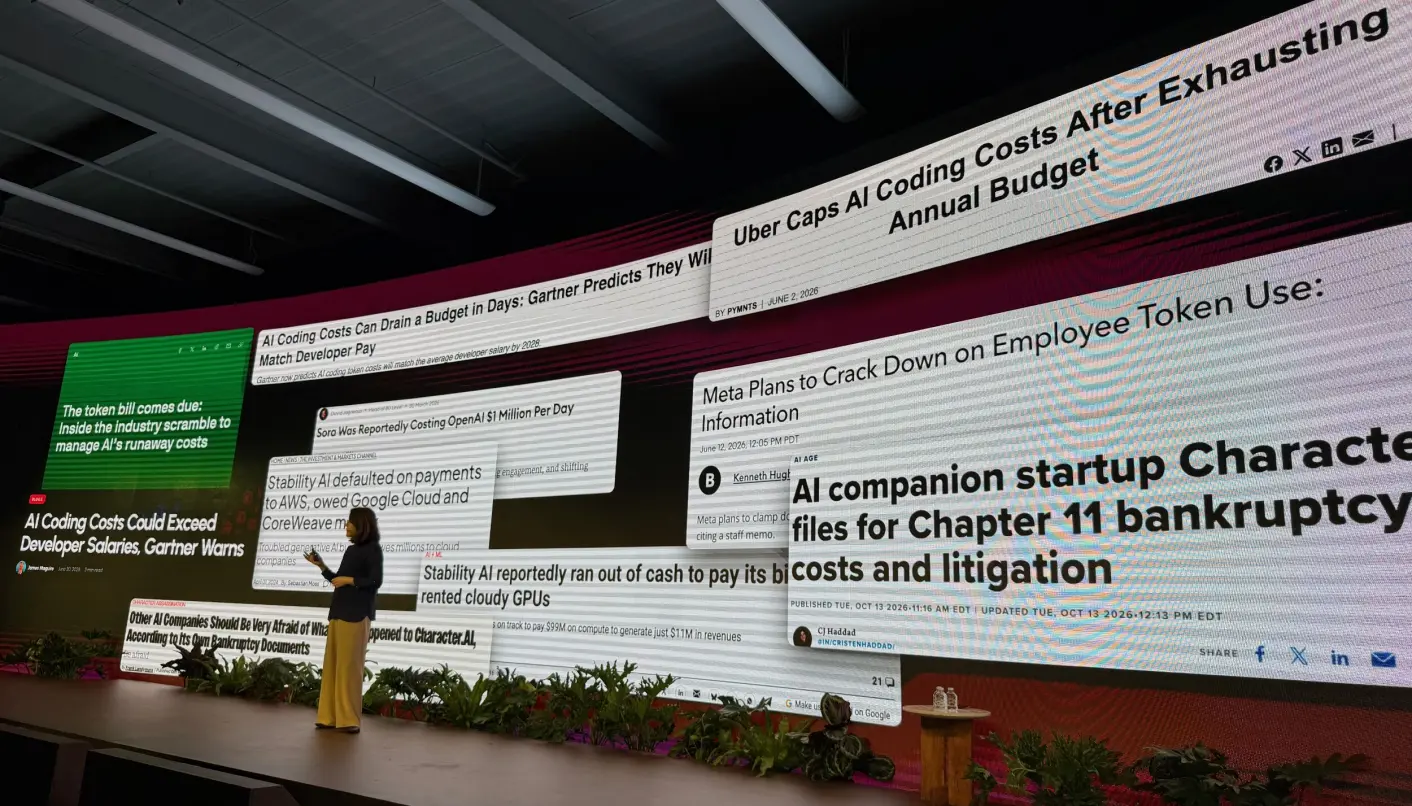
黄仁勋对开源模型的背书也符合林乔在开场发言中关于 AI 前沿需要开放的观点。但他很大程度上避免呼应林乔关于使用开源模型可节省成本的重点。在开场发言中,林乔站在舞台上,身后投影着一张由十个标题组成的幻灯片,突显了不受控制的 Token 支出的惊人成本。“成本已失控,”她说。
Huang's endorsement of open models also fits with Qiao's introductory remarks about the need for the AI frontier to be open. But he largely avoided echoing Qiao's focus on the cost savings allowed by working with open models. In her introductory remarks, Qiao stood on stage backlit by a slide composed of ten headlines highlighting the extraordinary cost of unchecked token spending. "Cost is out of control," she said.
“企业若不大量借贷,就无法实现规模化扩张。”这一主题在随后由Genspark联合创始人兼首席技术官Kay Zhu主持的题为“Gen-1 Slides:以非前沿成本实现前沿品质”的环节中得到呼应。Gen-1 Slides是Genspark用于生成幻灯片的模型,基于MiniMax M3构建并经过调优,其输出效果可与Anthropic的Opus 5媲美,但成本仅为后者的1/17——每百万Token 0.30美元,而Opus 5为每百万Token 5美元。
"Business cannot scale without borrowing a lot of money." That theme was echoed in a subsequent session helmed by Kay Zhu, co-founder and CTO of AI workspace Genspark, titled Gen-1 Slides: Frontier Quality Without Frontier Costs. Gen-1 Slides, Genspark's model for generating slide decks, was built atop MiniMax M3 and tuned to deliver results comparable to Anthropic's Opus 5 at 1/17th the cost – $0.30/M tokens compared to $5/M.
当被问及明年可能成为常态但如今看似不可能的事项时,黄仁勋表示,今年的突破在于将AI模型转化为智能体的智能体框架。他补充道:“我想明年我们将讨论的重大突破——这或许略带自利色彩——是Open Shell如何让全球每家公司都能安全、自信地部署智能体。”在被要求作出第二个预测时,黄仁勋表示:“我认为行业的第二大突破将是‘硬件在环’。而‘硬件在环’基本上就是机器人系统。”考虑到英伟达在机器人领域的显著兴趣和投资,这将是一个吉兆。®
Asked what might become commonplace next year but seems unlikely today, Huang said this year's breakthrough has been agent harnesses that turn AI models into agents. He added, "I would say the big breakthrough we'll talk about next year, maybe this is a little self-serving, is how Open Shell has enabled every company in the world to deploy agents safely, confidently." Given the nod to make a second prediction, Huang added, "I would say that the second big breakthrough for industry would be hardware in the loop. And hardware in the loop basically is robotic systems." Given Nvidia's evident interest and investment in robotics, that would be fortuitous. ®