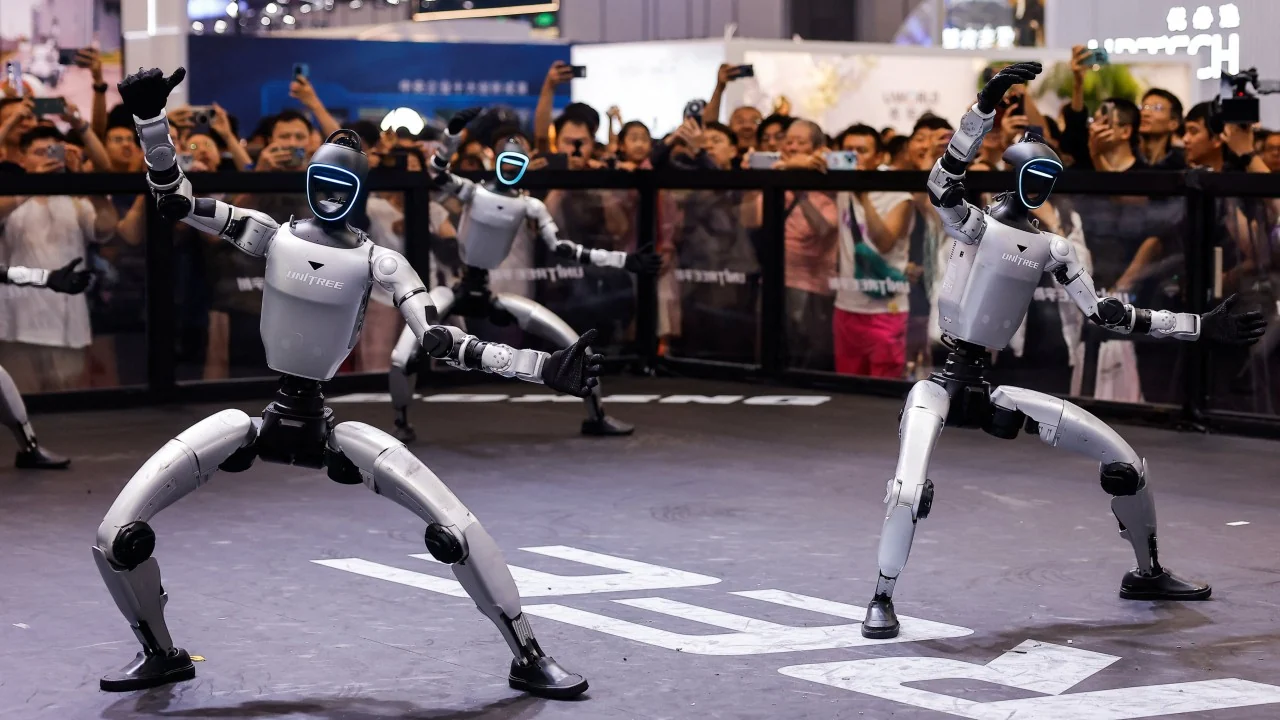
中国人形机器人制造商宇树科技创始人兼首席执行官王兴兴表示,该公司开发的机器人现在无需任何预先训练,依靠前沿AI模型即可绘画和下棋,完成复杂的物理任务。
Robots developed by Chinese humanoid maker Unitree Robotics can now paint pictures and play chess without any prior training, relying on frontier AI models to navigate complex physical tasks, according to founder and CEO Wang Xingxing.
王兴兴周四在上海举行的中国国际进口博览会(CIIE)上发言称,宇树的机器人由OpenAI的GPT-6提供支持,能够执行复杂的机器人操作序列,例如动态更换画笔水和混合颜料,完全由实时模型推理指导。
Speaking on Thursday at the China International Import Expo (CIIE) in Shanghai, Wang said Unitree’s machines, powered by OpenAI’s GPT-6, were capable of executing intricate robotic sequences, such as dynamically replacing brush water and blending pigments, guided purely by real-time model inference.
王兴兴说:“不出错地更换颜料所需的精度相当高。看到它在零训练情况下达到这种水平,确实令人震惊。”虽然宇树在演示中播放了机器人绘画的视频片段,但并未在现场进行现场演示。
“The precision required to change pigments without error is quite high,” Wang said. “Seeing it perform at this level with zero training was truly stunning.”
尽管如此,这些言论凸显了中国领先机器人企业如何利用尖端AI模型加速物理自动化。此前上个月,王兴兴曾表示,GPT-6已将行业的突破时间表提前至“一两年内”。他预测,明年的GPT-7可能攻克具身人工智能的核心挑战。
While Unitree displayed video clips of its robots painting during the presentation, it did not conduct a live demonstration on stage. Still, the remarks highlight how China’s leading robotics firms are using cutting-edge AI models to accelerate physical automation. They followed comments Wang made last month, when he said that GPT-6 had pulled forward the industry’s breakthrough timeline to “within one or two years”.
不过,王兴兴指出,将AI指令转化为精确的物理动作仍是一场艰难的战役。他在博览会上警告说,行业最大的障碍不再是数字推理或规划,而是弥合“最后一毫米”的机械差距。
He suggested that next year’s GPT-7 could crack core challenges in embodied artificial intelligence. Translating AI commands into precise physical actions remains an uphill battle, however, according to Wang.
王兴兴说:“目前的根本问题是AI模型的输入和输出之间存在对齐误差。”他预计,行业将在一两年内克服这一物理瓶颈。
He warned at the expo that the industry’s biggest hurdle was no longer digital reasoning or planning but closing a “last-millimetre” mechanical gap. “The fundamental problem right now is the alignment error between the AI model’s inputs and outputs,” Wang said, projecting that the industry would overcome this physical bottleneck within one or two years.
为加速这一转型,宇树正在开发一个“自我进化”反馈回路,让人形机器人能够编写代码、运行仿真并自主提升现实世界中的表现。
To speed up that transition, Unitree was developing a “self-evolving” feedback loop to allow humanoid robots to write code, run simulations and autonomously improve their real-world performance, Wang said.
王的乐观预期在展会上得到了其他业内高管的呼应。中国机器人初创公司X Square Robot(星动纪元)创始人王倩表示,具身智能正处于一个分水岭式飞跃的边缘,反驳了大规模应用还需五年时间的预测。
Wang’s bullish outlook was matched by other industry executives at the expo. Wang Qian, founder of Chinese robotics start-up X Square Robot, said embodied AI was on the verge of a watershed leap, pushing back against forecasts that mass adoption was half a decade away.
“我们认为,我们距离具身智能的‘GPT时刻’非常近——极有可能在一年左右,”X Square Robot创始人说。“我们希望看到机器人制造机器人、芯片制造芯片……在物理世界实现真正的人工智能。”然而,芯片供应商的基调则更为审慎,指出了软件层以下的制约因素。
“We believe we are very close to a ‘GPT moment’ for embodied AI – highly likely within a year or so,” the X Square Robot founder said. “We hope to see robots building robots, and chips manufacturing chips … achieving true artificial intelligence in the physical world.”Chip suppliers, however, struck a more cautious tone, pointing to constraints below the software layer.
国产图形处理器设计商摩尔线程联合创始人王东警告称,由于严重的数据稀缺和高昂的硬件成本,具身智能的发展持续落后于预期。
Wang Dong, co-founder of domestic graphics processing unit designer Moore Threads, warned that embodied AI development continued to lag expectations due to severe data scarcity and crippling hardware costs.
他表示,收集真实世界的交互数据依然困难,因此开发者被迫严重依赖合成训练集,并补充说摩尔线程正努力向国内机器人开发者提供自家芯片和解决方案,因为英伟达芯片极其昂贵。
Collecting real-world interaction data remained difficult, so developers were being forced to rely heavily on synthetic training sets, he said, adding that Moore Threads was making efforts to supply its own chips and solutions to domestic robotics developers as Nvidia chips were extremely expensive.