企业界正遭受围攻。短短几周内,一连串严重的网络安全事件动摇了老板们对自身防御能力的信心。在人工智能的助力下,数以千计的新软件漏洞被发现。再加上一系列黑客攻击,许多人认为网络风险正进入一个危险的新阶段。
The corporate world is under siege. In a matter of weeks a flurry of serious cyber-security incidents have shaken the confidence of bosses in their defences. Thousands of new software vulnerabilities have been discovered, aided by artificial intelligence. That, along with a slew of hacks, has led many to argue that cyber-risk is entering a perilous new phase.
上个月的测试之多,以至于一些分析师称之为“黑色十月”(其他人则称之为“黑客十月”)。首先,AI被用来发现PHP中的一处严重漏洞,PHP是一种广泛使用、支撑大多数网站的编程语言。该漏洞在补丁部署之前就被泄露,导致许多网站被暂时下线进行修复。随后,黑客从加密货币交易所币安窃取了约63亿美元。11月也并不轻松。在整个欧洲,超市冷柜的温度被调高,毁掉了价值数百万欧元的食品。在法国银行Crédit Mutuel Arkéa,资金在一连串欺诈交易中被盗。
So testing was the past month that some analysts have called it “Black October” (others, “the Hackening”). First AI was used to discover a critical flaw in PHP, a widely used programming language that underpins most websites. The vulnerability was leaked before patches could be deployed, so many websites were temporarily taken offline to be fixed. Then hackers stole some $6.3bn from Binance, a crypto exchange. November has been no easier. Across Europe, supermarket freezers have had their temperatures cranked up, destroying millions of euros worth of food. At Crédit Mutuel Arkéa, a French bank, funds have been stolen in a burst of fraudulent transactions.
政府也未能幸免。乌克兰和俄罗斯的空袭警报应用均遭到黑客攻击。网络犯罪分子从丹麦的人口登记系统、美国国土安全部和联邦调查局窃取了数据。日本已宣布进入网络安全紧急状态。11月3日,英国国家网络安全中心负责人理查德·霍恩警告称,未来几个月可能会出现“网络事件数量前所未有的上升”。
Governments have been hit, too. Air-raid alert apps have been hacked in both Ukraine and Russia. Cyber-criminals have swiped data from Denmark’s population registry, America’s Department of Homeland Security and the FBI. Japan has declared a cyber-security state of emergency. On November 3rd Richard Horne, head of Britain’s National Cyber Security Centre, warned that in the coming months there may be an “unprecedented rise in the number of cyber incidents”.
甚至在这场猛攻之前,威胁就已经在加剧。远程办公以及联网设备数量的增加制造了更多漏洞。数字货币的普及使黑客更容易通过漏洞利用获利。
Even before this onslaught, the threat was growing. Remote work and an increase in internet-connected devices created more vulnerabilities. The prevalence of digital currencies made it easier for hackers to make money from their exploits.
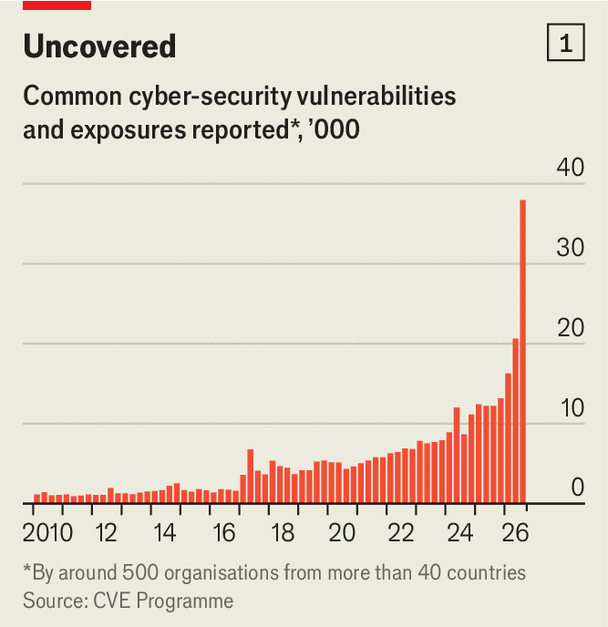
人工智能加剧了危险。4月,前沿实验室Anthropic表示,不会向公众发布其最新模型Mythos。相反,有限数量的软件供应商和金融机构获得了访问权限,以帮助它们堵塞网络防御中的漏洞。竞争对手实验室OpenAI很快启动了类似的举措。近几个月来,前沿模型挖掘出了大量安全缺陷:报告给软件制造商和专业网络安全组织的“通用漏洞披露”(CVE)数量激增(见图表1)。
AI has exacerbated the danger. In April Anthropic, a frontier lab, said it would not release Mythos, its latest model, to the public. Instead a limited number of software providers and financial institutions were granted access to help them plug gaps in their cyber-defences. OpenAI, a rival lab, soon launched a similar effort. In recent months frontier models have unearthed huge numbers of security flaws: the count of “common vulnerabilities and exposures” reported to software-makers and specialist cyber-security organisations is soaring (see chart 1).
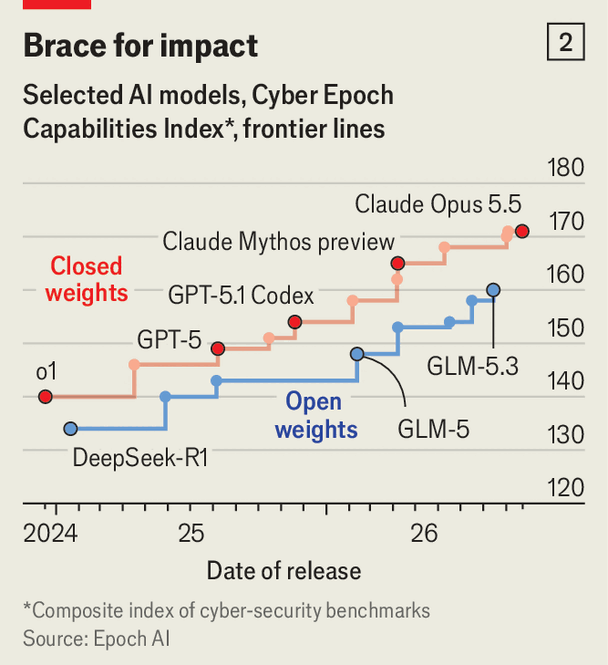
令人担忧的是,开放权重模型的网络能力也在同步快速提升,使得即使是新手黑客也能更容易地识别漏洞(见图表2)。此外,人工智能加快了漏洞被发现后的利用过程。过去弄清如何利用漏洞需要数天或数周;现在只需数小时。这意味着防御者修补软件缺陷的时间大幅减少。该技术还在助长“社会工程学”攻击,模型被用于自动化钓鱼邮件和克隆员工声音。
Worryingly, however, the cyber capabilities of open-weight models have been rapidly improving in parallel, making it easier for even novice hackers to identify vulnerabilities (see chart 2). Moreover, AI has sped up the process of exploiting a vulnerability once it is discovered. Working out how to do this used to take days or weeks; now it can take hours. That means there is far less time for defenders to patch flaws in their software. The technology is also fuelling “social engineering” attacks, with models being used to automate phishing emails and clone the voices of employees.
员工在日常工作中采用人工智能加剧了这一问题。网络安全公司Darktrace的Nicole Carignan表示,这使公司成为黑客的“现成目标”。调查显示,大多数员工使用某种未经IT团队审核的AI服务。10月21日,流行开源AI工具LiteLLM的制造商宣布,其再次遭到黑客入侵,此前3月发生的类似事件曾使数千家组织面临风险。
Employees’ adoption of AI in their everyday work is adding to the problem. This makes companies a “ripe target” for hackers, says Nicole Carignan of Darktrace, a cyber-security firm. Surveys suggest that most workers use some type of AI service that has not been vetted by IT teams. On October 21st the maker of LiteLLM, a popular open-source AI tool, announced that it had again been compromised by hackers, following a similar incident in March that put thousands of organisations at risk.
企业正争分夺秒地应对。咨询公司波士顿咨询(BCG)的瓦妮莎·里昂表示,在大型机构中,多达五分之一的IT资源正被重新调配,用于查找和修复安全漏洞。企业正优先处理暴露在互联网上的软件,例如网站和应用程序。IT巨头IBM的马克·休斯表示,对于已发现但尚无补丁可用的漏洞,他建议客户隔离有风险的软件,或许将其下线,或限制哪些员工拥有访问权限。
Businesses are scrambling to respond. At big institutions up to a fifth of IT resources are being rerouted to finding and fixing security flaws, says Vanessa Lyon of BCG, a consultancy. Firms are prioritising software that is exposed to the internet, such as websites and apps. Mark Hughes of IBM, an IT giant, says that in cases where no patch is available yet for vulnerabilities that have been unearthed, he is telling clients to contain the at-risk software, perhaps taking it offline or limiting which staff have access.
企业也在以AI对抗AI。模型不仅可被部署用于扫描漏洞,还可用于发现并中和可疑活动、识别网络钓鱼骗局。据知情人士透露,高盛已大幅增加该行分配给网络安全的AI预算份额。管理此类支出需要周密规划。“如何确保在遭遇入侵时不会耗尽token(计费单元)?”麦肯锡另一家咨询公司的查理·刘易斯问道。他指出,一些公司正预留token以备应急,另一些则建立程序,以便在发生网络攻击时快速审批支出。
Companies are also fighting AI with AI. Models can be deployed not just to scan for vulnerabilities, but also to spot and neutralise suspicious activity and catch phishing schemes. Goldman Sachs, for example, has greatly increased the share of the bank’s AI budget that it allocates to cyber-security, according to people familiar with the effort. Managing such spending requires careful planning. “How do you make sure you don’t run out of tokens mid-breach?” asks Charlie Lewis of McKinsey, another consultancy. He notes that some firms are setting aside tokens for emergencies, while others are establishing procedures to fast-track spending approvals in the event of a cyber-attack.
然而,各种挑战可能削弱防御者的力量。一是人性的轻信,即便最聪明的网络防御也难以完全弥补。据报道,币安被盗案据称由朝鲜黑客策划,起因是一名员工在一次虚假面试中将恶意软件下载到了工作电脑上。
Yet a variety of challenges may undermine the defenders. One is human gullibility, which even the cleverest cyber-defences will struggle to compensate for entirely. The heist of Binance, allegedly orchestrated by North Korean hackers, was reportedly caused by an employee downloading malware onto their work computer during a fake job interview.
第二个挑战是“运营技术”,即工厂和车间使用的工业硬件。这类机器通常运行着几十年前的软件,且常被网络安全团队忽视,因为陈旧的代码让黑客难以下手。然而,正如近期冰柜攻击事件似乎显示的那样,AI现在正被用来理解和操纵此类软件。
A second challenge is “operational technology”, the industrial hardware used on factories and shop floors. This type of machine typically runs on decades-old software, and has often been ignored by cyber-security teams because ancient code made it hard for hackers to get at. Yet, as seems to have been the case in the recent freezer attacks, AI is now being used to understand and manipulate such software.
此外,现实情况是许多小型企业缺乏投资网络安全能力所需的资源。这些企业随后可能被用作攻击其他目标(包括大型企业)的跳板。近期针对博彩平台 Polymarket 的一次黑客攻击,其源头正是该平台所使用的一个名为 DebugBear 的网站监控工具中的安全漏洞。
Then there is the reality that many smaller firms lack the necessary resources to invest in cyber-security capabilities. Such businesses can then be used as gateways to other targets, including larger enterprises. The source of a recent hack of Polymarket, a betting platform, was a security flaw in a website-monitoring tool it used called DebugBear.
一些大型公司正在向其较小的供应商提供网络安全建议。政府项目也提供支持。PHP 事件或许能为未来如何保护这些企业提供一个范例。亚马逊和 Cloudflare 等主要云基础设施提供商迅速为其客户部署了一系列防护措施,例如防火墙,在小企业无需动手的情况下就为其提供了保护。
Some large companies are providing their smaller suppliers with cyber-security advice. Government programmes offer support, too. The PHP incident may furnish a template for how these businesses will be defended in future. Major providers of cloud infrastructure, such as Amazon and Cloudflare, quickly put in place a number of protections for their customers, such as firewalls, that shielded small businesses without them having to lift a finger.
网络安全始终是一场军备竞赛,而 AI 的出现为攻击者递交了一件毁灭性的新武器。随着时间的推移,天平可能会重新向防御者倾斜,因为软件供应商正竞相推出 AI 驱动的解决方案。在那之前,企业将不得不面对一个危险的新世界。
Cyber-security has always been an arms race, and the advent of AI has handed attackers a devastating new weapon. In time the balance may shift back in favour of defenders, as software providers race to offer AI-powered solutions. Until then, businesses will have to confront a dangerous new world.