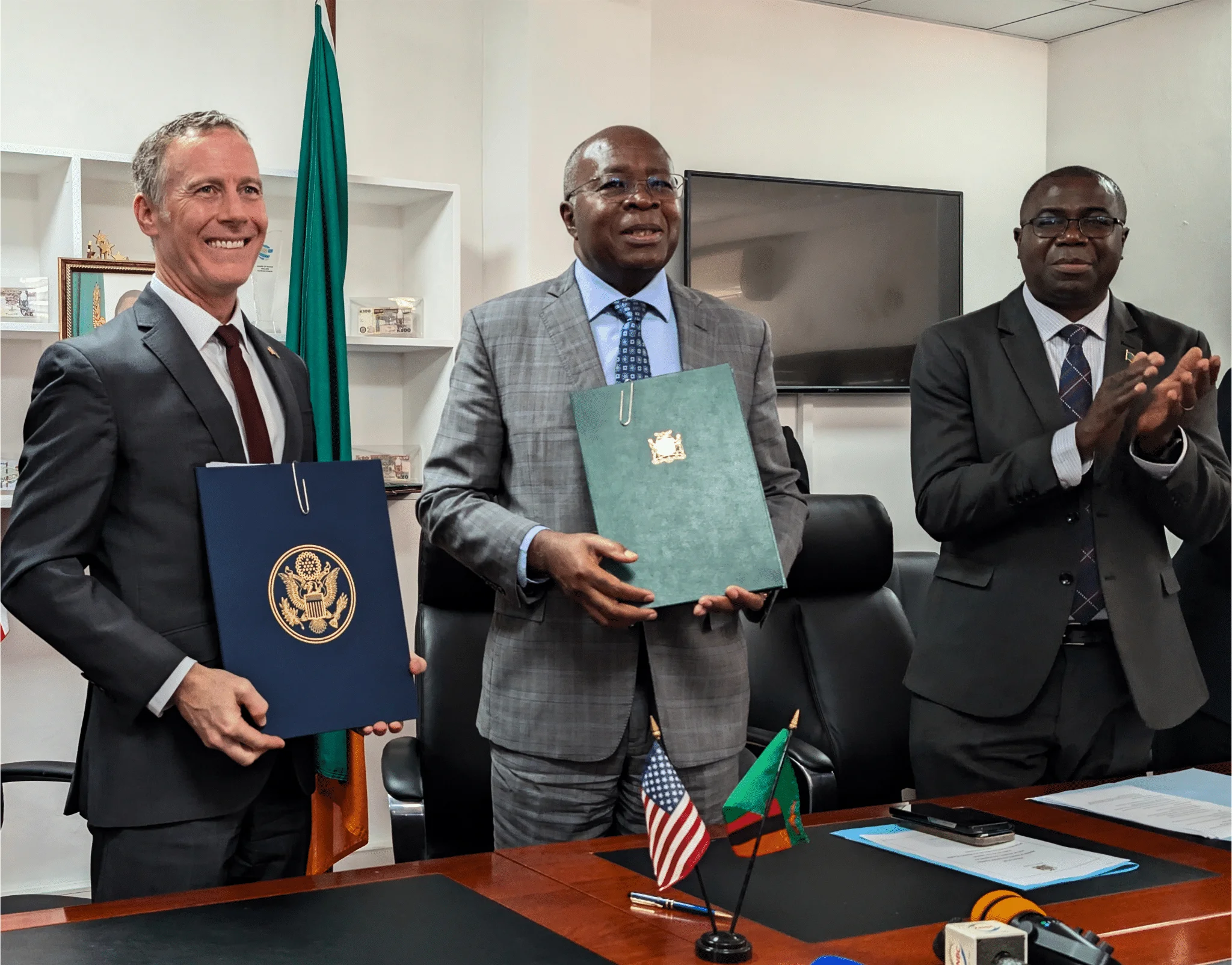
在10月的一次会议上,美国驻赞比亚大使馆临时代办米奇·科克尔(左)、赞比亚财政与国家规划部长西通贝科·穆索科特瓦内(中)展示美赞两国签署的卫生合作谅解备忘录副本。卫生部长罗马·奇伦吉(右)鼓掌致意。
At an October meeting, signed copies of the health cooperation memorandum of understanding between the U.S. and Zambia are displayed by U.S. Embassy Chargé d'Affaires Mich Coker (left) and Zambia's Minister of Finance and National Planning Situmbeko Musokotwane (center). Minister of Health Roma Chilengi (right) applauds.
美国驻赞比亚大使馆 从表面上看,这是一场典型的政府仪式。身穿正装的官员们。木桌周围摆放着巨大的黑色椅子。一簇麦克风。事情发生在10月8日,地点是赞比亚首都卢萨卡。在掌声中,美赞官员签署了一项全球卫生协议,称为谅解备忘录(MOU)。
U.S Embassy in Zambia By all appearances, it was a classic government ceremony. Officials in suits. Big black chairs around a wooden table. A cluster of microphones. It happened on October 8 in Lusaka, Zambia. Amid applause, U.S. and Zambian officials signed a global health agreement, called a Memorandum of Understanding or MOU.
但美国驻赞比亚大使馆临时代办米奇·科克尔表示,这项协议绝非典型。
But Mich Coker — the Chargé d'Affaires at the U.S. Embassy in Zambia — said this agreement was anything but classic.
“该备忘录代表了一种根本性的转变,”他在签署仪式上发言时说。他解释称,两国关系正在“从传统的捐助方-受助方模式转向真正的伙伴关系,这种伙伴关系建立在赞比亚的领导力、赞比亚的主导权和共同问责的基础之上。” 全球各地、不同政治立场的全球卫生专家都同意科克尔的观点,即美国在全球卫生方面的做法发生了根本性转变。
"This MOU represents a fundamental shift," he said, speaking at the g ceremony He explained that the relationship between the two countries was moving "from a traditional donor-recipient model to a true partnership, one grounded in Zambian leadership, in Zambian ownership and in shared accountability." Global health experts on all sides of the political spectrum and all over the world agree with Coker that there's been a fundamental shift in the U.S. approach to global health.
“目前正在展开的转变规模非常大,速度非常快,”全球发展中心全球卫生项目代理联合主任简·马登·凯勒说。
"The shift that's currently unfolding is very large and it's very rapid," says Janeen Madan Keller, acting co-director of the Global Health Program at the Center for Global Development.
据马登·凯勒和其他专家称,这个根本性转变的故事始于特朗普第二任期伊始数月的全球卫生动荡,但已让位于一个更清晰的战略。该战略目标宏大、时间紧迫,透明度却比以往低得多。
The story of this fundamental shift starts at the beginning of the second Trump Administration with months of global health turmoil — Madan Keller and other experts say — but has given way to a clearer strategy. One with big goals, a short timeline and a lot less transparency than what came before.
以下是对当前局势的梳理,以及由民主党控制的国会可能如何影响这一新格局。首先,“混乱”特朗普总统的第二个任期开局惊心动魄。当他以所谓的“欺诈、浪费和滥用”为由拆解美国国际开发署(USAID)时,一切在一夜之间发生了改变。
Here is a look at where things stand now and how a Congress controlled by the Democratic Party might impact the new landscape. First, the "chaos" President Trump's second term started dramatically. When he dismantled USAID (the U.S. Agency for International Development), citing alleged " fraud, waste and abuse " everything changed overnight.
“这是一个最好用混乱来形容的时期,”马丹·凯勒说。她表示,后果巨大且即时,“波及世界上一些最贫穷国家的人们和社区。”诊所突然关门。患者断了艾滋病毒药物。在赞比亚以及其他一些国家,许多依赖美国支持的诊所和项目的患者面临巨大的不确定性,往往导致严重的健康后果。“2025年上半年,彻底动荡不安,”凯撒家庭基金会(KFF)全球卫生与公共卫生政策高级副总裁兼主任珍妮弗·凯茨说。
"It is a period that is best described as chaos," says Madan Keller. The repercussions were massive and immediate, she says, "for people and communities in some of the poorest countries of the world." Clinics shut down suddenly. Patients ran out of HIV medications. In Zambia, as well as a number of other countries, many patients who relied on U.S.-supported clinics and programs faced tons of uncertainty and, often, dire health consequences "For the first half of 2025, there was a complete upheaval," says Jennifer Kates senior vice president and director of global and public health policy at KFF.
随后出现了一项策略 美国对外援助历史进入了一个新阶段。“从2025年夏天开始,一直到9月,实际上有一种退一步制定实际策略和计划的态势,”凯茨说。
A strategy emerged Next came a new stage in the history of U.S. foreign aid. "Starting over the summer of 2025 and going into September, there actually was a sort of step back to develop an actual strategy and a plan," says Kates.
国务院推出的“美国优先全球卫生战略”明确目标是让“美国更安全、更强大、更繁荣”。实施这一战略的主要方式是通过与个别国家签署协议。过去,美国更多是通过大型国际组织或当地非政府组织开展工作。
What emerged from the State Department was the America First Global Health Strategy with the stated goal of making "America safer, stronger, and more prosperous." The main way this strategy is being implemented is through agreements with individual countries. In the past, the U.S. had done more work through large international organizations or local non-governmental organizations.
专家表示,这些协议的一个显著特征是交易性。例如在赞比亚,“发生了一起大规模丑闻,因为活动人士能够证明,该协议计划将获得美国全球卫生资金的机会,以获取赞比亚铜和稀土矿产的准入作为条件,”艾滋病毒/艾滋病倡导组织“健康缺口”(Health GAP)执行主任亚洲·拉塞尔说。她的组织帮助揭露了这一情况。
Experts say one defining feature of these agreements is that they are transactional. For example, in Zambia "there was a massive scandal because activists were able to show that the agreement was planning to condition access to [U.S. global health] funding on access to [Zambia's] copper and rare earth minerals," says Asia Russell executive director of the HIV/AIDS advocacy organization Health GAP. Her organization helped expose this situation.
在公众抗议声中,协议中关于矿产的部分从全球卫生协议中被剥离出来,但许多全球卫生协议确实要求受援国共享病原体信息等数据。
While the part of the agreement about minerals was separated from the global health agreement after the public outcry in Zambia, many of the global health agreements do require the recipient country to share data such as pathogen information.
宏大(但非新)目标 在赞比亚的签署仪式上,科克列举了新战略的一些首要任务,包括要求受援国在未来几年增加对卫生领域的财政投入,以及在不久的将来逐步摆脱对援助的依赖。
Big (but not new) goals Speaking at theg ceremony in Zambia, Coker ticked off some of the top priorities in the new strategy, including that recipient countries increase their financial contributions to health in the years ahead and that they are transitioned off aid in the near future.
他说,根据赞比亚的谅解备忘录,美国将在五年内支付15亿美元,“赞比亚同时承诺将其国内卫生支出增加9.75亿美元。我们正在规划一条通往更强大、更自力更生的卫生体系的道路。”另一项优先任务是建设受援国自身的卫生基础设施——而不是由非营利组织和非政府组织运行的平行体系。
He said in the Zambian MOU, the U.S. would pay $1.5 billion over five years "with Zambia simultaneously committing to increase its own domestic health expenditures by $975 million. We are charting a path toward a stronger, more self-reliant health system." Another priority has been building up a country's own health infrastructure — and not a parallel system run by non-profits and NGOs.
赞比亚卫生部长罗马·奇伦吉在同一仪式上表示:“我们希望通过这项支持招募多达约4万名医护人员。”
"We are looking to have up to about 40,000 healthcare workers recruited through this support," said Zambian Health Minister Roma Chilengi at the same ceremony.
谅解备忘录中的优先事项——如要求受援国增加投入、逐步摆脱援助资金——并非新想法。在全球卫生领域,这些想法长期以来一直获得两党支持。但直到现在,它们一直难以落实。凯茨说:“这种方法确实以一种前所未有的新方式启动了这些目标。”
The priorities in the MOUs — such as recipient countries contributing more and being weaned off aid money — are not new ideas. In the world of global health they have long received bipartisan support. But, up until now, they've been hard to implement. "This approach really does kickstart them in a new way that had not occurred before," says Kates.
但在她看来,这种启动前的混乱局面使得实施这些目标更具挑战性——此外,现在所有人都在一个大幅缩减的美国全球卫生体系框架内运作。
But in her view the chaos before this kickstart makes implementing these goals more challenging — as does the fact that everyone's now operating within a greatly diminished U.S. global health system.
过渡的速度也让一些人感到担忧。马丹·凯勒表示,该战略旨在在短短几年内实现重大变革。“这是在一个压缩的时间线上进行的,且可以说管理能力有限,这正是一些风险和担忧的来源,”她说。
The speed of the transition also troubles some. Madan Keller says that the strategy aims to achieve major changes in just a handful of years. "It's happening on a compressed timeline with arguably limited capacity to manage it, and that's where some of the risks and concerns are coming from," she says.
拉塞尔则担心,特朗普政府的主要目标是敲定谅解备忘录,而不是制定雄心勃勃的卫生相关目标,例如减少艾滋病毒传播。她说:“特朗普政府关注的是‘过程指标——而非影响指标——作为其衡量成功的首要标准,这在应对大流行病时基本上是注定失败的赌注。’‘鲁比奥吹嘘文件。那救不了命。’”国务院拒绝了采访请求,但在一份声明中表示,大多数签署了谅解备忘录的非洲国家现在已经制定了实施计划,“美国驻外使馆目前正专注于落实这些实施计划,[而]受援国政府也在履行它们在谅解备忘录中作出的承诺。”
And Russell, for her part, is worried that the main goal of the Trump Administration has been hammering out MOUs rather than setting ambitious health-related goals, such as reducing HIV transmission. The Trump administration is focused on "process indicators — not impact indicators — as its first measure of success, which is basically a loser's gambit when it comes to pandemics," she says. "Rubio crowed aboutg documents. That doesn't save lives." The State Department declined an interview request but said in a statement that most African countries with MOUs now have drawn up implementation plans and "U.S. embassies globally are now focused on operationalizing these implementation plans [and] recipient country governments are also executing on the commitments they have made in the MOUs."
“很难获取信息”全球卫生专家表示,评估新战略面临的另一个重大挑战是向公众提供的信息匮乏。
"Very hard to get the information" Another major challenge in assessing the new strategy has been a lack of information provided to the public, says global health experts.
这与以往美国的全球卫生倡议形成了巨大反差。例如,美国的旗舰艾滋病毒/艾滋病项目——即“总统艾滋病紧急救援计划”(PEPFAR)——“一直是定期收集数据并透明共享的黄金标准——然后利用这些数据真正为决策提供依据”,现已解散的美国国际开发署前政策、规划和项目副主任拉莫娜·戈德博尔今年早些时候告诉美国国家公共电台(NPR)。
This represents a big break from past U.S. global health initiatives. For example, the U.S.'s flagship program for HIV/AIDS — called PEPFAR – "was a gold standard for collecting data on a regular basis and sharing it transparently — and then using that data to really inform decision making," Ramona Godbole the former deputy director of policy, planning and programs at the now-defunct U.S. Agency for International Development, told NPR earlier this year.
“现在的情况要不透明得多,很难获取信息。协议文本本身并未由美国政府公开发布,”凯茨说。不过,部分协议文本已通过诉讼或倡导团体提交的《信息自由法》请求而公开。
"Now it's much more opaque and very hard to get the information. The agreements themselves have not been publicly released by the U.S. government," Kates says. Although, the text for some of the agreements have become available through litigation or Freedom of Information Act requests filed by advocacy groups.
她说,关于实施计划的信息甚至更少,而这些计划本应包含资金如何使用、将支持哪些项目的详细目标和指标。
There is even less information on the implementation plans, she says, which are supposed to contain detailed goals and metrics for how the money will be spent and what programs will be supported.
凯茨表示,尽管这笔援助资金由美国纳税人承担,总额达160亿美元,分布在已签署的36份协议中,但上述情况属实。这笔资金源自国会拨付的对外援助款项。
Kates says this is true despite the fact that U.S. taxpayers are underwriting the aid, which totals $16 billion committed across the 36 agreements that have been signed. That money comes from U.S. taxpayer dollars that Congress allocated to foreign aid.
据计算,这意味着美国全球卫生援助下降了34%,并导致一些国家未能达成协议。例如,津巴布韦失去了美国全球卫生援助,因为双方政府未能就谅解备忘录条款达成一致。
has calculated that this represents a 34% drop in U.S. global health aid and it has left some countries without an agreement. For instance, Zimbabwe lost U.S. global health aid since the two governments were not able to agree to MOU terms.
国务院在声明中表示:“关于缺乏问责制和透明度的指控毫无根据……我们已经并将继续向国会分享每一份已签署的谅解备忘录。”新一届蓝色国会在本周中期选举之后,关于这项全球卫生领域根本性转变将如何演变,出现了新的疑问。随着民主党重掌国会多数派地位,许多人预计议员们将要求更高的透明度。
In its statement, the State Department said: "Claims of a lack of accountability and transparency are unfounded….We have and will share every signed MOU with Congress." A new blue Congress In the wake of this week's midterms, there are new questions about how this fundamental shift in global health will play out. With the Democratic Party returning to the majority in Congress, many expect that lawmakers will demand more transparency.
凯茨说:“我认为100%他们会要求:把谅解备忘录给我们,展示实施计划,来向我们详细汇报你们在做什么。”
"I think 100% they are going to demand: give us the MOUs, show us the implementation plans, come in and tell us more detail about what you're doing," Kates says.
另一个问题是,新国会是否会试图恢复被拆除的机制。凯茨表示,关于新国会1月3日召开后将采取何种行动,以及特朗普政府将如何回应,仍有许多未知数,但她预计议员们将首先推动公众获取更多信息,了解美国目前支持和不支持哪些全球卫生工作。
Another question is whether the new Congress might try to resurrect what was dismantled. Kate says there are still a lot of unknowns about what the new Congress will do after it convenes on January 3 and how the Trump Administration will respond, but she expects lawmakers will first push for the public to get more information on what global health work the U.S. is and isn't currently supporting.
拉塞尔表示,许多全球卫生活动人士呼吁加强监督——她也是其中之一。“除非并直到获得这些信息、实现问责,否则国会必须猛踩刹车,双脚同时踩下,”她说。
Russell says many global health activists are calling for more oversight — and she is one of them. "Congress needs to slam its feet, both feet, on the brakes unless and until it gets this information, gets this accountability," she says.
想了解更多关于变化世界中生活的故事,请订阅NPR全球卫生通讯。特朗普 美国国际开发署 美国对外援助
For stories about life in our changing world, to NPR's Global Health newsletter. trump USAID U.S. foreign aid