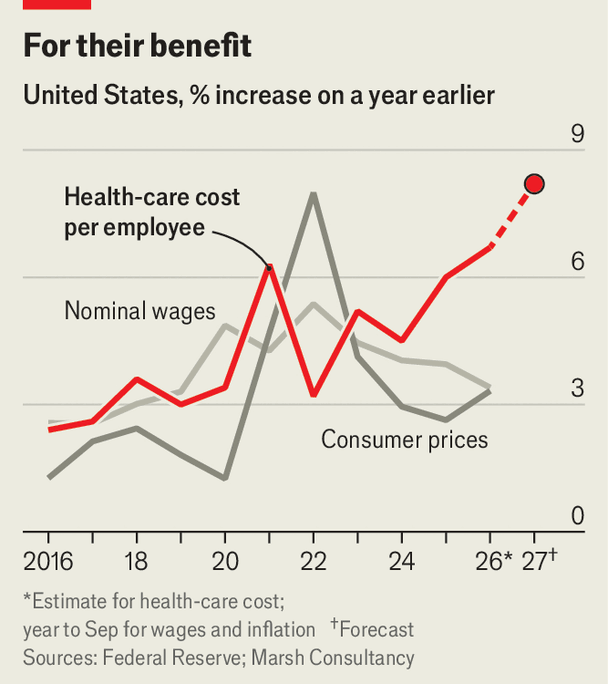
医疗保健在国会民主党的议程中位居前列,他们力求恢复购买个人保险的补贴,并扭转对医疗补助计划(即为穷人提供的医疗保健计划)的削减。然而,另一个问题也正在逼近。在未来几周内,1.57亿通过雇主获得保险的美国人将不得不为明年选择一份计划。据咨询公司Marsh称,他们的保险费用预计将在2027年平均上涨8%,这是20多年来最大的涨幅(见图表)。
Health care ranks high on Democrats’ agenda in Congress, as they seek to restore subsidies to buy individual insurance and reverse cuts to Medicaid, the health programme for the poor. However, a different problem looms, too. In the coming weeks, the 157m Americans who receive insurance through employers will have to choose a plan for next year. The cost of their insurance is due to rise by an average of 8% in 2027, according to Marsh, a consultancy, the biggest price hike in more than 20 years (see chart).
雇主资助的医疗保健长期以来一直是美国保险覆盖的支柱。约一半的美国人通过自己的工作、配偶或父母的工作获得健康保险。但随着医疗保健变得越来越昂贵,雇主们正在寻找削减开支的方法,无论是让员工为更多的医疗费用自掏腰包,削减保险覆盖范围,甚至完全取消健康福利。据健康研究机构KFF称,已经有六成十的美国人担心负担不起医疗保健,这一比例高于担心汽油价格的人。随着雇主削减保险覆盖范围,这种焦虑势必会上升。
Employer-sponsored health care has long been the backbone of American coverage. About half of Americans get their health insurance through their job, that of their spouse or their parents. But as health care gets ever more expensive, bosses are looking for ways to trim their spending, whether through making workers pay for more of their care in cash, cutting coverage or even scrapping health benefits entirely. Already, six in ten Americans worry about affording health care, according to KFF, a health-research outfit, a higher share than worry about petrol. As employers strip back coverage, that anxiety is sure to rise.
雇主通常承担保险计划约80%的费用,员工自己支付剩余的20%,或者家庭计划平均支付7500美元。这使得雇主成为有问题的中间人。雇主承担的保险费用限制了员工的薪水,通常这种限制对员工来说并不透明。
An employer generally covers about 80% of an insurance plan’s cost, with staff paying the remaining 20% themselves, or an average of $7,500 for a family plan. This makes employers problematic middle men. Insurance costs borne by employers limit workers’ salaries, usually in a way that is not transparent to staff.
2021年,随着美国人恢复在疫情期间推迟的手术和治疗,医疗成本飙升。但在近年来,保费一直呈上升趋势,涨幅快于通胀。创新的抗癌药物正在推高价格,GLP-1类药物也是如此——Marsh认为,抗肥胖药物可能已将医疗通胀推高约一个百分点。类似的比例来自新的人工智能工具,这些工具帮助医院发现人类可能忽略的额外收费。
Health costs spiked in 2021 as Americans resumed the surgeries and treatments that they had put off during the pandemic. But in recent years, premiums have trended upwards, rising faster than inflation. Innovative cancer medicines are helping to drive up prices, as are GLP-1s—Marsh reckons that anti-obesity medicines have probably pushed up health inflation by about a percentage point. A similar share comes from new artificial-intelligence tools that help hospitals to spot extra charges that a human might miss.
一些公司会四处比较不同的保险方案,但所有保险公司都面临成本上升。根据KFF的一项调查,2026年,大约五分之二的大型雇主让员工承担更高比例的保费。Marsh的贝丝·厄姆兰德表示,明年随着成本上升速度更快,每月支付增加约10%并非不可能。
Some companies will shop around for different coverage, but all insurers face higher costs. In 2026 roughly two in five large employers made workers pay a bigger share of their premiums, according to a survey by KFF. Next year, with costs rising even more quickly, monthly payment increases of around 10% are not out of the question, says Beth Umland of Marsh.
另一个选择是提供保障较少的保险。一些计划可能会限制患者选择医生的范围。星巴克已停止为减肥覆盖GLP-1药物,更多公司可能会效仿:根据倡导团体“企业健康集团”的数据,目前为治疗肥胖症提供GLP-1药物的公司中,有10%不打算明年继续提供。明年,迪士尼将取消员工配偶的保险覆盖,如果这些配偶能够通过自己的雇主获得保险的话。
Another option is to offer skimpier insurance. Some plans may limit patients’ choice of doctors. Starbucks has stopped covering GLP-1s for weight loss, with more firms due to follow suit: 10% of the companies now offering GLP-1s to treat obesity don’t plan on doing so next year, according to the Business Group on Health, an advocacy group. Next year, Disney will rescind coverage from employees’ spouses, if they can get insurance through their own employer.
员工福利研究院(一家智库)的保罗·弗龙斯坦解释说,情况在更小的公司中更为严峻,这些公司几十年来一直在取消保险覆盖。2000年,拥有10至49名员工的公司中,超过80%提供保险——现在只有59%提供。
The situation is more dire at tinier companies, which have been dropping coverage for decades, explains Paul Fronstin of the Employee Benefit Research Institute, a think-tank. In 2000 more than 80% of firms with 10-49 employees offered insurance—now, just 59% do.
由于失业率仍然较低,公司一直试图避免采取严苛的削减措施,以免驱走急需的员工。如果就业市场放松,他们可能会使健康福利更加简陋。这将为主张全民医疗保障的民主党人提供新的论据弹药。■
With unemployment still low, companies have tried to avoid draconian cuts, lest they drive away needed workers. Should the job market loosen, they might make health benefits even more bare. That would give the Democrats calling for universal health coverage new ammunition for their argument. ■