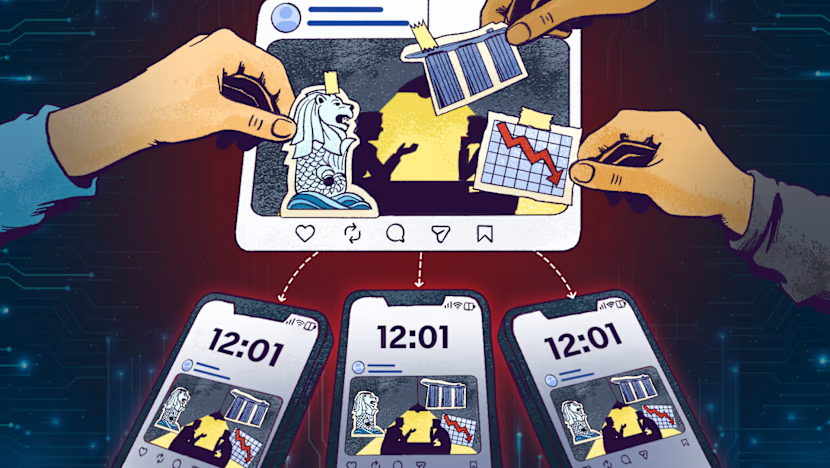
新加坡:10月下旬,多个社交媒体平台上近400条帖子传播了关于新加坡内政的虚假理论。从2025年底到2026年中期,约500个TikTok短视频编造了中国掌握新加坡命运的说法。
SINGAPORE: In late October, close to 400 posts across multiple social media platforms spread false theories about Singapore’s hand donesia’s affairs. From late 2025 to mid-2026, about 500 TikTok clips fabricated claims of China holding the key to Singapore’s fortunes.
而在今年年初,据报道,近300个YouTube视频被发现攻击新加坡及其总理劳伦斯·黄循财,其中编造了政治和经济动荡的虚构故事。
And at the start of the year, it was reported that nearly 300 YouTube videos were found attacking Singapore and its Prime Minister Lawrence Wong, with made-up tales of political and economic turmoil.
这些是CNA Verify近期调查案例中新加坡被针对的例子。所有案例均被判定为虚假信息,而非错误信息。
These are examples of how Singapore has been targeted in recent cases investigated by CNA Verify. All were judged to be disinformation, not misinformation.
两种形式都涉及虚假或误导性内容。区别在于意图:错误信息是无意欺骗地分享,而虚假信息是有意创造和传播,试图造成伤害。这些帖子背后是谁?在印尼案例中,专家表示“蜂群”可能参与其中。
Both forms involve false or misleading content. The difference is intent: Misinformation is shared without meaning to deceive, while disinformation is created and spread on purpose, to try and cause harm. Who’s behind these posts? In the Indonesian case experts said “buzzers” may have been involved.
这些人是受雇在社交媒体上推送信息、淹没其他观点,并大量转发和评论,以使某种叙事看起来比实际更受欢迎。这种做法至少可以追溯到2012年。
These are people paid to go on social media to push messages, drown out other views, and repost and comment en masse to make a narrative look more popular than it is. The practice dates back to at least 2012.
澳大利亚国立大学印尼研究人员罗斯·塔普塞尔在8月接受《卫报》采访时表示,这个名字“源于……他们在网上制造噪音的想法”。“就像许多小昆虫聚在一起会发出非常大的环境噪音。”观察人士警告称,这些组织紧密、大多匿名且大多为自由职业的“蜂群”,其效果是煽动愤怒并加深社会分歧。
The name “comes out of the idea that … they’re making noise online”, Indonesia researcher Ross Tapsell from the Australian National University told The Guardian in August. “In the way that lots of small insects put together make a really big ambient noise.”Observers have warned that these tightly organised, mostly anonymous and mostly freelancing buzzers have the effect of stoking anger and deepening divisions in society.
在其他地方,它们有不同的名称——菲律宾的“网络喷子”、马来西亚的“网络水军”——但工作是一样的:推动政治议程并左右公众舆论。
They go by other names elsewhere – “trolls” in the Philippines , “cybertroopers” in Malaysia – but the job is the same: Push a political agenda and sway public opinion.
马来西亚记者将“网络水军”与今年年中针对非马来群体(如罗兴亚人)的虚假信息和仇恨言论激增联系起来。
Malaysian journalists have linked cybertroopers to a surge in disinformation and hate speech against non-Malay groups like the Rohingya in the middle of this year.
5月的一份报告也描述了一个组织严密的行业,网络水军每月收入最高可达1万令吉(约合2470美元)。
A report in May also described a well-organised industry where cybertroopers earn up to RM10,000 (US$2,470) a month.
去年9月,新闻网站马来西亚前锋发现,有超过260名网络水军在首相安瓦尔·易卜拉欣的Facebook页面上人为虚增支持。马来西亚前锋将其中一个账号认定为安瓦尔所属人民公正党的一名官员。
In September last year, news website Malaysiakini found more than 260 cybertroopers artificially inflating support for Prime Minister Anwar Ibrahim on his Facebook page. One account was identified by Malaysiakini as belonging to an official from Mr Anwar’s Parti Keadilan Rakyat.
并非所有这些网络喧嚣都由人产生。其中一些来自机器人账号——由计算机程序运行、且表现出人类无法做到的行为的账号。
Not all of this online noise is generated by people. Some of it comes from bots – accounts run by computer programmes, and which behave in ways not humanly possible.
专家表示,机器人也可能解释了CNA Verify调查中视频积累的数百万次观看量。
Experts said bots could also explain the millions of views racked up by videos in CNA Verify’s investigations.
谁最终是这些活动的幕后黑手,则是另一回事:在某些情况下,证据表明这些账号共享一个运营者或一组运营者。但无法确定他们的身份,也无法确定他们是为企业还是政府工作。这些账号通常表现如何?
Who is ultimately behind the campaigns is another matter: In some cases, the evidence suggested that the accounts shared an operator or group of operators. But their identity could not be established, along with whether they were working for a business or a government. How do the accounts typically behave?
CNA Verify在多项调查中能够确定的是,存在协调不真实行为(“CIB”)的迹象。这指的是账号或页面等在线实体共同朝着一个共同目标努力——例如传播虚假信息——同时误导人们关于他们是谁或他们在做什么。识别CIB需要多层证据汇集在一起;单一线索本身无法证明。明显迹象包括:账号几乎同时创建,有时相隔仅几秒或几分钟。4月,CNA Verify发现,新加坡当局封锁的五个虚假网站是在24秒内相继注册的。
What CNA Verify could establish, in several investigations, were signs of coordinated inauthentic behaviour or “CIB”. This refers to online entities like accounts or pages working together towards a shared goal – such as the spreading of disinformation – while misleading people about who they are or what they’re doing. Spotting CIB requires multiple layers of evidence coming together; no single clue is proof on its own. Telltale signs include: Accounts created almost simultaneously, sometimes seconds or minutes apart. In April, CNA Verify found that five fake websites blocked by Singapore authorities had been registered within 24 seconds of one another.
帖子或评论相隔几秒或几分钟发布,或以固定间隔发布。使用阿里巴巴创始人马云AI生成肖像的YouTube频道,上传的视频相隔一秒;在2月针对新加坡的YouTube活动中,一些视频是在完全相同的秒数内发布的。
Posts or comments that go up seconds or minutes apart, or at regular intervals. YouTube channels using AI-generated likenesses of Alibaba founder Jack Ma uploaded videos one second apart; in the February anti-Singapore YouTube campaign some videos were posted at the exact same second.
不同账号发布相同的文字或视觉内容。2月YouTube活动中的视频共享相同的脚本、旁白或缩略图。相同的账号反复回复并推广彼此。
Different accounts posting the same words or visuals. Videos in the February YouTube campaign shared the same script, voice-over or thumbnail. The same accounts repeatedly replying to and boosting one another.
此类行为违反了大多数社交媒体平台的规则,涉及的账号可能会被删除。
Such behaviour breaks the rules of most social media platforms, and the accounts involved can be taken down.
南洋理工大学(NTU)魏君维传播与信息学院副教授赛夫丁·艾哈迈德表示,那些幸存下来的账号往往在新闻热点之间保持低调,安静下来,或者发布诸如表情包或生活方式内容等无害的帖子。
Those that survive tend to lie low between news flashpoints, going quiet or putting up harmless posts such as memes or lifestyle content, said Associate Professor Saifuddin Ahmed from Nanyang Technological University (NTU)’s Wee Kim Wee School of Communication and Information.
“他们这样做是为了积累粉丝并显得真实。当下一个议题在公众或媒体中变得突出时,他们会重新启动,并适应不断发展的故事,”他补充道。
“They do this to build followers and look authentic. When the next issue becomes salient in the public or the media, they reactivate and adapt to the developing story,” he added.
“这些账号中的一些还被发现改名或重新打造品牌。这很重要,因为效果会累积,反复接触这些叙事会带来风险。”
“Some of these accounts have also been seen renaming or rebranding. This matters because the effect builds up, and repeated exposure to these narratives creates risk.”
杰克·马调查还揭示了一些频道,它们一开始并不推送虚假信息,而是先吹捧新加坡,然后再掺入虚假说法——黑点研究公司创始人尼古拉斯·方将其描述为一种“诱饵与转换”策略。该公司是一家市场调研公司,同时也运营一家事实核查服务。
The Jack Ma investigation also revealed channels which did not push disinformation from the get-go, but instead began by flattering Singapore, before slipping in false claims – a “bait-and-switch” tactic as described by Mr Nicholas Fang, founder of Black Dot Research, a market research firm which also runs a fact-checking service.
他说,另一种策略是将虚假信息嵌入看似无害的个人观点或评论中。
Another ploy, he said, is to embed disinformation within what looks like harmless personal opinion or commentary.
“通过采用此类策略制造更大的怀疑和困惑,不法分子可以避免被更精明或更知情的受众过早发现,并让他们的活动更加成功,”他补充道。这些帖子的受众是谁?
“By adopting such tactics to create greater doubt and confusion, bad actors can avoid being spotted too early on by a more savvy or informed audience, and allow their campaigns to be more successful,” he added. Who are the posts for?
关于与新加坡大使会面的虚假说法,约占一组TikTok账号发布内容的2%。其余时间,这些账号发布的是关于印尼国内项目和政治的内容。
false claims about a meeting with Singapore’s ambassador made up about 2 per cent of posts by a network of TikTok accounts. The rest of the time, the accounts posted about Indonesian domestic programmes and politics instead.
这符合专家的观点,专家认为这些活动旨在既压制批评者,又在国内动员支持者。
This fits the view of experts, who believe the campaigns were meant to both silence critics and rally supporters at home.
在CNA Verify的其他调查中,更难说清这些帖子的受众是谁,尽管可以做出有根据的猜测。
In CNA Verify’s other investigations, it was harder to say whom the posts were meant for, though educated guesses were possible.
例如,以普通话进行的活动,可能是针对新加坡或海外的中文使用者。如果此类内容攻击新加坡,其目标可能是制造国内不确定性,或动摇人们对该国治理方式的信心。
Campaigns conducted in Mandarin, for instance, may have been aimed at Chinese speakers in Singapore or abroad. Where such content attacked Singapore, the objective may have been to cause domestic uncertainty or shake confidence in how the country is run.
究竟有多少真实的人相信了这些虚假说法,或者因此改变了观点,目前仍不清楚。
Whether and how many real people actually believed the false claims, or changed their views because of them, remains unclear.
印度尼西亚新闻媒体《Tempo》调查了据信是第一条传播虚假会议说法的帖子,发现该帖子下的大多数评论都持怀疑态度。
Indonesian news outlet Tempo examined what is believed to be the first post spreading the false meeting claim, and found that most comments under it were sceptical.
但实证证据表明,有些人确实会受到影响,副教授赛夫丁(Assoc Prof Saifuddin)表示。他指出,一项最近的研究显示,新加坡和印度尼西亚的部分受访者曾上当受骗于与霾害相关的深度伪造内容。
But empirical evidence shows that some people do get affected, said Assoc Prof Saifuddin. He pointed to a recent study showing that some respondents in both Singapore and Indonesia had fallen for haze-related deepfakes.
“当虚假信息在社交媒体上被反复传播时,虚假说法会随着时间的推移显得更加熟悉和可信,”这位政治传播研究员说。“如果一个谎言重复足够多次,对某些受众来说,它就变成了真理。”他补充说,担忧的不是整个人口会被左右,而是某些脆弱群体会被左右,并且信任会被慢慢侵蚀。新加坡如何保护自己?
“When disinformation is repeated on social media, it makes false claims appear more familiar and credible over time,” said the political communication researcher. “If you repeat a lie enough times, it becomes true for some audiences.”The worry, he added, is not of entire populations being swayed, but that some vulnerable groups will be – and that trust will slowly be eroded. How can Singapore defend itself?
至于为何新加坡成为目标,首先要看大局:随着各国寻求相对于竞争对手的优势,虚假信息运动变得越来越常见,方先生(Mr Fang)指出。他同时还担任新加坡国防部战略传播专家小组的主席。
As to why Singapore is being targeted, start with the big picture: Disinformation campaigns are becoming more common as countries look for an edge over rivals, noted Mr Fang, who also chairs an expert panel on strategic communications for Singapore’s defence ministry.
他说,此类运动有效、高效、成本低,并且可以相对匿名地进行,并具有可否认性。这使得它们成为那些旨在“破坏社会稳定”并让政策制定者“陷入困境、无法专注于关键问题”的人的得力工具。
Such campaigns are effective, efficient, cheap, and can be run relatively anonymously and with plausible deniability, he said. That makes them a handy tool for those with the aim of “destabilising societies” and leaving policymakers “bogged down and unable to focus on critical issues”.
他补充说,新加坡尤其如此,因为新加坡是多种族、多元文化、多宗教、开放、高度互联,并在全球舞台上举足轻重,是一个“理想目标”。
Singapore, specifically, is a “ripe target” because it is multi-racial, multi-cultural, multi-religious, open, highly connected, and important on the global stage, he added.
“能够影响或冲击新加坡……可能对那些与我们的利益相悖或存在竞争的人具有吸引力。”方先生表示,随着虚假信息运动变得越来越复杂、越来越难以发现和追踪,新加坡人最好的防御方式可能是更好地了解此类威胁的运作方式及其企图达到的目的。
“Being able to influence or impact Singapore … may be attractive to those whose interests run counter or are in competition with ours.”As disinformation campaigns become more sophisticated and harder to spot and trace, Singaporeans’ best defence might be to better understand how such threats work and what they hope to achieve, said Mr Fang.
这可以通过更多的公众宣传和教育来支持。他说,以这种方式在全社会建立韧性,可能比试图查明每一起虚假信息的源头更有效。
This can be supported by more public outreach and education. Building resilience across society in this way may be more effective, he said, rather than trying to figure out the source of disinformation in each and every case.