白宫表示,必须尽一切努力维持美国在人工智能领域对中国的领先地位,无论是通过阻止获取先进半导体,还是拒绝暂停前沿实验室的研究。然而,这一进程面临的最大威胁之一,可能正是本届政府自己的移民提案。
By The Editors The White House says everything must be done to maintain America’s lead over China in artificial intelligence, whether by blocking access to advanced semiconductors or refusing to pause research at frontier labs. Yet one of the biggest threats to that progress may be the administration’s own immigration proposals.
一系列潜在的新限制措施,针对的是将高技能移民输送至美国的整条通道上的每一个关键节点。拟议对学生签证停留期限的限制,将给国际博士生设置新的障碍。巨额新费用可能重创可选实习培训(OPT)和H-1B签证,这两个项目本是为外国毕业生和高科技工作者进入美国劳动力市场而设。对大型科技公司的打击,则提高了获得绿卡的门槛,也提高了在美国构建未来的信心门槛。
A barrage of potential new restrictions targets every key node in the pipeline that funnels highly skilled immigrants to the US. Proposed limits on the duration of student visas would raise new hurdles for international Ph.D. candidates. Massive new fees could cripple Optional Practical Training and H-1B visas, programs designed for foreign graduates and high-tech workers to enter the US workforce. A crackdown on major technology companies has raised barriers to getting a green card, and with it the confidence to build a future in the US.
本届政府的强硬做法似乎在这些措施生效之前就已开始吓退移民。近六成美国大学报告称,去年新国际学生入学人数下降。尽管法院已暂时阻止了此前对某些H-1B签证新申请征收10万美元费用的尝试,但注册人数仍从2025年的470,342人降至2026年的343,981人。
The administration’s hawkish approach appears to have begun deterring immigrants even before such measures take effect. Nearly 6 in 10 US universities reported a decline in new international student enrollments last year. While courts have temporarily blocked an earlier attempt to impose a $100,000 fee on certain new applications for H-1B visas, the number of registrations has nevertheless declined from 470,342 in 2025 to 343,981 in 2026.
人工智能实验室尤其依赖大量优秀移民的流入。人工智能相关领域的研究生项目由国际学生主导:他们占计算机与信息科学全日制学生的80%,占电气与计算机工程全日制学生的75%,占数学与统计全日制学生的62%。一项研究发现,2010年至2021年间美国排名前十的人工智能研究者中有7位是外国出生或外国培养的,其中大多数是中国人。美国顶尖人工智能公司中有60%由移民创立或联合创立。
AI labs are particularly dependent on a robust flow of talented immigrants. Graduate programs in AI-related fields are dominated by international students: They account for 80% of full-time students in computer and information sciences, 75% in electrical and computer engineering, and 62% in mathematics and statistics. One study found that 7 out of the 10 leading AI researchers in the US between 2010 and 2021 were foreign-born or foreign-educated, most of them Chinese. Immigrants have founded or cofounded 60% of the country’s top AI companies.
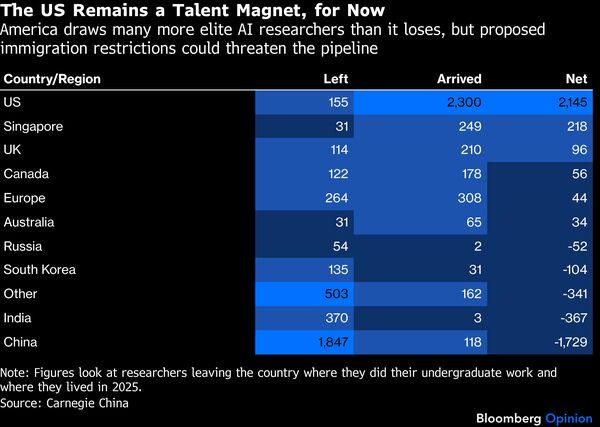
美国在人工智能领域的优势,关键在于能否招募并留住这些科学家。毫不意外,中国在数量上占据很大优势:卡内基国际和平基金会估计,57%的顶尖人工智能研究人员在中国大陆获得本科学位,而美国这一比例为13%。鉴于中国前沿实验室近来蓬勃发展、政府对研究投入巨资,越来越多的中国毕业生选择留在国内工作——去年这一比例接近十分之七。
US advantages in AI depend crucially on the ability to recruit and retain those scientists. China unsurprisingly has a big edge in numbers: The Carnegie Endowment for International Peace estimates that 57% of elite AI researchers received their undergraduate degrees on the mainland, compared to 13% in the US. Given the recent flourishing of Chinese frontier labs and huge government investments in research, more Chinese graduates are choosing to stay and work at home — nearly 7 in 10 last year.
美国仍是颇具吸引力的目的地,去年净吸引2145名顶尖研究人员,而中国净流失1729名。然而,一旦这种情况发生变化,美国实验室恐怕难以保持对竞争对手的领先。
The US remains an attractive destination, luring a net 2,145 top researchers last year, while China lost 1,729. If that changes, however, American labs could be hard-pressed to keep ahead of their rivals.
这种转变可能对整体经济造成严重后果。斯坦福大学的研究人员表示,自1990年以来,移民贡献了美国36%的创新。一项研究将1990年至2010年间生产率总增长的30%至50%归因于外国STEM(科学、技术、工程和数学)劳动力的流入。国防分析研究所的另一项研究则表明,这一群体在2019年为美国经济贡献了约3670亿至4090亿美元的劳动增加值。
A shift could have dire consequences for the broader economy. Researchers at Stanford University say immigrants have accounted for 36% of US innovation since 1990. One study has attributed 30% to 50% of aggregate productivity growth from 1990 to 2010 to inflows of foreign STEM workers. Another, from the Institute for Defense Analyses, suggests that cohort contributed somewhere between $367 billion and $409 billion in labor value-added to the US economy in 2019.
至少,行业领袖和议员应当向政府施压,要求寻找其他方式来解决OPT和H-1B项目被滥用的问题,而不是征收具有破坏性的新费用。但他们不应止步于此。应当扩大就业类签证的名额——包括回收未使用的绿卡——以引进更多人工智能研究人员。应当开辟更多途径,让年轻创业者能够留下来创办人工智能公司,而不是被迫为规模更大的雇主工作或进入学术界。政府应当考虑以激励措施吸引海外顶尖研究人员移居美国。
At minimum, industry leaders and lawmakers ought to pressure the administration to look for other ways to address abuses of the OPT and H-1B programs rather than imposing destructive new fees. But they shouldn’t stop there. The pool of employment-based visas should be expanded — including by reclaiming unused green cards — to bring in more AI researchers. More pathways should be created so young entrepreneurs can stay and launch AI companies, rather than being forced to work for larger employers or in academia. The government should think about targeting leading researchers abroad with incentives to move to the US.
随着人工智能模型日益精进,安全担忧将会上升。但更严格的审查程序以及更完善的“技术控制计划”——类似于国防承包商、芯片制造商和航空航天公司已经在使用的那类计划——应当能够缓解大部分担忧。
Security concerns will rise as AI models grow more sophisticated. But enhanced vetting procedures and improved “technology control plans,” similar to those already used by defense contractors, chipmakers and aerospace companies, should be able to alleviate most concerns.
无论如何,美国国防分析研究所2021年的研究发现,高技能移民带来的好处远远超过风险。而本届政府的短视提案则不能这么说。
Regardless, the Institute for Defense Analyses’ 2021 study found the benefits of highly skilled immigration far outweighed the risks. The same can’t be said for the administration’s shortsighted proposals.