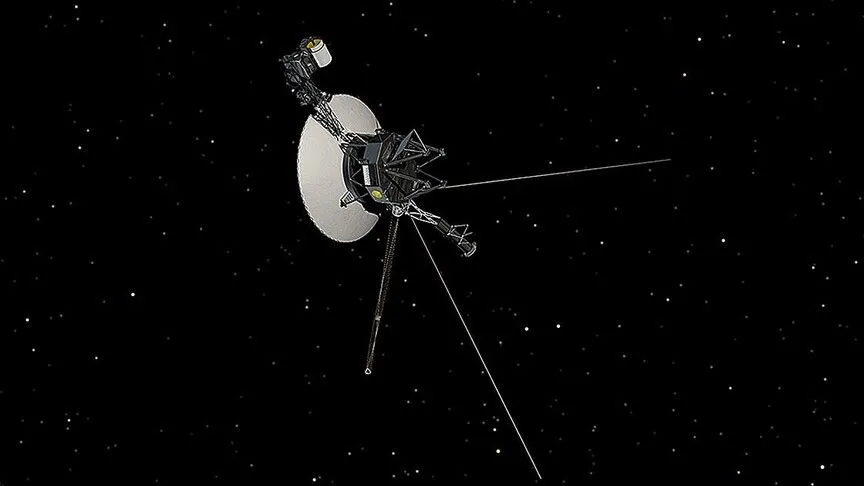
NASA的旅行者1号探测器将于周三(11月18日)达到一项历史性里程碑,成为首个距离地球达到一光日的造物,距其发射已近五十年。
NASA's Voyager 1 spacecraft is set to reach a historic milestone on Wednesday, Nov. 18, becoming the first human-made object to reach a distance of one light-day from Earth, nearly five decades after its launch.
据NASA称,该探测器将在格林威治时间1016分达到160.94亿英里(259.02亿公里)的距离。
The spacecraft will reach a distance of 16.094 billion miles (25.902 billion kilometers) at 1016GMT, according to NASA.
在这个距离上,无线电信号从地球传到旅行者1号需要24小时,返回又需要24小时,造成最短往返通信延迟达48小时。
At that distance, radio signals will take 24 hours to travel from Earth to Voyager 1 and another 24 hours to return, creating a minimum round-trip communication delay of 48 hours.
旅行者1号于1977年9月5日发射,最初设计用于探索木星和土星,随后继续飞向星际空间。
Launched on Sept. 5, 1977, Voyager 1 was originally designed to explore Jupiter and Saturn before continuing its journey toward interstellar space.
1998年2月,它超越NASA的先驱者10号探测器,成为距离地球最远的人造物体;2012年8月进入星际空间,成为首个做到这一点的探测器。
It became the most distant human-made object in February 1998 after overtaking NASA's Pioneer 10 spacecraft and crossed into interstellar space in August 2012, becoming the first spacecraft to do so.
旅行者1号及其孪生探测器旅行者2号仍是唯二在日球层(太阳产生的粒子和磁场形成的保护性气泡)之外运行的探测器。
Voyager 1 and its twin, Voyager 2, remain the only spacecraft to have operated beyond the heliosphere, the protective bubble of particles and magnetic fields generated by the Sun.
尽管已运行超过49年,旅行者1号仍在收集科学数据,NASA工程师正努力节约其日益减少的电力供应。
Despite operating for more than 49 years, Voyager 1 continues to collect scientific data as NASA engineers work to conserve its diminishing power supply.
为庆祝这一里程碑,NASA邀请全球民众于周二(11月17日)日落后向天空闪烁灯光,参与其“为旅行者的光日闪耀”活动。
To celebrate the milestone, NASA has invited people worldwide to participate in its Shine Bright for Voyager's Light-Day event on Tuesday, Nov. 17, by flashing lights toward the sky after sunset.