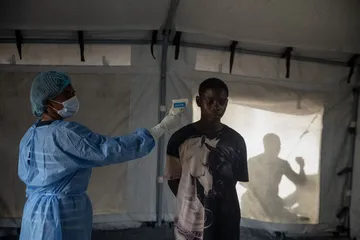
刚果(金)历史上最大规模的埃博拉疫情爆发已持续六个月,遏制病毒的成败越来越多地取决于解决远超埃博拉本身的问题——饥饿、武装冲突、不信任以及已在压力下濒临崩溃的医疗体系。
Six months into the biggest Ebola outbreak in the Democratic Republic of Congo’s history, containing the virus increasingly depends on solving problems far beyond Ebola — hunger, armed conflict, mistrust and a health system already buckling under the strain.
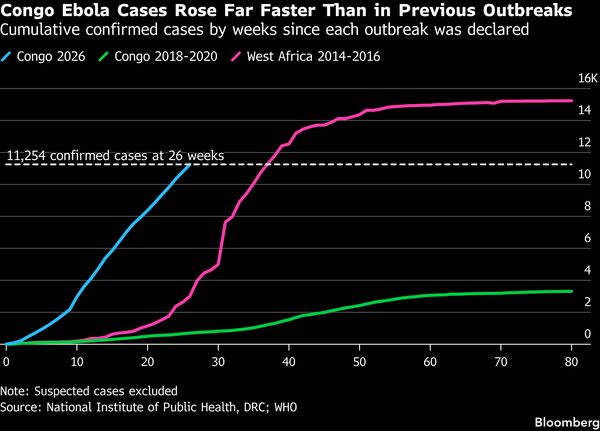
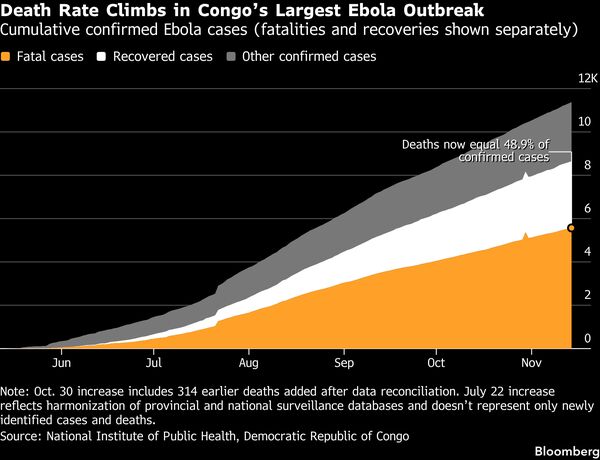
Jason Gale 和 Janice Kew 报道 自 5 月 15 日宣布疫情爆发以来,已有超过 1.1 万人感染,5500 人死亡。数月来,埃博拉每周造成约 240 人死亡,相当于每周发生约一架半波音公司 737 型客机坠毁。
By Jason Gale and Janice Kew More than 11,000 people have been infected and 5,500 have died since the outbreak was declared May 15. For months, Ebola has been killing roughly 240 people a week, the equivalent of about one and a half Boeing Co. 737 passenger jets crashing every week.
“这是一个系统性问题,叠加了地理、不安全、冲突、道路差、不信任等基本因素,”William Clemmer 说。这位在刚果(金)工作了三十年的医生,现任总部设在戈马的 Corus International 高级区域卫生顾问。
“It’s a systems problem compounded by basically geography, insecurity, conflict, poor roads, mistrust,” said William Clemmer, a physician who has worked in Congo for three decades and is senior regional health adviser for Corus International based in Goma.
现年 69 岁的 Clemmer 曾参与应对四次埃博拉疫情。他说,许多医疗机构在进入本次危机时,并无可靠的水、电、消毒、废弃物处理或供应系统。他表示,如果诊所缺乏安全使用防护装备所需的基本基础设施,单纯运送防护装备只能解决有限问题。
Clemmer, 69, who has worked on four Ebola outbreaks, said many health facilities entered the current crisis without reliable water, electricity, sterilization, waste disposal or supply systems. Delivering protective equipment can only accomplish so much if clinics lack the basic infrastructure needed to use it safely, he said.
刚果(金)自身的数据说明了这一问题。截至 11 月 14 日,该国累计记录 11376 例确诊感染和 5568 例死亡,病死率近 49%。疫情已波及八个省的 68 个卫生区。
Congo’s own data illustrate the problem. As of Nov. 14, the country had recorded 11,376 confirmed infections and 5,568 deaths, for a fatality rate of almost 49%. The outbreak had reached 68 health zones across eight provinces.
在北基伍省,截至 11 月 14 日,有 153 名埃博拉患者和疑似病例在指定治疗和隔离中心之外的普通医疗机构接受照护。未被识别和隔离的人员可能继续在家中、诊所和葬礼上传播埃博拉。
In North Kivu province, 153 Ebola patients and suspected cases were being cared for in ordinary health facilities outside designated treatment and isolation centers on Nov. 14. People who aren’t identified and isolated can continue spreading Ebola at home, in clinics and during funerals.
据无国界医生组织称,最近约三分之二的埃博拉死亡病例发生在社区而非治疗中心。
About two-thirds of Ebola deaths have recently occurred in communities rather than treatment centers, according to Médecins Sans Frontières.
“当我们三分之二的死亡病例发生在当地社区时,这基本上告诉我们,要么人们被确诊得太晚,要么他们根本无法获得医疗救治,”克莱默说。“这不仅表明监测系统失效,也反映出在医疗获取、信任和安全方面存在问题。”
“When two-thirds of our deaths occur in local communities, that basically tells us that either people are being detected too late or they’re not reaching care at all,” Clemmer said. “That is an indication not just of failure of surveillance, but also of access, trust and security.”Fear Factor The International Rescue Committee said its teams recently documented 84 rumors, including a recurring belief that people taken to Ebola treatment centers “do not return home alive.”The group said fear is discouraging some women from seeking routine medical care, including postnatal services.
恐惧因素 国际救援委员会表示,其团队最近记录了84条谣言,其中包括一种反复出现的观念,即被送往埃博拉治疗中心的人“活着回不了家”。该组织称,恐惧正阻碍一些女性寻求常规医疗服务,包括产后服务。
The outbreak’s roughly 50% fatality rate makes that reluctance understandable, Clemmer said. Unlike the 2018-2020 Ebola epidemic in eastern Congo, responders don’t yet have a vaccine or treatment proven to work against the Bundibugyo strain driving the current outbreak.
克莱默说,此次疫情约50%的致死率使这种抗拒情绪可以理解。与2018年至2020年刚果(金)东部的埃博拉疫情不同,应对人员目前尚无经证实对本次疫情流行的邦迪布焦毒株有效的疫苗或治疗方法。
Telling families that a relative needs to enter a treatment center where many patients are dying can fuel resistance, he said.
他表示,告诉家属亲人需要进入一个许多患者正在死亡的治疗中心,可能会加剧抵触情绪。
The consequences extend far beyond Ebola. Almost 29 million people in Congo already face acute food insecurity, a number projected to exceed 30 million in the first half of next year, according to United Nations agencies. More than 11 million of them are in Ituri, North Kivu and South Kivu, the eastern provinces at the center of the country’s humanitarian crisis.
后果远不止埃博拉。根据联合国机构的数据,刚果(金)已有近2900万人面临严重粮食不安全,预计明年上半年这一数字将超过3000万。其中1100多万人位于伊图里、北基伍和南基伍,这三个东部省份是该国人道主义危机的核心区域。
Conflict displaces families from their farms and livelihoods, while Ebola restrictions and fear can further disrupt farming and trade. For health officials, that creates another obstacle: asking someone exposed to Ebola to isolate is harder when leaving home may be necessary to earn money or find food.
冲突迫使家庭离开农田和生计,而埃博拉限制措施和恐惧情绪可能进一步扰乱耕作和贸易。对卫生官员而言,这造成了另一个障碍:当离开家园可能是赚钱或寻找食物的必要途径时,要求接触过埃博拉的人进行隔离会更加困难。“这些人有工作、为家人获取食物的责任,”克莱默说。
“These people have the responsibility of working, of getting food for their family,” Clemmer said.
暴力构成了更直接的威胁,联合国埃博拉应对高级协调员朱利安·哈内伊斯上周表示,在一些受影响地区,武装团体造成的死亡人数超过埃博拉本身。
Violence poses a more direct threat, with armed groups killing more people than Ebola itself in some affected areas, Julien Harneis, the UN’s senior Ebola response coordinator, said last week.
在最近的一个周末,死于“盟军民主力量”(ADF)之手的人数超过了死于病毒的人数,他在一篇纪念疫情宣布爆发六个月的帖子中说道。
Over one recent weekend, more people were murdered by the Allied Democratic Forces, or ADF, than died from the virus, he said in a post marking six months since the outbreak was declared.
暴力也让阻止疫情变得更加困难。哈内斯表示,应对工作面临的最紧迫挑战之一,是在冲突地区寻找改进接触者追踪的方法,因为“盟军民主力量”和其他武装团体的袭击正在阻碍工作开展。他还呼吁加强与私营医疗服务提供者的合作,并表示大多数人最初都是在那里寻求治疗。
The violence is also making the epidemic harder to stop. Harneis said one of the response’s most pressing challenges is finding ways to improve contact tracing in conflict areas where attacks by the ADF and other armed groups are impeding the work. He also called for greater engagement with private health providers, where he said most people initially seek care.
科学带来希望 存在乐观的理由。一些前疫情热点地区的传播已有所下降,邻国迄今避免了持续传播,而在刚果(金)进行的临床试验最终可能提供专门针对邦迪布焦伊博拉病毒的疫苗和治疗方法。
Scientific Hope There are reasons for optimism. Transmission has declined in some former hotspots, neighboring countries have so far avoided sustained spread, and clinical trials underway in Congo could eventually provide vaccines and treatments specifically suited to Bundibugyo Ebola.
在科学家研究默克公司的“厄博韦”疫苗(获批用于预防扎伊尔伊博拉病毒)是否也能预防邦迪布焦伊博拉病毒的同时,已有数千人接种了该疫苗。非洲疾控中心表示,新出现的证据表明它可能提供一定的交叉保护,并支持在评估继续进行的同时,将其用于高风险儿童。
Thousands of people are already receiving Merck & Co.’s Ervebo vaccine while scientists investigate whether the shot, approved against Zaire ebolavirus, can also protect against Bundibugyo. Africa CDC said emerging evidence suggests it may provide some cross-protection and supports its use in high-risk children while the evaluation continues.
与此同时,两款专门针对邦迪布焦伊博拉病毒设计的疫苗——一款由牛津大学与印度血清研究所共同开发,另一款来自莫德纳公司——即将在刚果(金)进入晚期临床试验。研究人员将测试它们能否保护接触过病毒的人群不发展为重症或死亡,结果预计将于2027年初出炉。
Meanwhile, two vaccines designed specifically against Bundibugyo — one developed by the University of Oxford with the Serum Institute of India and another from Moderna Inc. — are set to enter a late-stage trial in Congo. Researchers will test whether they can protect people exposed to the virus from developing severe disease or dying, with results expected in early 2027.
最新的政府报告凸显了这项工作的紧迫性和规模。北基伍省已有3300多人接种疫苗,当地仅剩247剂,促使方面紧急请求追加1万剂。研究人员还在作为多项试验一部分测试实验性治疗方法和暴露后疗法。
The latest government report underscores both the urgency and the scale of the effort. More than 3,300 people have been vaccinated in North Kivu, leaving just 247 doses there and prompting an urgent request for 10,000 more. Researchers are also testing experimental treatments and post-exposure therapies as part of several trials.
这些科学进展可能带来另一项挑战。总部位于伦敦的健康研究基金会韦康基金会警告称,必须在试验结果出炉前建立融资和采购安排,以便成功的疫苗或药物能够迅速大规模生产和交付。
Those scientific advances may create another challenge. Wellcome, a London-based health research foundation, warned that financing and procurement arrangements need to be established before trial results arrive so that successful vaccines or medicines can quickly be manufactured and delivered at scale.
“衡量此次疫情应对成败的标准,不在于新工具是否开发出来,而在于处于风险中的人群能否从中受益,”韦康基金会解决方案总监夏洛特·沃茨说。
“The measure of success of this outbreak response will not be whether new tools are developed, but whether those at risk can benefit from them,” said Charlotte Watts, Wellcome’s director of solutions.
然而目前,抗击疫情主要仍依靠疫情控制的基本手段:发现感染者、追踪其接触者、隔离患者、保护医护人员,并说服惊恐的社区配合。
For now, however, the epidemic is still being fought largely with the basic tools of outbreak control: finding infected people, tracing their contacts, isolating patients, protecting health workers and persuading frightened communities to cooperate.
这些措施是有效的。困难在于,要在受武装冲突影响、且在埃博拉到来前就已举步维艰的卫生系统所覆盖的广大地区,同时让这些措施发挥作用。
Those measures can work. The difficulty is making them work simultaneously across a vast area affected by armed conflict and a health system that was struggling long before Ebola arrived.
“只要采取良好的公共卫生措施,这场疫情是可以控制的,”克莱默说。“只是我们需要这些措施”来克服阻碍它们的系统性问题。
“This is an outbreak that with good public health measures can be controlled,” Clemmer said. “It’s just we need those measures” to overcome the systems problems standing in their way.