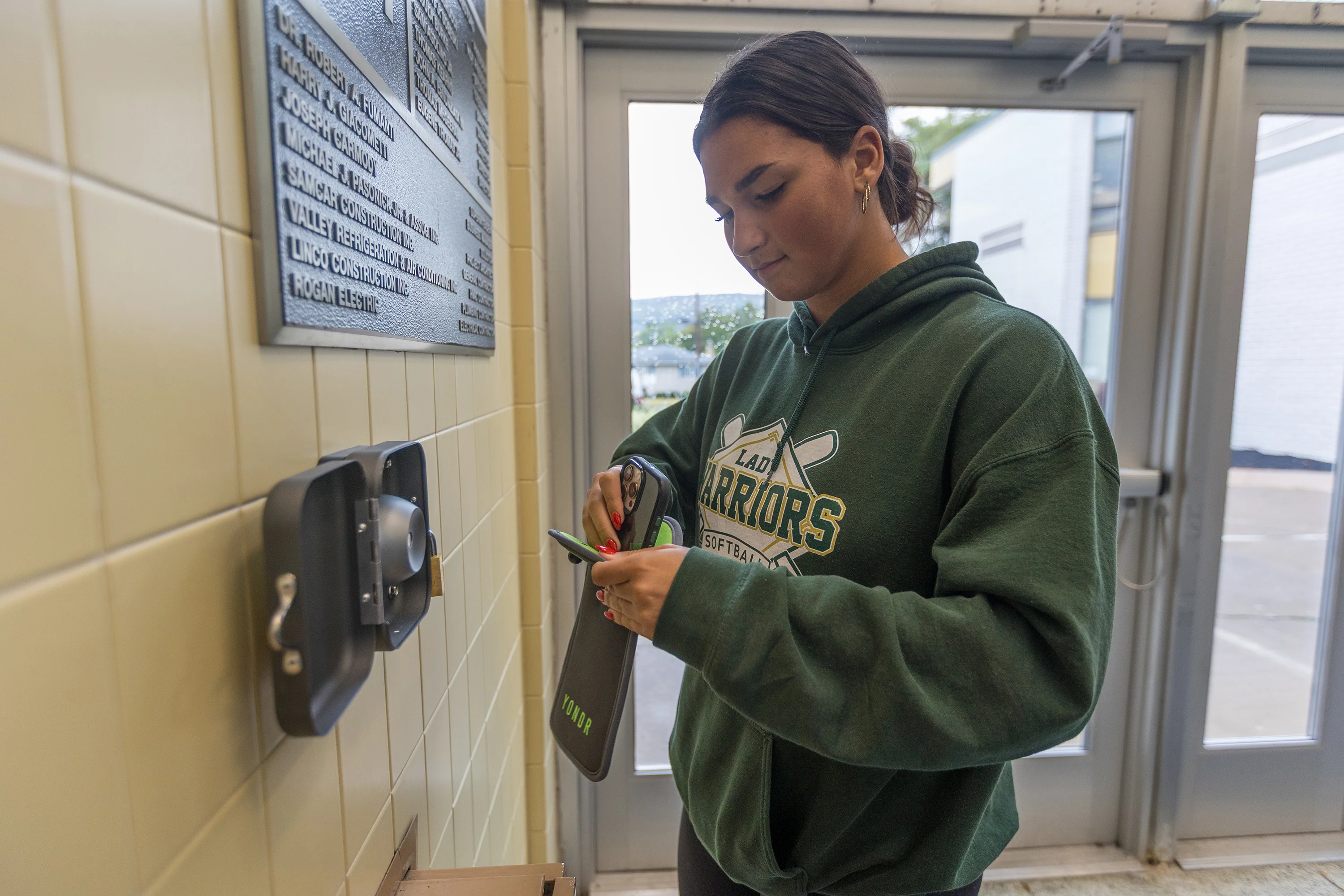
宾夕法尼亚州东北部怀俄明学区(Wyoming Area School District)的学生阿美莉亚娜·沃克(Ameriana Walker)于2025年9月演示Yondr手机袋的运作方式。
Ameriana Walker, a student in the Wyoming Area School District in northeast Pennsylvania, demonstrates how a Yondr pouch works in September 2025.
杰森·阿尔丹/《公民之声报》通过盖蒂图片社美国智能手机的普及,与中小学生阅读和数学成绩的大幅下滑在时间上相吻合。如今,一项新的研究表明,在上学期间将学生的手机放入加锁手机袋中,或许有助于恢复部分历史成绩损失。
Jason Ardan/Citizens’ Voice via Getty Images The rise of smartphones in the U.S. coincided with a dramatic slide in K-12 students' reading and math achievement. Now, new research suggests putting students' phones in locked pouches during the school day may help restore some of those historic losses.
新研究的共同作者之一、哈佛大学的汤姆·凯恩(Tom Kane)表示:“大约从2013年开始,美国学生每年开始损失相当于2到3周的学习进度。这是一个缓慢流失的过程,日积月累之下,让美国的8年级学生落后了将近一年。严格的手机禁令似乎堵住了大约一半的损失。”根据周二发布的研究,这相当于每年挽回1到2周的学习进度。凯恩称,这是一个幅度虽小但具有统计学意义的改善。
"Around 2013, U.S. students started losing 2-3 weeks of learning each year," says Harvard University's Tom Kane, one of the new study's co-authors. "It's been a slow leak that, over time, has put U.S. 8th graders almost a year behind. Strict cellphone bans seem to plug about half of that leak." Or the equivalent of 1-2 weeks of learning a year, according to the study released Tuesday.
另一位共同作者、达特茅斯学院(Dartmouth College)的道格拉斯·斯泰格(Douglas Staiger)补充道:“随着时间推移,这可能会累积起来,就像最初的成绩下降一样。”
That's a small but, according to Kane, statistically significant improvement. "That could add up over time, just as the initial declines did," adds Dartmouth College's Douglas Staiger, another co-author.
该研究的作者表示,这是针对中小学生在学校实施加锁手机袋禁令前后,数学和阅读学生级测试成绩进行的首次全国性分析。这项研究由哈佛大学教育政策研究中心(Center for Education Policy Research)、达特茅斯学院以及中小学测试与研究机构NWEA共同开展。
The study's authors say it is the first nationwide analysis of student-level test scores in math and reading both before and after schools enforced locked-pouch cellphone bans. It was a joint effort between Harvard's Center for Education Policy Research, Dartmouth and NWEA, a K-12 testing and research organization.
在过去的五个学年中,凯恩、斯泰格及其团队分析了涵盖全美300多万名小学、初中和高中生的全国样本,将采用手机袋的学校的测试成绩与未采用手机袋的类似学校的成绩进行了对比。
Kane, Staiger and their teams analyzed a nationwide sample of more than 3 million elementary-, middle- and high-school students over the past five school years, comparing the test scores in schools that adopted phone pouches to the scores at similar schools that did not.
研究人员表示,严格的手机禁令不仅似乎带来了小幅的学习成果提升,而且这些提升在实施的第一年后似乎并未消退。相反,凯恩称,这些提升似乎在一年又一年地延续——至少在采用该禁令后的三年内如此。关于手机禁令的研究结果喜忧参半周二的头条研究结果发现,在学校上课期间锁起手机带来了微小但在统计学上有意义的数学和阅读成绩提升,但这也附带了一个重要的前提:4月份的一项独立研究发现,这些手机袋对学生考试成绩的影响“接近于零”——即便存在收益,它也没有统计学意义上的显著性。
Not only did strict cellphone bans appear to trigger small learning gains, the researchers say, those gains didn't seem to fade out after the first year of implementation. Instead, Kane says, the gains appeared to continue, year after year – at least up to three years after adoption. Research on phone bans is mix Tuesday's headline finding, that locking phones during the school day led to small but statistically significant improvements in math and reading scores, comes with an important caveat: separate study from April, found that these pouches had "close to zero" impact on student test scores – and if there was a benefit, it was statistically significant.
“总的来说,我们没有发现有意义的学业成绩提升的证据,”该4月研究的共同作者、密歇根大学教育政策教授布赖恩·雅各布(Brian Jacob)说。我们该如何看待这些看似矛盾的结果?
"Overall, we didn't find evidence of meaningful achievement gains," says Brian Jacob, a co-author of that April study and a professor of education policy at the University of Michigan. What should we make of these seemingly contradictory results?
这两项研究都是由备受尊敬的研究团队开展的大规模研究。4月的研究所经过了同行评审;而较近的研究尚未经过同行评审。
Both are large-scale studies by well-respected teams of researchers. The April study has been peer-reviewed; the more recent study has not.
两项研究同样关注了学校采用营利性公司容德(Yondr)生产的上锁手机袋的情况。根据周二的论文,在2019-2020学年至2025-2026学年期间,全美有超过3300所学校开始使用这种手机袋。通常情况下,使用这种手机袋的学校要求学生在一天开始时将手机放进去,直到放学时才能取回;放学时,学校管理员会用特殊的磁性装置将手机袋打开。
Both studies similarly focused on schools' adoption of lockable pouches made by the for-profit company Yondr. According to Tuesday's paper, more than 3,300 schools nationwide began using the pouches between the '19-'20 and '25-'26 school years. Typically, schools that use the pouches require that students put their phones in them at the beginning of the day and don't get them back until the end of the school day, when the pouches are unlocked by a school administrator with a special magnetic device.
但这两项研究在关键方面也存在差异。4月的研究汇总了数千所采用容德手机袋的学校的平均考试成绩,而周二的研究则使用了844所学校的学生个人成绩,这些学校既使用了容德手机袋,又使用了西北教育测评协会(NWEA)管理的测试。
But the two studies also differ in key ways. The April study pooled school-level mean test scores at several thousand Yondr-adopting schools, while Tuesday's study used student-level scores at the 844 schools that use both Yondr pouches and tests administered by NWEA.
简而言之,周二发布的研究拥有更细致的学生个人数据,但4月发布的研究能够考察更大规模的学校样本。
Simply put, the study released Tuesday had more fine-grain, student-level data, but the study released in April was able to examine a much larger sample of schools.
不过,这两项研究的发现其实也并不像看上去那么大相径庭。雅各布和他的共同作者确实发现,在使用容德手机袋的高中里,数学成绩取得了统计学上显著的提升。只是这些提升被初中因手机禁令而导致的学习退步给抵消了。
But the two studies' findings also aren't as different as they may seem. Jacob and his co-authors did find statistically significant gains with Yondr pouches in high school math. It's just that those gains were offset by ban-related learning losses in middle school.
总体而言,雅各布表示,这项新研究“令人鼓舞。如果(这种益处)确实能够随着时间的推移持续并累积,它确实可能带来实质性的好处。我认为我们只能拭目以待,看这种情况是否会发生。”
Overall, Jacob says, the new study "is encouraging. And if [the benefit] really persists and accumulates over time, it really could be a meaningful benefit. I think we'll just have to wait and see if that happens."
那项4月研究的另一位联合作者、斯坦福大学教育学院教授汤姆·迪伊谈到周二的调查结果时表示:“我希望他们是正确的,即这些非常小的测试成绩增幅会随着时间推移不断累积并增加。然而,对于从微小、敏感且仅基于几年手机禁令的估算中得出这种外推结论,我感到不太放心。”
Another co-author of that April study, Tom Dee, a professor at Stanford University's Graduate School of Education, says of Tuesday's findings, "I hope they are right that these very small test score gains will aggregate and add up over time. However, I'm not comfortable making that extrapolation from estimates that are small, sensitive and based on just a few years of phone bans."
迪伊表示,综合来看,他认为这些关于手机禁令的早期研究结果“大体上令人失望”,并坚称“我们需要继续就这一主题进行研究”。
Taken together, Dee says, he considers the results from these early studies into cellphone bans "largely disappointing," and insists "we need continued study on this topic."
凯恩对结果的看法则不同。他辩称,即使益处微乎其微,但相对于每名学生大约25美元的成本而言,这些手机袋对学校来说依然合乎经济逻辑。“这仍然比不得不向教师支付额外一周或两周的教学费用要划算得多。”当一切开始出错时,在近四分之一个世纪的时间里(从1990年到2013年),四年级和八年级学生的数学成绩稳步上升。阅读成绩也有所改善。
Kane sees the results differently. Even if the benefit is small, he argues, relative to the cost – roughly $25 per student – these pouches still make financial sense for schools. "That's still a lot less than having to pay teachers for an extra week or two of instruction." When it all went wrong For nearly a quarter-century, from 1990 to 2013, math achievement among fourth- and eighth-graders rose steadily. Reading scores also improved.
随后在2013年前后,学生的测试成绩开始持续下滑,这种下滑一直持续到新冠疫情期间,直到最近才开始放缓。多年来,政客和评论人士将成绩下降归咎于疫情期间的学校停课,但数据说明了另一个不同的故事。
Then around 2013, student test scores began a sustained tumble that continued through the COVID-19 pandemic and has only recently begun to slow. For years, politicians and pundits blamed pandemic-era school closures for the losses, but the data tells a different story.
斯坦福大学研究员肖恩·里尔顿今年早些时候对美国国家公共电台表示:“特别是在阅读方面,测试成绩在疫情爆发前的四到六年里就已经在下降。事实上,如果只看过去10年或12年的测试成绩,你甚至不会真正察觉到疫情的影响。无论有没有疫情,成绩都一直处于一种稳定的下降趋势中。”这就引发了一个问题:2013年前后究竟发生了什么?
"Particularly in reading, test scores were going down for four to six years before the pandemic," Stanford University researcher Sean Reardon told NPR earlier this year "In fact, you wouldn't really know there was a pandemic effect if you just looked at the last 10 or 12 years of test scores. There's been just a steady kind of decline regardless of the pandemic." Which raises the question: What happened around 2013?
可能的解释有很多。联邦政府开始减少追究学校对低考试成绩的责任。在大衰退之后,许多学校的经费也遭到削减。
Possible explanations abound. The federal government began stepping back from holding schools accountable for low test scores. Many schools also saw funding cuts in the wake of the Great Recession.
这项新研究是最新一项提出以下观点的研究:儿童和青少年大规模使用手机也助长了这些考试成绩的下降。
This new study is the latest to make the case that the mass adoption of cell phones by children and teens also helped fuel those test score declines.
研究人员指出,在2011年,拥有智能手机的青少年学生比例不到四分之一。到2018年,这一比例达到95%。其他工业化国家的相似比例与学生学业成绩的类似下降时间吻合。
The researchers note that, in 2011, fewer than a quarter of teen students had access to smartphones. By 2018, 95% did. And similar rates in other industrialized countries coincided with similar student achievement declines.
凯恩表示,他现在想要研究学生在校外的智能手机和社交媒体使用情况。
Now, Kane says, he wants to study students' smartphone and social media use outside of school.