全球煤炭市场目前正出现两种看似矛盾的现象。这种燃料的消费表现出惊人的韧性。在本周于土耳其安塔利亚举行的第31届联合国气候变化大会(COP31)上,除两个国家外,其余193个参会国的煤炭总需求在2019年至2025年间下降了约10%。这本是个好消息,要不是有两个重量级国家:中国和印度,它们合计燃烧了全球每10公吨煤炭中的7公吨。
Two seemingly contradictory things are happening in the world’s coal market right now. Consumption of the fuel is showing remarkable resilience. Across 193 of the 195 countries represented at this week’s COP31 climate conference in Antalya, Turkey, aggregate demand fell by about 10% between 2019 and 2025. That would be good news, if it weren’t for the two heavyweights: China and India, which together burn seven out of every 10 metric tons used globally.
同期,两国煤炭消费量分别增长了13%和28%。加上继续偏向煤炭的政策,这足以让全球需求自2023年以来维持在每年约90亿吨的水平——偏偏就是在世界迫切需要煤炭需求快速且不可逆转地下降之际。
Their consumption rose by 13% and 28%, respectively, over the same period. Combined with policies that continue to favor coal, that has been enough to keep global demand bumping along at about 9 billion tons a year since 2023 — just when the world desperately needs a rapid and irreversible decline.
然而,顽固的高消费并不意味着现在是当煤矿工人的好时机。中国和印度通过容量电价补偿和有利的合同条款,为本国发电企业和矿企提供了缓冲。出口商却没有这种保护。随着大片行业领域每挖出一吨煤都在亏损,海运煤炭贸易已演变成一场类似《鱿鱼游戏》式的生存厮杀。
Yet stubbornly high consumption doesn’t mean it’s a good time to be a coal miner. China and India have been able to cushion domestic generators and miners with capacity payments and favorable contract terms. Exporters have no such protection. With swaths of the industry losing money on every ton dug from the ground, the seaborne coal trade has become a Squid Game-style fight for survival.
土耳其的主要煤炭供应国俄罗斯和哥伦比亚是重灾区。俄罗斯政府上月估算,约70%的俄罗斯煤炭公司无法盈利,该行业今年预计亏损3240亿卢布(约合39亿美元)。即使价格好转,亏损预计将在2027年延续至第四个连续年头。在库兹涅茨克煤田——俄罗斯约一半煤炭的产地——去年有7000人失业,约三分之一的矿企关闭或陷入财务困境。
Turkey’s principal coal suppliers Russia and Colombia are ground zero. About 70% of Russian coal companies can’t make a profit and the industry is likely to lose 324 billion rubles ($3.9 billion) this year, the government estimated last month. Losses are expected to continue into a fourth consecutive year in 2027, even if prices improve. In the Kuznets basin, from where about half of Russia’s coal is extracted, 7,000 people lost their jobs last year and roughly a third of mining companies are shut or financially distressed.
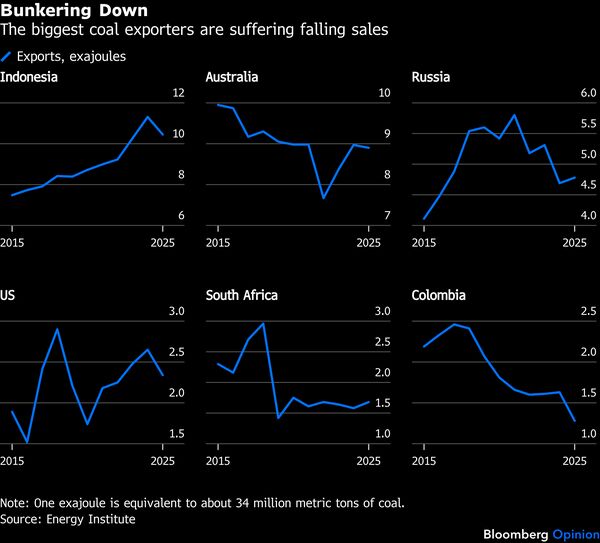
哥伦比亚的矿山曾在1990年代和2000年代帮助为欧洲提供动力,如今也感受到了挤压。2025年出口下降近四分之一,降至2003年以来的最低水平。嘉能可去年对Cerrejón煤矿——拉美最大煤矿,资源量达50亿吨——计提8.59亿美元减值,并计划在2034年开采权到期时将其移交政府。南非的出口矿山如今勉强维持盈利,似乎将成为下一个。
Colombia, whose mines helped power Europe through the 1990s and 2000s, is also feeling the squeeze. Exports fell by nearly a quarter in 2025, to their lowest level since 2003. Glencore Plc last year wrote $859 million off the value of Cerrejón — Latin America’s biggest coal mine, with a 5 billion-ton resource — and plans to hand it back to the government when its rights expire in 2034. South Africa, where export mines are barely making a profit these days, looks to be next in line.
这些业务在如此惨淡的条件下仍在运营,这一事实揭示了衰退大宗商品残酷的经济逻辑。矿商不需要需求复苏,他们需要竞争对手先倒闭。
The fact that these operations are still running amid such bleak conditions is a clue to the brutal economics of a declining commodity. Miners don’t need demand to recover. They need their competitors to fold first.
如果有足够多的俄罗斯矿山倒闭,海运市场将收紧,推高价格,使哥伦比亚和南非的亏损业务重新转为盈利。这应能为它们争取一些时间,直到需求的下一轮下行再次将它们置于风口浪尖。对美国、印度尼西亚和澳大利亚——海运贸易中仅存的其他主要参与者——而言,未来看起来不像是喘息,而更像是缓刑。
If enough Russian mines go under, the seaborne market will tighten, lifting prices and pushing loss-making operations in Colombia and South Africa back into the black. That should buy them some time before the next leg down in demand puts them in the firing line. For the US, Indonesia and Australia — the only other major players in the seaborne trade — what lies ahead looks less like a reprieve than a stay of execution.
这种衰退具有历史对称性。海运煤炭正受到与威胁液化天然气未来相同的无情经济规律挤压。两大行业都在1970年代石油冲击后崛起,当时进口国在寻找替代品,以摆脱对中东原油的依赖。
There’s a historical symmetry to this decline. Seaborne coal is being squeezed by the same remorseless economics that threaten the future of liquefied natural gas. Both industries took off in the aftermath of the 1970s oil shocks, when importers went searching for alternatives to dependence on Middle Eastern crude.
煤炭和天然气在就近消费时成本相对较低,尤其是当其井口价格未计入污染造成的气候和健康损害时。然而,一旦将它们装上铁路或船只、运往地球另一端,经济账就迅速恶化。高昂的运输成本使它们在能源市场上难以竞争,因为廉价、清洁的可再生能源正在持续压低价格。
Coal and gas can be relatively cheap when consumed close to the source, especially when their pit-head price excludes the climate and health damage their pollution causes. Put them on a railway or a ship and transport them halfway around the world, however, and the economics deteriorate fast. Hefty transport costs leave them struggling to compete in energy markets where cheap, clean renewable power is relentlessly pushing prices lower.
以西伯利亚矿工为例。中国电力公司每支付 100 美元购买一公吨煤炭,矿井端仅能收回约 25 美元。其余资金用于支付将全球最脏能源运至太平洋港口并沿海运输的天价成本。情况更糟的是,要与本地新建风电和光伏电站的成本竞争,中国电力公司需将采购价压至每吨约 75 美元。在运输成本基本不变的情况下,矿井端将几乎一无所获 —— 矿工的收入将归零,更别提利润了。
Consider those Siberian miners. For every $100 a Chinese utility pays for a metric ton of their coal, barely $25 makes it back to the pit. The rest pays for the astronomical cost of transporting the world’s dirtiest energy to a Pacific port and shipping it down the coast. It gets worse. To compete with the local cost of new wind and solar plants, the Chinese utility needs to be paying about $75 a ton. With transport costs largely unchanged, that would leave virtually nothing at the mine gate — wiping out the miner’s revenue, never mind its profits.
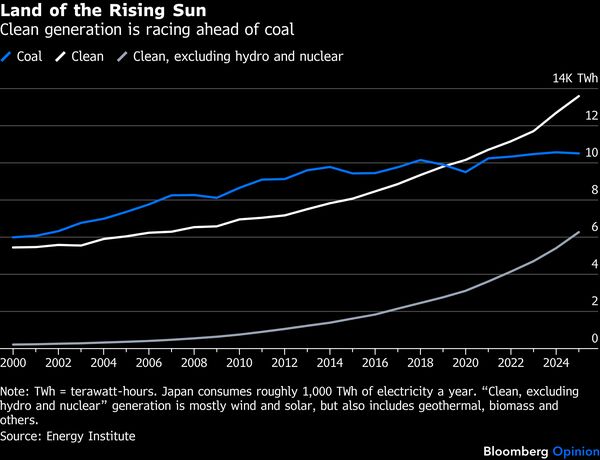
这大体就是当前的局面。尽管面临液化天然气短缺、化石能源政策扶持,以及政府出台法规限制风电和光伏发展,中国化石能源发电量在 2026 年将连续第二年下降。
That’s broadly the situation we’re seeing right now. Despite LNG shortages, policy support for fossil fuels, and government regulations to put a brake on wind and solar, Chinese fossil generation is declining in 2026 for the second year running.
煤炭行业曾设想需求上升、利润丰厚的未来。那些日子早已一去不复返。如今所谓的“好消息”仅是:消费量下降速度不如避免毁灭性气候变化所需的速度快。
The coal industry once imagined a future of rising demand and healthy profits. Those days are long gone. What passes for good news these days is that consumption isn’t falling as fast as we need to avoid devastating climate change.
在同时关闭矿井、裁员、亏损和资产减值的情况下,这算不上成功。能源的未来是本地化的。煤炭的问题在于:它的矿井不是。
That's an odd definition of success when you’re simultaneously shutting mines, laying off workers, losing money and writing down assets. The future of energy is local. Coal’s problem is that its mines aren’t.