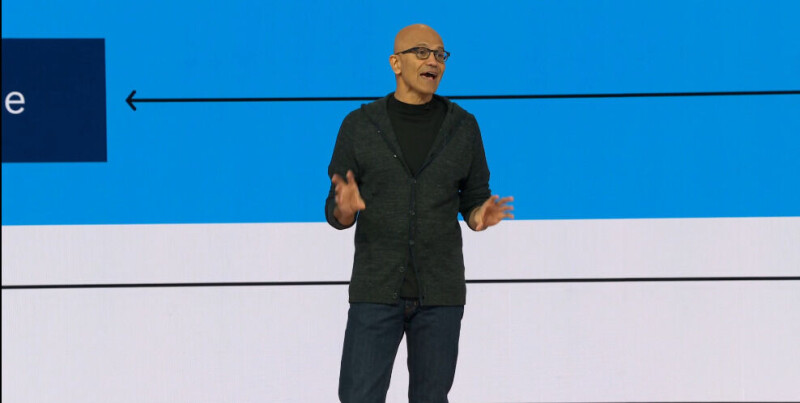
微软首席执行官萨提亚·纳德拉周二在Ignite大会的主题演讲全围绕“信任”展开。他开场承诺,将在上周大规模M365服务中断后赢回信任,随后重点阐述组织信任其AI模型的必要性。
Microsoft CEO Satya Nadella's Ignite conference keynote on Tuesday was all about trust. He opened by promising to earn back trust after last week's massive M365 outage and went on to focus on the need for organizations to trust their AI models.
纳德拉表示:“所以,上周在一定意义上是一个提醒,提醒我们数字基础设施作为世界‘拨号音’是多么关键。我们知道你们对我们服务的信任,并极其严肃地对待这一责任。在此背景下,我知道我们还有工作要做,以提供你们可以依赖、世界可以依赖的韧性,我们致力于确保吸取教训、持续改进。”
"So last week in some sense was really a reminder of how critical digital infrastructure is as the dial tone for the world," said Nadella. "We know the trust you place in our services and take that responsibility extremely seriously. And in that context, I know we have work to do to provide that resilience that you can count on, the world can count on, and we are committed to ensuring that we learn and we continuously improve."
在旧金山莫斯科尼中心发表演讲时,纳德拉描述了公司在构建他所谓的“前沿生态系统”过程中的三大关注领域:“始终以人为本,确保你们拥有对组织智能与学习的所有权,以及信任。”
Speaking at San Francisco's Moscone Center, Nadella described three areas of focus for the company as it works to build what he referred to as a frontier ecosystem: "Keeping the human at the center of it all, ensuring that you have ownership over your organization's intelligence and learning, and trust."
就在几周前刚向6万名员工提供离职买断方案,此时强调“以人为本”颇难令人信服。在描述从手写代码向智能体编写代码转变时,纳德拉指出,开发者已从构建软件制品转向构建“制造这些制品的软件工厂”。他说:“这里重要的是要记住,人的意图、判断、经验、技能、专长依然至关重要。”人们或许会评判开发工作,但若问他们是否仍拥有亲手编写每一行代码时那种所有权感,答案恐怕不同。
Anthrocentrism is a tough sell just weeks after offering buyouts to 60,000 employees. Describing the shift from hand-written code to agent-written code, Nadella suggested developers have moved from building software artifacts to building software factories that build those artifacts. "The important thing here though is to remember still that that human intent, that judgment, that experience, skills, expertise all very much matter," he said. People may judge development work, but ask them whether they have the same sense of ownership as when they wrote every line.
至于确保组织拥有对其智能的所有权,这对一家投入巨资建设云算力专门运行AI工作负载的公司而言,近乎异端邪说。如果每个人真拥有自己的机器学习模型,并在自己的数据中心和员工电脑上运行,Azure将陷入麻烦。
As to ensuring that organizations have ownership over their intelligence, that borders on heresy for a company with massive cloud computing commitments specifically to run AI workloads. If everyone really owned their machine learning models and ran them in their own data centers and on employee computers, Azure would be in trouble.
然而,纳德拉强调了所有权——考虑到谁拥有AI生成代码以及代码是否可受版权保护的法律模糊性,这一点并非显而易见。“在AI时代,关键问题是个体企业如何持续构建并拥有其学习成果和隐性知识?”他说。“要让经济保持为一个众多企业共存并繁荣的经济,智能按定义就需要广泛分布,而不是仅仅坍缩为几个模型。”
Yet Nadella emphasized ownership – which isn't at all obvious given the legal ambiguity of who owns AI generated code and whether it can be copyrighted. "In the age of AI, the key question is how do individual firms continually build and own their learning and tacit knowledge?" he said. "For an economy to remain an economy where many firms exist and thrive, intelligence by definition needs to be broadly distributed versus just collapsed into a couple of models."
简而言之,纳德拉正在推动客户对AI数据的控制权,这些数据主要在从微软租用的设备上处理,并允许一定程度的客户自控基础设施。但这仍应引起Anthropic和OpenAI等前沿AI实验室的担忧,它们倾向于一种白手套、黑盒的服务模式,由它们充当访问的仲裁者。至于纳德拉愿景的第三支柱——信任,则依然缺位。“你怎么能信任所有这些强大的技术?”纳德拉问道。
Suffice to say that Nadella is promoting client control over AI data that's processed mostly on equipment rented from Microsoft, with some allowance for customer-controlled infrastructure. But that still ought to concern frontier AI labs like Anthropic and OpenAI that favor a white-glove, black-box service model where they are the arbiters of access. As for the third pillar of Nadella's vision, that's trust, which remains missing in action. "How can you even trust all this powerful technology?" Nadella asked.
“现实是,按定义,你无法做到。换句话说,将智能的供给与对智能的控制权分离开来,成为一种架构上的必要要求。因此,我们的目标是构建一个解决这三大架构必要性的技术栈。”
"And the reality is, by definition, you can't. In other words, it becomes an architectural imperative to separate the supply of intelligence from the authority over it. And so our goal is to build a stack that addresses these three architectural imperatives."
微软最初的技术栈建立在操作系统的所有权之上。但该公司对AI的投入程度之深,使其现在用过去专门留给Windows的措辞来描述Copilot。“Copilot是工作的新操作系统,”纳德拉说。AI正在吞噬软件,而微软正全力拥抱这一趋势。十五年前,风险投资家马克·安德森曾著名地断言软件正在吞噬世界。现在,包括Copilot在内的AI正在吞噬软件。
Microsoft's original stack was built on ownership of the operating system. But the company's commitment to AI is such that it now describes Copilot in the terms once reserved for Windows. "Copilot is the new operating system for work," said Nadella. AI is eating software, and Microsoft is here for it Fifteen years ago, venture capitalist Marc Andreessen famously observed that software is eating the world. Now AI, including Copilot, is eating software.
“应用程序只是Copilot的插件,”纳德拉沉吟道。“这就是为什么我们实际上已将Office的所有功能、其所有的丰富性,直接内置进了Copilot。”Copilot也在吞噬其他公司。
"Apps are just plugins to Copilot," Nadella mused. "That's why we in fact have brought all of Office, all of its richness, right built into Copilot." Copilot is eating other companies too.
纳德拉表示,微软正在通过为特定行业任务提供技能、连接器和插件,将 Copilot 扩展至承担特定角色。为此,“Copilot 是通往 Dynamics 365 的新入口”,后者现已提供 CRM 插件。纳德拉还宣布与 Salesforce 达成名为 Copilotforce 的合作伙伴关系,将 Salesforce 的上下文引入 Copilot、Teams 和 Fabric。他还大力推介了 Microsoft IQ,这是该公司新的企业上下文管理平台。
Nadella said Microsoft is extending Copilot to take on specific roles by providing skills, connectors, and plugins for industry-specific tasks. Toward that end, "Copilot is the new front door to Dynamics 365," which now offers CRM plugins. And Nadella announced a partnership with Salesforce called Copilotforce that brings Salesforce context into Copilot, Teams, and Fabric. He also talked up Microsoft IQ, the company's new enterprise context management platform.
“IQ 背后的理念是帮助每个组织在组织内部构建、保留并持续改进自身的智能,”纳德拉说道,并将其描述为 Copilot 底层上下文系统的外部化。
"The idea behind IQ is to help every organization build, retain, and continuously improve your own intelligence across the organization," said Nadella, describing it as an externalization of the context system underlying Copilot.
纳德拉接着宣布了 GitHub Copilot Fusion 的新模型系列,GitHub 是微软旗下的代码托管子公司,Copilot Fusion 是其模型编排与路由产品。他指出,在 Terminal Bench(衡量 AI 代理利用终端完成任务能力的基准)上,Copilot Fusion 目前的排名高于 Anthropic 的 Claude Opus 5.5,且成本不到后者的一半。此外还有 Copilot Workspaces,纳德拉将其描述为 Copilot 的多人协作版。它不再是单人与模型交互的聊天窗口,而是一个供团队协作并与模型共享上下文的界面。
Nadella went on to announce a new model family for GitHub Copilot Fusion, its code hosting subsidiary's model orchestration and routing play. He noted that Copilot Fusion today is ranked above Anthropic's Claude Opus 5.5 at less than half the cost on Terminal Bench, a measurement of how well AI agents complete tasks using a terminal. Then there's Copilot Workspaces, which Nadella described as a multiplayer version of Copilot. Instead of a chat window where one person interacts with a model, it's an interface for team collaboration that shares context with a model.
微软的决策模型旨在挑战 TypeSafe AI 的 Jev,约一个月前首次亮相,现已推出 Decisions 1.1 正式版。“我们提升了性能,使决策更准确、响应更快,”纳德拉表示。“已有超过 4000 位客户在使用它。”随后他表示,Microsoft Foundry 将提供 OpenAI 的 GPT-6.2,这可能引起了一些困惑,因为当时 OpenAI 并无此模型。
Microsoft's decision model, intended to challenge TypeSafe AI's Jev, debuted about a month ago and now Decisions 1.1 is generally available. "We have improved performance, making decisions more accurate and responses faster," said Nadella. "Already over 4,000 customers have used it." He then said that Microsoft Foundry would offer OpenAI's GPT-6.2, which may have caused some confusion because at that point, OpenAI had no such model.
不久后,OpenAI 发布了 GPT-6.2 Astra 和 Sol。微软还推出了新的编程模型,即 Code 2、Code 2 Flash 和 Cyber 2 Flash,并表示其新一代 Cobalt 200 虚拟机现已正式上线。这是一个信任问题在列举了微软为帮助组织实现智能所有权而准备的各种产品和服务后,纳德拉回到了信任问题上。“今天我们几乎可以看到模型接触的一切,但你看不到模型内部发生了什么,”他说。
A short time later, OpenAI announced GPT-6.2 Astra and Sol. Microsoft also rolled out new coding models, in the form of Code 2, Code 2 Flash, and Cyber 2 Flash, and said its next-gen Cobalt 200 VMs are generally available. It's a question of trust After rattling off the various products and services Microsoft has prepared to help organizations with intelligence ownership, Nadella returned to the question of trust. "Today we can see almost everything that models touch, but you cannot see what happens inside a model," he said.
“更糟糕的是,我们知道模型告诉我们的关于它自己的信息甚至不是独立证据,因此无法被信任。”
"And really what's worse is that we know that what a model tells us about itself is not even independent evidence and therefore cannot be trusted.
“一个模型监控另一个模型也存在同样的问题。所以你本质上拥有这些不可接受的嵌套黑箱集合,而我们现在需要让它们变得透明且可验证。”
"And one model monitoring another model has the same issue. So you essentially have these unacceptable nested sets of black boxes, which we now need to make transparent and verifiable."
微软弥合信任鸿沟的尝试是“微软透明度计划”。该公司表示,这将涉及与美国国家标准与技术研究院(NIST)“SI智能体标准计划”的合作。微软AI是否将与NIST SI兼容仍有待观察。该计划还呼吁与其他组织合作,制定可问责、可验证、厂商中立的AI透明度标准,并要求微软将这项工作融入微软AI、Foundry和Copilot中。明年再来看看透明度是否实现。®
Microsoft's bid to bridge the trust gap is the Microsoft Transparency Initiative. The company says this will involve engagement with the National Institute of Standards and Technology's "SI Agent Standards Initiative." Whether Microsoft AI will be compatible with NIST SI remains to be seen. That initiative also calls for collaboration with other organizations to develop accountable, verifiable, vendor-neutral AI transparency standards, and for Microsoft to incorporate this work into Microsoft AI, Foundry, and Copilot. Check in next year to see whether transparency is achieved. ®