随着美国芯片限制令对数据中心融资产生疑问,并加大了投资者从拥挤的银行仓位中撤出的压力,对亚洲人工智能交易的担忧开始蔓延至新加坡的借贷机构。
Concerns over Asia’s artificial intelligence trade are starting to spill into Singapore’s lenders, as US chip curbs cast doubts on data-center financing and add pressure on investors to exit crowded positions in banks.
花旗集团已指出,华盛顿对中国获取高端人工智能芯片实施广泛限制,加之人工智能加速器的前景疲软,给该城邦的银行带来了资产质量风险。汇丰控股认为,投资者有空间将投资从借贷机构分散到韩国非科技公司等领域。
Citigroup Inc. has flagged asset-quality risks for the city-state’s banks stemming from Washington’s sweeping restrictions on China’s access to high-end AI chips and from a weaker outlook for AI accelerators. HSBC Holdings Plc sees scope for investors to diversify away from lenders into areas including South Korea’s non-technology companies.
这些担忧突显了围绕人工智能交易日益增长的不确定性正如何超出科技股范畴,从而使曾协助资助该地区数据中心及其他数字基础设施快速扩张的借贷机构面临更严格的审视。
The concerns underscore how the growing uncertainty around the AI trade is spreading beyond technology stocks, putting greater scrutiny on lenders that have helped finance the region’s rapid build-out of data centers and other digital infrastructure.
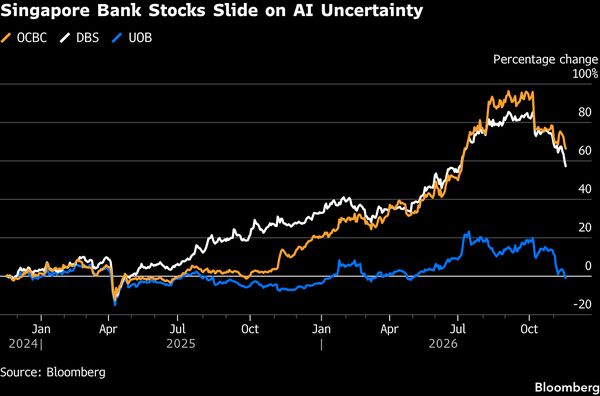
花旗分析师谭永鸿和黄费利在报告中写道:“我们先前的预测假设了极其低廉的整个周期信贷成本。”修正后的假设“基于来自对东南亚的新芯片限制以及较低的全球人工智能加速器预测所带来的重大不确定性,近期以大幅折价出售的汇丰数据中心贷款凸显了不断增加的资产质量风险。”该城邦的三大银行于周三下跌,其中华侨银行盘中一度下跌2.4%,创下7月以来最低水平。大华银行盘中一度下跌2.5%,创下4月30日以来的最低价格,而星展集团控股则触及四个月低点。
“Our prior forecast assumed exceptionally low through-cycle credit costs,” Citi analysts Yong Hong Tan and Ferry Wong wrote in a note. The revised assumptions are “predicated on significant uncertainty from new chip curbs to Southeast Asia, lower global AI accelerator forecast, with increased asset quality risks evident in recent HSBC data-center loans sold at steep discounts.”The city-state’s three major banks fell on Wednesday, with Oversea-Chinese Banking Corp. declining as much as 2.4% to its lowest since July. United Overseas Bank declined as much as 2.5% to its lowest price since April 30, while DBS Group Holdings hit a four-month low.
与此同时,汇丰指出韩国是投资者可以扩大投资敞口的领域之一。在吸引了来自东盟其他地区的资金流入后,新加坡银行的估值变得昂贵。以赫勒尔德·范德兰德为首的分析师在报告中写道,约有42%聚焦亚洲的基金目前对新加坡持超配态度,高于2024年4时的20%。
Meanwhile, HSBC pointed to South Korea as one area where investors could broaden exposure. Singapore banks are expensive after attracting flows from elsewhere in Asean. About 42% of Asia-focused funds are now overweight Singapore, up from 20% in April 2024, analysts led by Herald van der Linde wrote in a note.
汇丰分析师表示:“尽管人工智能仍将是亚洲股市的核心叙事,但我们预计到2027年将提供更广泛的投资选择,包括受科技板块疲软情绪影响的韩国非科技板块,以及寻找机会从新加坡银行等其他拥挤仓位中分散投资。”
“While AI will remain central to Asia’s equity story, we expect 2027 to offer an expanded set of investment choices, including Korea’s non-tech sectors, which have been affected by the weak sentiment in the tech sector, as well as opportunities to diversify away from other crowded positions such as Singapore banks,” HSBC analysts said.