在美国与伊朗的战争、乌克兰与俄罗斯的战斗等大标题新闻之外,许多其他致命冲突仍在持续蔓延。随着新型武器的研发与装备,以及全球秩序的持续恶化,这些冲突在未来一年可能变得更难被忽视。
Beyond the headlines of America’s war with Iran and Ukraine’s battling with Russia, many other deadly conflicts are rumbling on. And as new weapons are developed and adopted, and the global order continues to decay, these may become harder to ignore in the coming year.
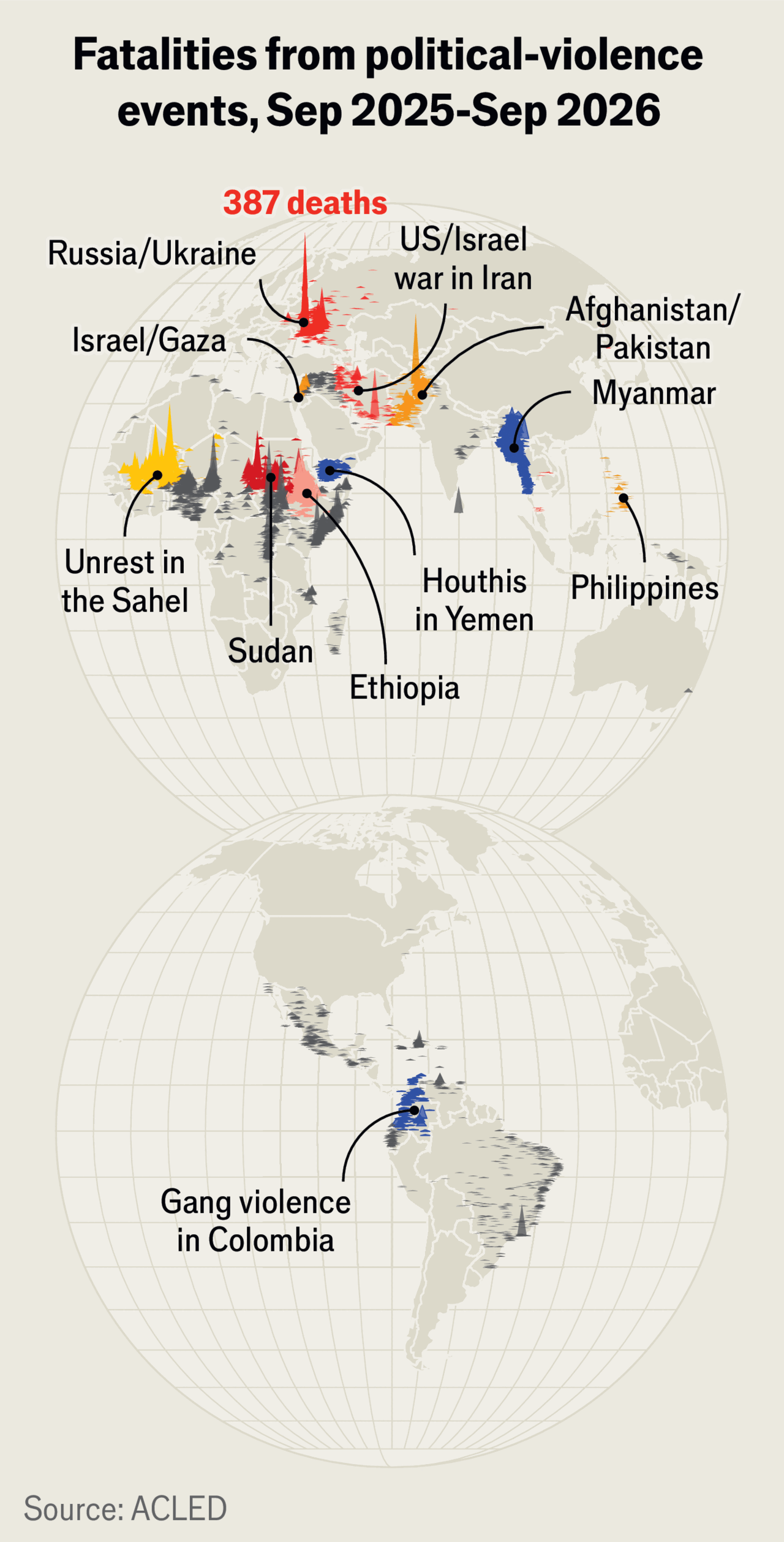
生活在冲突附近的人比你想象的要多。我们对武装冲突位置与事件数据项目(ACLED,一个冲突监测机构)的数据进行分析发现,截至2026年9月15日的一年间,至少有3亿人居住在距离发生过致死政治暴力冲突(造成两人及以上死亡)不到5公里(约3英里)的地方。而在25个国家,同期发生了超过100起此类致命事件。
More people live close to conflict than you might expect. Our analysis of data from Armed Conflict Location & Event Data (ACLED), a conflict monitor, finds that in the year to September 15th 2026, at least 300m people lived less than 5km (three miles) from a clash where two or more people were killed in political violence. And in 25 countries, there were more than 100 such deadly incidents over that period.
冲突造成的总死亡人数未知。由于ACLED的记录基于媒体报道,在贫困且暴力频发的地区记录往往不全。而且并不明显该将哪些冲突纳入统计。犯罪与革命的界限难以划清,政府与匪帮的界限同样难以界定。
The total number killed in conflict is unknown. Because ACLED’s records are based on media reports, they are patchy in poor and violent places. And it is not obvious which clashes to count. The line between criminal and revolutionary can be hard to draw, as can the line between government and bandit.
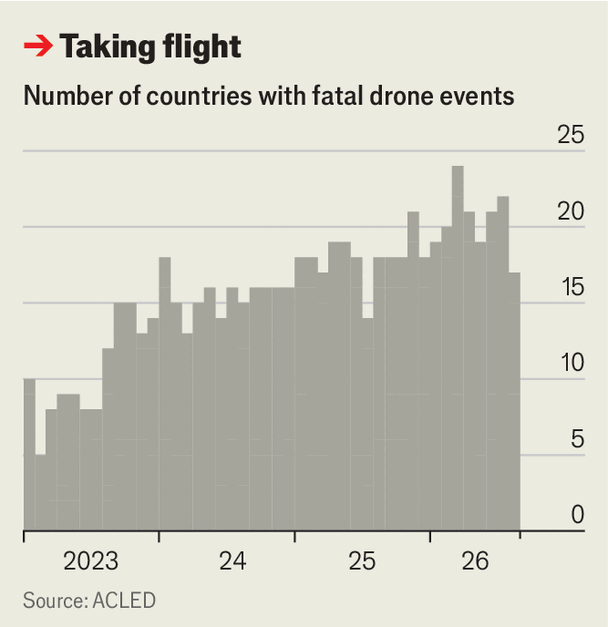
明确的是,全球冲突正在发生变化。截至2026年9月中旬,无人机已在至少36个国家被用于致命袭击,超过2025年全年。星链及其他卫星通信设备在伊朗、缅甸、乌克兰和委内瑞拉的冲突中被缴获或摧毁。
What is clear is that conflicts around the world are changing. By mid-September 2026, drones had been used in deadly attacks in at least 36 countries, more than in the whole of 2025. Starlink and other satellite-communication devices were seized or destroyed in clashes in Iran, Myanmar, Ukraine and Venezuela.
一些帮派如今对主导现代战争的装备拥有的实战经验,可能比许多常规军队还要丰富。5月,哥伦比亚时任总统古斯塔沃·佩特罗告诉部队——他们是拉美最老练的部队之一——“贩毒集团拥有制空优势。”这场技术革命的全球效应并非理论推演。控制也门部分地区的胡塞武装向曼德海峡的商业航运开火,迫使许多船只改道。在正常时期,按价值计算,承载16%海运贸易的船只会通过该海峡。
Some gangs may now have more practical experience with the kit dominating modern warfare than many conventional armies do. In May Colombia’s then president, Gustavo Petro, told his troops, among the most seasoned in Latin America, that “narco-traffickers have the aerial advantage.”The global effects of this technological revolution are not theoretical. The Houthis, who control parts of Yemen, have fired on commercial shipping in the Bab al-Mandab strait, prompting many vessels to take alternative routes. In normal times, ships carrying 16% of seaborne trade by value would pass through it.
胡塞武装并非唯一活跃在关键水道附近的反政府武装。苏丹海岸线仍是该国内战中争夺的奖品,这场冲突在俄乌战争之后,极有可能是全球最致命的冲突。在泰国南部,距离马六甲海峡不远处,一场叛乱已持续进入第三个十年。而在南海对岸的菲律宾,共产主义叛乱已延续近60年。
The Houthis are not the only rebel group near a critical waterway. Sudan’s coastline remains a prize in the country’s civil war, which is probably the world’s deadliest conflict after that between Russia and Ukraine. In southern Thailand, not far from the Strait of Malacca, an insurgency is now in its third decade. And across the South China Sea in the Philippines, communist rebels are nearly 60 years into theirs.
大国同样可能在混乱中看到机遇。2026年,美国推翻并抓捕了委内瑞拉独裁者。在缅甸,中国既与满手血腥的军政府合作,也与大量武装反政府组织合作,以推进其议程。在非洲萨赫勒地区,伊斯兰武装分子等势力仍在俄罗斯及其雇佣军部队的怂恿下持续活动。
Great powers, too, may see opportunity in the disorder. In 2026 America toppled and captured Venezuela’s dictator. In Myanmar, China works with both the blood-soaked regime and a vast array of armed rebel groups to advance its agenda. In Africa’s Sahel, Islamists and others continue to be egged on by Russia and its mercenary forces.
人们很容易假设长期存在的小规模叛乱将继续保持小规模。但历史是由例外塑造的。近年来,全球动荡与新型武器帮助小型武装扩张为能够抗衡大国的力量。出于不同原因,美国和中国的领导人都应牢记这一点。■
It is easy to assume that long-running, small-scale insurgencies will remain small. But history is shaped by exceptions. In recent years, global disorder and new weapons have helped small groups expand into forces able to defy great powers. That is something that leaders in America and China, for different reasons, would do well to remember. ■