明年将是一次不同寻常记者会的20周年。2007年3月,时任中国总理温家宝在全国人大闭幕后面对记者提问。有人抛了一个软球问题:中国能否延续快速增长(超过10%)和低通胀(低于3%)?他的回答出奇地尖锐。他说,现在不是“吹嘘”的时候。中国的发展是“不稳定、不平衡、不协调、不可持续”。
The coming year will mark the 20th anniversary of an unusual press conference. In March 2007 Wen Jiabao, then China’s prime minister, faced reporters after a meeting of the country’s parliament. He was asked a soft question: could China continue its fast growth (over 10%) and low inflation (under 3%)? His answer was surprisingly edgy. There was no time to “boast”, he said. China’s development was “unstable, unbalanced, uncoordinated and unsustainable”.
这“四个不”迅速为人熟知,概括了许多人对中国奇迹般增长的担忧。温家宝解释说,中国的快速进步之所以不稳定,是因为过度放贷;之所以不平衡,是因为沿海城市遥遥领先于农村腹地;之所以不协调,是因为制造业投资与消费脱节,导致经济依赖出口;而增长之所以不可持续,是因为其对环境造成的代价。
The “four uns”, as they quickly became known, encapsulated many people’s fears about China’s miracle growth. The country’s rapid progress was unstable, Mr Wen explained, because of excessive lending. It was unbalanced because coastal cities had raced ahead of rural backwaters. It was uncoordinated because manufacturing investment was out of sync with consumption, leaving the economy reliant on exports. And growth was unsustainable because of its toll on the environment.
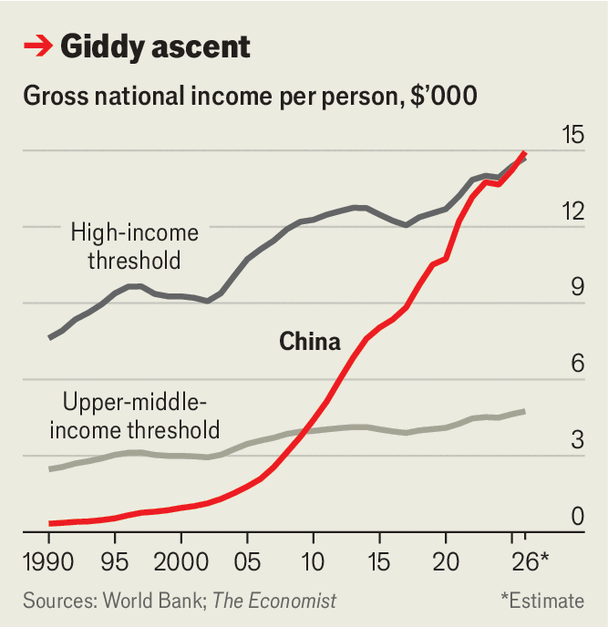
20年后的今天,这对中国前景还有意义吗?表面上看,没有。经济已变得面目全非。根据世界银行标准,2007年中国属于“中低收入”国家。到2027年7月,它大概率将跻身高收入国家行列(见图表)。
Is this relevant to China’s prospects 20 years later? On the face of it, no. The economy has changed beyond recognition. In 2007 it was classed as “lower middle-income”, according to the World Bank. In July 2027 it will probably be crowned a high-income country (see chart).
中国更繁荣的经济也更加平庸。现在的增长速度不足温家宝拒绝吹嘘的那一半。2026年将达到4.5%-5%的官方增长目标,但决策者明年不会设定更具雄心的目标。
China’s more prosperous economy is also more pedestrian. It is now growing at less than half the rate Mr Wen refused to boast about. It will reach the official growth target of 4.5-5% in 2026, but policymakers will not aim for anything more ambitious in the year ahead.
中国也将达不到温家宝曾被问及的3%通胀率。在他主政时期,低通胀是罕见而值得称道的成就。在今天的中国,低通胀却是一种长期而危险的状况。按某些衡量标准,从2023年到2025年,物价连续三年下跌。伊朗战争推高了燃料和石化产品成本,从而终结了这一轮下跌。但在未来一年,这些高价格将成为衡量进一步通胀的基准。如果大宗商品价格停止上涨甚至下跌,中国在2027年很容易重新陷入通缩。
China will also fall short of the 3% inflation rate that Mr Wen was quizzed about. In his time low inflation was a rare and praiseworthy accomplishment. In today’s China it is a chronic and dangerous condition. Prices fell for three years in a row from 2023 to 2025, by some measures. The Iran war brought that run to an end, by pushing up fuel and petrochemical costs. But in the year ahead those high prices will be the baseline from which further inflation is measured. If commodity prices stop increasing or even fall, China could easily slip back into deflation in 2027.
尽管中国在过去二十年发生了转变,温家宝所指出的某些失衡仍然困扰着这个国家。一个突出的例子是贸易顺差。制造业产能的快速扩张仍与消费需求增长乏力不相匹配。结果是商品过剩——生产出来却未被国内吸收,中国转而将其卖给世界其他地区。
Despite China’s transformation over the past two decades, some of the imbalances Mr Wen identified still afflict the country. A glaring example is its trade surplus. Rapid expansion of manufacturing capacity is still out of sync with lacklustre growth in consumer demand. The result is a surfeit of goods, produced but not absorbed at home, which China instead sells to the rest of the world.
另一个仍然困扰中国政策制定者的旧失衡是债务。2007年温家宝对信贷过度扩张发出警告后,问题只是变得更糟。为应对全球金融危机,中国让地方政府通过表外融资工具借款。这些工具的债务现在超过60万亿元人民币(9万亿美元),占GDP的45%。作为回应,中央政府对地方官员实施了更严格的财政纪律。这打击了投资。省市级官员正试图修复资产负债表,而不是扩大基础设施。
Another old imbalance that still haunts China’s policymakers is debt. After Mr Wen warned about excessive credit creation in 2007, the problem only got worse. To combat the global financial crisis, China let local governments borrow through off-balance-sheet financing vehicles. The debts of these vehicles now exceed 60trn yuan ($9trn), or 45% of GDP. In response, the central government has imposed tighter financial discipline on local officials. That hit investment. Provincial and city officials are trying to repair their balance-sheets rather than expanding their infrastructure.
扭转这一放缓,可能是中国在2027年维持增长、抵御通缩和缩小贸易顺差的最大希望。政府已开始调动资金,用于其所谓的“六张网”:电信、算力、物流、电力、城市地下管网和水网。五年内可能投入25万亿元人民币。
Reversing this slowdown is probably China’s best hope for maintaining growth, warding off deflation and narrowing the trade surplus in 2027. The government has begun mobilising money to spend on what it calls the “six networks”: telecoms, computing, logistics, power, underground city pipelines and water. It could spend 25trn yuan over five years.
批评者会指出,这笔支出可能只是通过加剧另一个失衡(中国对投资的过度依赖)来收窄一个失衡(贸易顺差)。这话没错。如果政策制定者转而通过快速增加消费支出提振经济,那会更好。可惜,储蓄习惯不会一夜之间改变,消费者信心也无法靠命令凭空产生。温先生指出消费与生产不协调,至今已近20年。这么多年过去,两者依然不协调,这本身就说明问题:那个特定的“不”字,到2027年也不会解决。■
Critics will point out that this spending may narrow one imbalance (the trade surplus) only by worsening another (China’s overreliance on investment). That is true. It would be better if policymakers instead boosted the economy through a rapid increase in consumer spending. Alas, saving habits do not change overnight, and consumer confidence cannot be ordered into existence. It has been almost 20 years since Mr Wen noted that consumption and production were uncoordinated. The fact they remain so all these years later is telling: that particular “un” will not be solved in 2027. ■