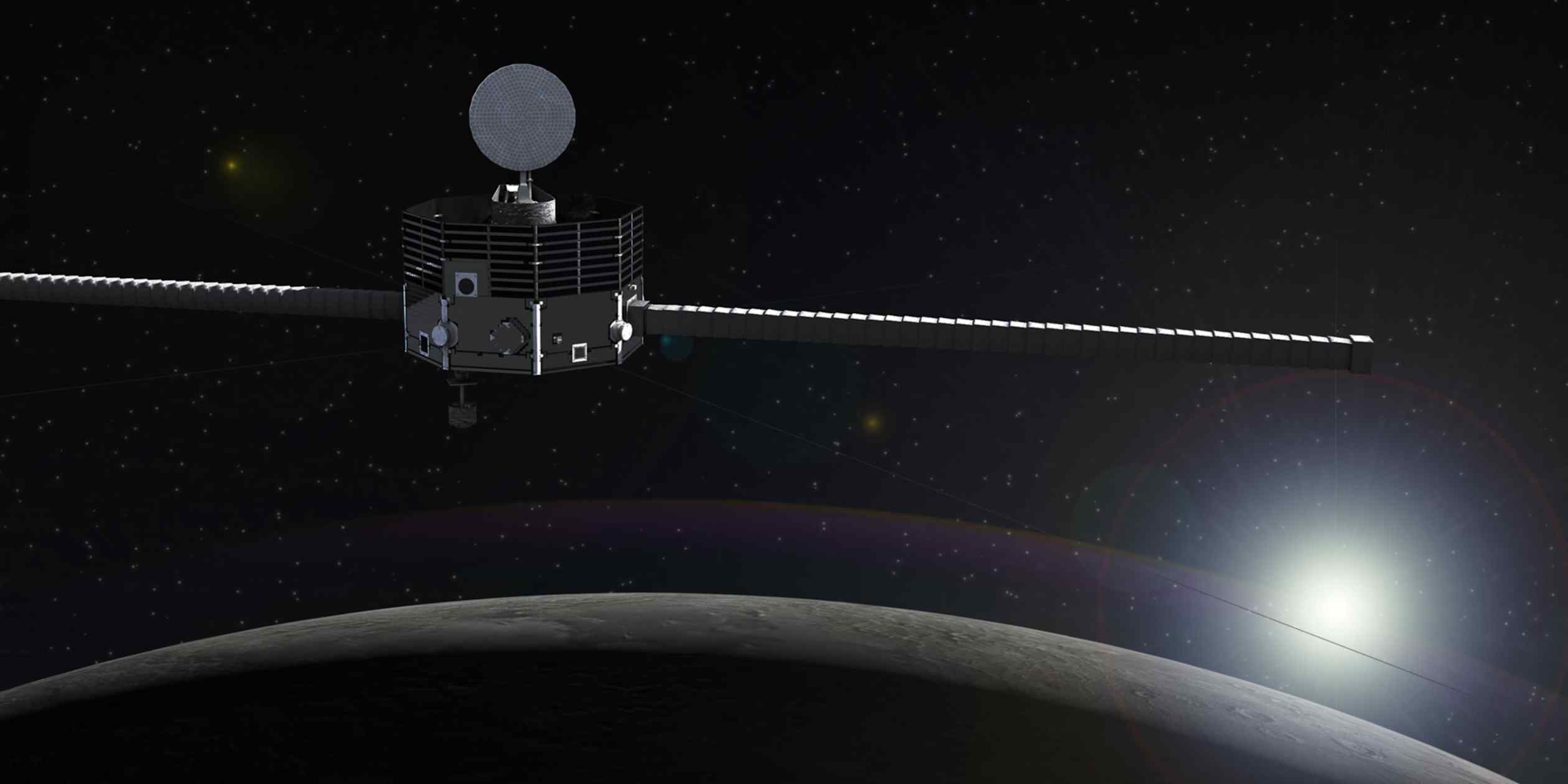
东京——日本宇宙航空研究开发机构的“水星磁层轨道器”Mio将于日本时间周日进入水星轨道,并开始在一个阳光强度约为地球10倍的环境中开展观测。
TOKYO -- The Japan Aerospace Exploration Agency's Mercury magnetospheric orbiter Mio is set to enter Mercury's orbit on Sunday Japan time, where it will begin taking observations in an environment with sunlight that is about 10 times stronger than on Earth.
日本宇宙航空研究开发机构与欧洲航天局合作发射了“贝皮科伦坡”任务。Mio于2018年发射,与欧洲的水星行星轨道器(MPO)相连。该航天器将于周日进入水星轨道,并计划于12月10日前后与MPO分离。科学观测预计将于4月开始。
JAXA launched the BepiColombo mission in partnership with the European Space Agency. Mio was launched in 2018 attached to Europe's Mercury Planetary Orbiter (MPO). The spacecraft will enter Mercury's orbit on Sunday and is scheduled to separate from MPO around Dec. 10. Scientific observations are expected to begin in April.
水星距离太阳很近,强烈的引力和极端高温使得前往水星的任务比前往其他行星更为困难。目前只有两艘航天器成功探索过这颗行星,均由美国国家航空航天局发射。
Mercury's proximity to the sun means the intense gravitational pull and extreme heat make missions there more difficult than those to other planets. Only two spacecraft, both launched by NASA, have successfully explored the planet.
以NEC为首的日本企业在促成此次任务方面发挥了关键作用。NEC协调了参与Mio研发和生产的企业。该公司在日本航天计划中有着悠久历史,曾设计并开发了日本第一颗卫星“大隅”号以及“向日葵”气象卫星。
Japanese companies led by NEC have played a key role in enabling the current mission. NEC coordinated the companies involved in Mio's development and production. The company has a long history in Japan's space program, having designed and developed the country's first satellite, Ohsumi, as well as the Himawari weather satellites.
就Mio而言,由于需要承受极端温度,工程师们从零开始设计该航天器。在水星向阳面,温度可达430摄氏度,而在背阴面,温度可骤降至零下170摄氏度。
For Mio, engineers started from scratch to design the spacecraft, given the requirement to withstand extreme temperatures. On Mercury's sunlit side, temperatures can reach 430 C, while on the dark side they can plunge to minus 170 C.
其中一项措施是让Mio成为自旋稳定卫星,使其能够持续旋转,从而避免热量集中在单一区域。在运行过程中,该航天器还限制机载设备产生的热量。通信系统可在需要时断电,优先防止故障和设备失效,同时保持观测能力。
One step was to make Mio a spin-stabilized satellite, enabling it to rotate continuously so heat does not concentrate on a single area. During operations, the craft also limits heat generated by onboard equipment. Communications systems can be powered down when needed, prioritizing the prevention of malfunctions and equipment failures while maintaining observation capabilities.
NEC项目经理川口明表示:“我们首先希望确保水星周边的稳定运行,并获取科学数据。我们希望为理解水星是如何形成的作出贡献。”Mio搭载了15台科学仪器,总部位于群马县的明星电气负责其中7台。该公司还为10月发射的火星卫星探测任务提供了设备,该任务旨在从火星卫星火卫一采集样本并带回地球。
"We first want to ensure stable operations around Mercury and obtain scientific data," said Akira Kawaguchi, NEC's project manager. "We hope to contribute to the understanding of how Mercury was formed." Mio carries 15 scientific instruments. Meisei Electric, based in Gunma prefecture, was responsible for seven of them. The company also supplied equipment for the Martian Moons eXploration mission launched in October that aims to collect a sample from Mars's moon Phobos and bring it back to Earth.
明星电气的钠大气光谱成像仪在由BepiColombo任务送往水星前接受测试。(明星电气)明星电气运营着模拟太空恶劣条件的测试设施。该公司太空与防务业务负责人上田行广表示:“除大型航空航天企业外,很少有公司拥有自己的测试设施。”
Meisei Electric's sodium atmosphere spectral imager is tested before being sent to Mercury on the BepiColombo mission. (Meisei Electric) Meisei operates testing facilities that simulate the harsh conditions of space. "Few companies outside of major aerospace firms have their own test facilities," said Yukihiro Ueda, head of the company's space and defense business.
与探测器本身一样,高温是一大挑战。工程师开发了隔热罩及其他措施,以减少到达仪器的热量。
As with the spacecraft itself, heat was a major challenge. Engineers developed shielding and other measures to reduce the amount of heat reaching the instruments.
Mio于2018年发射,如今在发射近八年后正进入水星轨道。由于太阳引力强大,探测器必须逐步接近水星,以免被拉向太阳。
Mio is entering Mercury's orbit nearly eight years after its launch in 2018. Because of the sun's strong gravity, a spacecraft must approach the planet gradually to avoid being pulled into the sun.
在近八年的航行中,古河电池的锂离子电池持续运行,没有出现明显衰减。这些电池储存探测器太阳能电池板产生的电力。
During the nearly eight-year voyage, lithium-ion batteries from Furukawa Battery have continued performing without significant degradation. The batteries store electricity generated by the spacecraft's solar panels.
当Mio进入水星阴影区时,其电池将成为唯一电源。工程师必须同时实现轻量化设计和充足的储能容量。
When Mio passes into Mercury's shadow, its batteries will become its sole power source. Engineers had to achieve both a lightweight design and ample energy-storage capacity.
古河通过改进电池材料提高了容量,包括测试钴酸锂的不同颗粒结构。
Furukawa increased capacity by refining battery materials, including testing different particle structures for lithium cobalt oxide.
与欧洲探测器分离后,“Mio”将反复经历无法发电、每次持续约一周的时期。古河电池的近藤弘厚表示:“我们能否在这些时期稳定供电将是一个关键问题。”
After separating from the European craft, Mio will experience repeated periods of about one week during which it cannot generate electricity. "Whether we can provide stable power throughout those periods will be a key issue," said Hiroatu Kondo of Furukawa Battery.
此次任务标志着首次由美国以外的国家探索水星,为日本提供了展示其技术能力的机会。
The mission marks the first effort to explore Mercury by a country other than the U.S., offering Japan a chance to showcase its technological capabilities.