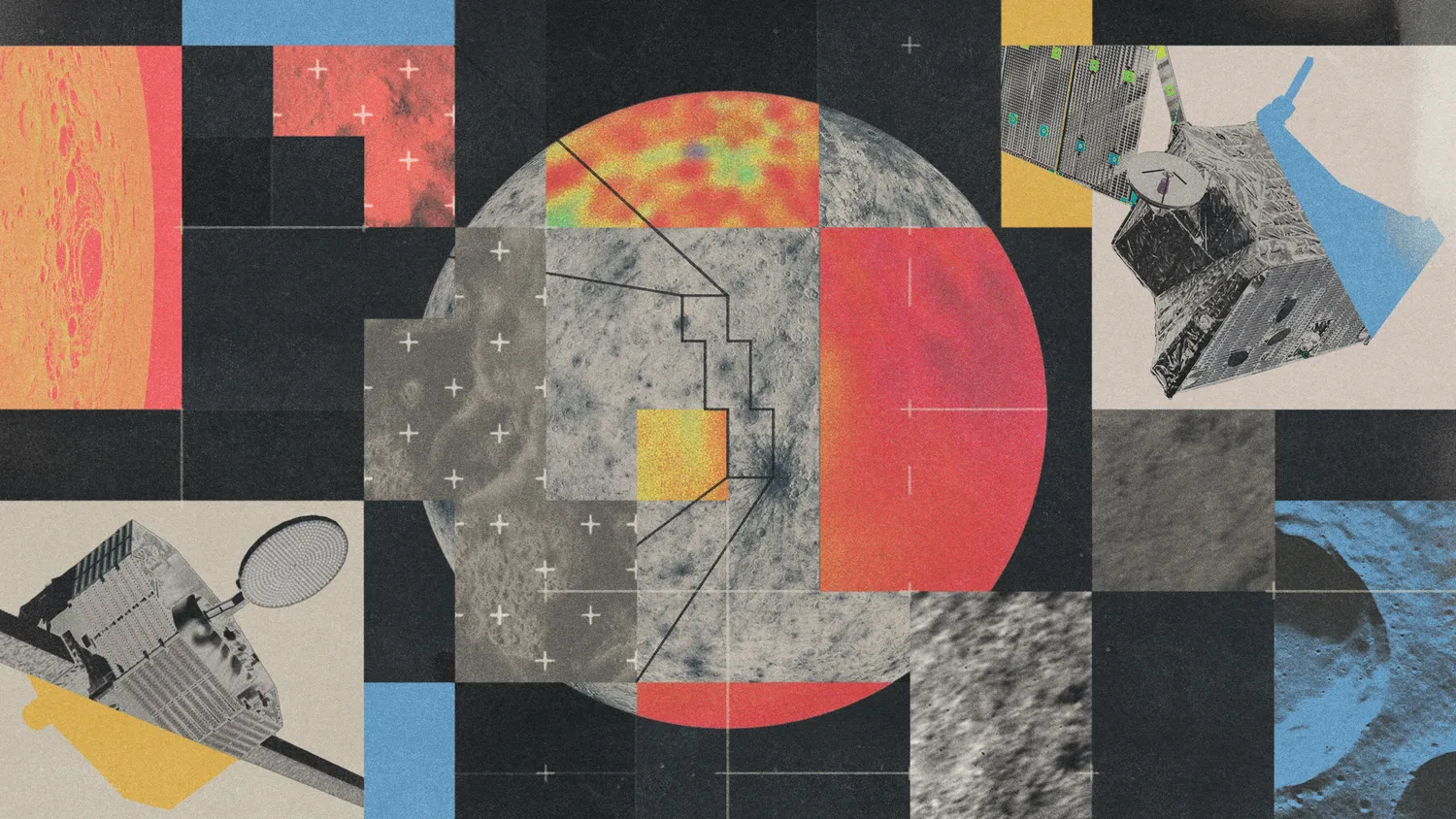
本周,欧洲和日本航天机构的联合任务“贝皮可伦坡号”完成了长达60亿英里(约96亿公里)的旅程,抵达了距离太阳最近的行星——水星。11月21日,它成为历史上第二个进入水星轨道的航天器。现在,它将花费至少一年时间勘测水星,使科学家能够绘制详细地图、测量行星成分,并推断其地表之下可能存在的物质。他们最终希望水星能帮助揭示太阳系行星是如何形成的——甚至可能提供关于地球生命起源成分的线索。
This week, BepiColombo, a joint mission of Europe and Japan’s space agencies, completed a six-billion-mile journey to Mercury, the closest planet to the sun. On November 21st, it became the second spacecraft in history to enter orbit around the planet. Now it will spend at least a year surveying Mercury, enabling scientists to make detailed maps, measure what the planet is made of, and deduce what might be below its surface. They ultimately hope that Mercury will help reveal how the planets of the solar system formed—and perhaps even provide clues about the ingredients that gave rise to life on Earth.
鲜有人预料到水星会开启行星科学一个引人入胜的新篇章。在小学教科书式的太阳系模型中,水星可能是最不起眼的行星。火星有探测车,也是人们梦想宇航员前往的地方;金星是最热的行星,某种程度上是地球的一面“哈哈镜”。天王星名字有趣,土星拥有美丽的光环,是天体舞会上的“舞会皇后”。水星——体积微小、布满陨石坑、被持续不断的阳光漂白——没有轴向倾斜,大气几乎为零,意味着它没有季节、没有风、没有天气。
Few people predicted that Mercury would inaugurate a riveting new chapter in planetary science. In the elementary-school model of our solar system, Mercury may have been the least distinctive. Mars was where the rovers were, and where people dreamed of astronauts going; Venus was the hottest planet, and a sort of fun-house mirror of Earth. Uranus had the funny name, and Saturn, with its lovely rings, was the belle of the celestial ball. Mercury—tiny, cratered, bleached by unrelenting sunlight—has no axial tilt and virtually zero atmosphere, meaning that it experiences no seasons, no wind, and no weather.
它缺乏板块构造,因此地表几乎不发生变化。“它有点被忽视、不受宠的行星,”莱斯特大学空间物理学家、负责“贝皮可伦坡号”上X射线探测器的艾玛·邦斯告诉我。天文学家甚至难以将望远镜指向水星,因为它离太阳太近。到1973年美国宇航局发射首个前往水星的航天器“水手10号”时,美国和苏联已经分别向金星和火星发射了二十多次任务。
It lacks plate tectonics, so its surface barely changes. “It’s a bit of an overlooked, underloved planet,” Emma Bunce, a space physicist at the University of Leicester who oversees an X-ray detector on BepiColombo, told me. Astronomers had trouble even pointing telescopes at Mercury, because it was so close to the sun. By 1973, when NASA launched the first Mercury-bound spacecraft, Mariner 10, the United States and the Soviet Union had already launched more than twenty missions each to Venus and Mars.
然而最近,正是让水星显得“乏味”的那些特性,重新将其定义为探索太阳系重大奥秘的关键之地。由于水星自转轴稳定且近乎垂直,阳光无法照射到其极地最深处的陨石坑,这种状况已持续亿万年。虽然其无大气层的表面在阳光直射下温度可达华氏八百度(约摄氏四百二十七度),但这些陨石坑内部却常年保持在零下数百度。
Lately, though, what made Mercury boring has redefined it as the place to explore some of the solar system’s leading mysteries. Because of Mercury’s stable, upright rotation, sunlight cannot reach its deepest polar craters, and hasn’t for eons. Its airless surface can reach eight hundred degrees Fahrenheit in the sun, yet the craters remain hundreds of degrees below zero.
因此,它们可能成为封存古老水冰和前生命物质的“时间胶囊”,这些物质早于我们已知的生命起源。美国国家航空航天局(NASA)的“信使号”探测器于2011年3月成为首个进入水星轨道的航天器,确认了水冰的存在。“探索其他类地行星具有特殊的吸引力,因为它们是地球的‘兄弟姐妹’,”领导“信使号”任务的哥伦比亚大学行星科学家肖恩·所罗门告诉我,“理解它们的家族特征是如何在与地球相同的定律、同一时期演化而成的,有助于我们概括认知、检验观点,从而理解我们自己的星球是如何运作的。”
As a result, they may be a time capsule for ancient water and prebiotic materials that predate life as we know it. NASA’s MESSENGER spacecraft, which became the first to enter orbit around Mercury, in March, 2011, confirmed the presence of water ice. “The exploration of other rocky planets has a special appeal, because they are Earth’s siblings,” Sean Solomon, a planetary scientist at Columbia University who led the MESSENGER mission, told me. “Understanding how their familial traits worked themselves out, following the same laws at the same time as Earth, helps us generalize our understanding and test our ideas for how our own planet operates.”
1974年和1975年,“水手十号”三次飞掠水星,发现了——不同于火星和金星——这颗行星会产生内部磁场。“这出乎意料,也是通往行星内部的一扇窗口,”邦斯告诉我。水星的外核部分熔融,有点像地球;从地质学角度说,水星并非一颗“死寂的世界”。尽管如此,航天计划仍间隔了二十年才开始筹划下一次前往水星的任务。
Mariner 10’s three flybys of Mercury, in 1974 and 1975, discovered that—unlike Mars and Venus—the planet generates an internal magnetic field. “That was unexpected, and is a window into the interior of the planet,” Bunce told me. Mercury’s outer core is partially molten, a bit like Earth’s; geologically speaking, Mercury is not a dead world. Still, twenty years elapsed before space programs began to plan another mission there.
1995年,欧洲空间局(ESA)宣布计划发射水星轨道飞行器,该项目后来成为“贝皮可伦坡号”。四年后,NASA 宣布了“信使号”的计划。“欧洲科学家当时相当不满,认为双方有默契:ESA 负责水星,NASA 专注于其他行星,”所罗门告诉我。他说,一个欧洲代表团曾赴美,担心 NASA 抢占了 ESA 的任务,但最终确信这两个任务将是互补的,便满意地离开了。“信使号”最终于2004年8月发射,比原计划早了十四年。
In 1995, the European Space Agency announced its intent to launch the Mercury orbiter that would become BepiColombo. Four years into this effort, NASA announced its plans for MESSENGER. “European scientists were quite upset, thinking there was an understanding that ESA would do Mercury and NASA would concentrate on the other planets,” Solomon told me. He said that a European delegation came to the U.S., anxious that NASA was preëmpting the ESA, but left satisfied that the two missions would be complementary. MESSENGER ultimately launched with a fourteen-year head start, in August, 2004.
进入水星轨道极具挑战。当物体靠近太阳时,其速度会自然加快,这大致类似于花样滑冰运动员收拢双臂时旋转速度加快的原理。但工程师所谓的“轨道插入”机动要求航天器大幅减速。“信使号”沿着一条迂回的、长达50亿英里(约80亿公里)的路径飞行,随后实施“转向点火”,点燃推进器作为一种制动系统。相比之下,“贝皮可伦坡号”则花费数年时间逐渐减速,以便采用一种称为“弱捕获”的技术。
Entering orbit around Mercury is difficult. As an object approaches the sun, it naturally speeds up, in roughly the way that ice skaters spin faster when they pull their arms inward. But the maneuver that engineers call orbital insertion requires a spacecraft to slow significantly. MESSENGER followed a circuitous, five-billion-mile path, and then used a “turn and burn,” blasting its thruster as a kind of braking system. BepiColombo, in contrast, spent years slowing down gradually so that it could use a technique called weak capture.
它实际上是以近乎正确的速度悄悄靠近水星,让引力完成其余工作。其发动机将在约三周内进行微小调整。
It effectively sidled up to Mercury, already travelling at approximately the correct speed, and let gravity do the rest. Its engines will make small adjustments for about three weeks.
在“信使号”环绕水星运行的四年里,没有什么是按预期进行的。探测器不仅拍摄了陨石坑,还拍到了古老的火山和陡峭的悬崖。科学家发现了全新的地质结构,称为“洼地”——成簇的凹陷,横跨数百米。尽管它们表面上类似陨石坑,但并非由撞击形成。相反,它们很可能是地下某种物质逸出到太空中形成的;没人知道是什么、如何以及何时发生的。另一个令人好奇的发现是,水星磁场中心位于行星几何中心以北300英里(约480公里)处。“这意味着什么目前还没有定论,”所罗门告诉我。
In the four years that MESSENGER orbited Mercury, nothing went as expected. The probe photographed not only craters but also ancient volcanoes and steep cliffs. Scientists discovered entirely new geological structures called hollows—clustered depressions that are hundreds of metres across. Despite their superficial resemblance to craters, they are not caused by impacts. Instead, they likely formed when something underground escaped into space; no one knows what, how, or when. Another curious finding was that the center of Mercury’s magnetic field was three hundred miles north of the planet’s geometric center. “The jury’s still out on what that means,” Solomon told me.
据美国国家航空航天总部水星项目负责人肖莎娜·韦德介绍,“信使号”激发了关于水星如何形成的新理论。其中最主要的是巨大撞击假说。“水星拥有一个非常大的核心,但地壳和地幔却非常小,”韦德说。也许这颗行星曾经大得多,但后来有什么东西撞上了它,剥离了其大部分外层。奇怪的是,“信使号”还发现了令人惊讶的大量挥发性元素,如硫、钠、钾和氯。
MESSENGER inspired new theories about how Mercury formed, according to Shoshana Weider, the Mercury lead at NASA headquarters. Chief among them was the giant-impact hypothesis. “Mercury has a very big core and a very small crust and mantle,” Weider said. Maybe the planet was once much larger, but then something smashed into it, removing much of its outer layer. Strangely, MESSENGER also found surprisingly large amounts of volatile elements such as sulfur, sodium, potassium, and chlorine.
“挥发性物质是指你预期在受热时容易蒸发的物质,”韦德说。一次碰撞会产生大量热量。“科学界一直在为此苦苦探索,”所罗门告诉我。“目前还没有一个令人信服的解决方案。”
“Volatiles are materials that you expect to evaporate easily when things are heated,” Weider said. A collision would have generated a lot of heat. “The community has been wrestling with that,” Solomon told me. “There hasn’t been a compelling solution.”
在我们的太阳系中,水星、金星、地球和火星是人类理论上可以登足的唯一行星(只是不适程度各不相同)。它们之间的差异实际上充当了天然实验。火星和地球都有天气和季节,但火星离太阳更远,且缺乏全球性磁场。金星和地球都有浓厚的大气层,但金星酷热难耐,几乎没有水——以此类推。行星科学家特别热衷于解释地球独有的一种现象:广阔的液态水海洋,这肯定在生命起源中发挥了关键作用。这些水从何而来?其中还含有什么其他物质?
In our solar system, Mercury, Venus, Earth, and Mars are the only planets on which humans could theoretically set foot (with varying degrees of discomfort). The differences between them effectively serve as natural experiments. Mars and Earth both have weather and seasons, but Mars is farther from the sun, and lacks a global magnetic field. Venus and Earth both have thick atmospheres, but Venus is sweltering and has virtually no water—and so on. Planetary scientists are particularly keen to explain something that only Earth has: vast oceans of liquid water that surely played a key role in the origins of life. Where did they come from? What else was in them?
所罗门说,主流理论认为,“当岩石行星形成时,冰在内太阳系并不稳定——那里温度高得多。”相反,水冰很可能在寒冷的外太阳系形成,然后搭乘彗星和小行星“顺风车”来到内太阳系。其他挥发性物质很可能也随之而来。“这种输送催生了早期的有机化学反应,从中诞生了有机化合物,并最终孕育了生命本身,”所罗门说。
The working theory, Solomon said, is that “when the rocky planets formed, ices were not stable in the inner solar system—it was much too warm.”Instead, water ice probably formed in the cold outer reaches of the solar system, and hitched a ride to the inner solar system on comets and asteroids. Other volatiles likely came with them. “That delivery gave rise to the early organic chemical reactions, out of which were born organic compounds and, ultimately, life itself,” Solomon said.
具有讽刺意味的是,唯一已知孕育生命的行星,也是研究生命起源的糟糕场所。地球受困于动荡的天气、腐蚀性的大气层,以及抹去远古历史的板块系统。火星失去了海洋和磁场,而在金星上,温室效应蒸发了潜在的海洋。“水星可能是外太阳系输送水和有机化合物的最佳见证者,”所罗门说。“它不会告诉我们是什么在我们自己的星球上启动了生命,但它将让我们在理解这一过程的阶梯上向上迈进几级。”
Ironically, the only planet known to foster life is also a bad place to study life’s origins. Earth is vexed by turbulent weather, a corrosive atmosphere, and tectonic systems that erase the ancient past. Mars lost its oceans and its magnetic field, and, on Venus, the greenhouse effect boiled away potential seas. “Mercury may be the best witness to the delivery of water and organic compounds from the outer solar system,” Solomon said. “It won’t tell us what kick-started life on our own planet, but it will get us a few rungs up on the ladder of understanding that process.”
虽然“贝皮可伦坡”号本身无法从轨道上采集冰样本,但行星科学家和工程师正在研究未来如何返回样本。
Although BepiColombo itself can’t collect ice samples from orbit, planetary scientists and engineers are studying how to return samples in the future.
“贝皮可伦坡”号以二十世纪意大利数学家朱塞佩(贝皮)·科伦坡命名,被视为旗舰任务——即行星探测任务中规模最大的一类,旨在推动整个研究领域的发展。12月,在航天器稳定轨道后,它将分离为两个不同的探测器——来自欧洲航天局的水星行星轨道飞行器,以及来自日本宇宙航空研究开发机构的水星磁层轨道飞行器。
BepiColombo, named for the twentieth-century Italian mathematician Giuseppe (Bepi) Colombo, is considered a flagship—the largest class of planetary mission, intended to advance entire fields of research. In December, after the spacecraft stabilizes its orbit, it will separate into two distinct probes—the Mercury Planetary Orbiter, from the ESA, and the Mercury Magnetospheric Orbiter, from the Japan Aerospace Exploration Agency.
每个探测器将在距离水星表面不同高度的轨道上环绕飞行。“你可以让日本探测器处于太阳风中,让欧洲探测器处于磁层内,”邦斯告诉我。前者将允许对空间天气进行整体研究,空间天气源自太阳湍流向外扩散;后者将阐明水星本身正在发生什么。
Each will circle the planet at a different distance from its surface. “You can have the Japanese spacecraft in the solar wind, and the European spacecraft in the magnetosphere,” Bunce told me. The former will allow for holistic research into space weather, which ripples out from turbulence on the sun, and the latter will clarify what’s happening on Mercury itself.
“贝皮可伦坡”号的欧洲轨道器将绘制水星表面矿物分布图,其观测波长是“信使”号无法覆盖的。它将让我们更多地了解水星的核心,测量地壳厚度,以及地面储存和释放热量的方式。这些数据将为解释水星如何形成、太阳系如何演化的模型提供素材。研究结果也将与太阳系外行星相关,推动在其他恒星周围寻找其他“地球”的进程。
BepiColombo’s European orbiter will map surface minerals at wavelengths unavailable to MESSENGER. It will teach us more about Mercury’s core and measure how thick the crust is, along with how the ground stores and releases heat. Such data will feed models that seek to explain how Mercury formed, and how the solar system evolved. The results will also have relevance to extrasolar planets, advancing the search for other “Earths” around other stars.
科学家们等待了八年,“贝皮可伦坡”号才抵达水星,所罗门告诉我,他正准备迎接意想不到的发现。“我们对事物的理解永远不可能充分到能预判造访新地方或更近距离审视旧地方时会有什么发现,”他说,“我们总是会感到惊讶。”
Scientists waited eight years for BepiColombo to reach Mercury, and Solomon told me that he was preparing for something unexpected. “We’re never so full in our understanding that we can anticipate the discoveries when we visit a new place, or look closer at an old one,” he said. “We’re always surprised.”