天文学家预测,2029年4月中旬,小行星“阿波菲斯”将飞掠地球。这颗宽约450米的天体将以仅1.9万英里(约3.06万公里)的距离擦肩而过。这比月球距离地球近约12倍,也比许多卫星的轨道更近。届时,它甚至将肉眼可见。
Astronomers predict that in mid-April 2029, the asteroid Apophis will fly by Earth. The 450-meter-wide body will miss us at a distance of only 19,000 miles. That’s about 12 times closer to us than the moon and much closer than many satellites. It will even be visible to the naked eye.
过去几十年里,这类预测取得了巨大进展。随着空间探测器加深了我们对太阳系小天体的认知,天文学家拥有了越来越可靠、详尽的数据,用于寻找潜在危险小行星。然而,我们应对此类威胁的能力,则是另一码事。这正是缺失且极其关键的一环——行星防御技术,它能让我们及时改变危险天体的轨道。
In the past few decades, there’s been enormous progress in making these kinds of predictions. As space probes deepen our knowledge of small bodies in the solar system, astronomers have increasingly reliable and detailed data for finding potentially hazardous asteroids. Our ability to respond to such a threat, however, is another story. This is the missing and extremely important link—planetary defense technology that could allow us to deflect a dangerous object in time.
在科幻大片中,此类情境往往靠核弹解决。但在现实世界里,将一块巨大的太空岩石炸成碎片并非上策。相反,改变小行星的轨道更为妥当。真空中的一切都在运动。我们的地球每秒约行进20英里(约32公里)。如果能让飞向我们的天体减速,从而稍晚抵达交汇点,它就会直接错过地球。
In a sci-fi flick, such situations are often solved with a nuclear bomb. But in the real world, blowing up a big space rock into tiny bits is not ideal. Instead, it’s better to alter the asteroid's orbit. Everything in the vacuum of space is in motion. Our own planet travels about 20 miles every second. If the object hurtling towards us can be slowed down and thus reach the meeting point a little later, it will simply miss the Earth.
四年前,美国国家航空航天局(NASA)在一对被称为“迪迪莫斯”和“迪莫尔福斯”的天体上,实质上测试了这种方法。30年前,基特峰天文台的天文学家发现了直径约780米的小行星迪迪莫斯。几年后,捷克天文学家彼得·普拉韦茨观测到,这颗小行星拥有一颗约每12小时绕其公转一次的“卫星”。这颗直径约151米的较小天体随后被命名为迪莫尔福斯。
Four years ago, this was essentially what NASA tested on a pair of celestial bodies known as Didymos and Dimorphos. Astronomers at the Kitt Peak Observatory discovered Didymos, an asteroid measuring 780 meters across, 30 years ago. A few years later, Czech astronomer Petr Pravec observed that this asteroid had a “moonlet” orbiting it about every 12 hours. This smaller body, measuring about 151 meters in diameter, was then named Dimorphos.
这对天体是行星防御系统所涉及的偏转技术的完美试验场。锁定这些目标后,NASA于2021年底发射了“双小行星重定向测试”(DART)任务。近一年后,DART探测器撞击了迪莫尔福斯。
The paired objects were a perfect testing ground for the kind of deflection a planetary defense system would involve. Locked in on these targets, NASA launched the Double Asteroid Redirection Test (DART) in late 2021. Nearly a year later, the DART probe crashed into Dimorphos.
科学家原本希望,探测器以每小时13000多英里的速度冲向小行星的撞击,能将这颗“迷你卫星”的公转周期缩短一分钟或更多。最终,其公转周期缩短了33分钟。这一巨大偏差是由撞击抛射出的碎片造成的,产生的反冲力远大于撞击本身产生的力。此外,这两颗小行星绕太阳公转的速度也有所减慢。从某种意义上说,迪莫尔福斯短暂地变成了一颗彗星——撞击释放的碎片在其身后形成了一条长长的尾巴。
Scientists had hoped that the impact of the probe—which was barreling toward the asteroids at over 13,000 miles per hour—could shorten the period of the mini-moon's orbit by a minute or more. In the end, it was slowed down by 33 minutes. This major deviation was caused by the ejection of debris, leading to a much greater recoil than what was produced by the impact itself. In addition, the orbital speed of both asteroids around the sun also slowed. And in a sense, Dimorphos briefly became a comet—the debris released by the impact creating a long tail behind it.
但关于这次测试的长期影响,仍存疑问。2024年10月,欧洲航天局(ESA)发射了“赫拉号”探测器,前往与这两颗小行星会合。在飞越火星后,探测器于今年10月开始进入到达阶段。它在距离约800英里处拍摄了第一张图像,迪迪莫斯的第一张详细图像于11月初发布。
But questions remain about the longer-term impacts of this test. In October 2024, the European Space Agency (ESA) sent off the space probe Hera to rendezvous with both asteroids. After a flyby of Mars, the probe began its arrival phase this past October. It took its first image about 800 miles away, and the first detailed image of Didymos was published in early November.
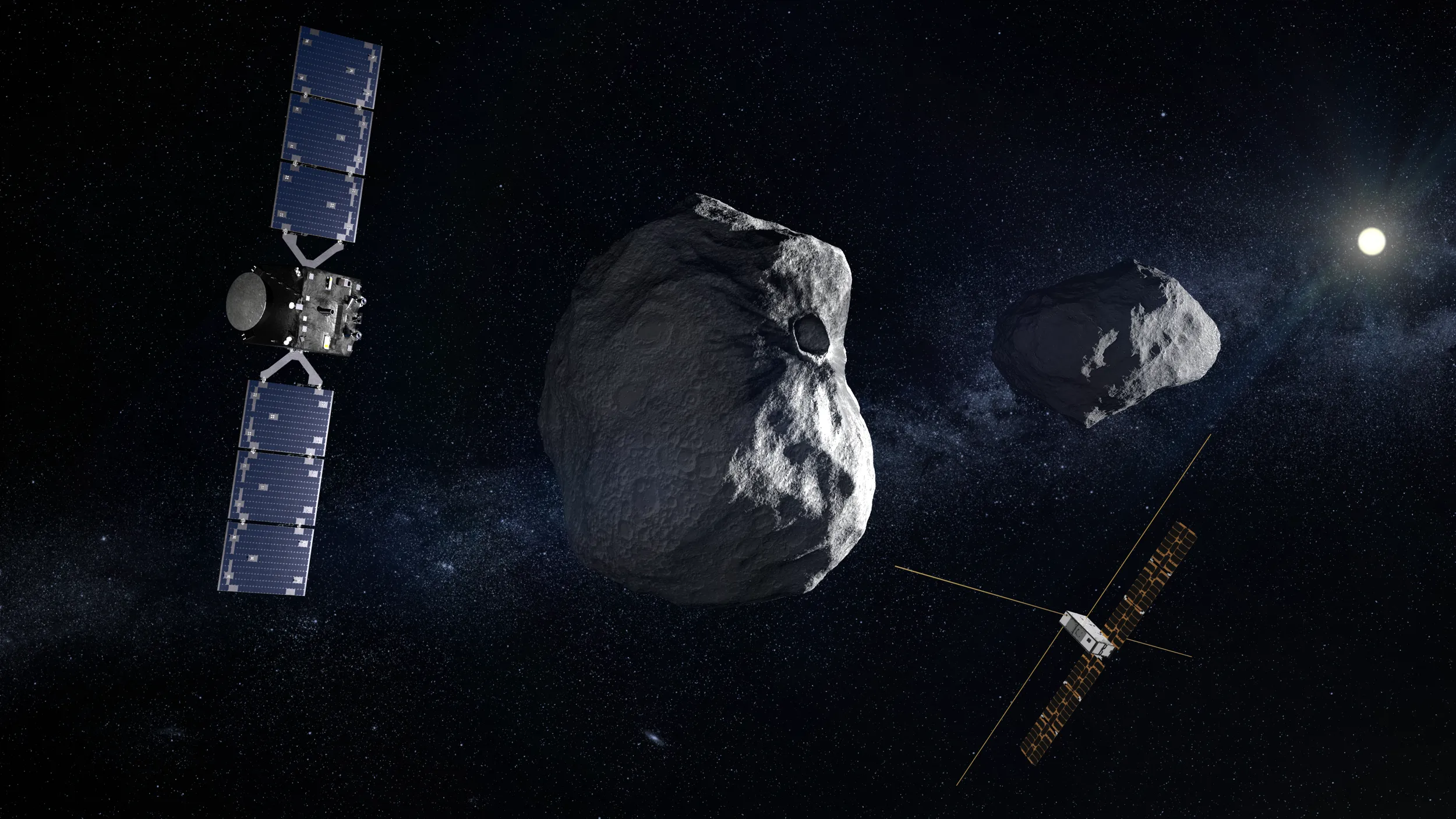
如今已抵达附近,“赫拉号”将深入研究这两个天体。虽然我们通过从地球观测小行星可以学到很多,但近距离探测无可替代,这将是人类首次详细探索双小行星系统。任务目标之一是弄清此类小行星对是如何形成的。迪迪莫斯因其快速自转也颇具研究价值,其自转周期仅2.3小时——处于稳定性的临界边缘。
Now in their vicinity, Hera will study both bodies in depth. Though there’s much we can learn about asteroids by observing them from our planet, nothing can replace close-up exploration, and this will be the first time a binary asteroid system will be explored in detail. One of the mission's goals is to find out how such asteroid pairs form. Didymos is also interesting for its rapid rotation, turning once every 2.3 hours—placing it on the very edge of stability.
当然,除了本可在另一组双小行星上开展的传统天文学研究外,“赫拉号”还将调查“双小行星重定向测试”(DART)任务的后果。这将包括研究撞击地点。由于撞击本身的许多参数已知,科学家也可借此机会更广泛地了解撞击坑,回答诸如材料强度还是重力在撞击坑形成中起更决定性作用等问题。
But of course, beyond this traditional astronomy research, which could also take place at another set of binary asteroids, Hera will investigate the consequences of the DART mission. This will include studying the impact site. Because there are so many knowns about the impact itself, scientists can also use this opportunity to understand craters more broadly, answering questions such as whether the strength of the material or gravity plays a more decisive role in crater formation.
“赫拉”还将精确测定迪莫尔福斯的质量,这是评估“双小行星重定向测试”(DART)任务作为行星防御技术测试有效性的重要细节。探测器还搭载了一台激光雷达仪器,用于绘制小行星地形图,以及用于研究表面化学成分的仪器。此外,我们预计将看到以每像素 1 米分辨率拍摄的小行星详细图像。
Hera will also determine the exact mass of Dimorphos, an important detail in assessing the effectiveness of the DART mission as a test of planetary defense technology. The probe also contains a lidar instrument for mapping the asteroid's topography and instruments for investigating the chemical composition of the surface. Additionally, we can expect to see detailed images of the asteroids taken with a resolution of 1 meter per pixel.
探测器还携带两颗微型立方体卫星,简称“立方星”,将于 2027 年 1 月部署。在地球轨道上,立方星常用于简单实验,包括学生项目,甚至可以堆叠在一起组成更大的卫星。
The probe is also carrying two miniature, cube-shaped satellites, called “CubeSats” for short, which it will deploy in January 2027. In Earth’s orbit, CubeSats are often used for simple experiments, including student projects, and they can even be stacked together to create larger satellites.
“赫拉”的两颗立方星名为“朱文塔斯”和“米拉尼”,将尝试登陆小行星表面。朱文塔斯将利用可探测深达 100 米的雷达,专注于对迪莫尔福斯进行地球物理勘探。此外,搭载的重力仪将测量迪莫尔福斯在绕行母体小行星迪迪莫斯时重力的变化。与此同时,米拉尼将对小行星表面成分进行详细调查,并搜寻尘埃痕迹以及许多太空岩石中含有的挥发性物质。
Hera’s CubeSats, named Juventas and Milani, will attempt to land on the surface. Using radar capable of probing up to a depth of 100 meters, Juventas will focus on geophysical exploration of the asteroid Dimorphos. Additionally, a gravimeter on board will measure how the gravity on Dimorphos changes during its orbit due to the parent asteroid, Didymos. Meanwhile, Milani will carry out a detailed investigation of the asteroids’ surface composition and will search for traces of dust and the volatile substances contained within many space rocks.
按目前计划,“赫拉”探测器的这一主要任务阶段预计将持续到明年夏天,随着阿波菲斯的临近,甚至在它重新甩回太空后,该探测器的发现只会变得更加重要。2000 年,我们仅知道 300 颗近地小行星——即那些接近地球或直接穿越地球轨道的小行星。如今,我们已知晓超过 4.3 万颗。
According to current plans, this main phase of the Hera probe's mission is expected to last until the summer of next year, and findings from this probe will likely only become more relevant, not just as Apophis approaches, but even after it slings back into space. In the year 2000, we knew of only 300 near-Earth asteroids—those that approach Earth or directly cross its orbit. Today, we know of over 43,000.
本文最初发表于《连线》捷克版和斯洛伐克版,由捷克语翻译而来。
This story originally appeared on WIRED Czech Republic and Slovakia and has been translated from Czech.