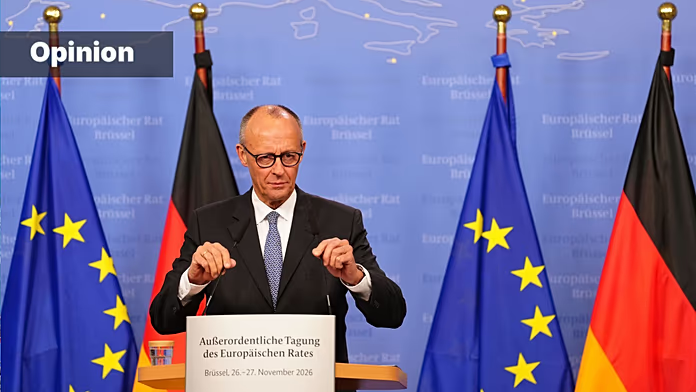
欧洲观点。德国总理弗里德里希·默茨在布鲁塞尔欧盟峰会的媒体发布会上发言,摄于2026年11月26日星期四。
Euroviews. Germany's Chancellor Friedrich Merz speaks during a media conference at the EU summit in Brussels, Thursday, Nov. 26, 2026.
美联社照片 亚历山大·沃尔夫博士,汉斯·赛德尔基金会柏林总部负责人 发布于2026年11月27日 - 14:33 GMT+1 本文观点仅代表作者,绝不代表欧洲新闻台的编辑立场。
AP Photo Dr. Alexander Wolf, Leiter des Hauptstadtbüros der Hanns-Seidel-Stiftung Published on 27 November 2026 - 14:33 GMT+1 The opinions expressed in this article are those of the author and do not represent in any way the editorial position of Euronews.
欧盟关于2028至2034年共同预算的峰会初步告吹。柏林汉斯·赛德尔基金会外交政策专家亚历山大·沃尔夫警告称,有人想要维护既定开支,有人则想削减成本并主要为新的战略任务提供资金。
The EU summit on the Union's common budget for 2028-2034 has initially failed. Some want to protect established spending, others to cut costs and mainly finance new strategic tasks, warns foreign policy expert Alexander Wolf of the Hanns Seidel Foundation in Berlin.
欧洲想要变得更加独立、更有竞争力、更安全。然而,对实现这一目标至关重要的任务,在下一份欧盟预算草案中却面临最深度的削减。这背后是欧洲政治的一个结构性问题。
Europe wants to become more independent, competitive and secure. Yet it is precisely the tasks that are crucial to this that face the deepest cuts in the draft for the next EU budget. Behind this lies a structural problem in European politics.
关于2028至2034年欧洲预算的布鲁塞尔特别峰会未达成协议而结束。12月17日,各国国家元首和政府首脑将再次会晤。在此之前,主要问题将是欧洲准备花多少钱。
The special Brussels summit on the European budget for the years 2028 to 2034 ended without agreement. On 17 December, the heads of state and government will meet again. Until then, the main question will be how much Europe is prepared to spend.
科斯塔主要想在新的战略优先事项上削减开支 欧盟委员会提出了略低于2万亿欧元的财政框架。欧盟理事会主席安东尼奥·科斯塔将其削减至约1.78万亿欧元。德国和其他净缴款国仍认为这过高。
Costa wants cuts above all in new strategic priorities The European Commission has proposed a financial framework of just under €2 trillion. Council President António Costa has reduced this to around €1.78 trillion. Germany and other net contributors still consider that too high.
然而,比总额更能说明问题的是科斯塔在何处动刀。与委员会草案相比,他在竞争力、繁荣与安全方面削减了约955亿欧元,在农业、凝聚力及相关任务方面削减了约540亿欧元。这分别相当于16%和5%的减幅。在国防工业、安全和航天领域,削减幅度接近30%。
More revealing than the overall figure, however, is where Costa makes the cuts. Compared with the Commission’s draft, he removes around €95.5 billion from competitiveness, prosperity and security, and around €54 billion from agriculture, cohesion and related tasks. That amounts to reductions of 16 and 5% respectively. In defence industry, security and space, the cuts are almost 30%.
科斯塔的草案确实预见到,与现行预算相比,国防和竞争力方面将大幅增加。即便如此,新的战略优先事项仍被不成比例地削减。
Costa’s draft does foresee substantial increases for defence and competitiveness compared with the current budget. Even so, the new strategic priorities are being cut disproportionately.
国家利益的逻辑 德国和其他净缴款国希望限制其缴款,并让预算更加聚焦于竞争力和安全。波兰和其他凝聚力国家捍卫其地区的资金。法国想要一个雄心勃勃的欧洲预算,同时也要保护其农业。意大利对额外的欧洲税收持怀疑态度。
The logic of national interests Germany and other net contributors want to limit their payments and focus the budget more strongly on competitiveness and security. Poland and other cohesion countries defend the funding for their regions. France wants an ambitious European budget while also protecting its agriculture. Italy takes a sceptical view of additional European levies.
从国家视角看,这些立场各有其道理。问题在于它们如何相互作用。
Each of these positions is understandable from a national perspective. The problem arises from how they interact.
欧洲财政框架要求理事会一致通过并经欧洲议会同意。每个政府都可以将其批准以本国利益得到保障为条件。这有利于那些收益可明确归属于个别成员国的支出。
The European financial framework requires unanimity in the Council and the consent of the European Parliament. Every government can make its approval conditional on its own interests being safeguarded. This favours spending whose benefits can be clearly attributed to individual member states.
法国总统可以向农民解释他在布鲁塞尔争取到了哪些补贴。波兰总理可以指着新修的公路和实现现代化的地区。但哪位政府首脑能宣称,联合的欧洲防空系统的收益纯粹归属于自己的国家?
A French president can explain to farmers which subsidies he has secured in Brussels. A Polish prime minister can point to new roads and modernised regions. But which head of government can claim the benefit of a joint European air defence system purely for his or her own country?
联合欧洲任务确实有政治倡导者。但它们的收益不易映射到那张几乎支撑每一次预算谈判的国家损益表上:我们缴了多少,又拿回多少?
Joint European tasks do have political advocates. But their benefits are less easily mapped onto the national balance sheet that underpins almost every budget negotiation in the end: how much did we pay in, and how much do we get back?
农业还是国防?面向新世界的预算 现行欧洲财政框架约 60% 用于农业和凝聚力。这两个领域服务于欧洲一体化的核心目的:粮食安全、经济发展和缩小地区差距。
Agriculture or defence? A budget for a new world About 60% of the current European financial framework is devoted to agriculture and cohesion. Both areas serve core purposes of European integration: food security, economic development and the reduction of regional disparities.
然而,欧洲现在必须应对额外任务,而在该预算结构建立时,这些任务的分量远不如今天。
However, Europe now has additional tasks to tackle that did not carry anything like the same weight when this budget structure was created.
俄罗斯正在威胁欧洲的安全秩序。中国在战略领域建立了显著的技术和产业能力。美国正在追求自身的经济和安全利益,这些利益不一定与欧洲一致。
Russia is threatening Europe’s security order. China has built up significant technological and industrial capacity in strategic sectors. The United States is pursuing its own economic and security interests, which do not necessarily coincide with Europes.
欧洲集团在过去几十年里建立繁荣所依赖的条件正在发生根本性变化。
The conditions under which the bloc has built its prosperity in recent decades are changing fundamentally.
这不能仅靠增加国家国防开支来解决。同样重要的是联合国防研究、工业生产能力、安全的供应链、跨境能源网络、军事机动性以及欧洲在关键技术领域的专业知识。
That cannot be addressed simply through higher national defence spending. It is equally about joint defence research, industrial production capacity, secure supply chains, cross-border energy networks, military mobility and European expertise in key technologies.
2024年,马里奥·德拉吉列出了所需措施:缩小与美国和中国的创新差距,将脱碳与竞争力相结合,并通过减少战略依赖来加强欧洲的安全。他估计每年需要额外的私人和公共投资7500亿至8000亿欧元。
In 2024 Mario Draghi set out what would be needed: catching up the innovation gap with the United States and China, combining decarbonisation with competitiveness, and strengthening Europe’s security by reducing strategic dependencies. He put the additional private and public investment required at €750 to 800 billion a year.
这笔资金不能也不应仅靠欧洲预算来融资。然而,预算可以调动国家和私人投资,并使联合项目成为可能,而单个成员国无法独自达到必要的规模。
This sum cannot and should not be financed solely from the European budget. However, the budget can mobilise national and private investment and make joint projects possible where individual member states cannot achieve the necessary scale on their own.
实质在萎缩:欧洲应共同资助什么 我认为欧洲预算的制定应更多地由其任务决定。决定性因素应是成员国共同行动比单独行动能更好、更高效或更廉价地实现什么。
The substance is shrinking: what Europe should finance jointly I believe the European budget should be shaped much more by its tasks. The decisive factor should be what the member states can achieve better, more efficiently or more cheaply together than alone.
农业和欧洲欠发达地区仍然需要可靠性。但在适当的过渡期后,它们在预算中的份额应逐步且明确地下降,以便为未来的联合投资腾出更多空间。
Agriculture and the less developed regions of Europe still need reliability. But their shares of the budget should, with appropriate transition periods, gradually yet clearly decline in order to create more scope for joint investment in the future.
认为欧洲可以像以往一样继续前行的人,正在靠一种正在稳步萎缩的实质生活。一个想要变得更有主权、更独立的欧洲,也必须未雨绸缪。
Anyone who thinks Europe can simply carry on as before is living off a substance that is steadily shrinking. A Europe that wants to become more sovereign and more independent also has to get ahead of events.
这要求在收入方面保持诚实。科斯塔的草案专门预留了1580亿欧元,专门用于偿还疫情期间承担的欧盟债务。这笔资金不可用于其他任务。
That calls for honesty on the revenue side. Costa’s draft sets aside €158 billion solely for repaying the EU debt taken on during the pandemic. This money is not available for other tasks.
因此,科斯塔提出了额外的欧洲自有收入来源,包括对大型公司提供的数字服务、烟草以及未回收电子垃圾征收税费。任何拒绝增加自有收入的人,都必须说明他们是倾向于增加国家缴款,还是倾向于相应削减开支。而任何要求增加欧洲任务的人,都必须说明资金来源。
Costa therefore proposes additional European sources of revenue, including levies on digital services provided by large companies, on tobacco and on non-recycled electronic waste. Anyone who rejects additional own resources has to explain whether they prefer higher national contributions or corresponding cuts. And anyone who demands more European tasks has to say how they should be funded.
缴款退款也属于这一范畴。它们体现了一种预算逻辑,即以国家回报衡量欧洲政策的成效。只要这种算计占主导地位,为共同任务提供资金在结构上就会依然更加困难。达成协议的代价:既有任务还是新任务?
The contribution rebates also belong in this context. They are the expression of a budget logic that measures the success of European policy by national returns. As long as this calculation dominates, funding joint tasks will remain structurally more difficult. The price of an agreement: established or new tasks?
德国和法国正在推动在年底前达成谅解。考虑到明年春天的法国总统大选,这是可以理解的。
Germany and France are pushing for an understanding before the end of the year. Given the French presidential election next spring, that is understandable.
一种可能的妥协方案是进一步压缩总规模,同时向净缴款国、农业领域和凝聚力国家做出让步。特别有争议的收入来源可以推迟解决,对乌克兰的进一步援助资金可以单独谈判。
One possible compromise would be an even smaller overall volume combined with concessions to the net contributors, agriculture and the cohesion countries. Particularly contentious sources of revenue could be postponed, and funding for further aid to Ukraine could be negotiated separately.
这样的协议将具有分量。它将创造规划确定性,并表明27个政府尽管利益各异,但有能力达成妥协。
Such an agreement would carry weight. It would create planning certainty and show that 27 governments, despite differing interests, are capable of reaching a compromise.
然而,关键问题在于达成协议的代价。如果主要效果是保护既有支出,而再次让新的战略任务承担大部分节省额,那么根本问题将依然存在。
The crucial question, however, would be the price at which it is achieved. If the main effect is to protect established spending while once again making the new strategic tasks bear most of the savings, the underlying problem would remain.
欧洲仍将不得不通过国家预算、贷款和额外的融资工具,来应对大部分新任务。尤其是在安全、基础设施和技术竞争力方面的长期投资,缺乏联合规划可能导致成本更高,并产生可避免的重复建设。
Europe would still have to tackle many of its new tasks largely through national budgets, loans and additional financing instruments. Especially for long term investment in security, infrastructure and technological competitiveness, a lack of joint planning can lead to higher costs and avoidable duplication.
我们不必把所有挑战都变成欧洲性的挑战。但对于那些在国家层面已无法妥善处理的挑战,我们应当在欧洲层面加以组织和资助。
We do not have to turn all our challenges into European ones. But we should organise and fund at European level those we can no longer adequately handle at national level.
任何希望拥有更主权、更独立的欧洲的人,也必须做好从财政政策中得出相应结论的准备。北约东翼的联邦国防军:战争从未如此之近 无障碍快捷方式
Anyone who wants a more sovereign and more independent Europe must also be prepared to draw fiscal policy conclusions from that. With the Bundeswehr on NATO's eastern flank: The war has never been this close Go to accessibility shortcuts