它曾经连简单的加法都算不对。但现在,AI正在攻克像黎曼猜想这样艰深的数学难题。AI是如何实现这一非凡飞跃的——以及为什么数学家们应该“深感担忧”。
It once struggled to get simple sums right. But AI is now tackling tough mathematical problems like the Riemann hypothesis. How AI made this extraordinary leap — and why mathematicians should be "deeply worried."
去年,我让ChatGPT帮我加一下英国养老金缴费总额。幸运的是,我又核对了一遍。结果相差了几英镑。
Last year, I asked ChatGPT to add up my British state pension contributions. Thankfully, I double-checked.
一位教数学的朋友对此并不感到意外。他说,聊天机器人经常算错简单的计算。
The total was wrong by a few pounds. A friend who teaches math wasn't surprised. Chatbots , he said, often get simple calculations wrong.
快进到2026年11月,在人工智能公司Anthropic工作的数学家勒文特·阿尔普厄(Levent Alpöge)声称,借助该公司的聊天机器人克劳德(Claude),解决了数学史上最难的难题之一。
Fast-forward to November 2026, and a mathematician working at artificial intelligence company Anthropic , Levent Alpöge, claims to have solved one of the hardest problems in mathematical history with the help of the company's chatbot, Claude.
这个难题就是黎曼猜想,它涉及质数的分布,自1859年以来一直困扰着数学家。
That problem was the Riemann hypothesis, which concerns the distribution of prime numbers, and has baffled mathematicians since 1859.
AI是如何从在简单算法上跌跌撞撞,到攀登如此非凡的数学高峰的?
How did AI go from stumbling over simple arithmetic to scaling such extraordinary mathematical heights?
为什么AI曾经在数学上如此糟糕?意大利博洛尼亚大学计算机科学教授安德烈亚·阿斯佩尔蒂(Andrea Asperti)表示,答案在于AI处理信息的方式。
Why was AI so bad at math? The answer lies in how AI processes information, said Andrea Asperti, a professor in computer science at Italy 's University of Bologna.
与传统计算器不同,早期的聊天机器人是被训练来预测语言的,它们会给出看似合理的答案,但不一定真的进行了数学运算。
Unlike conventional calculators, early chatbots were trained to predict language , producing plausible answers without necessarily doing the math.
具有讽刺意味的是,它们可能进行数百万次计算,却得出了错误的答案。
Ironically, they may perform millions of calculations to arrive at the wrong answer.
在某种程度上,问为什么聊天机器人尽管拥有强大的计算能力,却仍会出现算术错误,就像问为什么人类尽管大脑中有数十亿个神经元,却仍会在心算中出错一样,Asperti对德国之声说。
"In a sense, asking why a chatbot makes arithmetic mistakes despite its enormous computational power is like asking why humans make mistakes in mental arithmetic despite having billions of neurons in their brains," Asperti told DW. Ken Ono, a mathematics professor at the University of Virginia in the United States , recalled how Google's Gemini once concluded that 9.11 was greater than 9.8.
弗吉尼亚大学数学教授肯·奥诺回忆说,谷歌的Gemini曾得出9.11大于9.8的结论。“但请不要误解,如今这类错误非常罕见,”奥诺对德国之声说。
"But make no mistake, those errors are very rare today," Ono told DW. ## How AI got so much better at math
AI如何在数学方面取得巨大进步Asperti将AI的进步归因于模型规模、训练数据和方法的逐步改进,而非单一突破。
Asperti attributed AI's gains to gradual improvements in model size, training data and methods rather than a single breakthrough.
AI现在可以探索不同的方法,检查自己的工作,纠正错误,并使用专门的计算工具。
AI can now explore different approaches, check its work, correct mistakes and use specialized computational tools.
Claude可以与专门的数学软件协作,生成并验证形式证明,而不仅仅依赖其语言能力Image: Thomas Trutschel/IMAGO“值得注意的是,这些相对渐进的技术改进已带来智力能力的质的飞跃,”Asperti说。
Claude can work with specialized mathematical software to generate and verify formal proofs, rather than relying solely on its language capabilitiesImage: Thomas Trutschel/IMAGO "What is remarkable is that these relatively incremental technological improvements have resulted in qualitative leaps in intellectual capabilities," Asperti said.
也许最令人惊讶的是,AI能够解决此前未解决的问题——许多人曾怀疑它能否做到这一点。
Perhaps most surprising was AI's ability to solve previously unsolved problems — something many had doubted it could do.
“解决开放性数学问题需要相当程度的创造力:它不仅仅是检索现有知识或复现已知论证的问题,”Asperti说。
"Solving open mathematical problems requires a considerable degree of creativity: it is not simply a matter of retrieving existing knowledge or reproducing known arguments," Asperti said.
英国伦敦帝国学院数学家凯文·巴兹德对黎曼假设的拟议证明感到兴奋,但并不感到惊讶。
Kevin Buzzard, a mathematician at Imperial College London, UK , was excited but not surprised by the proposed proof of the Riemann hypothesis.
他已经看到AI通过找到反例解决代数几何中的一个问题 。
“我自己也思考过这个问题,能看出其中的困难所在。AI 迎刃而解,”巴兹德对德国之声说。
He had already seen AI resolve a problem in algebraic geometry by finding a counterexample . "I had thought about the problem myself and could see what the difficulties were.
为什么 AI 在数学方面如此出色奥诺以棋类为例进行类比:人类难以提前思考几步棋,而 AI 可以探索无数种可能性。在高等数学领域,范围要大得多。
AI cut through them," Buzzard told DW. ## What makes AI so good at math Ono draws an analogy with chess: While humans struggle to think several moves ahead, AI can explore countless possibilities. In advanced mathematics, the scope is far greater.
“说到纯数学,有成千上万篇研究论文,每篇都是 AI 可以运用的棋步。我们看到的正是这种能力的力量,”奥诺说。另一个优势是 AI 能够识别数学不同领域之间的联系。
"When it comes to pure mathematics, there are tens of thousands of research papers that are the individual moves that it gets to play with. And what we're seeing is the power of that capacity," Ono said. Another advantage is AI's ability to recognize connections across different areas of mathematics.
“大多数人都成为专家,在随时间学习的理论基础上进行构建。要在少数几个领域之外精通更多领域,是很难的,”奥诺说。
"Most of us become specialists, building upon theories that we learn over time. And it's difficult to become proficient in many more than a small handful of areas," Ono said.
所提议的黎曼猜想证明体现了这种广度。“你可能得把 30 或 40 名数学家关在一个房间里,才能拼凑出这个证明,”他说。而 AI 的知识远远超出数学领域。
The proposed Riemann proof illustrates that breadth. "It might be 30 or 40 mathematicians you would have to put in a room before you could assemble this proof," he said. And AI's knowledge extends well beyond math. ## How AI is changing the working world To view this video please enable JavaScript, and
AI 如何改变工作世界并奥诺表示,协助证明的数学家本可以中断工作,向聊天机器人问道:“嘿,顺便说一句,下周我要去夏威夷。为夏威夷的长周末设计一个精彩的行程。”然后他和克劳德可以无缝地回到高等数学工作中。
Ono suggested that the mathematician behind the Claude-assisted proof could have interrupted his work to ask the chatbot: "Hey, by the way, next week I'm going to Hawaii. Come up with a beautiful itinerary for a long weekend in Hawaii." He and Claude could then have seamlessly returned to advanced mathematics.
“我要说的观点是,克劳德似乎在相当深层次上无所不知,而人类不是,”奥诺说。
"The point I make there is that Claude seems to know everything at a fairly deep level, and humans don't," Ono said. ## A 'superhuman' achievement
“超人类”的成就奥诺认为,所提议证明背后的单个想法可能都在人类智力范围之内。
Ono suggests the individual ideas behind the proposed proof may all be within human intellectual reach .
“但其巨大的范围,以及将从未被组合在一起的想法进行组合的能力,这才是这里非凡之处,”他说。奥诺将这项成就称为“超人水平”。
"But the sheer scope and the ability to assemble ideas that had never been assembled before, that is what is extraordinary here," he said. Ono called the achievement "superhuman."
阿斯佩蒂认为,人工智能可能会发展出一种完全不同的数学直觉。
Asperti believes AI could develop an entirely different kind of mathematical intuition .
数学家们处理的是数百或数千维的抽象空间,而生活在三维世界里的人类很难将其可视化。
Mathematicians work with abstract spaces of hundreds or thousands of dimensions, which humans, living in a three-dimensional world, struggle to visualize.
阿斯佩蒂说,人工智能可能会发展出理解此类结构的自身方式,并“发现我们甚至难以想象的关系”。
AI might develop its own ways of understanding such structures and "discover relationships that are difficult for us even to imagine," Asperti said.
数学家未来的“深切担忧”奥诺对数学的未来感到兴奋,但对数学家的未来感到担忧。
'Deep worry' for mathematicians' future Ono is excited about the future of mathematics but concerned about the future of mathematicians.
直到最近,他还会劝阻年轻数学家去攻克像黎曼假设这样的问题,说他们可能会花20年时间却毫无成果。
Until recently, he would have discouraged young mathematicians from tackling problems like the Riemann hypothesis, saying they could spend 20 years without producing any results.
“瞄准月亮!门槛已经被抬得如此之高,如果你作为数学家的主要兴趣在于问题本身,那么现在是一个大好时机。”
"Shoot for the moon! The bar has been raised so high that if your primary interest as a mathematician is in the questions themselves, then this is a great time."
“另一方面,如果你是一名数学家,而你的身份认同是想成为想法的源头,那么,你可能已经失去了其中的大部分。”奥诺培养了35名博士生,他对他们的未来“深感担忧”。
"The flip side, if you're a mathematician and your identity is that you want to be the source of the ideas, well, you may have lost most of that." Ono, who has trained 35 PhD students, is "deeply worried" about their future. "Make no mistake.
“别搞错了。在2026年,整个人类数学研究大厦的根基都发生了移动,”他说。
In the year 2026, the ground shifted beneath the entire edifice of the world of human mathematical research," he said.
奥诺认为,未来数学家的角色将“更像是一位最非凡乐队的指挥”。
Ono believes the role of future mathematicians will be "much more like being a conductor of the most extraordinary orchestra."
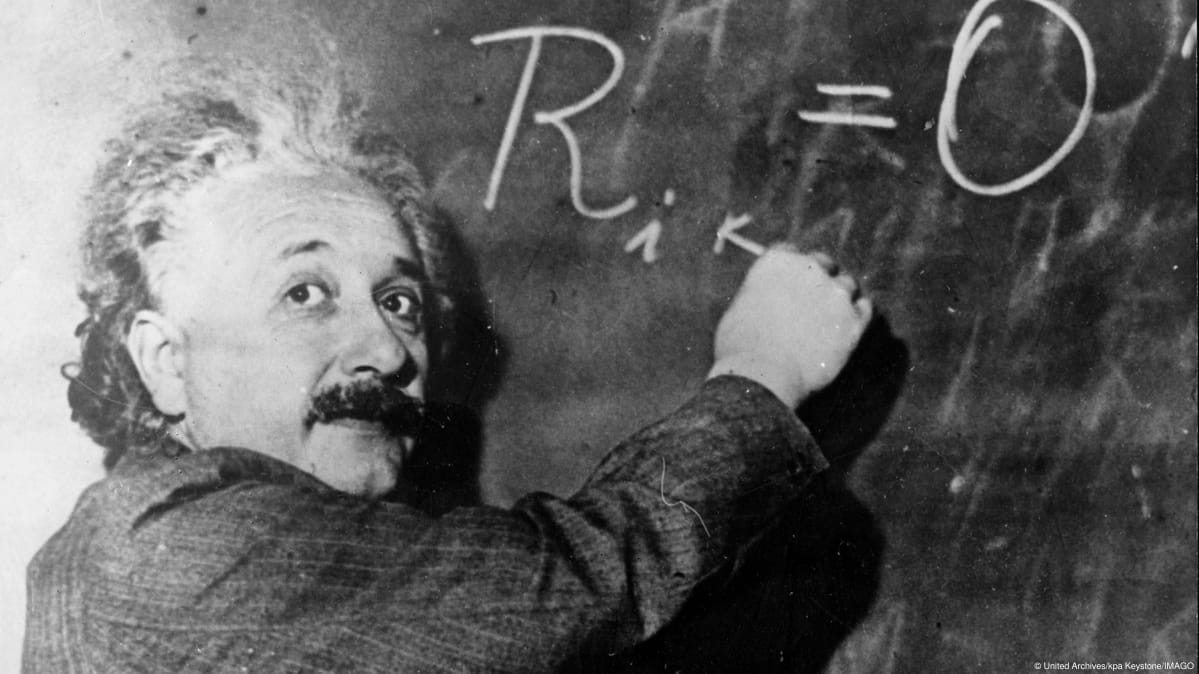
爱因斯坦改变了我们对空间和时间的理解。人工智能能否独立做出可比拟的科学突破?
Einstein transformed our understanding of space and time. Could AI independently make a comparable scientific breakthrough?
数学家如何重新思考自己的角色过去,数学家是通过证明定理来接受训练的。
Image: United Archives/kpa Keystone/IMAGO ## How mathematicians can rethink their role
“现在你可以按一下按钮就证明一个定理,”巴扎德说,“所以我们需要新的方法。”
In the past, mathematicians were trained by getting them to prove theorems. "Now you can prove a theorem by pressing a button," said Buzzard, "so we need new methods."
巴扎德正在建立一个强调理解、解释和捍卫复杂数学论证的实验室。
Buzzard is setting up a lab that emphasizes understanding, explaining and defending complex mathematical arguments.
“最适合做数学的团队是计算机加人类团队,从机器所做的事情中提取洞察和理解,目前仍相对简单,”他说。
"The best team for doing mathematics is a computer plus human team, and it is still relatively straightforward to extract insights and understanding from what machines are doing," he said.
但他说,数学研究可能“最终完全被机器主导,机器做的事情人类根本无法再理解,而且成本极低,只需轻轻一点即可。”
But, he said, mathematical research may "end up completely dominated by machines doing things which humans simply cannot comprehend any more, very cheaply and at the touch of a button."
那么,解决数学问题是这样。那人工智能提出数学问题和命题的能力呢,比如像阿尔伯特·爱因斯坦那样?
So, that is the issue of solving mathematical problems. What about AI's ability to come up with mathematical problems and propositions, like an Albert Einstein?
奥诺说:“如果你用19世纪末已知的所有数学和所有物理学来训练一个大型语言模型,这个模型会自行产生爱因斯坦的相对论吗?我认为我们还没有看到那种创造性火花,那种能力。”
Ono said: "If you trained a large language model on all the mathematics and all the physics that was known by the end of the 19th century, would a model spin up Einstein's theory of relativity on its own? I don't think we've seen that sort of creative spark, that sort of ability yet."