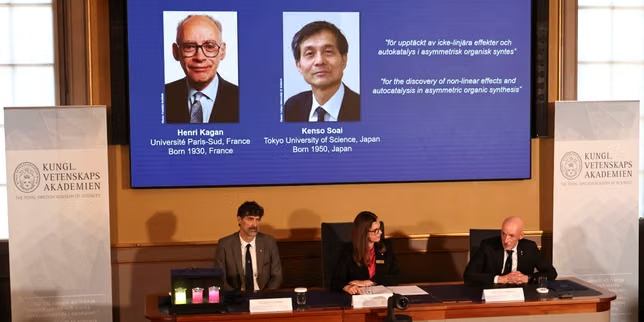
迟到总比不到好。10月7日周三,95岁的法国化学家亨利·卡根(Henri Kagan)与76岁的日本科学家宗桥健生(Kenso Soai)一同荣获诺贝尔化学奖。卡根是巴黎-萨克雷大学的教授,曾在2001年与该奖项失之交臂,尽管当时他已被公认为该奖项所表彰领域——不对称催化——的先驱之一。
Better late than never. French chemist Henri Kagan, 95, finally received the Nobel Prize in Chemistry on Wednesday, October 7, together with Japanese scientist Kenso Soai, 76. Kagan, a professor at Paris-Saclay University, had narrowly missed the prize once before, in 2001, even though, at the time, he was already recognized as one of the pioneers in the field for which the honor was awarded: asymmetric catalysis.
“我们非常高兴。这纠正了一个历史性的不公正,”法国国家科学研究中心(CNRS)荣休研究员、其化学研究所前所长雅克·马达卢诺(Jacques Maddaluno)表示,“他是一位杰出的科学家,充满了人性和谦逊。”奥赛分子化学与材料研究所(ICMMO)所长埃曼纽尔·舒尔茨(Emmanuelle Schulz)补充道:“法国化学非常幸运。”该研究所源于卡根共同创立的一个实验室。
"We are extremely happy. This corrects a historical injustice," said Jacques Maddaluno, an emeritus researcher at the National Center for Scientific Research (CNRS) and former director of its Institute of Chemistry. "He is a brilliant scientist, full of humanity and humility." "French chemistry is very fortunate," added Emmanuelle Schulz, director of the Institute of Molecular Chemistry and Materials of Orsay (ICMMO), which descends from a laboratory Kagan co-founded.
不对称 catalysis(不对称催化)是卡根和宗桥健生专攻的领域,也是最常受到瑞典皇家科学院表彰的领域之一,因为它涉及一个根本问题:分子在三维空间中呈现什么形状,以及如何控制这些形状?凭借五根手指和一个手掌,人们可以做出左手或右手,它们是镜像关系但无法重叠。右手手套不适合左手。这些被称为手性形式。
Asymmetric catalysis, the field in which Kagan and Soai specialize, is one of those most frequently recognized by the Royal Swedish Academy of Sciences because it deals with a fundamental question: What shapes do molecules adopt in three-dimensional space, and how can those shapes be controlled? With five fingers and a palm, one can make either a left hand or a right hand, which are mirror images but cannot be superimposed. A right-handed glove does not fit the left hand. These are called chiral forms.