过去一个月,布伦特原油价格大部分时间在每桶100美元以上,柴油价格更是超过两倍,人们可能会想象,世界上最贫困的化石燃料进口国如今正面临危机。
With Brent crude above $100 a barrel for most of the past month and diesel prices more than twice as high, you might imagine that the world’s poorest fossil fuel importers would be hitting crisis conditions right now.
他们尚未陷入危机,这得益于发展融资领域增长最快的趋势之一——帮助石油和天然气用户支付他们负担不起的燃油费用。
That they’re not quite there is down to one of the fastest-growing trends in development finance — helping oil and gas users pay for fuel they can’t afford.
以孟加拉国政府上周达成的33亿美元紧急能源方案为例。亚洲开发银行将提供2亿美元,用于为首都达卡快速城郊地区修复破旧的电网,为期五年。该地区因停电时间长达12小时或更久而引发抗议和封锁。不过,这笔资金的大头——约31亿美元——将用于支付本财政年度的石油和天然气进口。
Take the $3.3 billion emergency energy package agreed by Bangladesh’s government last week. Some $200 million from the Asian Development Bank will go toward a five-year program repairing the crumbling electricity grid on the fast-urbanizing fringes of the capital Dhaka, where power cuts lasting 12 hours or more have provoked protests and blockades. The lion’s share of the money, though — some $3.1 billion — will pay for oil and gas imports in just the current fiscal year.
而这笔资金,又很大程度上依赖于世界上增长最快的多边银行之一——伊斯兰贸易金融公司(ITFC)的资金和专业能力。
That money, in turn, depends heavily on the cash and expertise of one of the world’s fastest-growing multilateral banks, the International Islamic Trade Finance Corp., or ITFC.
与世界银行和亚洲开发银行等传统多边机构不同,ITFC的主要业务并不是提供低成本融资以支持基础设施建设和经济发展。相反,自2008年成立以来,ITFC累计发放的780亿美元资金中,大部分用于类似孟加拉国贷款的交易:即半商业性贷款,帮助财政紧张的国家支付石油进口费用。这对OPEC成员国来说是一大利好,因为它们是ITFC的主要股东。
Unlike conventional multilaterals such as the World Bank and Asian Development Bank, the ITFC isn’t primarily in the business of providing cheap financing for infrastructure to aid economic development. Instead, most of the $78 billion it has disbursed since it was founded in 2008 has gone to transactions similar to the Bangladeshi loan: Semi-commercial lending to help cash-strapped countries pay for their imports of petroleum. That’s a win for the OPEC members who are the ITFC’s main shareholders.
对这种金融的需求已经足以让伊斯兰贸易融资公司(ITFC)在近年来成为世界主要的多边贷款机构之一。2020年至2024年,其总放款额达到290亿美元,使其与非洲开发银行和欧洲复兴开发银行等传统机构处于同一水平。仅今年,它就为马尔代夫和埃及各签署了价值15亿美元的框架协议,为布基纳法索、科特迪瓦和吉布提签署了29亿美元的协议,为毛里塔尼亚签署了10亿美元的协议,为塞内加尔签署了7.06亿美元的协议。
The hunger for such finance has been enough to turn the ITFC into one of the world’s major multilateral lenders in recent years. Between 2020 and 2024, total disbursements came to $29 billion, putting it in the same league as conventional institutions such as the African Development Bank and European Bank for Reconstruction and Development. This year alone, it has signed framework agreements worth $1.5 billion apiece for the Maldives and Egypt, plus $2.9 billion for Burkina Faso, Cote d’Ivoire and Djibouti, $1 billion for Mauritania and $706 million for Senegal.
这并没有什么阴暗的方面。如今哈瓦那、卡拉奇或马尼拉的任何人都会明白,燃料进口短缺可能和货币危机一样具有毁灭性。通过在这些紧急情况下支持受援国,ITFC正在满足困难人群的紧急需求,正如国际货币基金组织在外汇储备耗尽时所做的那样。其部分贷款也用于非石油需求:截至2024年的累计放款中,约有16%用于粮食和农业,而有67%直接用于非可再生能源。
There’s nothing nefarious about this. As anyone in Havana, Karachi or Manila these days would appreciate, being starved of fuel imports can be as devastating as going through a currency crisis. By supporting recipients through such emergencies, the ITFC is meeting the immediate needs of desperate people, as the International Monetary Fund does when foreign-exchange reserves dry up. A slice of its lending goes to non-petroleum needs, too: About 16% of cumulative disbursements through 2024 went to food and agriculture, compared with 67% going direct to non-renewable energy.
但对受援国而言,这仍然看起来是一笔不好的交易。世界上最贫困的国家——包括许多伊斯兰合作组织成员国,而ITFC正是为了服务这些国家而成立的——由于资本短缺而难以实现增长。反复借款来融资燃料进口并不能解决这一根本问题——它只是把问题推迟到以后,届时外汇储备耗竭和政府债务高企的问题很可能会再次出现。
It still looks like a bad deal for recipients. The world’s poorest nations, including many members of the Organization of Islamic Cooperation that the ITFC was set up to serve, struggle to grow because they’re short of capital. Repeatedly borrowing money to finance fuel imports doesn’t solve that underlying problem — it merely defers it to a later date, when the same issues of depleted foreign-exchange reserves and government debt may well recur.
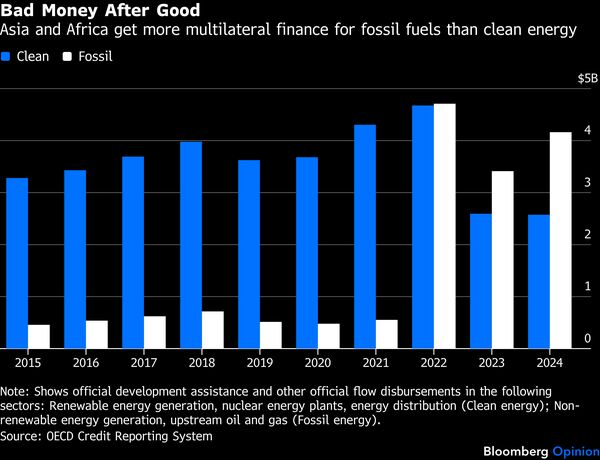
更糟的是,它鼓励受援国向富裕国家支付燃料费用,而这些燃料将在几个月内全部被燃烧殆尽。然而,这些国家的根本问题在于缺乏能够支撑数十年增长的资产。价值10亿美元的太阳能农场在其整个生命周期内所提供的电力大约是同样金额用于购买液化天然气所能提供的电力的10倍。然而,后者的廉价融资却很容易获得,而前者则必须在主要开发银行漫长的审批过程中艰难前行。
Worse, it encourages recipients to pay richer countries for fuel that will all be burned in a matter of months, when their fundamental problem is a shortage of assets that could support decades of growth. A billion dollars’-worth of solar farms will provide roughly 10 times as much electricity over their lifetimes as the same amount of money spent on liquefied natural gas. Cheap financing for the latter, however, is readily available, whereas the former must struggle through the interminable approval processes at major development banks.
这一切的结果是让发展中国家继续依赖化石燃料,尽管更好的替代方案已经存在。孟加拉国的情况凸显了这种荒谬性:作为气候变化加剧下最易受洪水、热浪和气旋威胁的国家之一,孟加拉国正从石油输出国那里借款以购买石油。而这种燃料又太昂贵,以至于其本国公民若没有进一步的政府补贴就无法购买。与此同时,同一政府却在制定一套繁杂的法规,以阻碍更便宜的清洁能源的发展。
The outcome of all this is to keep developing countries hooked on fossil fuels when better alternatives are already available. Bangladesh’s underscores this absurdity: One of the countries most at risk of flooding, heatwaves and cyclones as climate change intensifies is borrowing money from oil exporters to buy petroleum. That fuel, in turn, is too expensive for its own citizens to buy without further government subsidies. Meanwhile, the same government cultivates a thicket of regulations to choke the growth of cheaper clean energy.
解决这一问题的办法不是生气,而是以牙还牙。传统开发银行在以所需规模融资清洁能源方面进展太慢、太笨重。如果能源转型要避免被化石燃料经济的支出所超过,其贷款方就必须提升自身的能力。
The answer to this isn’t to get mad, but to get even. Conventional development banks have been too slow and cumbersome in financing clean power on the scale required. If the energy transition is to avoid being outspent by by the fossil-fuel economy, its lenders will have to step up their game.