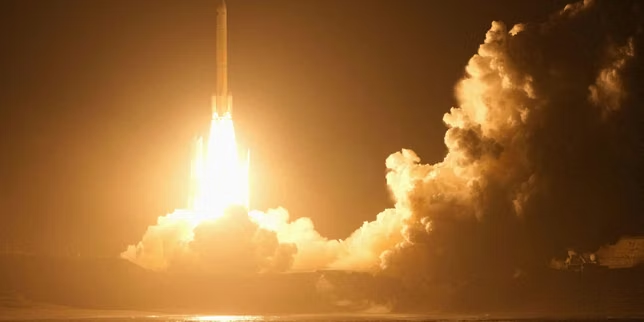
10月20日星期二,日本科学家成功发射了一艘太空探测器。该探测器旨在成为首个从火星卫星上采集样本的任务,有望帮助人类揭开太阳系及地球生命起源的奥秘。据日本宇宙航空研究开发机构直播显示,搭载着“火星卫星探测计划”(MMX)无人探测器的H3主力火箭于凌晨4点41分从种子岛航天中心升空,直入漆黑的夜空。
Japanese scientists successfully launched a spacecraft Tuesday, October 20, that aims to be the first to retrieve samples from one of Mars's moons, potentially helping unlock the origins of the Solar System and life on Earth. The flagship H3 rocket carrying the unmanned Martian Moons eXploration (MMX) probe blasted off into a pitch black sky from the Tanegashima Space Center at 4:41 am, according to a live stream broadcast by the Japan Aerospace Exploration Agency.
一个多小时后,日本宇宙航空研究开发机构通过直播宣布,探测器已成功与H3火箭分离,并“正踏上前往火星系统的旅程”。该机构科学家相田真理感慨道:“我一直梦想着这一天的到来,此刻真是欣喜若狂。现在终于可以松一口气了。”尽管当时正值凌晨,仍有数千名观众收看直播并纷纷留言予以鼓励。据悉,该探测器预计将于明年8月抵达火星附近,随后开始环绕火星的卫星火卫一运行。
Over an hour later, JAXA announced via the live broadcast that the probe had successfully separated from the H3 and was "beginning its journey toward the Martian system." "I'd dreamt of this day, so I'm incredibly happy," said JAXA scientist Mari Aida. "Right now I feel really relieved." Despite the early hour in Japan, thousands of people tuned into the live stream, posting messages of encouragement. The spacecraft is due to arrive near Mars around August next year, where it will orbit one of its moons, Phobos.
此次任务还搭载了一辆由法国与德国联合研发的探测车,其名称“IDEFIX”取自法国漫画《高卢英雄传》中主人公阿斯特里克斯的宠物狗的名字。这辆探测车将成为首个在火卫一表面行驶的探测工具,负责开展地表观测工作以确保后续着陆安全。在随后三年时间里,MMX探测器将在火星周边区域运行,并从火卫一表面采集至少10克(约0.35盎司)的样本。
A French-German rover dubbed IDEFIX – the French name for the comic hero Asterix's dog – will be the first vehicle to travel across Phobos, conducting surface observations aimed at ensuring a safe landing. Once MMX arrives on Phobos, it will collect at least 10 grams (0.35 ounces) of material from the surface during its planned three years in the Red Planet's vicinity.
这项任务旨在实现人类首次往返火星区域的壮举,由日本宇宙航空研究开发机构携手美国及欧洲各航天机构,以及众多大学与科技企业共同实施。科学家们期望借此为未来人类登陆火星奠定坚实基础。
The mission – which aims to be the first round trip to the Martian region – is a collaboration with US and European space agencies, as well as numerous universities and tech companies. Scientists hope it will help lay the groundwork for eventual human exploration.
“随着美国国家航空航天局即将把人类送上火星,MMX任务采集的样本必将为后世研究火星系统带来颠覆性科学发现,”美国国家航空航天局科学任务局局长尼基·福克斯在直播中发来贺词说道。
"The samples from MMX will bring forth paradigm-shifting science on the Mars system for generations to come, especially as NASA prepares to send the first humans to Mars," Nicky Fox, administrator of NASA's Science Mission Directorate, said in a message of encouragement broadcast on the JAXA live stream.
日本宇宙航空研究开发机构(JAXA)希望这次任务能够揭示火星及其两颗卫星的形成机制,这是了解太阳系起源的关键信息。关于这些卫星起源的一种理论是“巨行星撞击假说”——认为它们是在某个天体撞击火星后形成的。另一种理论是“引力捕获假说”,认为这些卫星是被火星的引力吸引而来的。JAXA表示,确定哪种理论正确将有助于我们了解“类地行星(即水星、金星、地球和火星)上如何形成适合生命存在的环境”。
JAXA hopes the mission will reveal how Mars and its two moons formed, a key piece of knowledge in working out how the Solar System was born. One theory for the origin of the moons – the "giant impact" hypothesis – is that they formed after a celestial body collided with Mars. The "capture" hypothesis, meanwhile, postulates that the moons are asteroids pulled in by Mars's gravity. Determining which theory is correct will help reveal "how a habitable environment for life might have arisen on the terrestrial planets," JAXA said, referring to the four rocky worlds closest to the Sun – Mercury, Venus, Earth and Mars. 'Natural space station'
JAXA还称,这次任务还将探索将火卫一(Phobos)作为“天然空间站”使用的可行性,包括研究实现往返火星所需的技术条件;同时,该任务也会观测火星的另一颗卫星火卫二(Deimos),尽管不会在火卫二上着陆。
JAXA said the mission will also explore the possibility of using Phobos as a "natural space station" by establishing the requirements for a round trip – something "essential for crewed Mars exploration." It will also observe the planet's other moon, Deimos, although it will not land on it.
美国和中国航天机构也在竞相成为首个将火星表面岩石样本带回地球的机构。自2021年以来一直在火星表面进行探测的NASA“毅力号”(Perseverance)探测器已经采集到了样本。然而,根据美国国会1月份的投票结果,这项样本返回计划实际上已被唐纳德·特朗普政府取消了。中国的“天问三号”(Tianwen-3)探测器计划于2028年左右发射,并有望在2031年之前将火星样本带回地球——这可能比日本的探测任务更早完成样本返回任务。
US and Chinese space agencies have also been vying to be the first to return rock samples from the surface of Mars back to Earth. NASA's Perseverance rover, which has been roaming across Mars since 2021, has already collected samples. The return mission, however, was effectively canceled by the administration of President Donald Trump following a vote by Congress in January. China's Tianwen-3 spacecraft is scheduled for launch around 2028 and hopes to return Mars samples to Earth as early as 2031 – potentially before the Japanese mission's return.