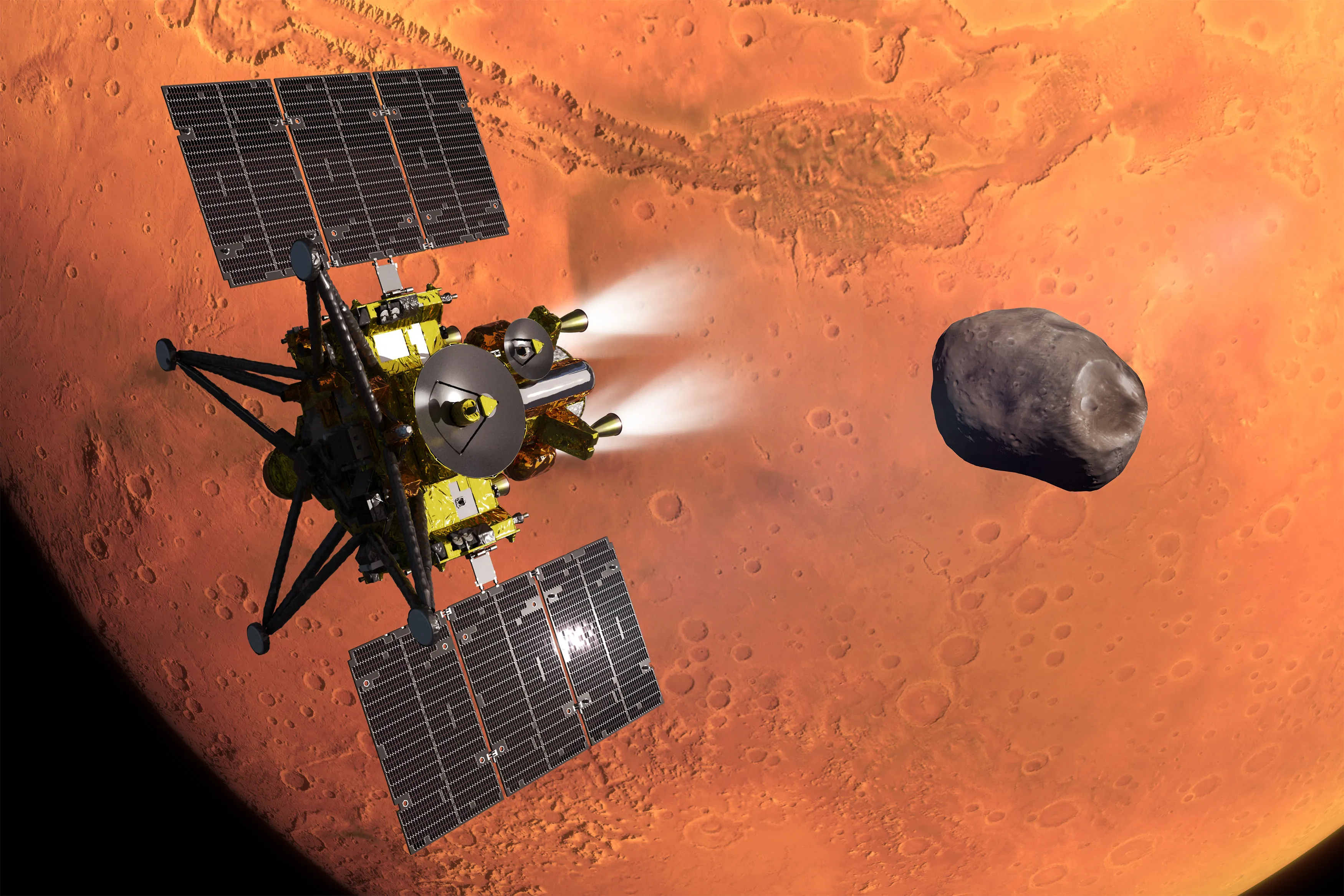
很难想象还有比前往一颗以希腊恐怖之神命名的外星卫星更艰巨的旅程了——尤其是此前三次尝试都以失败告终。
It’s difficult to imagine a more daunting journey than one to an alien moon named after the Greek god of fear—especially when three other attempts to make that journey have failed.
然而,随着日本宇宙航空研究开发机构(JAXA)及其合作伙伴准备向火星那颗名字颇为吓人的卫星发射一艘航天器,“所有成员都充满了安静的兴奋感,”该任务国际科学家团队的负责人清水洋(Kiyoshi Kuramoto)表示。
And yet, as Japan’s space agency, JAXA, and its collaborators gear up to send a spacecraft to Mars’ formidably named moon, “all the members are filled with a quiet sense of excitement,” says Kiyoshi Kuramoto, who leads the mission’s slew of international scientists.
这项名为火星卫星探索(MMX)的任务,计划于日本时间周二凌晨(美国时间周一下午)从日本种子岛宇宙中心发射。历经近一年的航行后,航天器将抵达火星及其两颗卫星:在希腊语中意为“恐惧”的福波斯(Phobos)和意为“恐怖”的戴摩斯(Deimos)。MMX将远距离观测这两颗卫星,并从福波斯采集样本,试图回答一个悬而未决的科学问题:这两颗卫星究竟是如何形成的?
This mission, called the Martian Moons eXploration (MMX), is set to launch from Japan’s Tanegashima Space Center in the wee hours of Tuesday in Japan (Monday afternoon in the US). After almost a year of travel, the spacecraft will reach Mars and its two moons: Phobos, meaning fear in Greek, and Deimos, meaning dread. MMX will observe the pair from afar and collect samples from Phobos in a bid to answer a looming scientific question: How, exactly, did the moons come to be?
研究人员数十年来一直在尝试类似的冒险。自20世纪80年代以来,俄罗斯已向福波斯发射了三艘探测器,均告失败。尽管如此,研究人员仍渴望完成这项“不可能的任务”,因为福波斯及其伴星的起源至今仍是个谜。它们的一些属性,例如反射可见光的模式,表明它们是被火星引力捕获的小行星。但卫星与火星赤道一致的圆形轨道表明,它们可能是由一颗 nascent Mars 与一颗巨型小行星碰撞后遗留的碎片形成的,美国宇航局MMX项目执行官汤姆·斯塔特勒(Tom Statler)在一次新闻发布会上表示。
Researchers have been attempting similar gambits for decades. Since the 1980s, Russia has sent three probes to Phobos, all of which failed. Still, researchers are anxious to achieve this mission impossible because the origin of Phobos and its sibling remains a mystery. Some of their attributes, such as the pattern of visible light they reflect, suggest they are asteroids captured into Mars’ orbit by its gravity. But the moons’ circular orbits in line with the Martian equator indicate that they could have formed from debris left over from a collision between a nascent Mars and a gigantic asteroid, Tom Statler, MMX program executive at NASA, said at a press briefing.
这项新任务旨在通过一套科学仪器详细勘测火星及其卫星,以帮助解决这一争论。例如,利用MMX的MEGANE仪器,研究人员将通过测量福博斯释放的中微子粒子和伽马射线,确定其元素组成。如果福博斯含有更多氢或钾等挥发性元素,则可能更倾向于被捕小行星假说;而挥发性元素较少,则可能支持撞击假说。
The new mission is designed to help settle the debate by surveying Mars and the moons in detail using a suite of scientific instruments. With MMX’s MEGANE instrument, for instance, researchers will determine the elemental makeup of Phobos by measuring the neutrino particles and gamma rays it emits. If Phobos ends up having more volatile elements such as hydrogen or potassium, it could lean closer to the captured-asteroid hypothesis, while fewer volatiles could support the impact idea.
“我们对福博斯的元素组成一无所知,”来自约翰斯·霍普金斯大学、负责MEGANE团队的大卫·劳伦斯说。“对我来说,这正是令人兴奋的地方——进行前所未有的测量。”NASA喷气推进实验室的MMX团队成员阿比盖尔·弗里曼表示,这些观测“将为我们关于福博斯的重大问题提供一些线索”,“但真正能解决这些问题的,将是带回的样本。”
“We know nothing about Phobos' elemental composition,” says David Lawrence, who leads the MEGANE team from Johns Hopkins University. “For me, that’s what’s exciting—making a measurement nobody’s done before.”These observations are “going to give us a hint at some of the answers to the really big questions we have about Phobos,” says Abigail Fraeman, an MMX team member at NASA’s Jet Propulsion Laboratory. “But really, the return samples are going to nail those questions.”
该航天器将利用其搭载的仪器和一辆将在飞船之前着陆以探索新地形的小型车勘测福博斯,随后登陆该卫星,采用两种不同的采样方法采集至少10克物质。目标是在2031年前将样本带回地球,这将是有史以来首次从地球以外的卫星带回样本。
After scoping out Phobos with its onboard instruments and a rover—which will land ahead of the spacecraft to explore the new terrain—the spacecraft will land on the moon to collect at least 10 grams of material using two different sampling methods. The goal is to bring them to Earth by 2031, which would make them the first ever samples returned from a moon other than our own.
研究人员怀疑福博斯表层土壤中含有火星物质,对其分析有助于更清晰地描绘这颗行星在数十亿年的演变过程。但MMX还将为我们更广泛地了解太阳系提供洞察。斯塔特勒在简报会上表示,对样本的实验室分析将有助于确定早期太阳系残留物质的起源及其运输方式。
Researchers suspect Phobos’ surface soil contains Martian material, and analyzing it could paint a better picture of how the planet evolved over billions of years. But MMX will also provide insight into our solar system at large. Laboratory analysis of the samples will help determine the origin of leftover material from the early solar system and how it was transported, Statler said during the briefing.
开展这项研究需要克服艰巨的障碍。库拉莫托表示,由于科学家目前对福波斯表面了解甚少,在对这颗卫星进行近距离观测之前,无法选定着陆点。他补充说,该任务还采用两种采样方法,以防其中一种失败。“从火星卫星带回样本是一项世界首创的挑战,并非易事。”不过,参与研究人员的数量及其深厚的专业知识,让团队有信心在其他人失败的地方取得成功。
Undertaking this research will require overcoming daunting obstacles. Because scientists currently know little of Phobos’ surface, they can’t pick a landing spot until taking up-close observations of the moon, Kuramoto says. The mission also uses two sampling methods as a safeguard in case one fails, he adds. “Returning samples from a Martian moon is a world-first challenge that is not easy.”Still, the number of researchers involved and their depth of expertise give the team confidence that it can succeed where others have failed.
MMX是一项国际合作的壮举,来自美国宇航局、欧洲空间局以及德国和法国航天局的科学家参与其中。“这种复合的专业知识和贡献,确实有助于使任务目标变得非常可行,”欧洲空间局MMX项目科学家埃利奥特·塞夫顿-纳什表示。
MMX is a feat of international collaboration with scientists from NASA, the European Space Agency, and Germany’s and France’s space agencies. “That kind of compounded set of expertise and contributions really helps make the mission objectives very achievable,” says Elliot Sefton-Nash, MMX project scientist at ESA.
日本宇宙航空研究开发机构也有成功开展样本返回任务的可靠记录。尽管遭遇一些挫折,其隼鸟号任务仍成为首个从近地天体表面带回样本的任务,于2010年带回了小行星伊托卡瓦的物质。其后续任务隼鸟2号于2020年带回了原始小行星龙宫的样本。许多隼鸟2号成员参与了MMX任务的设计,但采集福波斯样本将有所不同——例如,其轨道和重力与龙宫不同,库拉莫托表示。
JAXA also has a proven track record of successful sample-return missions. Despite some setbacks, its Hayabusa mission became the first mission to return a sample from the surface of a near-Earth object when it brought back material from asteroid Itokawa in 2010. Its successor, Hayabusa2, delivered samples from the primitive asteroid Ryugu in 2020. Many Hayabusa2 members have helped design the MMX mission, but sampling Phobos will be different—its orbit and gravity are different from Ryugu’s, for instance, Kuramoto says.
不过,“日本宇宙航空研究开发机构在样本返回任务中积累了大量经验并取得了诸多成就,因此非常有能力完成这项任务,”弗劳曼表示。
Still, “JAXA's learned and achieved so much with their sample-return missions that they are really well positioned to be able to do this,” Fraeman says.