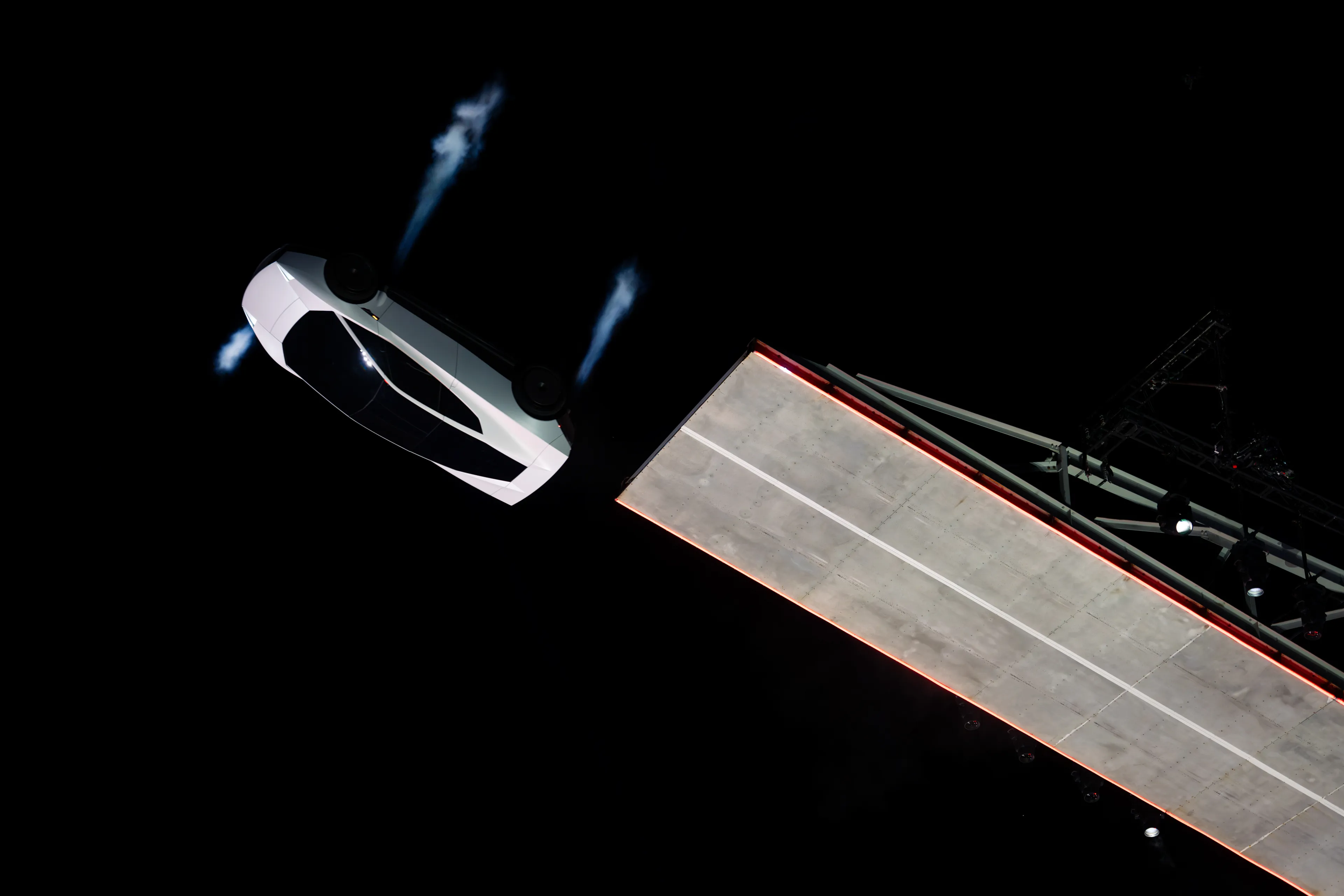
上周,埃隆·马斯克发布了跳票已久的特斯拉 Roadster 2(第二代 Roadster),并展示了一些“花哨”功能。这辆车会飞——虽然飞不了太久——原型车还做了几件普通汽车做不到的事,比如垂直爬墙,以及跳过特斯拉全系车型。
Last week, Elon Musk revealed Tesla’s long-delayed Roadster 2 with a few bells and whistles. The car flies—but not for very long—and the prototype also did a few other things normal cars can’t, like driving up a vertical wall and jumping over Tesla’s entire lineup of vehicles.
这引出两个问题:我们该不该允许人类开车爬墙、飞上天?考虑到人们连二维平面道路都难以驾驭,答案显而易见是否定的。但这属于律师和美国联邦航空管理局(FAA)要解决的范畴。另一个问题是,Roadster 2 原型车究竟是如何做到这些的?我们可以用物理学自己找出答案。
This raises two questions: Should we let humans drive up walls and into the air? Given their trouble navigating two-dimensional roads, this seems like an obvious no. But that’s one for lawyers and the Federal Aviation Administration to figure out. The other question is, how did the Roadster 2 prototype do this stuff? We can answer that ourselves, with physics.
垂直爬墙 先看车辆如何沿环形坡道行驶,然后像蜘蛛侠一样“粘”在上面,完全倒悬。我不建议任何人尝试,但 Roadster 2 的这一特性实际上能提升在普通路面上的性能。这与摩擦力有关。
Driving Up a Wall Let’s start with how the car drove up a circular ramp and then stayed glued to it Spider-Man–style, completely upside down. I don't think you should ever do this, but this feature of the Roadster 2 can actually improve performance on normal roads. It has to do with friction.
当两个表面相互作用——比如橡胶轮胎与路面——会产生一个阻止两表面发生相对滑动的力。这种相互作用称为静摩擦力。我们有一个简单的模型来描述静摩擦力大小(Ff),它取决于两表面压合的紧程度(FN)以及两表面的材质(μ)。
When two surfaces interact—like rubber tires and a road—there can be a force that prevents the surfaces from sliding relative to one another. This interaction is called static friction. We have a simple model for this static friction force where the magnitude (Ff) depends on how hard the two surfaces are pushed together (FN) and the two types of surfaces (μ).
将表面压合在一起的力常称为“正压力”,因为它垂直于两个表面。静摩擦系数(μ)描述相互作用材料的类型。实际最大摩擦系数为 1,橡胶在沥青路面上的值约为 0.6。那个 ≤ 号是怎么回事?因为静摩擦力是“约束力”。它提供防止滑动所需的力——但不超过某个最大值。
The force pushing the surfaces together is often called the “normal” force, since it's perpendicular to both surfaces. The coefficient of static friction (μ) describes the types of materials interacting. The practical maximum coefficient of friction is 1, and for rubber on asphalt, the value is somewhere around 0.6. What about that ≤ sign? This is because static friction is a “force of constraint.”It applies the force needed to prevent sliding—up to some maximum value.
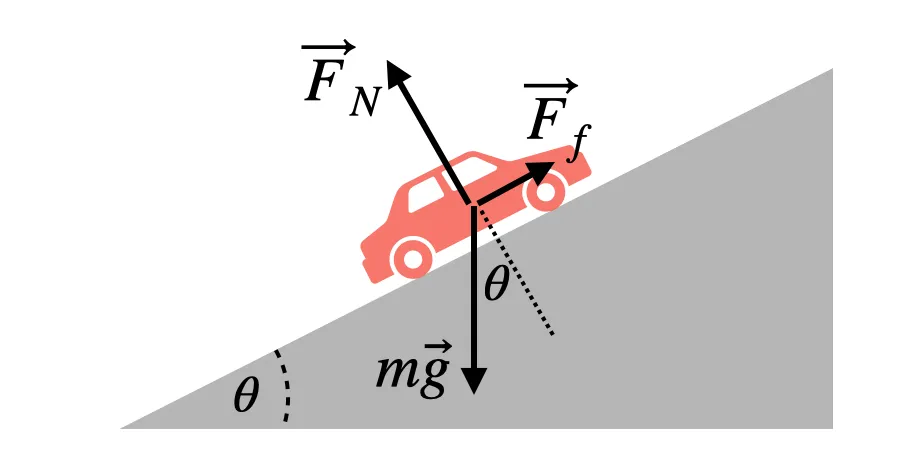
假设一辆普通汽车试图驶上斜坡。这是一个受力图,显示了三个重要的力:摩擦力、正压力和重力(质量与重力场的乘积)。
Suppose a mere mortal car tries to drive up an incline. Here's a force diagram showing the three important forces: friction, normal force, and gravity (the product of mass and the gravitational field).
随着倾斜角(θ)增大,重力(mg)在垂直于表面方向上的分量变小。这意味着正压力(FN)也随之减小,最大摩擦力也随之减小。如果这个摩擦力小于沿斜面向下拉动物体的重力分量,汽车就会打滑。当摩擦系数为 0.6 时,这个最大角度约为 31 度。这不是垂直状态,甚至离垂直状态还差得远。即使摩擦系数达到 0.9,也只能达到 42 度的倾斜角度。
As the angle (θ) of the incline increases, the gravitational force (mg) has less of a component in the direction perpendicular to the surface. This means the normal force (FN) also decreases, as does the maximum frictional force. If this frictional force is less than the component of the gravitational force pulling down the incline, the car will slip. With a coefficient of 0.6, this maximum angle is about 31 degrees. That's not vertical. It's not even close to vertical. Even with a coefficient of friction at 0.9, you still only get to an incline of 42 degrees.
那么汽车如何能在垂直墙面上行驶?答案是增加正压力——进而增加摩擦力。对于垂直墙面,这个摩擦力必须等于重力,才能防止汽车滑落。
So how can a car drive up a vertical wall? The answer is to increase the normal force—and, by extension, the frictional force. For a vertical wall, this friction force must be equal to the gravitational force to prevent the car from slipping.
Roadster 2 的第一个绝招就在这里。它利用风扇将车底的空气吹出。配合侧裙,这会降低车底气压,原理类似于吸尘器。
Here's where the Roadster 2 does its first trick. It uses fans to blow air out from under the car. With some side flaps, this lowers the air pressure under the car, akin to how a vacuum cleaner works.
权且估算一下 Roadster 2 吸附在墙面上所需的车底气压。厂方称该车目标重量为 1700 千克。我们还需要知道接触面积,大致按 2 平方米估算。请记住 F = P × A,其中 P 为压力,A 为面积。但这实际是与外部大气压的压差,大气压约为每平方米 105 牛顿。代入数值计算得出,车底压力需为大气压的 86%。这看起来非常合理。当然,由于车底密封并不完美,风扇将需要持续抽气。
Just for fun, let's estimate the pressure under the Roadster 2 that you would need for it to stick to a wall. The company says the car has a target weight of 1,700 kilograms. We also need to know the contact area. Let’s ballpark it at around 2 square meters. Remember that F = P × A, where P is the pressure and A is the area. But this is really a pressure difference with the external atmospheric pressure at about 105 newtons per square meter. Cranking the numbers gives a bottom pressure of 86 percent of atmospheric pressure. That seems very plausible. Of course, since the seal around the bottom isn't perfect, the fans will need to continue pulling out.
倒置的 Roadster 2 确实是个极具吸引力的销售噱头,但这套吸附系统在车辆正常行驶时其实有着强有力的实际用途。摩擦力是让汽车加速的关键。摩擦力越大,性能越强。将车身向下压紧,意味着能更快加速、更快刹车、过弯更锐利。(高性能车企几十年来一直在利用这一原理,只是程度不如特斯拉的新款原型车那么极致。)
The upside-down Roadster 2 makes for a compelling sales pitch, but the suction actually has a strong use case when it’s driving right side up. Frictional force is the thing that makes a car accelerate. More frictional force, better performance. Pushing the car down means you can accelerate faster and brake faster and make sharper turns. (Performance automakers have harnessed this principle for decades, though not to the degree of Tesla’s new prototype.) 0–60 in 1 second The Roadster 2 also boasts an acceleration of 0 to 60 mph in less than a second.
百公里加速 1 秒内 Roadster 2 还号称能在 1 秒内从 0 加速到 60 英里/小时(约 96.6 公里/小时)。对传统汽车来说,这是不可能的。普通汽车依靠轮胎与路面之间的摩擦力加速,因此受限于摩擦系数。按 0.6 的摩擦系数(合理数值)计算,理论极限只能做到 4.56 秒破百。没错,你可以换更好的轮胎,也可以利用高速行驶时与空气的相互作用产生下压力来增加摩擦力——但这些改进依然无法让你在 1 秒内冲到 60 英里/小时。
For a traditional car, this is impossible. Since a normal car uses the frictional force between the tires and road to accelerate, it's limited by the coefficient of friction. Using a coefficient of friction at 0.6 (reasonable), the best you can do is 0 to 60 mph in 4.56 seconds. Yes, you can get better tires and you can also increase the frictional force once the car moves faster and interacts with the air (pushing it down)—but those improvements still won’t get you to 60 mph in a second.
Roadster 2 依赖的是另一种力:压缩空气向后喷射。这正是火箭的工作原理。既然我们大多数人手边没有火箭,不妨想一想用充气气球推动玩具车的简单实验。
The Roadster 2 relies on another form of force: compressed air shooting out the back. This is how rockets work. Since most of us don’t have rockets handy, consider the simple experiment of a toy car propelled by an inflated balloon.
气球一旦释放,拉伸的橡胶会对气球内的空气施加力,将其通过连接的管子排出。但因为空气有质量,要让它从静止加速到排气速度,需要施加力。力的妙处在于它是两个物体之间的相互作用(如气球和空气)。这意味着,当气球壁推挤空气时,空气会以大小相等、方向相反的力推回气球——这是牛顿第三定律的例证。这个作用在气球上的反作用力,正是让玩具车加速的原因。Roadster 2 用的不是喘息的气球,而是一个压缩空气罐。
Once the balloon is released, the stretched rubber acts as a force that pushes the air out of the balloon and through an attached tube. But since this air has mass, it will take a force to accelerate it from rest to its exhaust velocity. Here's the cool thing about forces—they are an interaction between two things (like the balloon and the air). That means that when the balloon’s walls push on the air, the air pushes back with an equal force in the opposite direction—an example of Newton’s third law. This push-back force on the balloon is what makes the toy car accelerate. Instead of a wheezing balloon, the Roadster 2 relies on a tank of compressed air.
飞行汽车(勉强算) 接下来谈谈飞行汽车部分。Roadster 2 采用同样的压缩空气方式向车身施加向上的推力,使其离地。这在很大程度上是在拓展“飞行”一词的定义,特别是因为储气罐只能提供几秒钟的推力,压力就会下降。储气罐压力降低时,排出的空气速度变慢,推力也随之减小。如果我要拥有一辆飞行汽车,我希望它至少能在空中飞行 10 分钟。
Flying Cars (Sort Of) Now, we get to the flying car part. The Roadster 2 uses the same compressed-air method to push up on the car and get it off the ground. That’s stretching the limits of the term “flying,” especially because there's only a few seconds of thrust that it can get from the tank before the pressure drops. With a lower tank pressure, the air comes out with a lower velocity and less thrust. If I was going to have a flying car, I would hope it could at least fly for 10 minutes of air time.
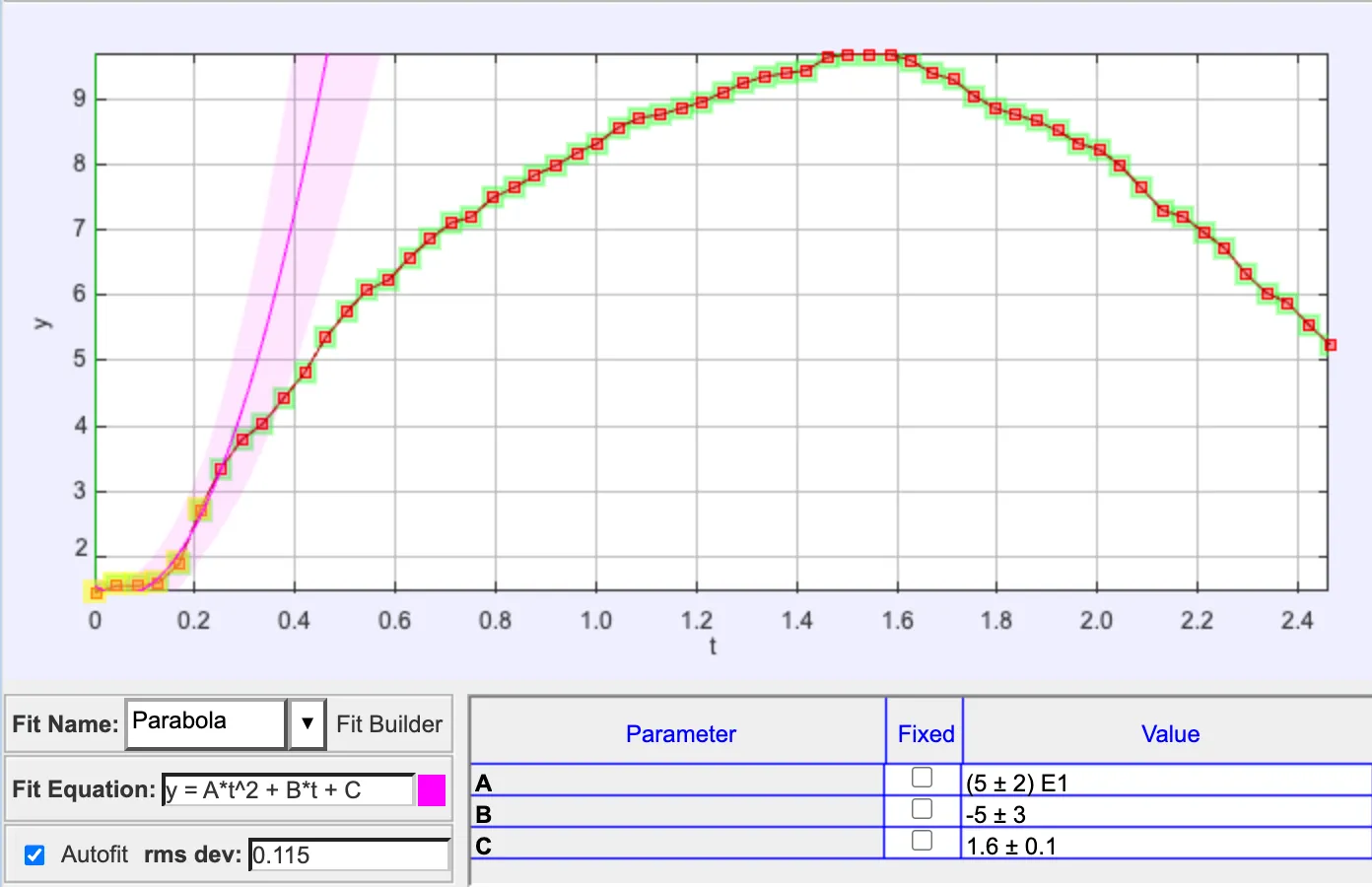
还存在第二个问题——加速度。由于火箭推进器只能工作很短的时间,它们必须施加很大的力,才能改变车速,让汽车跃过卡车或其他障碍物。但大力意味着大加速度,而大加速度通常对人体有害。我们可以通过视频分析来估算这一加速度。我将使用 Tracker 视频分析软件,逐帧标记汽车跃过 Tesla Semi 卡车时的位置。因为已知卡车高度约为 4 米,所以可以得到汽车位置随时间变化的函数。下面是 Roadster 2 在此次跳跃过程中的垂直位置数据。
There's a second issue—acceleration. Since the rockets only last for a short time, they need to apply a large force to get a change in velocity and get the car to leapfrog over a truck or some other obstacle. But with a large force, you also get a large acceleration, and large accelerations are generally bad for humans. We can estimate this acceleration using video analysis. I'm going to use Tracker Video Analysis to mark the location of the car in each frame as it jumps over a Tesla Semi truck. Because we know the truck is about 4 meters tall, we can get the position of the car as a function of time. Here is the vertical position of the Roadster 2 during this jump.
在运动初始时刻,汽车的垂直速度为零,随后向上加速。如果假设跳跃过程中加速度恒定,那么位置-时间数据应呈抛物线形状。对该数据进行二次函数拟合可得出加速度。针对这一特定运动,我粗略估算出的垂直加速度约为每秒平方 98 米。这相当于人体承受约 10 g 的过载。当然这只是估算值。人体可在短时间内承受该级别的过载,但体验不会舒服,且仍存在风险。或许这正是该演示由机器人驾驶的原因。
Right there at the beginning of the motion, the vertical velocity of the car is zero, and then it accelerates upward. If we assume constant acceleration during this jump, then the position-time data should be in the shape of a parabola. Fitting a quadratic function to this data gives the acceleration. For this particular motion, I get a rough estimate of about 98 meters per second squared of vertical acceleration. That's right around 10 g’s for humans. That’s just an estimate, of course. Humans can survive that level of force for a short period, but it wouldn’t be pleasant, and it still comes with risks. Maybe that's the reason this particular demo had a robot behind the wheel.