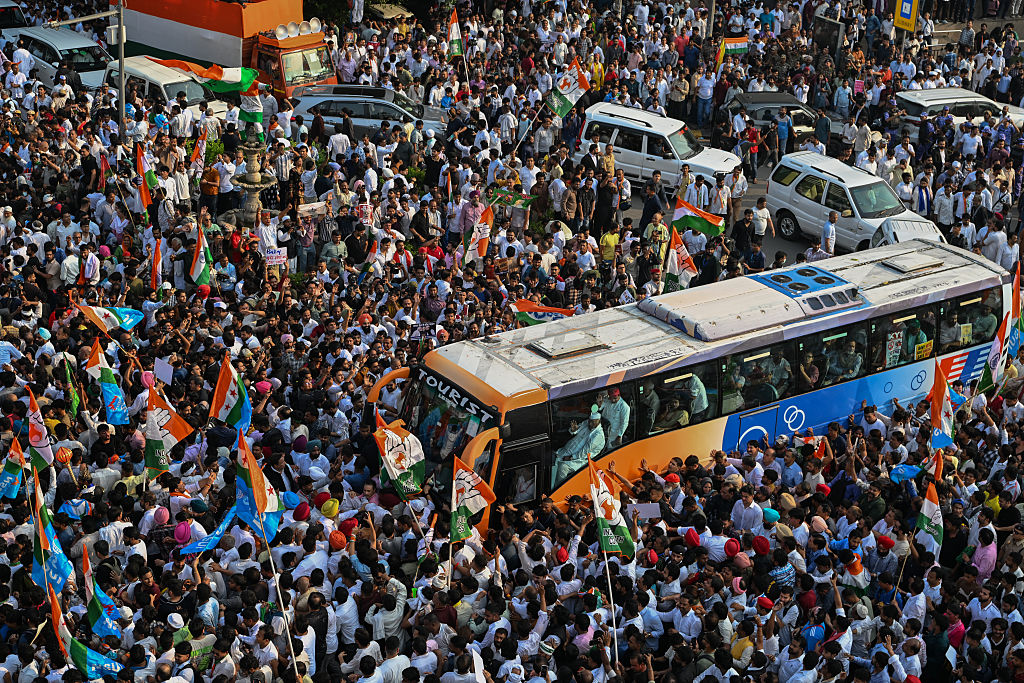
近几周,示威活动席卷印度各地,抗议者愤怒地指责选民名册清洗是出于政治动机。
Demonstrations have swept across India in recent weeks, fueled by anger over what protesters say is a politically motivated purge of electoral rolls.
抗议由选举机构从名册中删除约 1.3 亿个名字引发。选举机构为这一过程辩护,称该行动旨在剔除不合格选民。
The protests were sparked by the removal of some 130 million names from the rolls by election authorities, who have defended the process, saying the exercise was intended to weed out ineligible voters.
但被称为“特别强化修订”这一过程的批评者表示,其目的是巩固总理纳伦德拉·莫迪领导的印度人民党(BJP)的地位。他们要求首席选举专员 Gyanesh Kumar 辞职。
But critics of the process, known as the Special Intensive Revision, said it was designed to bolster Prime Minister Narendra Modi’s Bharatiya Janata Party (BJP). They have demanded the resignation of the chief election commissioner, Gyanesh Kumar.
印度当局以强硬手段应对示威,封锁首都新德里,并拘留了今年早些时候兴起的青年主导运动“蟑螂人民党”(CJP)的领导人。周一,印度一家法院延长了对该运动两名领导人 Ashutosh Ranka 和 Saurav Das 的拘留。
The demonstrations have been met with a heavy-handed response from Indian authorities, who locked down the capital, New Delhi, and detained leaders of the burgeoning Cockroach Janta Party (CJP), a youth-led movement that emerged earlier this year. An Indian court on Monday extended the detention of two Cockroach movement leaders, Ashutosh Ranka and Saurav Das.
今年夏天,该运动在印度政坛展现了强大力量,成功推动教育部长 Dharmendra Pradhan 辞职,后者于 7 月 25 日辞职。
The movement proved itself a powerful force in Indian politics this summer when it successfully campaigned for the removal of Education Minister Dharmendra Pradhan, who resigned on July 25.
为讨论抗议活动及其意义,TIME 采访了历史学家、小说家、印度最知名作家之一 Mukul Kesavan。本次访谈为清晰起见已进行压缩和编辑。
To discuss the protests and what they mean, TIME spoke with Mukul Kesavan, a historian, novelist, and one of India’s best-known writers. This interview has been condensed and edited for clarity.
问:这些抗议究竟是为了什么?它们是“蟑螂”运动早期抗议的自然延续,还是完全不同的事情?
Q: What are these protests actually about? Are they a natural progression from the Cockroach movement’s earlier protests, or something different?
MK:这与蟑螂运动(CJP)在贾特尔·曼塔尔(印度首都的传统抗议场所)的静坐有关,那次静坐导致教育部长辞职,因为它通过迫使莫迪政府退让,为异见创造了空间。但[10月12日的游行]与众不同,因为它是由国大党联合其他传统政党组织的。CJP并未参与组织,尽管其进步/左翼明星人物内哈·博拉参加了前往最高法院的游行。抗议的议题也不同:针对的是选举委员会对选民名册的摆布。
MK: It’s related to the Cockroach movement (CJP) sit-in at Jantar Mantar [a traditional site of protest in the Indian capital] that led to the resignation of the education minister, in that the sit-in created a space for dissent by making Modi’s government back down. But [the Oct. 12 march] was distinct because it was organized by the Congress Party along with other conventional political parties. The CJP had no hand in organizing it, though one of its progressive/left stars, Neha Bora, participated in the march to the Supreme Court. It was also about a distinct issue: the Election Commission’s fiddling with voter rolls.
问:警方在10月10日集会前拘留了运动领袖,几天后又在贾特尔·曼塔尔再次拘留了其中两人。这说明政府如何看待这场运动?
Q: Police detained the movement’s leaders before the October 10 rally, then detained two of them again at Jantar Mantar days later. What does that tell you about how the government sees this movement?
MK:政府对CJP的态度发生了逆转。在贾特尔·曼塔尔1.0时期,政府低估了蟑螂们,以为这只是一场会自行平息的静坐。他们在7月20日年轻人大规模涌现的场面中陷入被动。政府从警方暴力导致其信誉扫地的教训中吸取了经验:它承担不起让蟑螂们占据一个空间、让大批市民在手机摄像头前与警察对峙的后果。我们看到的是一种预防性拘留策略,旨在杜绝这种可能性。
MK: There has been a reversal of the government’s attitude towards the CJP. At Jantar Mantar 1.0, the government underestimated the cockroaches, thinking it was a sit-in that would peter out. They were ambushed by the massive turnout of the young on July 20. The lesson the government learned from the police violence that discredited it was that it couldn’t afford to let the cockroaches occupy a space where massed citizens confronted the police for phone cameras to record. We’re seeing a strategy of pre-emptive detention to head off that possibility.
问:印度的选举长期以来一直是国家的骄傲。这一事件是否损害了这种形象,无论是在国内还是国际上?
Q: India’s elections have long been a source of national pride. Has this episode damaged that image, at home or abroad?
MK:印度的选举一度颇为靠不住,直到一位名叫 T.N. Seshan 的人在 1990 年代初成为首席选举专员。他是个古怪的自我中心狂,但他对职位极其认真,以至于清理了整个选举流程。选举委员会变成了一个三人机构,大体上保持中立,直到莫迪政府通过一项法律,让政府在任命选举专员的三人小组中占据多数。Gyanesh Kumar 表现出极其露骨的偏袒,而特别密集修订如此明显地试图调整选民名册以利于印度人民党,以至于该机构在公众面前信誉扫地。
MK: India’s elections were a bit iffy until a man called T.N. Seshan became chief election commissioner in the early 1990s. He was an awkward egomaniac who took his office seriously enough to clean up the whole election process. The Election Commission became a three-member body that was more or less impartial till the Modi government passed a law that gave the government the majority in the three-member panel that appoints the election commissioners. Gyanesh Kumar has been grotesquely partisan and the Special Intensive Revision has so obviously tried to shape the electoral roll to favor the BJP that the institution has been publicly discredited.
印度开始类似于其他地方的选举威权国家,如土耳其。问:这些抗议活动说明了莫迪处于什么位置?
India begins to resemble electoral autocracies elsewhere like Turkey. Q: What do these protests tell you about Modi’s position?
MK:这是一种常规的说法,但显而易见,莫迪那种威慑力和权威的光环已经消散。年轻蟑螂的嘲弄和无礼,尤其是挤满贾特尔·曼塔尔的年轻女性,做到了严肃的意识形态反对派未能做到的事:让他显得荒谬、衰老且脱离现实。我不知道抗议活动是否说明了他的选举号召力有何变化:我们得等到选举才能知道。反对党必须找到一种方法,将这种沸腾的情绪转化为选票。
MK: It’s the conventional thing to say, but it’s palpable that Modi’s aura of menace and authority has dissipated. The mockery and rudeness of young cockroaches, especially the young women who crowded into Jantar Mantar, did something that solemn ideological opposition had failed to do: it made him seem ridiculous, old and out of touch. I don’t know if the protests tell us anything about his electoral reach: we’ll have to wait for an election to find out. Opposition parties have to find a way of turning this fizz into votes.
问:莫迪执政已有 12 年。他的真实成就是什么?历史学家会如何评价他?
Q: Modi has now been in power for 12 years. What are his real achievements? What will historians credit him with?
MK:在基础设施方面有些成就:修路、建机场等。这正是威权者擅长的事。很难知道经济增长数字在普遍福祉方面意味着什么。在地缘政治上,他任内的表现是一场灾难:印度与所有邻国关系恶化,对中国采取否认态度,且在特朗普那里落了个不受欢迎。与其谈论他的成就,不如谈谈他是如何败坏共和国的制度——新闻界、法院、选举委员会。他最大的“成就”在于让印度教至上主义的言论常态化。
MK: Some achievements in infrastructure: road building, airports, etc. The kind of things authoritarians do well. It’s hard to know what the economic growth figures mean in terms of general wellbeing. Geopolitically, his time in office has been a disaster: India is on bad terms with all its neighbors, in denial about China and in the doghouse with Trump. It might be more useful to talk about how he has degraded the republic’s institutions—the press, the courts, the election commission—than his achievements. His greatest "achievement" has been to normalize the rhetoric of Hindu supremacy.
问:印度拥有世界上最大的年轻人口群体之一,但其教育质量和年轻人的前景却十分严峻。与其他年轻人正在抗议的地方相比,情况如何?
Q: India has one of the largest young populations in the world, yet the quality of its education and the prospects for its young people are grim. How does the situation compare to other places where young people are protesting?
MK:除斯里兰卡可能之外,所有南亚国家,包括近期出现青年起义的尼泊尔、孟加拉国和印度,其中小学和大学体系总体都很差,只有少数精英院校例外。这本身就很糟糕,但中国在各个层面改善其教育体系的成功,让我们的失败更加令人沮丧。
MK: With the possible exception of Sri Lanka, all South Asian countries, including the ones that have seen youthful insurrections in recent times like Nepal, Bangladesh and India, have school and university systems that are generally poor, with a few exceptions: elite institutions. This would be bad in itself, but the success of China in improving its educational system at every level makes our failure demoralizing.