新加坡 -- 根据周三发布的一份报告,尽管面临经济不确定性,且该技术的变现程度仍然非常低,但人工智能在电商产品推荐和内容创作方面的应用不断扩大,将推动东南亚数字经济增长。
SINGAPORE -- The expanding use of AI for product recommendations and content creation in e-commerce will boost Southeast Asia's digital economy despite economic uncertainty and still very low monetization of the technology, according to a report released on Wednesday.
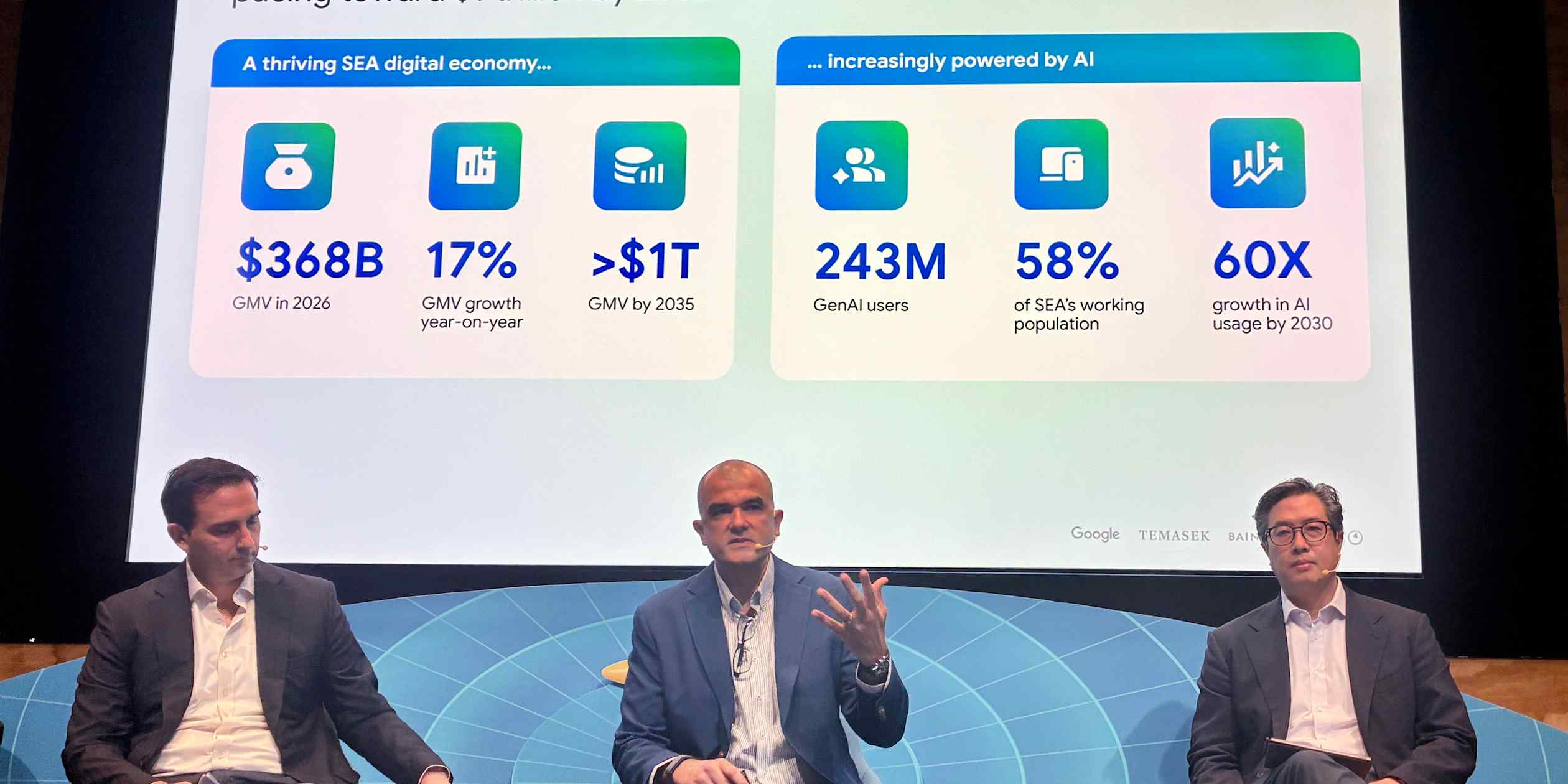
根据谷歌、淡马锡控股(新加坡主权基金)和美国咨询公司贝恩公司共同编制的最新年度《东南亚互联网经济报告》(e-Conomy SEA),该地区数字经济的商品交易总额将在2026年达到3680亿美元,较去年增长17%。该数据涵盖东盟(一个由11个成员国组成的区域组织)几乎所有成员国,但不包括东帝汶。
According to the latest annual e-Conomy SEA report compiled by Google, Temasek Holdings (Singapore's sovereign fund) and U.S. consultancy Bain & Co., the region's digital economy will reach $368 billion in gross merchandise value in 2026, up 17% from last year. The figure covers nearly all members of ASEAN, an 11-member regional grouping, except for East Timor.
报告预测,东南亚数字经济将在2030年扩大至6200亿美元,2035年达到1.1万亿美元,从今年起复合年增长率为13%。电商预计将继续占据大头,其次是在线旅游。
Southeast Asia's digital economy is projected to expand to $620 billion in 2030 and $1.1 trillion in 2035, representing compound annual growth of 13% from this year. E-commerce is expected to continue to make up the majority of that, followed by online travel.
谷歌东南亚董事总经理Nitin Gajria表示,这种快速增长部分源于从线下向线上商业的转变,人工智能在零售端和消费端均提供了支持。他表示,人工智能可帮助小企业让其产品在在线市场上尽可能容易被发现。
Nitin Gajria, Google's managing director for Southeast Asia, said this rapid growth is partially driven by the shift from offline to online commerce, with AI supporting expansion on both the retail and consumer sides. He said AI could help small businesses make their products as discoverable as possible across online marketplaces.
贝恩公司合伙人Florian Hoppe表示,人工智能可支持“为您的产品制作短视频等内容,从而提高转化率”。他表示,人工智能工具可帮助卖家将在线销售完成率提高约10%-15%,并改善面向买家的产品推荐。
Florian Hoppe, a partner at Bain, said AI could support "things like creating short-form videos for your products that help drive conversion." He said AI tools help sellers increase completion of online sales by roughly 10-15% and improve product recommendations for buyers.
在消费端,报告称该地区75%的人工智能用户愿意利用该技术寻找最优价格并进行购买。Gajria表示,当人工智能参与购买流程时,消费者倾向于花费更多,这表明该技术让他们更有信心增加支出。
On the consumer side, the report said 75% of AI users in the region are willing to use the technology to find the best prices and make purchases. Gajria said consumers tended to spend more when AI was involved in the purchasing process, suggesting that the technology gives them confidence to spend more.
报告显示,该地区六大经济体中有2.43亿人(相当于劳动人口的58%)已采用生成式AI。“互联网用了十多年才达到这一里程碑,而生成式AI凭借低试用门槛仅用了三年便达成,”报告称。
The report shows that 243 million people in the region's six major economies -- equivalent to 58% of the working population -- have adopted generative AI. "While the internet took over a decade to reach this milestone, GenAI got there in three years with its low barriers to trial," it said.
报告指出,尽管东南亚AI的商业化仍处于“萌芽”阶段,但预计将在“近期内规模化扩张”。该地区六大经济体中目前仅有1%-2%的人口付费使用生成式AI,而美国这一比例为3%。
It noted that while the monetization of AI is still "nascent" in Southeast Asia, it is expected to "scale up in the near future." Only 1-2% of the population in six major economies in the region currently paying to use generative AI compared to 3% in the U.S.
各主要东南亚经济体的生成式AI采用率差异巨大。新加坡渗透率最高,达70%,马来西亚以68%紧随其后,印尼和菲律宾分别为54%和53%。
Generative AI adoption varies widely across major Southeast Asian economies. Singapore has the highest penetration rate at 70%, followed by Malaysia at 68%, while Indonesia and the Philippines stand at 54% and 53%, respectively.
《2026年东南亚互联网经济报告》引入“Token”来量化AI使用量,将其作为商品交易总额(GMV)的等价指标,这使得六大经济体在企业级采用方面的差距更加明显。
The e-Conomy SEA 2026 report introduces "tokens" to quantify usage of AI as its equivalent of gross merchandise value, which makes the gap in enterprise adoption more evident among the six major economies.
按企业使用的AI Token占比衡量,新加坡以55%-60%领跑该区域,马来西亚以45%-50%位居第二,而印尼和越南仅为15%-20%——在这两国,AI使用仍以消费者为主导。
Measured by the share of AI tokens used by enterprises, Singapore leads the region at 55-60%, followed by Malaysia at 45-50%, compared with 15-20% in Indonesia and Vietnam -- where AI usage remains largely consumer-driven.
报告还强调,东南亚在AI基础设施和算力方面的私募融资激增,2026年上半年达到约170亿美元,主要源于大型数据中心交易。这较上年同期增加了10亿美元。
The report also highlighted a surge in private funding in Southeast Asia for AI infrastructure and computing capacity, which reached approximately $17 billion in the first half of 2026, mostly stemming from major data center deals. That is up $1 billion year on year.
淡马锡亚太区(不含中国和印度)负责人Fock Wai Hoong表示,东南亚的大多数AI应用聚焦于数字金融服务和企业需求,“AI产品已融入产品工作流和功能中。”
Fock Wai Hoong, head of Asia-Pacific (excluding China and India) at Temasek, said most AI applications in Southeast Asia have been focused on digital financial services and enterprise needs, "where AI products have been integrated into the product workflow and features."