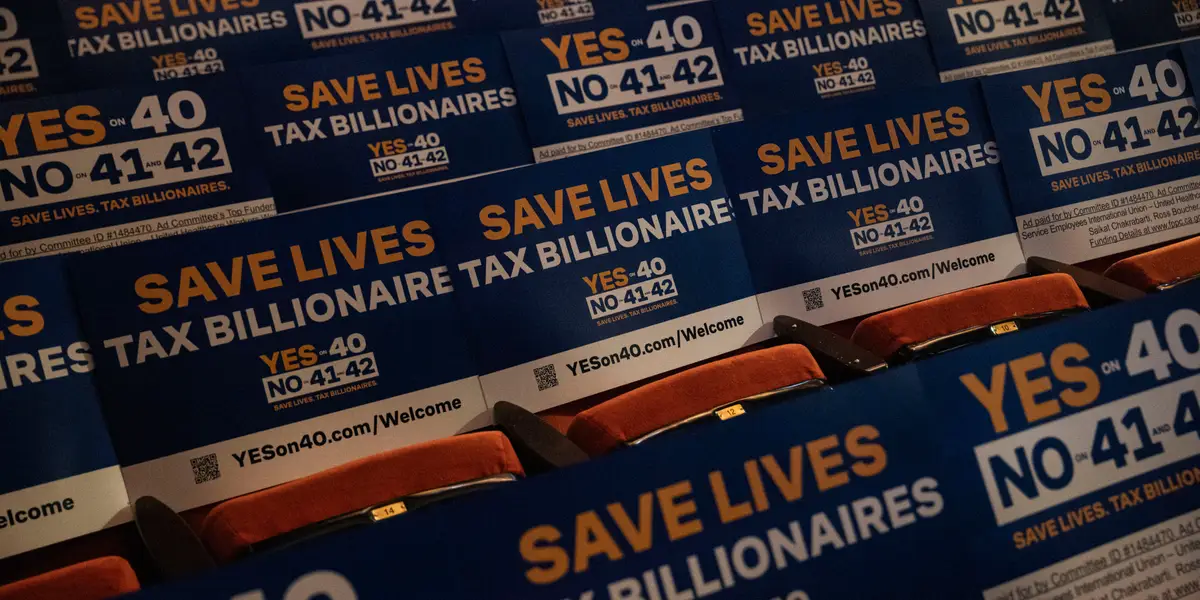
加州拟议中的亿万富翁税支持者称,该税项可能带来约1000亿美元的收入。但一份新论文将税收估算降至约300亿美元,并警告称,如果该州最富有的居民流失,加州最终可能会亏损。提案40将于11月3日提交选民表决,该提案将对2026年1月1日为加州居民的亿万富翁征收一次性5%的税,其财富按年底价值计算。大部分税收将用于医疗保健。
Supporters of California’s proposed billionaire tax say it could raise about $100 billion. But a new paper puts the takings closer to $30 billion and warns that the state could ultimately lose money if its richest residents flee. Proposition 40, which goes before voters on November 3, would impose a one-time 5% tax on billionaires who were California residents on January 1, 2026, with their wealth valued at the end of the year. Most of the tax proceeds would go toward healthcare.
本周发布的一份国家经济研究局工作论文中,斯坦福大学经济学家本杰明·贾罗斯和乔舒亚·劳估计,该税项将征收280亿至360亿美元,远低于支持者预测的1000亿美元。他们指出,亿万富翁可能在居住权截止日期前搬离。他们的估计还假设,法律挑战可能会阻止加州征收部分剩余税款。作者确定了七位据称在截止日期前离开该州的亿万富翁:谷歌联合创始人拉里·佩奇和谢尔盖·布林、投资者彼得·蒂尔、导演史蒂文·斯皮尔伯格、优步联合创始人特拉维斯·卡拉尼克、投资者大卫·萨克斯以及汽车贷款大亨唐·汉基。
In a National Bureau of Economic Research working paper released this week, Stanford economists Benjamin Jaros and Joshua Rauh estimate the tax would collect between $28 billion and $36 billion — far short of supporters' $100 billion projection. They point to billionaires moving away before the residency cutoff. Their estimate also assumes legal challenges could prevent California from collecting some of the remaining tax. The authors identified seven billionaires reported to have left the state before the cutoff: Google cofounders Larry Page and Sergey Brin, investor Peter Thiel, director Steven Spielberg, Uber cofounder Travis Kalanick, investor David Sacks, and car loan tycoon Don Hankey.
这七人共计占研究人员认为可能被征税的财富的近30%。研究人员指出,搬离该州本身并不决定某人的税务居住身份。作者更担心的是之后会发生什么。加州只会征收一次财富税,但离开的亿万富翁可能会年复一年地停止缴纳州所得税。如果这些离开和损失的付款持续下去,他们的模型预测平均净损失为389亿美元。研究人员称,他们进行了10万次模拟,在85%的情景中,损失超过了该税项带来的收入。
Together, they accounted for nearly 30% of the wealth the researchers considered potentially taxable. The researchers noted that moving out of the state does not, by itself, settle someone's tax residency. The authors' bigger concern is what happens afterward. California would collect the wealth tax only once, but billionaires who leave could stop paying state income taxes year after year. If those departures and lost payments last, their model projects an average net loss of $38.9 billion. The researchers said they ran 100,000 simulations, and that in 85% of scenarios, losses outweighed revenues from the tax.
预测取决于谁实际离开以及他们是否长期不归。加州非党派立法分析师办公室持较为乐观的看法。
The forecast depends on who actually left and whether they stay away. California's nonpartisan Legislative Analyst's Office offers a less stark view.
该税收政策预计将为政府带来数百亿美元的税收收入,但亿万富翁们的所得税缴纳额每年可能仅减少不到10亿美元。布林(Brin)还在其他方面反对这项提案:他至少向“建设更美好的加州”(Building a Better California)组织捐赠了1.02亿美元,该组织致力于阻止或否决提案40(Proposition 40)的通过。如果同一张选票上同时出现两项相互竞争的税收措施,即使选民投票通过了提案40,该提案也可能无法正式生效。
It expects tens of billions in tax revenue and a possible ongoing drop of less than $1 billion a year in billionaire income-tax payments. Brin is fighting the proposal on another front, too. He has given at least $102 million to Building a Better California, a group backing efforts to defeat or block Proposition 40. Two competing measures on the same ballot could keep Proposition 40 from taking effect, even if voters approve it.
虽然一些亿万富翁公开表示反对这项税收政策,但也有人表示支持。英伟达(Nvidia)首席执行官黄仁勋(Jensen Huang)上个月在接受CBS News采访时表示,能够在五年内缴纳约80亿美元的税款是一种“荣幸”。本周公布的文件显示,Meta首席执行官马克·扎克伯格(Mark Zuckerberg)曾考虑因这项税收政策而搬离加州,但最终决定留在那里。
While some billionaires have been vocal in their opposition to the tax, some have welcomed it. Nvidia CEO Jensen Huang told CBS News last month that being able to pay an estimated $8 billion over five years would be a "privilege." In filings released this week, it was revealed that Meta CEO Mark Zuckerberg had considered moving out of California due to the tax, but ultimately decided to stay.
为确保扎克伯格有足够的资金来支付税款同时不会稀释他对公司的控制权,Meta专门设立了一种新的股票类型。许多经济学家支持这项税收政策;六位诺贝尔奖得主——达龙·阿西莫格鲁(Daron Acemoglu)、阿比吉特·班纳吉(Abhijit Banerjee)、彼得·戴蒙德(Peter Diamond)、埃丝特·杜弗洛(Esther Duflo)、保罗·克鲁格曼(Paul Krugman)和约瑟夫·斯蒂格利茨(Joseph Stiglitz)——在9月份联合签署了一封信,称这项提案是“人民开始限制亿万富翁权力的首次机会”。
To ensure that Zuckerberg has sufficient liquidity to pay without diluting his control of the company, Meta created a new class of shares. Many economists back the plans. Six Nobel Prize winners — Daron Acemoglu, Abhijit Banerjee, Peter Diamond, Esther Duflo, Paul Krugman, and Joseph Stiglitz — signed a letter in September calling the proposal the "first opportunity for the people to start reining in the power of billionaires."
阿西莫格鲁表示,这项政策可以遏制极富人群多年的逃税行为,并削弱他们的政治影响力。他认为,尽管这项提案并不完美,但它“值得支持”。
At the time, Acemoglu said it could counter years of tax avoidance by the very wealthy and curb their political influence. He said that while the proposal isn’t perfect, it "deserves support."