在阿拉伯半岛以东,波斯湾沿岸,战争正在酝酿,表现为美国与伊朗时起时伏的冲突。伊朗导弹倾泻在阿拉伯城市和基础设施上,并持续威胁着半岛的经济命脉——霍尔木兹海峡的航运。但真正战火正酣的,是在西部和南部,沿红海和亚丁湾海岸的国家。
TO THE EAST of the Arabian peninsula, along the shores of the Persian Gulf, war is simmering, in the form of America’s on-again-off-again conflict with Iran. Iranian missiles have rained down on Arabian cities and infrastructure and continue to menace shipping in the Strait of Hormuz, the peninsula’s economic lifeline. But it is to the west and south, in the countries along the shores of the Red Sea and the Gulf of Aden, that fighting is really raging.
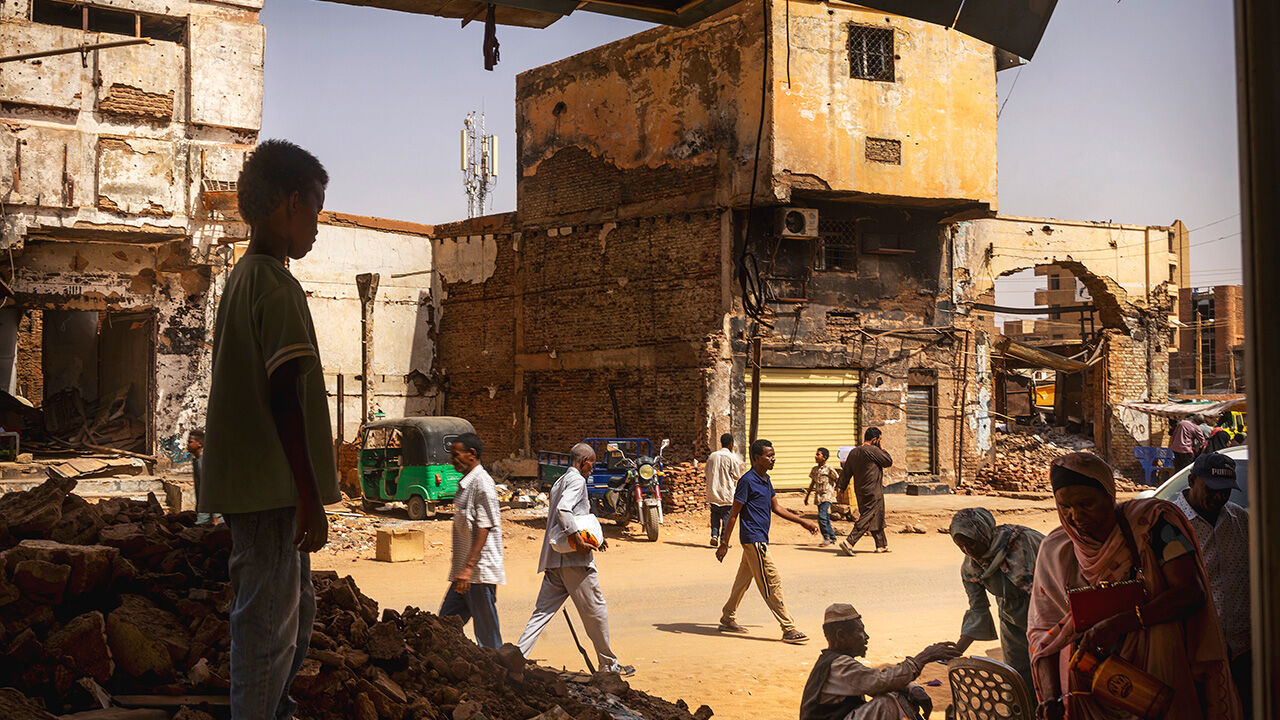
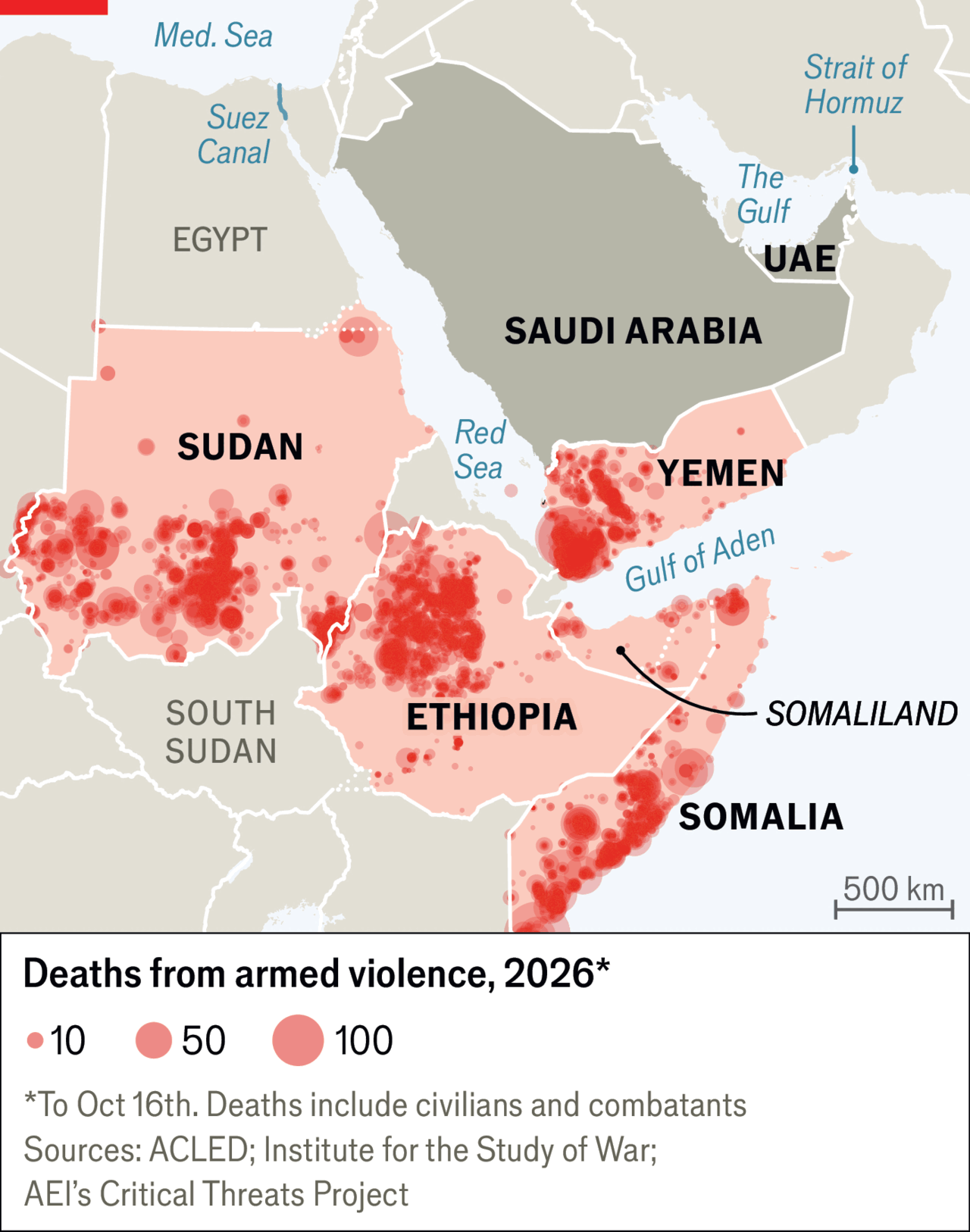
也门持续12年的内战正蔓延至国境之外,火箭弹袭击红海航船,以及沙特阿拉伯的石油终端和机场。在红海对岸,苏丹内战已夺去数十万人的生命,并迫使该国5000万人口中的约1100万人流离失所。更南方,埃塞俄比亚的另一场内战有演变为地区性冲突之势,厄立特里亚部队已加入战斗。这些战争反过来又加剧了利比亚和索马里等邻国的分裂。这是一片巨大的毁灭地带(见地图),其破坏和杀戮的规模远超与伊朗的冲突,甚至超过加沙或乌克兰的冲突。
Yemen’s 12-year-old civil war is spilling beyond its borders, with rocket attacks on ships in the Red Sea and on oil terminals and airports in Saudi Arabia. On the far side of the Red Sea, the civil war in Sudan has claimed hundreds of thousands of lives and forced some 11m of the country’s 50m people from their homes. Farther south, yet another civil war, in Ethiopia, threatens to become a regional one, as forces from Eritrea join the fighting. These wars, in turn, aggravate divisions in neighbouring countries such as Libya and Somalia. It is a vast zone of devastation (see map), with destruction and killing on a scale far exceeding that of the war on Iran, or even the conflicts in Gaza or Ukraine.
阿拉伯半岛的两大强国——沙特阿拉伯和阿拉伯联合酋长国——曾试图避免伊朗爆发战争,担心——事实证明担心是对的——自己会陷入交叉火力之中。但它们并未试图平息南方和西方的战事,反而火上浇油,选边站队,向心仪的派系输送支持。考虑到两国地缘政治利益相似,令人咋舌的是,沙特和阿联酋有时在同一场冲突中支持对立力量,加剧并固化了本已血腥惨烈的战争。
The Arabian peninsula’s two biggest powers, Saudi Arabia and the United Arab Emirates, tried to avert the war in Iran, fearing—rightly, it turns out—that they would get caught in the crossfire. But instead of trying to quell the wars to their south and west, they have fuelled them, taking sides and funnelling support to favoured factions. Extraordinarily, given their similar geopolitical interests, Saudi Arabia and the UAE sometimes support opposing forces in the same conflict, intensifying and entrenching wars that were already grotesquely bloody.
即便理论上站在同一边,如在也门,这对搭档往往也无法合作,导致苦难和流血持续蔓延。即便伊朗战争构成的生存威胁已扼杀了两国的石油出口,撕碎了美国的安全保护伞,也未能说服这两国搁置分歧。相反,它们琐碎的竞争正在助长一个拥有2.5亿人口的广大地区的毁灭。
Even when they are theoretically on the same side, as in Yemen, the pair often fail to co-operate, helping draw out the misery and bloodshed. Not even the existential threat posed by the war in Iran, which has throttled their oil exports and shredded America’s security umbrella, has convinced the two countries to put their differences aside. Instead, their petty rivalry is abetting the demolition of a vast region of 250m people.
相关冲突极其惨烈。在也门和苏丹,数十万人丧生,数百万人流离失所。埃塞俄比亚内战规模仅略小一些。这三场冲突都涉及饥荒、大屠杀及其他暴行。绝非所有流血都源于阿联酋和沙特的干预;这三场冲突都反映了相关国家长期存在的内部分歧。这两个海湾君主国也不是唯一的搅局者:埃及、以色列、土耳其等国也纷纷插手。然而,沙特尤其是阿联酋的介入,因其破坏稳定和短视性而格外突出。
The conflicts in question are vicious. In Yemen, as in Sudan, hundreds of thousands have died and millions have been displaced. The civil war in Ethiopia is on an only slightly smaller scale. All three have involved famine, massacres and other atrocities. Not all this bloodshed stems from Emirati and Saudi meddling by any stretch; all three conflicts reflect long-standing divisions within the countries concerned. Nor are the two Gulf monarchies the only meddlers: Egypt, Israel and Turkey, among others, have eagerly stuck their oars in. Yet the Saudi and especially the Emirati involvement stands out as destabilising and short-sighted.
沙特阿拉伯和阿联酋几乎在所有方面都极为相似:它们是邻国,使用相同的语言、信仰相同的宗教,也拥有相同的文化;两国都是富裕的绝对君主制国家,其经济繁荣依赖于石油的稳定出口以及美国的军事支持;同时,两国都在努力实现经济多元化(摆脱对石油的依赖)。它们都面临着相同的地缘政治威胁——来自伊朗的敌对态度——以及相同的国内困境:如何在缺乏民主制度的情况下让民众保持满意。
Saudi Arabia and the UAE could scarcely have more in common. They are neighbours, sharing the same language, religion and culture. They are both wealthy, absolute monarchies whose fortunes depend on the steady export of oil and the steady military support of America. They are both trying to diversify their economies away from hydrocarbons. They both face the same geopolitical threat, a hostile Iran, and the same domestic quandary, keeping their citizens happy without democracy.
沙特阿拉伯的王储兼实际统治者穆罕默德·本·萨勒曼(Muhammad bin Salman),与阿联酋的阿布扎比酋长兼总统穆罕默德·本·扎耶德(Muhammad bin Zayed)之间也有许多共同点。两人都是年轻一代的领导人,最初并没有被培养成未来的统治者;他们都自视为推动国家现代化的改革者,并渴望在地区乃至全球范围内发挥影响力。
Muhammad bin Salman, the crown prince and de facto ruler of Saudi Arabia, and Muhammad bin Zayed, the emir of Abu Dhabi and president of the UAE, also have a lot in common. They are both younger siblings, not initially raised in the expectation that they would rule. They both cast themselves as modernisers, bringing development to their countries. They both fancy themselves as statesmen, wielding influence in their region and beyond.
或许正因如此,穆罕默德·本·萨勒曼与穆罕默德·本·扎耶德之间的关系一直非常融洽。2017年,31岁的穆罕默德·本·萨勒曼通过一场“宫廷政变”实际上掌握了沙特阿拉伯的统治权,而当时穆罕默德·本·扎耶德已经在2014年帮助自己哥哥哈利法(Khalifa)中风后掌控了阿联酋的政权。阿联酋方面积极支持穆罕默德·本·萨勒曼在美国的影响力——尽管许多美国官员对这位年轻且行事冲动的王储持怀疑态度。
Perhaps that is why MBS and MBZ, as they are often known, used to get on so well. In 2017, when MBS staged a palace coup at the age of 31 to become ruler of Saudi Arabia in all but name, he had help from MBZ, who had largely taken control of the UAE after his older brother, Khalifa, suffered a debilitating stroke in 2014. The Emiratis worked to promote MBS in America, where many officials had their doubts about the young, impulsive crown prince.
外交人士将两人之间的关系描述为“导师与门徒”或“兄长与弟弟”的关系。两人曾携手合作,在地区事务中推行自己的意志:例如在2015年向也门派遣军队,以及在2017年对卡塔尔实施封锁。
Diplomats described the relationship between MBZ and MBS as that of mentor and protégé, or elder and younger brother. They worked together to impose their will on the region, sending troops to Yemen in 2015 and blockading Qatar in 2017.
这段指导关系并未持续。2019年,阿联酋从也门撤出部分军队后,裂痕开始出现。随后又产生更多分歧。阿联酋于2020年与以色列建立关系,而沙特则没有。2021年,双方在贸易壁垒、石油输出国组织(OPEC)的产量配额,以及沙特推动企业将地区总部迁至利雅得(以牺牲阿联酋为代价)等问题上发生争执。
The mentorship did not last. Cracks began to appear in 2019, when the UAE withdrew some troops from Yemen. More disagreements followed. The Emiratis established ties with Israel in 2020, whereas the Saudis did not. In 2021 they argued over trade barriers, production quotas at the Organisation of Petroleum Exporting Countries (OPEC) and a Saudi push for firms to move their regional headquarters to Riyadh, at the expense of the Emirates.
部分分歧至今仍在。以石油为例。沙特需要每桶油价高于90美元才能平衡预算,并为推动经济多元化的昂贵计划买单。沙特希望OPEC实施严格的产量上限,以维持高油价。相比之下,阿联酋在油价约为每桶50美元时就能平衡预算。阿联酋更倾向于现在多卖石油,即使油价较低,以免未来其石油储备变得一文不值。在多年关于配额的争执之后,阿联酋最终于4月退出OPEC。
Some of these disagreements endure. Take oil. The Saudis need prices above $90 a barrel to balance the budget and pay for costly schemes to diversify the economy. They want OPEC to impose strict production caps to keep prices high. The UAE, in contrast, can balance its budget at around $50 a barrel. It would prefer to sell more oil now, even at lower prices, lest its reserves become worthless in the future. After years of bickering about quotas, the UAE finally left OPEC in April.
沙特的经济多元化努力也使其与阿联酋产生竞争。两国都希望成为金融、贸易和旅游的地区枢纽,并在人工智能和替代能源领域成为重要力量。然而,阿联酋拥有数十年的先发优势,并且渴望保持其领先地位。
Saudi Arabia’s diversification effort has also brought it into competition with the UAE. Both seek to be regional hubs for finance, trade and travel, and big forces in AI and alternative energy. The Emiratis have a decades-long head start, however, and they are keen to keep their edge.
但这场王室竞争中,受伤的自尊心与其实质问题至少不相上下。沙特自视为海湾君主国中最具影响力的大国。它是六国中人口最多的国家,公民(2000万)多于其他五国之和,且经济规模远远最大。这种态度令阿联酋感到不快,阿联酋已将自己视为海湾地区真正的成功典范:其经济更加多元化,军队更专业,社会更开放。
But there is at least as much injured pride as there is substance to the royal rivalry. Saudi Arabia sees itself as the pre-eminent power among the Gulf monarchies. It is the most populous of the six, with more citizens (20m) than the other five combined and by far the biggest economy. This attitude grates on the Emiratis, who have come to see themselves as the Gulf’s real success story: their economy is more diversified, their army more professional and their society more open.
尽管沙特阿拉伯和阿联酋之间的宫廷政治局势十分复杂且难以理解,但个人恩怨似乎也是导致两国关系紧张的重要因素。外交官们表示,这两位领导人常常数月不互通音信,还刻意避免前往对方的首都。2022年,穆罕默德·本·扎耶德(MBZ)缺席了在利雅得举行的与中国总统的峰会;一个月后,当阿拉伯国家领导人齐聚阿布扎比时,穆罕默德·本·萨勒曼(MBS)也以同样的方式回敬了对方。近年来,阿联酋领导人对阿塞拜疆的访问频率远高于对沙特阿拉伯的访问。
Though court politics are opaque, personal animosity appears to play a part in the Saudi-Emirati rift. Diplomats say the two rulers often go months without speaking. They make a point of avoiding each other’s capitals. MBZ skipped a summit with China’s president in Riyadh in 2022. MBS returned the snub a month later when Arab leaders gathered in Abu Dhabi. In recent years the Emirati leader has visited Azerbaijan more often than Saudi Arabia.
他们竞争中最具“粗鲁”(或最不友善)的表现或许体现在外交政策上。十年前,沙特阿拉伯和阿联酋曾是盟友,共同对抗胡塞武装——这支什叶派武装曾在2014年控制了也门的大部分地区。两国在反胡塞联盟中支持不同的派系:阿联酋支持那些寻求建立独立南也门的分离主义者,而沙特阿拉伯则支持“伊斯兰复兴运动”(Islah)以及也门北部的部落组织。尽管存在分歧,两国仍设法找到了共同的目标。
Perhaps the most churlish element of their competition is foreign policy. A decade ago Saudi Arabia and the UAE were allies fighting the Houthis, a Shia militia that had seized much of Yemen in 2014. They backed different factions in the anti-Houthi camp: the UAE aligned itself with separatists who seek an independent south Yemen, whereas the Saudis backed Islah, an offshoot of the Muslim Brotherhood, and tribal groupings in the north. But they managed to find common cause.
然而到了12月,这些分离主义者突然对沙特和阿联酋发动了进攻。沙特方面担心这些分离主义者可能会试图独立建国,于是成功击退了他们的进攻,并迫使阿联酋从也门撤军。如今,沙特阿拉伯不得不独自对抗胡塞武装。不过最近几周,阿联酋方面暗示可能会重新加入这场战斗。与此同时,胡塞武装一直在不断推进攻势,本周他们通过火箭袭击摧毁了一个由沙特支持的训练营,导致70多名新兵丧生;他们还包围了塔伊兹市,使约60万名平民陷入绝境(这些平民几乎得不到食物和医疗援助)。
In December, though, the separatists launched an offensive against their supposed allies. The Saudis worried that they might attempt to secede. They eventually pushed the separatists back and forced the UAE to withdraw its troops from Yemen. Now they find themselves battling the Houthis without the UAE, although in recent weeks the Emiratis have hinted that they may rejoin the fight. The Houthis, meanwhile, have been advancing against their divided opponents. This week they killed more than 70 recruits to the Saudi-backed forces in a rocket attack on a training camp. They have also encircled the city of Taiz, trapping some 600,000 civilians with little food or medicine.
更糟糕的是对苏丹造成的破坏,阿联酋的冒险主义和沙特的不妥协正在延长一场灾难性的冲突。死亡人数永远无法确知,但来自战乱尤为惨烈的达尔富尔地区的报道让人得以一窥这场骇人的伤亡。去年,快速支援部队(RSF)——这支由阿联酋支持的民兵组织——在围困并最终攻占法希尔市期间屠杀了数千名平民。武装分子在社交媒体上发布了炫耀杀戮的视频。随后他们将尸体丢入乱葬坑,以掩盖其罪行的规模,并开始搜捕城中仅存的几名医生,唯恐他们泄露在救治幸存者期间的所见所闻。
Even worse is the damage inflicted on Sudan, where the UAE’s adventurism and Saudi intransigence are prolonging a catastrophic conflict. The number of people killed will never be known, but reports from Darfur, an especially war-torn region, give a sense of the appalling toll. During their siege and eventual capture of the city of el-Fasher last year, the Rapid Support Forces (RSF), the militia backed by the UAE, slaughtered thousands of civilians. Fighters posted gloating videos of killings on social media. They then dumped the bodies in mass graves to cover up the scale of their crimes and began hunting the few remaining doctors in the city lest they reveal what they had seen and heard while treating survivors.
这样的恐怖景象很难与海湾国家所宣称的在苏丹的利益相吻合。阿联酋富裕但国土狭小,担心对石油的依赖,将非洲之角视为潜在的经济腹地。它沿红海一线到处投资,包括吉布提、埃及、厄立特里亚、索马里和索马里兰。战前,阿联酋被苏丹的港口、贵金属和农田所吸引(阿联酋约90%的粮食依赖进口)。
It is hard to square such horror with the Gulf countries’ stated interests in Sudan. The UAE, a rich but small country worried about its reliance on oil, sees the Horn of Africa as a potential economic hinterland. It has made investments all along the Red Sea, including in Djibouti, Egypt, Eritrea, Somalia and Somaliland. Before the war, the UAE was drawn by Sudan’s ports, precious metals and agricultural land (the UAE imports about 90% of its food).
沙特阿拉伯主要担心苏丹的不稳定,两国隔红海相望,最近处不到200公里。沙特也在农业领域进行了投资,并急于维护经由苏丹港的贸易。阿联酋在沙特视为自家后院的地区扮演日益重要的角色,这让沙特感到不安。
Saudi Arabia is concerned mainly about instability in Sudan, less than 200 kilometres across the Red Sea at its closest point. It has also invested in agriculture and is keen to preserve trade through Port Sudan. The UAE’s growing role in what it considered its backyard made it nervous.
近几个月来,随着伊朗战争扰乱了经由霍尔木兹海峡的贸易,这些担忧变得更加明显。但这两个海湾国家之间的分歧从一开始就塑造了苏丹的战争。起初,两国都支持阿卜杜勒·法塔赫·布尔汉和穆罕默德·哈姆丹·达加洛——这两位将军于2021年推翻了苏丹短暂的文官政府。这些王子们或许担心,苏丹若民主实验成功,可能会给自己国家的民众带来启发,因此似乎更青睐军政权。
These concerns have grown more pronounced in recent months as the Iran war has disrupted trade through the Strait of Hormuz. But disagreements between the two Gulf countries shaped the war in Sudan from the very beginning. Initially both supported Abdel Fattah al-Burhan and Muhammad Hamdan Dagalo, the two generals who overthrew Sudan’s short-lived civilian government in 2021. The princes, perhaps worried that a successful democratic experiment in Sudan might give their own people ideas, seemed to prefer the military regime.
然而,当这两位强人于2023年开始互相交战之时,沙特阿拉伯支持了由布尔汉领导的苏丹武装部队。与此同时,阿联酋因担忧伊斯兰主义者在苏丹武装部队队伍中的影响力,选择支持达加洛的快速支援部队(尽管它并不公开承认这一点)。这一事态转折不乏讽刺意味:2015年,数千名快速支援部队战士曾代表沙特阿拉伯在也门与胡塞武装作战。据信,沙特为此次部署支付的款项帮助资助了快速支援部队对抗苏丹武装部队的战斗。
Yet when the two strongmen began fighting each other in 2023 Saudi Arabia supported the Sudanese Armed Forces (SAF), led by Mr Burhan. Meanwhile the UAE, concerned about the influence of Islamists in the ranks of the SAF, threw its weight behind Mr Dagalo’s RSF (although it does not publicly admit doing so). That turn of events was not without irony: in 2015 thousands of RSF fighters battled the Houthis in Yemen on behalf of Saudi Arabia. The Saudi payment for the deployment is thought to have helped fund the RSF’s battle against the SAF.
若非这两个海湾王子之间的裂痕,苏丹冲突或许不会持续如此之久。战争爆发之初,美国与沙特阿拉伯在沙特城市吉达召集会谈,试图促成停火。沙特外交官对阿联酋支持快速支援部队深感愤怒,拒绝邀请阿联酋参加会谈。在被排除在外后,阿联酋加倍加大对快速支援部队的支持,使其在战场上取得早期胜利,并鼓励达加洛继续战斗。
The conflict in Sudan might not have lasted so long were it not for the rift between the two Gulf princes. At the outbreak of the war, America and Saudi Arabia convened talks in the Saudi city of Jeddah to broker a ceasefire. Saudi diplomats, infuriated by the Emirati support for the RSF, refused to invite the UAE to the talks. After being excluded, the UAE redoubled its backing for the RSF, bringing it early successes on the battlefield and encouraging Mr Dagalo to keep fighting.
自伊朗战争爆发以来,一种同样有害的态势在相反方向上演绎。霍尔木兹海峡交通的中断使沙特阿拉伯更加聚焦于维护红海稳定和防止苏丹解体——自快速支援部队去年在达尔富尔地区宣布成立平行政府以来,这一结局的可能性日益增大。苏丹智库交汇咨询机构的霍卢德·海尔表示,沙特的立场已从调解苏丹武装部队与快速支援部队之间的停火转变为直接支持苏丹武装部队。
Since the beginning of the war in Iran, a similarly pernicious dynamic has played out in the other direction. The disruption to traffic in the Strait of Hormuz has sharpened Saudi Arabia’s focus on shoring up stability in the Red Sea and preventing the break-up of Sudan—an outcome that has looked increasingly possible since the RSF declared a parallel government in the Darfur region last year. The Saudi position has shifted from mediating a ceasefire between the SAF and the RSF to supporting the SAF outright, says Kholood Khair of Confluence Advisory, a Sudanese think-tank.
沙特的支持很可能帮助苏丹武装部队近几个月从快速支援部队手中夺取了一些领土,或许也解释了军方为何顽固拒绝考虑停火、甚至拒绝与快速支援部队会谈。
Saudi support has probably helped the SAF capture some territory from the RSF in recent months and may explain the army’s intransigent refusal to consider a ceasefire or even talks with the RSF.
阿联酋同时可能在助长埃塞俄比亚的冲突。去年九月,全国政府与北部提格雷叛军缔结的为期四年的和平协议已崩溃。叛军据信得到厄立特里亚的援助,厄立特里亚是埃塞俄比亚的北部邻国,其部队已被目击进入埃塞俄比亚领土。埃塞俄比亚总理阿比·艾哈迈德希望其内陆国家通过厄立特里亚(1993 年前属埃塞俄比亚的地区)的港口重新获得通往红海的通道。人们担忧他可能会以厄立特里亚的入侵为借口发动入侵,导致两国全面战争。
The UAE, meanwhile, may also be helping to foment conflict in Ethiopia. A four-year-old peace agreement between the national government and rebels in the northern region of Tigray broke down in September. The rebels are thought to be getting help from Eritrea, Ethiopia’s northern neighbour, whose troops have been spotted on Ethiopian territory. Abiy Ahmed, Ethiopia’s prime minister, would like his landlocked country to regain access to the Red Sea via the ports of Eritrea (which was part of Ethiopia until 1993). There are concerns that he may use Eritrea’s incursion as a justification for an invasion, sparking a full-blown war between the two sides.
如果阿比尔采取此举,部分要归功于阿联酋的坚定支持。自 2018 年他上台以来,阿联酋已向埃塞俄比亚提供数十亿美元的财政援助、投资和武器。仅九月份,数十架来自阿联酋的航班抵达埃塞俄比亚,据信携带的是针对提格雷行动的物资。
If Mr Abiy does so, it will be thanks in part to the steadfast support of the UAE. Since he came to power in 2018, it has sent billions of dollars in financial aid, investment and weapons. In September alone dozens of flights from the UAE landed in Ethiopia, thought to be carrying supplies for the campaign in Tigray.
厄立特里亚正在努力争取沙特阿拉伯的支持。厄立特里亚独裁者艾萨亚斯·阿法尔基已与沙特官员举行了多轮谈判。但沙特目前保持回避。然而,现在有人指控快速支援部队(RSF)利用埃塞俄比亚领土在苏丹发动袭击,这激怒了苏丹武装部队(SAF),如果埃塞俄比亚发动攻击,萨尔可能会支持厄立特里亚,从而可能导致两场战争合并。相反,如果沙特王储(MBS)和阿联酋王储(MBZ)和解,他们或许能够对战事双方施压,促使其化解分歧。
Eritrea, meanwhile, has been trying to secure Saudi Arabia’s backing. Issaias Afwerki, Eritrea’s dictator, has held several rounds of talks with Saudi officials. The Saudis have thus far demurred. But the RSF is now being accused of using Ethiopian territory to launch attacks in Sudan. That has angered the SAF, which might back Eritrea if Ethiopia attacks, potentially merging the two wars. In contrast, if MBS and MBZ were to reconcile, they might be able to exert pressure on the warring parties to settle their differences.
同样不幸的局面似乎也正在索马里上演。阿联酋与分裂省份索马里兰以及其他由分离主义者控制的地区关系密切,这与苦苦挣扎的中央政府产生了裂痕,后者正寻求沙特阿拉伯作为制衡力量。与此同时,有报道称胡塞武装与圣战组织“青年党”之间的联系正在加强,“青年党”正在索马里同时与中央和地方武装作战。换言之,阿联酋人这种目光短浅的派系之争,肯定无助于结束索马里内战,实际上可能正在使其恶化。
An equally unfortunate dynamic appears to be in motion in Somalia. The UAE’s close ties to Somaliland, a breakaway province, and other regions run by secessionists have caused a rift with the beleaguered national government, which is courting Saudi Arabia as a counterweight. In the meantime, there are reports of strengthening links between the Houthis and the jihadists of al-Shabab, who are battling both national and provincial forces in Somalia. The Emiratis’ short-sighted factionalism, in other words, is certainly not helping to end Somalia’s civil war and may in fact be exacerbating it.
阿联酋和沙特阿拉伯卷入这些冲突、并逐渐走向对立的每一个单独决策,在当时看来或许都合情合理。但结果显然不符合任何一方的利益。他们家门口的地区比干预开始时更贫穷、更动荡、更暴力。投资机会减少,难民或暴力外溢等不受欢迎的溢出效应风险增加。他们的干涉在两国之间滋生怨恨,而此时他们首要关切本应是合作遏制伊朗的威胁。而围绕着这2.5亿人口、地区战争正在加剧,他们的所作所为制造了无法估量的苦难。■
Each individual decision that embroiled the UAE and Saudi Arabia in these many conflicts and then gradually pitted them against one another may have seemed rational enough at the time. But the results clearly do not serve either country’s interests. The region on their doorstep is poorer, more unstable and more violent than when their interventions began. It presents fewer opportunities for investment and more potential for unwelcome spillovers, of refugees or violence. Their meddling generates ill-will between the pair at a time when their overriding concern should be co-operating to counter the menace of Iran. And it generates untold misery for the 250m people around whom the region’s wars are intensifying. ■