
据黑石集团总裁称,人工智能领域并不存在泡沫。财政部长斯科特·贝森特也不认为这轮热潮中存在“系统性问题”。然而,尽管华尔街高层竭力平息外界对该领域的担忧,市场却拒绝被安抚。
According to the president of Blackstone Inc., there’s no bubble in artificial intelligence. Treasury Secretary Scott Bessent isn’t seeing a “systemic problem” in the boom. But as hard as Wall Street brass works to tamp down concerns around the space, markets are refusing to be calmed.
纳斯达克100指数录得自去年4月以来最糟糕的两周跌幅,同时信贷风险指标和市场波动指标双双跳升。随着与人工智能相关的股票篮子大跌4.9%,投资者纷纷涌入美国国债,推动10年期收益率一个月来首次跌破5%,并令今夏一度消失的避险交易重新回归。
The Nasdaq 100 capped its worst two-week drop since April of last year, while measures of credit risk and turbulence both jumped. As an AI-linked equities basket tanked 4.9%, investors piled into Treasuries, driving the 10-year yield below 5% for the first time in a month and reviving a haven trade that went missing over the summer.
综合来看,这些走势表明,投资者对先前几乎被视为华尔街坚不可摧共识的交易正日益怀疑:做多大型科技股,做空因担忧以人工智能为核心的支出将重新点燃通胀而承压的防御性市场。尽管过去的几轮波动被证明是可以挺过去的,但本周美国国债的上涨让Neuberger Berman的杰弗里·布拉泽克认为,一场更重大的转变可能正在发生。
Taken together, the moves show rising skepticism toward bets that previously represented an almost bulletproof Wall Street consensus: long big tech, and short defensive markets stressed by anxiety that AI-focused spending will revive inflation. Although past bouts of volatility proved survivable, this week’s Treasury rally is evidence to Neuberger Berman’s Jeffrey Blazek that a more significant shift may be underway.
“它来势汹汹——我们看到资金涌向高质量的美国国债,与人工智能交易形成反向走势,”布拉泽克说,他是这家规模6300亿美元公司的多资产联席首席投资官。“这完全是一个剧情反转。”由于担心人工智能交易过热以及利率上升,Neuberger的资产配置委员会大约一个月前开始削减股票风险。
“It came with a vengeance — we’re seeing a flight to quality bid of Treasuries inverted to the AI trade,” said Blazek, who is the $630 billion firm’s co-chief investment officer of multi-asset. “It’s completely a plot twist.”Neuberger’s asset-allocation committee started to cut risk on equities about a month ago on concerns about the AI trade getting overheated and rising rates.
本周股市下跌,标普500指数下跌0.5%。以科技股为主的纳斯达克100指数下跌0.8%,目前较本月早些时候创下的纪录高点下跌7.3%。与此同时,追踪长期债券的最大ETF连续第三周上涨,该基金有望创下去年2月以来最佳月度表现。据Baird Strategas称,这一转变也体现在ETF资金流向上,股票与固定收益需求之间的差距已降至最低十分位,因投资者日益青睐债券敞口。
Stocks fell this week, with the S&P 500 losing 0.5%. The tech-heavy Nasdaq 100 index shed 0.8% and is now off 7.3% from a record hit earlier this month. Meanwhile, the largest ETF tracking long-dated bonds rose for the third straight week, with the fund on pace for its best month since February of last year. And the shift showed up in ETF flows, where the gap between equity and fixed-income demand has fallen into the bottom decile as investors increasingly favor bond exposure, according to Baird Strategas.
投资者的不安很大程度上集中在企业为人工智能借贷和支出的巨额资金上——以及这项技术能否足够快地带来回报以证明这些支出合理。本周《华尔街日报》的一篇报道称,领先的人工智能开发商之一Anthropic(安谱泰)在未来几年可能在额外算力上花费7500亿美元。
Much of investors’ unease is focused on the sums companies are borrowing and spending on AI — and whether the technology can deliver returns fast enough to justify them. A Wall Street Journal report this week said that Anthropic — one of the leading AI developers — may spend $750 billion on additional computing power in the coming years.
扎克伯格旗下的Meta Platforms公司表示,将在未来的算力以及人工智能基础设施租赁和合同上花费约8250亿美元。受该消息影响,该公司股价本周下跌逾9%,为5月以来最大跌幅,衡量其信用风险的指标升至历史新高。其他超大规模科技公司和芯片制造商的债务保护成本也随之跳升。
Mark Zuckerberg’s Meta Platforms Inc. said it will spend about $825 billion in future computing power and AI-infrastructure leases and contracts. Shares dropped more than 9% this week, the most since May, and a measure of the company’s credit risk hit a record high following that announcement. The cost of protecting debt from other hyperscalers and chipmakers also jumped.
与此同时,全球企业债券收益率溢价上升,衡量美国企业债券市场感知风险的关键指标——CDX投资级指数——周五盘中一度上涨1.5个基点至64.4,创下3月以来的最高盘中水平。该指数上升表明投资者对信用风险的担忧加剧。
At the same time, corporate bond yield premiums have risen globally, while a key gauge of perceived risk in the US corporate bond market, the CDX Investment-Grade Index, climbed as much as 1.5 basis points to 64.4 on Friday, its highest intraday level since March. The index rises as investor concerns over credit risk intensify.
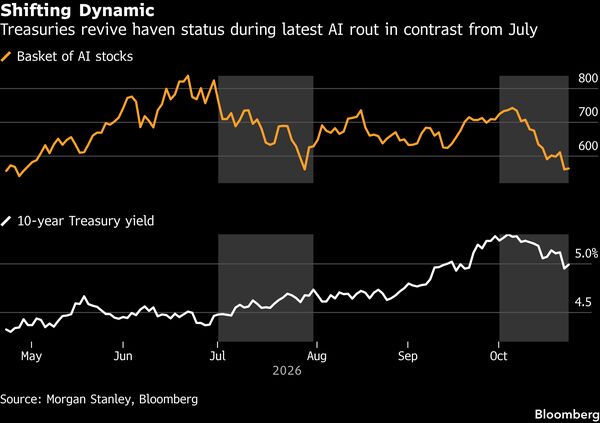
一篮子人工智能股票已连续九周与10年期美国国债收益率同向波动,这是自OpenAI推出ChatGPT以来最长的同步波动时期,反映出投资者将关注点转移到了该技术对经济的影响上。这与7月的走势形成对比,当时人工智能交易随国债一起失去动能。
A basket of AI stocks has gone in the same direction as 10-year Treasury yields for nine straight weeks, the longest stretch of tandem moves since the launch of OpenAI’s ChatGPT, as investors shifted focus on the technology’s impact on the economy. That contrasts with the pattern in July, when the AI trade lost momentum along with Treasuries.
“随着此前引领股市上涨的板块走势疲软并转向更具防御性的方向,且信用指数闪现出压力迹象,投资者现在有理由寻求债券的相对安全性,”NewEdge Wealth首席投资官Cameron Dawson表示。
“As prior equity leadership has buckled and shifted more defensive, and as credit indexes have flashed signs of stress, investors now have a reason to seek out the relative safety of bonds,” said Cameron Dawson, CIO at NewEdge Wealth.
尽管债券市场释放出警示信号,但一些知名人士正在反驳关于AI交易构成更广泛威胁的担忧。据《金融时报》报道,贝森特在一个闭门会议上告诉投资者,他并不认为AI繁荣存在系统性问题。黑石集团的乔恩·格雷传递了类似的信息,认为投资者不必担心AI交易正步入泡沫领域。
Yet even as bond markets flash caution, some prominent voices are pushing back on fears that the AI trade poses a broader threat. Bessent told investors at a closed-door conference that he did not see a systemic problem with the AI boom, according to the Financial Times. Blackstone’s Jon Gray struck a similar message, arguing that investors shouldn’t worry that the AI trade was heading into bubble territory.
摩根大通的策略师尼古拉奥斯·帕尼吉尔佐格鲁等人将AI股票的剧烈抛售归因于所谓的“VaR冲击”,该术语指资产管理者的风险模型强制触发抛售的情况。在他们看来,在近几个月市场相对平静期间建立大量头寸的投资者,如今正因波动率飙升而被迫平仓。该团队估计,芯片制造商占据了全球股票市场总风险资本的五分之一左右。
JPMorgan Chase & Co. strategists including Nikolaos Panigirtzoglou attribute the violent selloff in AI stocks to so-called VaR shocks, a term that refers to instances where selling is imposed by asset managers’ risk models. The way they see it, investors who took large positions during the recent months of relative market calm are now being forced to unwind their bets as volatility erupts. The team estimates that chipmakers consume around a fifth of the total risk capital in global equity markets.
帕尼吉尔佐格鲁及其同事在一份报告中写道:“VaR冲击不一定需要基本面触发因素,而往往反映的是仓位调整。”他们表示:“鉴于半导体股票近期的下跌,我们怀疑之前高企的半导体多头敞口超配现象已基本消除。”尽管如此,转向防御性姿态的迹象正在美国ETF市场显现,固定收益基金的需求正在增加。据彭博情报汇编的数据,投资者本月迄今已向债券ETF净投入约580亿美元,约占所有ETF资金流入的38%。
“VaR shocks do not necessarily need to have a fundamental trigger, but rather often reflect positioning adjustments,” Panigirtzoglou and his colleagues wrote in a note. “Given the recent declines in semiconductor stocks, we suspect that the previous overhang of elevated long semiconductor exposures has been largely unwound.”Nevertheless, the shift to a defensive posture is showing up in the US ETF market, where demand for fixed-income funds is gaining ground. Investors have poured roughly $58 billion into bond ETFs so far this month, accounting for about 38% of all ETF flows, according to data compiled by Bloomberg Intelligence.
这是固定收益类连续第二个月占总流入比例超过35%,也是自去年年初以来首次出现这种连续两个月的情况。
It’s the second consecutive month that fixed income has captured more than 35% of overall flows, the first such back-to-back stretch since early last year.
彭博情报的阿萨纳西奥斯·普萨罗法吉斯表示:“过去两个月,债券资金流入表现强于预期。部分原因可能反映了更偏向防御的倾向,但收益率也足够有吸引力,投资者可能只是想趁现在锁定一些收益。”
“Bond flows have been punching above their weight over the past two months,” said BI’s Athanasios Psarofagis. “Some of that likely reflects a more defensive tilt, but yields are also attractive enough that investors may simply be looking to lock in some income while they still can.”