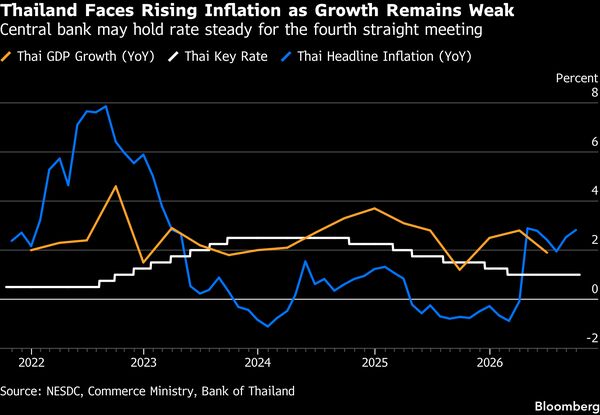
泰国央行预计将连续第四次会议维持利率不变,争论焦点已从进一步宽松转向政策制定者何时可能最终开始加息。
Thailand’s central bank is expected to keep interest rates unchanged for a fourth straight meeting, with the debate shifting from further easing to when policymakers may eventually start raising borrowing costs.
据彭博新闻社调查的23位经济学家全部预测,泰国央行货币政策委员会将于周三将一日回购利率维持在1%。值得注意的是,新加坡和菲律宾最近的政策决定均出乎市场预料。
The Bank of Thailand’s Monetary Policy Committee will leave the one-day repurchase rate at 1% on Wednesday, according to all 23 economists surveyed by Bloomberg News. To be sure, recent policy decisions in Singapore and the Philippines both defied market expectations.
泰国央行预期的暂停将延续两年来最长的连续维持不变纪录,这发生在政策制定者面临相互竞争的压力之际。通胀已加速,部分原因是能源成本上升,而经济增长依然疲软,近期洪水又增加了另一拖累因素。
The BOT’s expected pause would extend the longest run of unchanged decisions in two years, and comes as policymakers grapple with competing pressures. Inflation has accelerated, partly because of higher energy costs, while economic growth remains subdued and recent flooding has added another drag.
大多数经济学家仍预计基准利率将维持在1%直到2027年底,尽管美国银行、摩根大通和华侨银行已强调明年收紧政策的可能性日益增大。
Most economists still expect the benchmark rate to remain at 1% through the end of 2027, though Bank of America Corp., JPMorgan Chase & Co. and Oversea-Chinese Banking Corp. have highlighted a growing likelihood of tightening next year.
“泰国央行近期仍可能优先支持增长,”华侨银行高级经济学家拉万亚·文卡特斯瓦兰表示。虽然总体通胀正在上升,但可能还需要几个月时间,涨幅才会实质性传导至核心价格,这给央行留出了空间,可至少等到2027年上半年。
“BOT is likely to still prioritize growth support in the near-term,” said OCBC senior economist Lavanya Venkateswaran. Headline inflation is rising, but it may take several more months for the increase to feed materially into underlying prices, giving the central bank room to wait until at least the first half of 2027, she said.
泰国央行高层官员的言论表明,1%的利率正成为一个有效下限,而非进一步宽松的垫脚石。副行长皮提·迪亚萨特本月初接受彭博电视采访时表示,当前立场属于宽松,且无论按泰国历史标准还是与其他经济体相比,都属于异常宽松。
Comments from senior BOT officials suggest the 1% rate is becoming an effective floor rather than a stepping stone to further easing. Deputy Governor Piti Disyatat told Bloomberg Television earlier this month that the current stance is accommodative and unusually loose by both Thai historical standards and compared with other economies.
“除非遭遇巨大、巨大的冲击,否则我们不会进一步降息,”皮提说。
“Unless a big, big shock hits us, we will not go any lower,” Piti said.
不过,他表示,随着时间的推移,利率将需要随着经济复苏而恢复常态。皮迪将1.5%-2%描述为更正常的区间,并表示该水平“肯定高于现在”,同时强调泰国可以“按自己的节奏”实现常态化。行长维泰·拉塔纳科恩同样表示,没有紧迫需求降低借贷成本,政策制定者可根据条件变化双向调整。
Over time, however, rates will need to normalize alongside the economic recovery, he said. Piti described 1.5%-2% as a more normal range and said that level would be “definitely higher than now,” while stressing that Thailand can normalize “at our own pace.”Governor Vitai Ratanakorn has similarly said there is no urgent need to lower borrowing costs and that policymakers can move in either direction as conditions change.
以下是周三下午2点(曼谷时间)即将发布的声明中值得关注的要点:主要焦点将在于泰国央行是否就暂停周期能持续多久提供更明确的信号,以及今明两年更新后的增长和通胀预测。
Here’s what to watch in the statement due at 2 p.m. in Bangkok: The main focus will be on whether the BOT offers any clearer signal on how long its pause can last, along with updated growth and inflation forecasts for this year and next.
6月时,政策制定者预测2026年经济增长2.3%、2027年增长1.8%,总体通胀分别平均为2.8%和1.4%。
In June, policymakers projected economic growth of 2.3% in 2026 and 1.8% in 2027, with headline inflation averaging 2.8% and 1.4%, respectively.
9月通胀连续第二个月加速至2.82%,尽管价格压力比泰国央行预期的要温和。皮迪本月表示,全年通胀可能在2%左右,而增长应接近此前2.3%的预测,或略强一些。
Inflation accelerated for a second month to 2.82% in September, though price pressures have been milder than the BOT anticipated. Piti said this month that full-year inflation will probably be around 2%, while growth should be close to the previous 2.3% forecast or slightly stronger.
泰国对近期的能源冲击尤为敏感。据皮迪称,该国进口约80%的原油,其中大约一半来自中东。即便如此,政策制定者在其两年政策期限内仍将影响定性为暂时性的。
Thailand is particularly exposed to the recent energy shock. The country imports about 80% of its crude oil, roughly half from the Middle East, according to Piti. Even so, policymakers have characterized the impact as temporary over their two-year policy horizon.
近期洪灾也不太可能实质性改变全国前景。皮迪表示,部分地区受灾严重,汽车等行业受到影响,但对整体国内生产总值“几乎完全没有影响”。泰铢将是另一关注点,政策制定者将评估全球收益率上升和油价上涨是否给货币带来足够压力,从而使其宽松立场复杂化。
Recent flooding is also unlikely to materially change the national outlook. Piti said the disruption was severe in some areas and affected industries including autos, but its impact on overall gross domestic product “won’t much at all.”The baht will be another focus as policymakers assess whether higher global yields and oil prices are putting enough pressure on the currency to complicate their accommodative stance.
今年以来,泰铢兑美元已贬值近7%,在彭博追踪的亚洲货币中跌幅排名第三,高油价推高了进口成本。
The currency has fallen almost 7% against the dollar this year, ranking as the third-worst performer among Asian currencies tracked by Bloomberg, as high oil prices push up import costs.
但截至目前,BOT的表现几乎没有引发警报。相比之下,菲律宾央行上周出人意料地加息50个基点,旨在抑制通胀并提振今年已下跌约8%的比索。
But the BOT has so far shown little alarm. In contrast, the Philippine central bank last week surprised with a 50 basis point rate hike, aiming to cool inflation and boost a peso that has fallen about 8% this year.
Piti表示,泰铢在大型全球冲击中的表现反映了对泰国政策框架和经济基本面的信心,并指出尽管增长缓慢、能源价格高企,泰铢仍保持相对韧性。
Piti said the baht’s performance through large global shocks reflected confidence in Thailand’s policy framework and economic fundamentals, noting that the currency had remained relatively resilient despite slow growth and high energy prices.
泰国预计维持不变的政策反映了地区政策的混合局面。印尼上周也连续第四次会议维持利率不变,而新加坡本月则意外保持政策不变。
Thailand’s expected hold reflects a mixed regional policy picture. Indonesia last week also kept rates unchanged for a fourth straight meeting, while Singapore this month unexpectedly held policy unchanged.