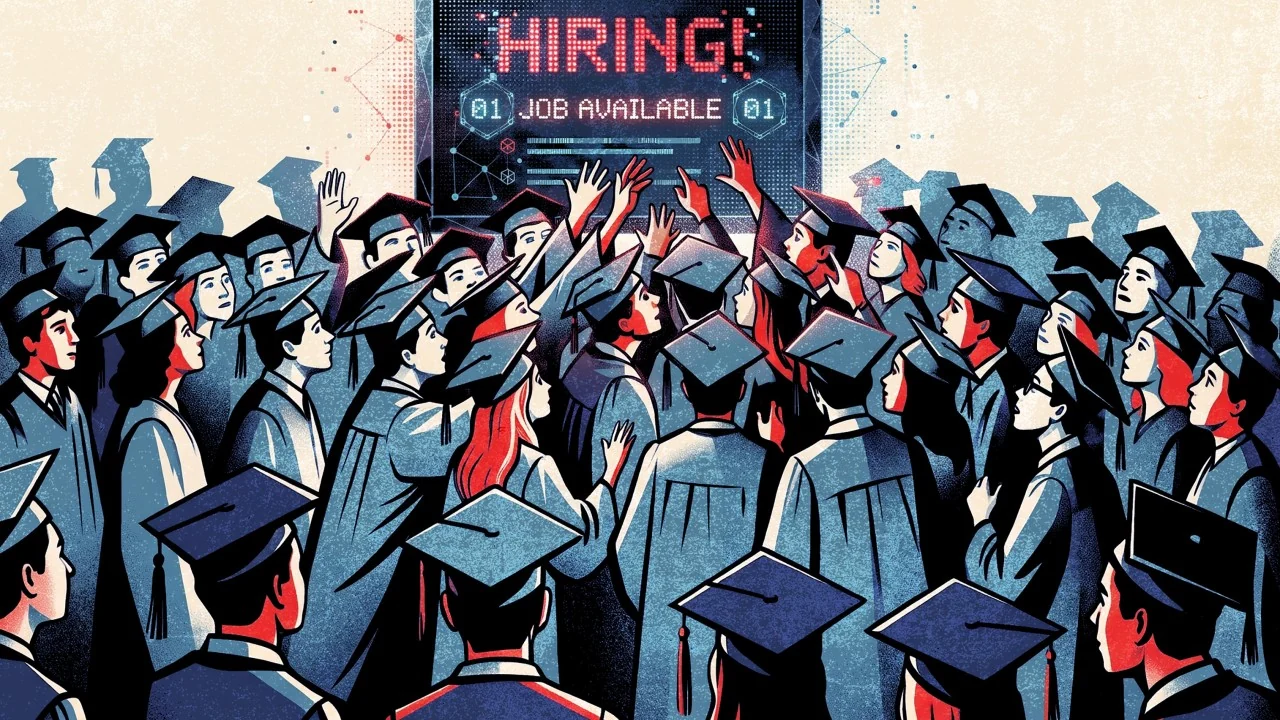
马来西亚市场营销专业毕业生纳菲萨·阿兹曼过去两个月申请了数百份工作,这位24岁的年轻人至今仍未找到一份既能满足薪资需求、又能发挥她花费数年时间和大笔金钱培养技能的正式职位。
Nafeesa Azman has applied for hundreds of jobs over the past two months, yet the 24-year-old Malaysian marketing graduate is yet to find a permanent role that pays what she needs or uses the skills she spent years, and a good deal of money, developing.
在曼谷就读媒体艺术专业大四的娜塔妮查·因塔翁形容,许多同龄人在准备踏入就业市场时感到恐惧,因为人工智能已经开始大举“收割”这个市场。
Natthanicha Intawong, a final-year media arts student in Bangkok, describes the terror many of her peers feel as they prepare to enter a jobs market that artificial intelligence is already beginning to scythe through.
对于新加坡毕业生约书亚·奈来说,预兆已非常明显——字面意义上的“写在墙上”。他于2024年在新加坡理工学院完成了为期三年的动画与游戏艺术文凭课程,但在看到行业内及其他领域越来越多地使用AI生成的艺术作品后,放弃了在游戏行业发展的梦想。
For Joshua Nai, a Singaporean graduate, the writing was quite literally on the wall. He completed a three-year diploma in animation and game art at Singapore Polytechnic in 2024, but abandoned his dream of a career in gaming after seeing the increasing amounts of AI-generated artwork being used in the industry and elsewhere.
他说这是“当头一棒”。“似乎人们已经忘记了让艺术具有意义的人类独创性。”奈随后改变了职业规划,现在在一家健身房全职工作。
It was “a slap in the face”, he said. “It seems like people have forgotten the human ingenuity that makes art meaningful.”Nai has since changed course on his career ambitions and now works full-time in a gym.
在整个东南亚,数百万毕业生正步入一个因生成式AI而发生不可逆转变革的职场:这种软件是流行聊天机器人ChatGPT、Claude、DeepSeek等的核心技术,能根据简短的文字指令生成文本、图像和代码。
Across Southeast Asia, millions of graduates are entering a workforce that has been irrevocably changed by generative AI: the software behind popular chatbots ChatGPT, Claude, DeepSeek and the like that produces text, images and code from short written instructions.
国际劳工组织(ILO)估计,近8000万东南亚工人——即该地区总劳动力的五分之一以上——将受到AI兴起的影响。其中约1170万人可能彻底失业,或看到其工作任务被完全重塑。
The International Labour Organization (ILO) estimates that nearly 80 million Southeast Asian workers – or more than one-fifth of the region’s total workforce – will be affected by the rise of AI. Some 11.7 million could lose their jobs outright or see their tasks entirely reworked, it said.
尽管国际劳工组织7月发布的一份报告发现,目前尚无大规模AI驱动的区域性失业证据,但最初的影响已开始在职业阶梯的底端显现。
Though an ILO report published in July found no evidence of large-scale AI-driven regional job losses as yet, the first effects are beginning to be felt at the bottom of the career ladder.
毕业生传统上在职业生涯的前几年通过做笔记、制作幻灯片、整理数据等常规工作在岗位上学习,但他们发现人工智能现在能更快、更廉价地完成这些任务。
Graduates, who traditionally learn on the job during their first few years in a role doing routine work such as taking notes, preparing slides and compiling data, are increasingly finding that AI can now do those tasks faster and cheaper.
“如果你从事的是重复性任务工作,那就跟它说再见吧,”国际货币基金组织总裁克里斯塔利娜·格奥尔基耶娃本月初在曼谷举行的一场关于人工智能的小组讨论中在线表示。
“If you are in a repetitive task job, kiss it goodbye,” Kristalina Georgieva, managing director of the International Monetary Fund, told a panel discussion on AI in Bangkok earlier this month for online.
作为东南亚国家联盟(东盟)最富裕的成员,新加坡已出现毕业生招聘放缓的早期迹象,因为它难以将该地区受教育程度最高的年轻人的期望与合适的工作相匹配。
Singapore, the Association of Southeast Asian Nations’ wealthiest member, is already showing early signs of slower graduate hiring as it struggles to match the aspirations of the region’s best-educated young people with suitable work.
该城市国家六所公立大学去年底进行、今年3月发布的一项调查显示,在期末考试后六个月内找到工作的求职毕业生比例,从2024年的87.1%下降至2025年的83.4%。
A survey by the city state’s six public universities conducted late last year and released in March found that the share of job-seeking graduates who found work within six months of their final exams fell to 83.4 per cent in 2025 from 87.1 per cent in 2024.
无论这种变化是渐进的还是突如其来的,该地区的每个国家现在都在应对一种新技术带来的后果,这种技术让专业经验和判断力与既更快又更廉价的机器智能正面交锋。
Whether the change is gradual or sudden, every country in the region is now grappling with the fallout from a new technology that pits professional experience and judgment against machine minds that are at once faster and cheaper.
在菲律宾,人们越来越担心人工智能可能取代业务流程外包行业中至少部分从业者的工作,该行业雇佣了近200万人为外国客户处理行政任务——并每年为约85万名毕业生提供第一份工作。
In the Philippines, concerns are mounting that AI could replace at least some of the nearly 2 million people employed in the business process outsourcing sector that handles administrative tasks for foreign clients – and provides about 850,000 graduates with their first job every year.
在印度尼西亚,国际劳工组织估计约13%的年轻人已经失业,初级岗位的进一步空心化在躁动的学生群体中带来政治风险,这些学生在最近几个月里多次走上街头抗议政府政策。
donesia, where the ILO estimates around 13 per cent of young people are already unemployed, a further hollowing out of entry-level work carries political risks among restive students who have repeatedly taken to the streets in recent months to protest against government policies.
对于没有条件重塑教育的年轻人来说,搭上人工智能的浪潮变得越来越困难。
For young people without the means to retrofit their education, catching the AI wave is becoming increasingly difficult.
据 Nafeesa 称,这项技术已经重创了马来西亚的营销行业,只需几个精准的聊天机器人提示词,文案撰写和视觉内容制作的工作就被夺走了。
The technology has already ravaged Malaysia’s marketing sector, according to Nafeesa, taking away copywriting and visual-content production work with the stroke of a few well-aimed chatbot prompts.
她在大约两个月前结束了一份实习,并表示此后已申请了“200 到 300 份工作”却无一成功,因为 AI 的兴起减少了可用岗位,而配备了机器助手的雇主压低薪资。
She finished an internship around two months ago and says she has since applied for “200 to 300 jobs” without success as the rise of AI pares back the available roles and employers armed with machine assistants lowball on pay.
“至少 3000 令吉(约合 730 美元)是我预期的月薪,但许多报价达不到这个标准,似乎并不反映我所获得的技能和知识,”Nafeesa 说。
“My expected [monthly] salary is at least 3,000 ringgit [US$730], but many offers fall short and don’t seem to reflect the skills and knowledge I have gained,” Nafeesa said.
“AI 可能有用,但不应取代整个创作过程,”她说,并辩称该技术最好用于辅助产生创意,“而不是取代人类的创造力”。
“AI can be useful but it shouldn’t replace the entire creative process,” she said, arguing that the technology was best employed to help generate ideas “rather than supplanting human creativity”.
AI 领域的巨头们热衷于预言一个由机器编写的未来,既不可预测且危险,又丰富且令人兴奋。
The big beasts of AI are fond of prophesying about a machine-scripted future that is as as unpredictable and dangerous as it is abundant and exciting.
本月在曼谷,Anthropic 联合创始人 Jack Clark 称 AI 是一种“创造性毁灭”,引用了经济学中新创新和产业取代旧创新和产业的术语。
In Bangkok this month, Anthropic co-founder Jack Clark called AI a form of “creative destruction”, using an economist’s term for new innovations and industries replacing old ones.
他表示,高度接触 AI 的领域(如呼叫中心)可能会出现失业,同时预测科学研究等其他领域的就业将增长——并称该技术在全新产业中创造就业的潜力是一个巨大的未知数。
He said job losses were likely in fields with high exposure to AI, such as call centres, while simultaneously predicting employment would grow in other areas such as scientific research – and calling the technology’s potential to create jobs in entirely new industries a major unknown.
Anthropic 的聊天机器人 Claude 是全球使用最广泛的聊天机器人之一,该公司正准备进行首次公开募股(IPO),估值可能高达 2 万亿美元——这将使 Clark 和他的联合创始人变得难以想象的富有。
Anthropic, whose chatbot Claude is among the world’s most used, is preparing for an initial public offering that could value the company at up to US$2 trillion – making Clark and his fellow founders unfathomably rich.
在另一端,AI 时代的到来让即将进入职场的人们陷入了一种无力感。
At the other end of the spectrum, the advent of the AI age has those who are about to join the workforce overcome by a sense of powerlessness.
“我很害怕,”Natthanicha说。“AI技术不断进步,我担心它会取代人类劳动力。”她梦想成为一名演员,这本身就是一条艰难的道路,但随着AI生成的剧本和视频日益渗透娱乐产业,这位25岁的年轻人对自己成功的几率有着清醒的认识。
“I’m terrified,” Natthanicha said. “AI technology keeps getting more advanced and I’m worried it will replace human labour.”She dreams of becoming an actress, already a tough calling, but as AI-generated scripts and videos increasingly pervade the entertainment industry, the 25-year-old is realistic about her chances of success.
“企业不会浪费钱去招聘,当他们知道有技术可用,而且更快、更好、成本[几乎]为零时,”她说。
“Businesses will not waste money hiring when they know there’s technology available that’s faster, better and costs [next to] nothing,” she said.
“我想归根结底,我宁愿先谋生,也不愿等待合适的机会来实现我的梦想工作。”Natthanicha是泰国六成人文社科毕业生中的一员,这些专业输送了许多最容易受AI冲击的岗位从业者。
“I guess at the end of the day I’d rather just make a living than wait for the right opportunity to come so I can do my dream job.”Natthanicha is among the six in 10 Thai graduates who study humanities and social sciences, fields that feed many of the jobs most exposed to AI.
与此同时,失业毕业生队伍正在壮大。根据Kasikorn Research Centre(开泰研究中心)最近的一份简报,泰国失业者中约44%是20至24岁的毕业生,许多人拥有的技能与就业市场不匹配。
And the ranks of unemployed graduates are growing. About 44 per cent of Thailand’s unemployed are graduates aged 20 to 24, many with skills that do not match the jobs market, according to a recent briefing paper from the Kasikorn Research Centre.
与此同时,得益于价值数十亿美元的AI基础设施投资涌入该国,就业岗位正在被创造出来——但长期资金不足且未经改革的教育体系,导致该国缺乏这些产业所需的科学、技术、工程和数学毕业生。
At the same time, jobs are being created thanks to the billions of US dollars’ worth of investment in AI infrastructure that is pouring into the country – but a chronically underfunded and unreformed education system has left it short of the science, technology, engineering and mathematics graduates these industries need.
观察人士指出,政府因此必须让大学跟上步伐,教授年轻人关于一项已经到来的技术。然而,在政府争相拨款资助计划、以提升每年成千上万离校毕业生技能的同时,初级岗位正悄然消失。
The government must therefore bring its universities up to speed to teach young people about a technology that is already here, according to observers. Yet while it scrambles to fund plans to upskill the graduates leaving university in their thousands every year, entry-level roles are quietly disappearing.
“通常情况下,应届毕业生是在工作中学习的,”泰国企业AI咨询公司AEIOU的联合创始人Thongnuakao Kampim说。
“Normally, fresh graduates learn on the job,” said Thongnuakao Kampim, co-founder of AEIOU, an AI consultancy for Thai businesses.
“他们可能需要一两年时间才能跨越学习曲线、熟练掌握工作,但现在 AI 已经能够处理那些初级任务,而且在许多情况下表现甚至更好。因此,企业主不再像以前那样有必要、也没有时间去培养他们。”这位 37 岁的受访者表示,秘书、文员、行政人员,以及负责制作演示文稿、保存记录、录入数据的人员,正变得多余——这些正是曾经让新人得以切入、了解公司系统、文化与专业知识的岗位。
“It might take one or two years for them to get through the learning curve and become proficient at what they do, but now AI can already handle those initial tasks, and in many cases, it can do them even better. As a result, business owners no longer have the same need, or the time, to train them.”Secretaries, clerks, administrators and those who made presentation decks, kept records or entered data were all becoming redundant, the 37-year-old said – the selfsame roles that once gave newcomers an entry point and an understanding of a company’s systems, culture and expertise.
“过去雇佣数千人的公司,可能会缩减到仅 100 人,”她说。“组织内可供任职的席位将大幅减少,职位空缺也会随之减少。招聘和求职将变成一场‘抢椅子’游戏。”新出现的职位,例如办公室“AI 推动者”,负责帮助企业利用 AI 智能体和专业知识增强竞争力,对于正逐渐被冻结在就业市场之外的毕业生来说,也可能遥不可及。
“A company that once employed thousands of people might shrink to just 100,” she said. “There will simply be fewer seats available within organisations, fewer positions to fill. It will become a game of musical chairs when it comes to hiring people and competing for jobs.”New roles, such as that of office “AI champion”, who helps a firm compete using AI agents and expertise, may also prove out of reach for graduates gradually being frozen out of the jobs market.
“光擅长使用 AI 是不够的,”Thongnuakao 说。“他们还需要其他技能……比如培养和提升全组织员工能力的能力,使员工能在工作中有效运用 AI。”据商业分析师称,工作的本质正在改变,要求从业者不断更新技能,并迫使雇主在运营中全面嵌入 AI,只为保持领先。
“It’s not just about being good at using AI,” Thongnuakao said. “They need other skills … like the ability to develop and upskill people across the organisation so that employees can effectively use AI in their work.”The very nature of work is changing, according to business analysts, demanding constantly updated skills from workers and pushing employers to embed AI throughout their operations just to stay ahead.
“延迟采用可能导致技能差距扩大,竞争力削弱,”咨询公司普华永道马来西亚在七月的报告中表示。“最终,优势不仅来自技术本身,而是来自对技术的有效整合和管理——在人、流程和人工智能之间的协同。” 对于失业的毕业生而言,适应人工智能时代说起来容易做起来难。23岁的安迪·伊斯坎达尔·巴哈鲁丁(Andy Iskandar Baharudin)是马来西亚一所公立大学的金融专业毕业生,自七月完成会计与行政实习后,已向超过100家公司投递简历。
“Delayed adoption risks widening skill gaps and weakening competitiveness,” consultancy PwC Malaysia said in a July report. “Ultimately, the advantage will come not just from technology, but from effectively integrating and managing it – across people, processes and AI.”For jobless graduates, adapting to the AI age is easier said than done. Andy Iskandar Baharudin, 23, a finance graduate from a Malaysian public university, has applied to more than 100 companies since finishing an accounting and administration internship in July.
他每天都在辛苦投递求职申请,努力保持对前景的乐观,同时完成一轮又一轮的猜测性邮件和电话。
He spends his days slogging through job applications, trying to stay upbeat about his prospects as he completes round upon round of speculative emails and calls.
“作为应届毕业生,我们不仅要与其他求职者竞争,还必须不断提升技能,以跟上技术发展的步伐,”他感叹入门级岗位竞争激烈,往往要求两年工作经验。
“As fresh graduates, we not only have to compete with other applicants, but also continually upgrade our skills to keep up with technological developments,” he said, lamenting the amount of competition for entry-level jobs that often called for two years’ prior experience.
“如果连获得工作机会都很困难,我们应届毕业生该如何积累经验?”他补充道。
“How are we supposed to gain experience as fresh graduates if even getting an opportunity to work is difficult?” he added.
“并不是所有仍未就业的应届毕业生都太挑剔或不想找工作。我们确实想工作、积累经验、打造自己的职业生涯,只是有时机会实在太难得。” 在新加坡,勤奋学习、努力工作以换取就业和‘美好生活’的承诺,在许多方面已成为社会契约的一部分。但随着这条老路不再像过去那样确定,政策制定者正坦率地谈论未来可能的样貌。
“Not every fresh graduate who is still unemployed is being too picky or isn’t trying to find work. We do want to work, gain experience and build our own careers. It’s just that sometimes the opportunities are so hard to come by.”In Singapore, the promise of employment and “the good life” in return for working hard in school and college is, in many respects, part of the social contract. But with that well-worn path no longer as certain as it once was, policymakers are speaking frankly about what the future might look like.
新加坡总理劳伦斯·黄(Lawrence Wong)在10月12日的星展银行亚洲未来前瞻大会上表示,人工智能可能已经冲击了职业阶梯的“底层”。他指出,记笔记、起草演讲稿和制作PowerPoint幻灯片等例行工作很快将变得过时。
AI might have already broken the “bottom rung” of the career ladder, Prime Minister Lawrence Wong said at the DBS Asia Future Forward Conference on October 12. Routine tasks such as note-taking, speech drafting and preparing PowerPoint slides would soon be obsolete, he said.
黄循财说:“因此,雇主需要更加深思熟虑地考虑如何培训和指导年轻员工。这正是新加坡正在逐个行业研究的事情。”作为这一努力的一部分,政府已同意为接收学生实习的公司提供补贴,目的是在毕业生进入转型后的劳动力市场之前,教会他们所需的系统、文化和软技能。
“So employers will need to be more deliberate in thinking about training and mentoring of their young officers,” Wong said. “And that is something we are studying in Singapore, sector by sector.”As part of that push, the government has agreed to subsidise companies that take on students as interns, with the aim of teaching them the systems, culture and soft skills they will need before graduating into a transformed workforce.
迄今为止,这个城市国家因人工智能而导致的失业似乎只是涓涓细流,但随着该技术在各行业的应用不断扩大,这股细流可能会变成洪流。
So far, job losses in the city state attributable to AI appear to be little more than a trickle, but that could become a flood as use of the technology expands across industries.
人力部4月份的一份报告发现,在已采用人工智能的新加坡企业中,6.2%报告员工人数减少,另有8.5%报告招聘活动减少。
Of those Singapore firms that have adopted AI, 6.2 per cent reported lowered headcount and another 8.5 per cent reported lower hiring activity, an April report by the Manpower Ministry found.
黄循财表示,仍有时间对受人工智能影响的工人进行再培训,并为他们匹配新的就业机会。今年,这个城市国家公布了雄心勃勃的计划来实现这一目标,包括投资10亿新元(7.8亿美元)用于工人技能提升、基础设施升级、获取先进硬件以及研发。
Wong said there was still time to retrain workers affected by AI and match them to new job opportunities. This year, the city state unveiled ambitious plans to do just that, including a S$1 billion (US$780 million) investment in worker upskilling, infrastructure upgrades, securing advanced hardware and research and development.
他在10月12日的会议上说:“这就是新加坡正在做的事情,希望随着时间的推移,全球经济也能为世界其他地区做到这一点。”
“That is what we are doing in Singapore and hopefully that is what, over time, the global economy will be able to do for the rest of the world as well,” he said at the October 12 conference.
新加坡因其远见和准备而赢得赞誉。但它是一个小而富裕的国家,在规划、采用技术和实施政策方面有着良好的记录。
Singapore has won praise for its foresight and preparation. But it is a small, wealthy state with a strong record in planning, adopting technology and implementing policy.
对其他东南亚国家来说,前景更为黯淡。国际货币基金组织警告称,本已不平等的经济体可能会变得更加不平等,因为少数人因掌握人工智能技术而获得溢价,而大多数人仍被困在服务阶层。
For other Southeast Asian nations, the outlook is bleaker. The IMF has warned that already unequal economies risk becoming even more so as a few people earn a premium for harnessing AI technology while most stay trapped in a service class.
国际货币基金组织总裁格奥尔基耶娃在曼谷峰会上说:“年轻人原本通常会从事常规的专业工作,现在却在星巴克端咖啡。这不是年轻人所向往的。”
“You get young people, who would normally have gone into professional routine jobs, now serving coffee in Starbucks,” IMF chief Georgieva told the Bangkok summit. “That is not what young people aspire for.”