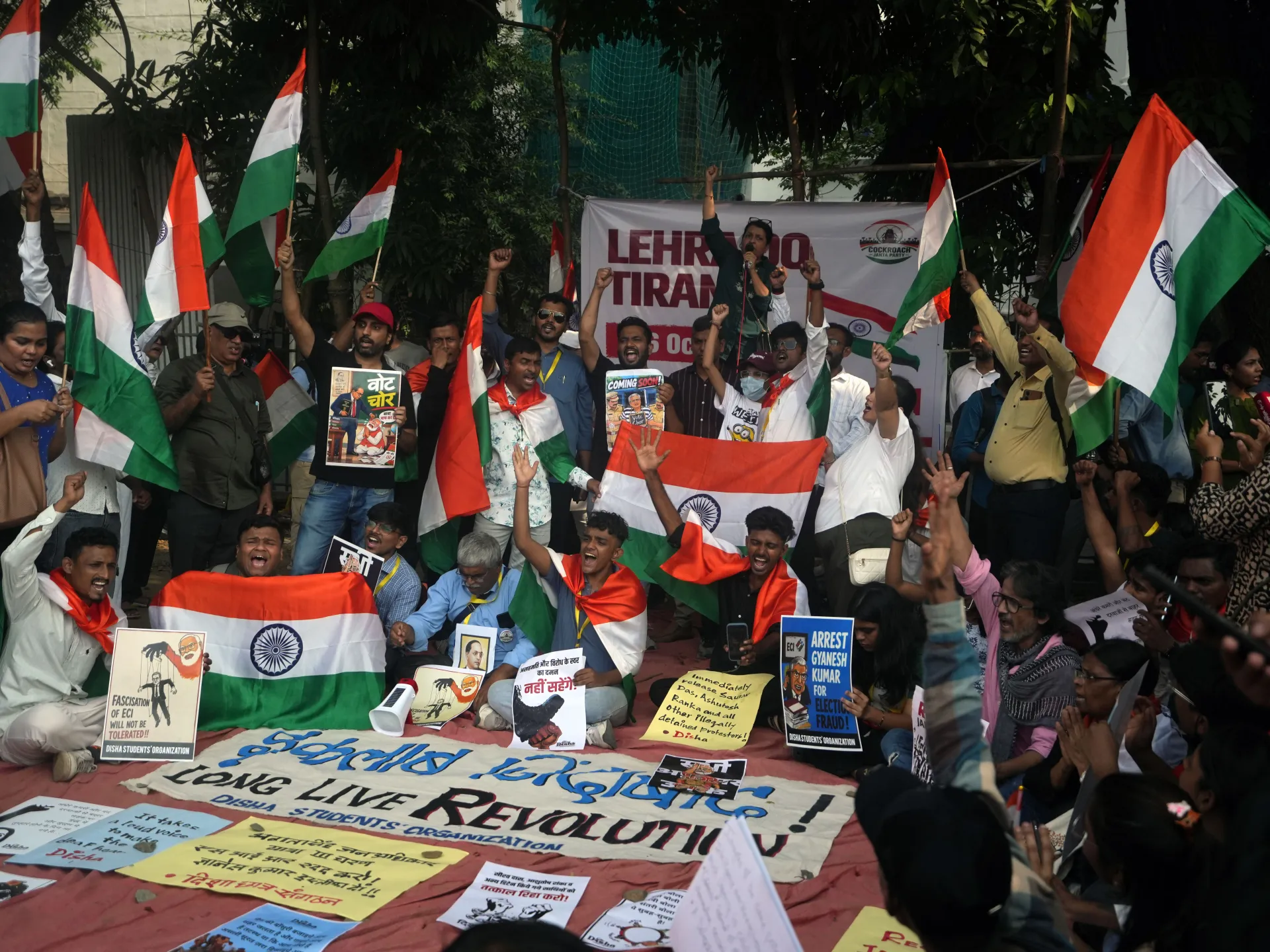
在印度各地,反对党、学生和农民正在抗议一项全面修订选民名册的举措,该举措已导致约1.3亿个名字被删除。他们要求恢复旧版选民名单,并要求首席选举专员(CEC)Gyanesh Kumar(贾内什·库马尔)辞职。印度选举委员会(ECI)将这项工作称为“特别深度修订”(SIR),要求选民证明其资格,通常需要通过旧文件来证明。
Across India, opposition parties, students and farmers are protesting against a sweeping revision of electoral rolls that has removed some 130 million names. They are demanding the restoration of the old voter lists and the resignation of Chief Election Commissioner (CEC) Gyanesh Kumar. The Special Intensive Revision (SIR) – as the Election Commission of India (ECI) calls the exercise – requires voters to prove their eligibility, often through old documents.
六年前,穆斯林走上街头警告称,让公民身份取决于此类文书工作可能会使数百万人面临被排除在外的风险,尤其是穆斯林。他们的警告在很大程度上被忽视了。如今,随着被排除在外的威胁已超出穆斯林群体,许多曾忽视这些警告的人自己也走上了街头。
Six years ago, Muslims took to the streets to warn that making citizenship dependent on such paperwork could leave millions vulnerable to exclusion, particularly Muslims. Their warnings were largely ignored. Now that the threat of exclusion extends beyond Muslims, many who ignored their warnings are taking to the streets themselves.
我为看到印度各地普通民众在抗议中为了彼此承担风险而感到自豪。但我无法忽视反对派回应中的虚伪性:虽然挑战SIR是正确的,但其诉求却未触及穆斯林在2019年抗议的那部公民法,也未触及将他们视为“渗透者”的嫌疑。
I am proud to see common people across India taking risks for one another in these protests. But I cannot ignore the hypocrisy in the opposition’s response: while it is right to challenge the SIR, its demands leave untouched the citizenship law against which Muslims protested in 2019 and the suspicion cast on them as “infiltrators”.
如今游行抗议修订选民名册的人中,有些人曾反对2019年的抗议活动。问题在于,这场运动是将挑战穆斯林所警告的歧视,还是仅仅要求为那些如今陷入同一机器中的人提供保护。
Some of those now marching against the revision once opposed the 2019 protests themselves. The question is whether this movement will challenge the discrimination Muslims warned about, or simply demand protection for those now caught in the same machinery.
2019年12月,议会通过了《公民身份修正法案》(CAA),为来自三个穆斯林占多数邻国的六个宗教群体中受迫害成员提供快速入籍通道。伊斯兰教是该地区唯一被排除在外的主要信仰。
In December 2019, Parliament passed the Citizenship Amendment Act (CAA), which fast-tracks citizenship for persecuted members of six religious communities from three Muslim-majority neighbours. Islam is the one major faith of the region it leaves out.
危险在于政府计划将其与什么搭配。那年4月,现任印度内政部长阿米特·沙阿在东部西孟加拉邦首府加尔各答对记者说,要“理解时间顺序”:先是公民法案,随后是全国公民登记册(NRC)。NRC将是一份全国性的印度公民名册,要求人们证明自己的公民身份才能被列入。2019年11月,他在议会表示,NRC将在全国范围内实施。
The danger lay in what the government planned to pair it with. That April, Amit Shah, now India’s home minister, told reporters in Kolkata, the capital of the eastern state of West Bengal, to “understand the chronology”: the citizenship bill first, a National of Citizens (NRC) after it. The NRC would be a nationwide of Indian citizens, requiring people to prove their citizenship to be included. In November 2019, he told Parliament that the NRC would be carried out across the country.
穆斯林立刻明白了这一顺序。任何无法证明公民身份的人都面临被排除在外的风险。那些连住所和一日两餐都难以负担的人,怎么可能拿得出他们从未被要求保存的旧文件?《公民身份修正案》(CAA)随后将为所有被其捕捉到的人提供一条回归之路,唯独穆斯林除外。
Muslims understood the sequence at once. Anyone unable to prove their citizenship risked being excluded from the. How could people who could barely afford shelter or two meals a day be expected to produce old documents they had never been required to keep? The CAA would then offer a way back to everyone it caught, except Muslims.
穆斯林女性在国家首都辖区德里的沙欣巴格发起静坐抗议,持续整个冬季。她们不仅是在警告未来的NRC,更是在拒绝接受一项基于宗教理由进行歧视的公民法。2019年12月22日,总理纳伦德拉·莫迪坚称其政府从未讨论过全国性的NRC。全国大部分民众信以为真。
Muslim women staged a sit-in at Shaheen Bagh in the national capital territory of Delhi that continued through the winter. They were not simply warning about a future NRC, but refusing to accept a citizenship law that discriminated on religious grounds. On December 22, Prime Minister Narendra Modi insisted that his government had never discussed a nationwide NRC. Much of the country took him at his word.
六年后,文件依然被要求提交,只是换了一个部门、一个名义。当印度选举委员会(ECI)于2025年6月24日下令在比哈尔邦进行修订时,其理由中列出了“将外国非法移民的名字纳入”。其文件规则取决于两个出生日期:1987年7月1日和2004年12月2日。出生日期越晚,需要提供的父母文件就越多。在最高法院,选举委员会的律师表示,此次修订是根据2003年修正案核实公民身份。这意味着,在政府从未宣布实施NRC的情况下,选民名单实际上正被用作一份公民名册。
Six years later, documents are being demanded anyway by a different office and under a different name. When the ECI ordered the revision in the state of Bihar on June 24, 2025, it listed the “inclusion of the names of foreign illegal immigrants” among its reasons. Its document rules turned on two birth dates, July 1, 1987 and December 2, 2004. The later you were born, the more of your parents’ documents you had to produce. In the Supreme Court, the ECI’s lawyer said the revision verifies citizenship according to the 2003 amendment. This means that a voter list is, in effect, being used as a of citizens, without the government ever announcing an NRC.
去年12月在议会上,阿米特·沙阿表示,SIR旨在“探测、删除并驱逐渗透者”。他按动机将难民与渗透者区分开来。在他的说法中,难民是为寻求宗教安全而来,而渗透者则是为经济原因而跨境。CAA将这一区别写入了法律。在印度政治中,“ghuspaithiya”(印地语“渗透者”)一词有着公认的指向对象。在西孟加拉邦,现任该邦执政的印度人民党领导人苏文杜·阿迪卡里承诺,SIR将“从选民名册中划除孟加拉国穆斯林”。印度选举委员会(ECI)至今尚未披露其发现了多少外国人。
In Parliament last December, Amit Shah said the SIR was meant to “detect, delete and deport infiltrators”. He has separated refugees from infiltrators by motive. In his account, refugees come seeking safety for their religion, while infiltrators cross for economic reasons. That is the distinction the CAA writes into law. In Indian politics, the word ghuspaithiya, which means infiltrator in Hindi, has a well-understood target. In West Bengal, Suvendu Adhikari, the BJP leader who now governs the state, promised that the SIR would “strike out the Bangladeshi Muslims from the electoral rolls”. The ECI has still not revealed how many foreigners it found.
西孟加拉邦是修订工作全程推行之地,因此我们可以在那里看到其效果。约910万个名字、约占选民总数12%被在该邦4月投票前移除。据一个投票站层面的统计,被移除者中近三分之二为印度教徒。大多数是在第一阶段被剔除的,即官员将选民标记为缺席、迁出、死亡或重复登记。在该阶段,印度教徒和穆斯林被移除的比例大致与其人口比例相当。
West Bengal is where the revision has run its full course, so it is where we can see what it does. About 9.1 million names, roughly 12 percent of the electorate, were removed before the state voted in April. By one booth-level count, almost two-thirds of those removed were Hindus. Most were dropped at the first stage, where officers mark voters as absent, shifted, dead or duplicated. At that stage, Hindus and Muslims were removed roughly in proportion to their numbers.
第二阶段是州政府必须作出判断的环节。约600万名选民的表格显示选举委员会所谓的“逻辑差异”,被移交司法官员处理。差异可能小至父母姓名在2002年选民名册与现在的拼写不一。司法官员移除了270万人。据对选举委员会公布名单的分析,在第二阶段被移除者中,约70%按姓氏判定为穆斯林。穆斯林约占该邦选民的四分之一。
The second stage is where the state had to make judgements. About six million voters whose forms showed what the ECI called “logical discrepancies” were sent to judicial officers. A discrepancy could be as small as a parent’s name spelt one way in the 2002 roll and another way now. The judicial officers removed 2.7 million people. Of those removed at this second stage, about 70 percent were identified as Muslim by surname in an analysis of the ECI’s published lists. Muslims make up about a quarter of the state’s electorate.
加尔各答萨巴尔研究所的研究人员发现,穆斯林在追溯家族至旧名册方面反而更成功,且在官员上门时更可能在家。他们是在结果取决于官员自由裁量权的阶段被移除的。
Researchers at the Sabar Institute in Kolkata found that Muslims had, if anything, been more successful at tracing their families to the old rolls and were more likely to have been at home when officers visited. They were removed at the stage where the outcome turned on an official’s discretion.
去年10月,随着修订工作推进至西孟加拉邦,该邦印度人民党(BJP)计划在边境地区设立约700个营地,帮助印度教难民依据《公民身份修正法案》(CAA)申请公民身份。传递的信息是:申请者将保住自己在选民名册上的位置。在西孟加拉邦,一户被划出名册的印度教难民家庭有专门的法规为其提供保障,而缺少同一份文件的穆斯林家庭则面临积压案件可能需数年才能审结的法庭。
In October last year, as the revision reached West Bengal, the state BJP planned about 700 camps in border districts to help Hindu refugees apply for citizenship under the CAA. The message was that those who applied would keep their place on the roll. A Hindu refugee family struck off in West Bengal has a statute written for it, but a Muslim family missing the same paper has a tribunal whose backlog could take years to clear.
这种排除现象并不局限于西孟加拉邦。在德里,8月31日公布的初步名册将该市1450万选民中的475万排除在外。包含沙欣巴格和贾米亚纳加尔的奥克拉(Okhla)德里立法议会选区,失去了45%的选民。为达利特候选人保留席位的帕特尔纳加尔(Patel Nagar)选区,失去了42%的选民。
The exclusions extend beyond West Bengal. In Delhi, the draft roll published on August 31 left out 4.75 million of the city’s 14.5 million voters. Okhla, the Delhi Legislative Assembly constituency that includes Shaheen Bagh and Jamia Nagar, lost 45 percent of its electorate. Patel Nagar, a seat reserved for Dalit candidates, lost 42 percent.
如今,穆斯林社群之外的选民也在为证明自己有资格留在选民名册上而挣扎,这一事实本应强化对保障措施的呼声。但这些保障措施究竟是为了保护谁?
The fact that voters beyond the Muslim community are now struggling to prove they belong on the electoral roll should strengthen the demand for safeguards. But who exactly are those safeguards meant to protect?
运动自身的表述就是最好的证据。9月30日,反对派联盟“印度国家发展包容性联盟”(INDIA)提出了其“不可妥协”的要求。这些要求包括:罢免首席选举专员库马尔(CEC Kumar)、恢复SIR实施前的选民名册、采用纸质选票、建立上诉机制,以及“保护真实选民免因技术/行政原因被排除”。
The movement’s own words are the best evidence. On September 30, the opposition bloc of the Indian National Developmental Inclusive Alliance (INDIA) set out its “non-negotiable” demands. Those were CEC Kumar’s removal, the pre-SIR rolls, paper ballots, an appeals mechanism and “protection for genuine voters from exclusion due to technical/administrative reasons”.
我看最后那句表述的问题在于,它保护的是免受粗心官员误伤的真实选民。对于国家认定为非真实的选民,它只字未提;而在西孟加拉邦,这类选民最常见的是穆斯林。本月,沙阿(Shah)指责反对派计划让非法渗透者成为选民。国大党回应询问:SIR究竟抓获了多少渗透者?在他的任内渗透情况是否加剧?这本意是反驳,却也默认了他的前提。
The problem I see with that last phrase is that it protects the genuine voter from a careless official. It has nothing to say about the voter whom the state has decided is not genuine, and in West Bengal that voter was most often Muslim. This month, Shah accused the opposition of planning to infiltrators as voters. The Congress party replied by asking how many infiltrators the SIR had actually caught, and whether infiltration had grown on his watch. It was meant as a rebuke. It also accepted his premise.
如今领导这些游行的一些人,早在SIR存在之前就持这一前提。10月4日,表兄弟乌达夫·萨克雷和拉杰·萨克雷在西部马哈拉施特拉邦首府孟买领导了抗议活动,要求撤销此次修订。2020年2月,拉杰的马哈拉施特拉复兴军党游行穿过孟买,前往阿扎德广场。该党要求驱逐巴基斯坦和孟加拉国“渗透者”,拉杰称这是对反CAA抗议的“恰当回击”。他告诉人群,他不明白为什么穆斯林要抗议CAA和NRC。
Some of the people now leading these marches held that premise long before the SIR existed. On October 4, cousins Uddhav Thackeray and Raj Thackeray led protests in Mumbai, the capital of the western state of Maharashtra, demanding that the revision be scrapped. In February 2020, Raj’s Maharashtra Navnirman Sena party marched through Mumbai to Azad Maidan. It demanded the eviction of Pakistani and Bangladeshi “infiltrators”, and Raj called it a “befitting reply” to the anti-CAA protests. He told the crowd he did not understand why Muslims were protesting against the CAA and the NRC.
因此,对团结的考验在于,人们是否愿意捍卫那些政治主张被认为不合时宜、过于教派化或风险太大而不宜公开重复的人的权利。
The test of solidarity, then, is whether people will defend the rights of those whose political claims are considered inconvenient, too communal or too risky to repeat in public.
这也是为什么反CAA抗议后入狱者的问题无法与当前的动员分开。活动人士乌马尔·哈立德和沙尔吉勒·伊玛目仍因与2020年德里暴力事件相关的更大阴谋案而被关押在狱中。他们的案件不能替代数百万面临选民名册排除的人的关切。他们继续被关押,是对当前运动是否准备与2019年反CAA抗议者站在一起的又一次考验。
That is also why the question of those imprisoned after the anti-CAA protests cannot be separated from the current mobilisation. Activists Umar Khalid and Sharjeel Imam remain in prison in the larger conspiracy case connected to the 2020 Delhi violence. Their cases are not a substitute for the concerns of millions facing electoral-roll exclusions. Their continued imprisonment is another test of whether the present movement is prepared to stand with those who protested against the CAA in 2019.
如果这场运动想表明它从2019年吸取了教训,就需要挑战CAA,并要求释放仍因德里“更大阴谋”案而被关押的人。如果它止步于旧名册和纸质选票,那么它虽然捍卫了受SIR威胁的人,却对六年前穆斯林所抗议的歧视性公民法置之不理。
If this movement wants to show it has learned anything from 2019, it needs to challenge the CAA and demand the release of those still held in the Delhi “larger conspiracy” case. If it stops at the old rolls and paper ballots, it will have defended those threatened by the SIR while leaving the discriminatory citizenship law that Muslims protested against six years ago untouched.