
美国股市徘徊在历史高位附近,对与伊朗的战争、顽固的通胀以及华尔街将如何为不断扩大的人工智能建设融资这一日益增多的疑问,似乎毫不在意。但对于在这个万圣节寻找惊悚元素的投资者来说,市场一些最令人不安的信号正隐藏在表面之下。
US stocks are hovering near record highs, unfazed by the war with Iran, stubborn inflation and mounting questions over how Wall Street will finance the expanding AI buildout. But for investors looking for a scare this Halloween, some of the market’s most unsettling signals are hiding just beneath the surface.
从半导体股票的剧烈波动和与人工智能相关的债务膨胀,到股债对冲失去部分可靠性,以及不断扩大的贫富差距,占据华尔街关注焦点的这些图表描绘出的图景,比主要指数所暗示的要令人不安得多。
From violent swings in semiconductor shares and ballooning AI-related debt, to a stock-bond hedge that’s lost some of its reliability, as well as a widening wealth divide, the charts occupying Wall Street’s attention paint a less comforting picture than the major indexes might suggest.
彭博新闻社询问了九位金融专业人士哪些图表让他们感到恐惧。以下是他们分享的内容:花旗财富经济主管康拉德·德夸德罗斯:我们认为,考虑到近期的价格数据,市场共识预测2027年通胀放缓令人担忧。市场共识预测2027年PCE通胀率为2.5%,前十名预测的平均值为3.1%。同样,美联储9月的经济预测摘要显示,明年PCE通胀率的中位数预测为2.3%,且没有任何联邦公开市场委员会(FOMC)参与者预计2027年通胀率会超过2.6%。
Bloomberg News asked nine financial professionals what charts spook them. Here’s what they shared: Conrad DeQuadros, head of economics for Citi Wealth: We find concerning the consensus forecasts for slower inflation in 2027 given recent data on prices. The consensus forecast for PCE inflation in 2027 is 2.5% and the average of the top 10 forecasts is 3.1%. Similarly, the Fed’s September Summary of Economic Projections show a median forecast of 2.3% PCE inflation next year and no FOMC participant sees inflation above 2.6% in 2027.
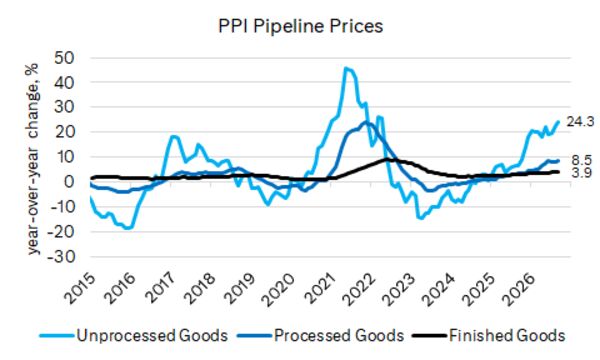
因此,即使是最悲观的预测,也没有预见到明年通胀率会高于当前水平。这些预测——私营经济学家的预测基于希望关税冲动将消退、敌对行动停止将导致油价下跌——在数据中几乎找不到支持。生产者价格指数(PPI)报告显示,管道制造商品价格出现可怕趋势,例如,核心加工品PPI价格在过去一年飙升了24.3%。这开始看起来像2021/22年,如果这些飙升的管道价格传导至成品价格,这可能会让美联储决策者噩梦连连。
Thus, even the most pessimistic forecasts don’t envisage inflation running higher than current rates next year. These projections, which for private economists are based on the hope that the impulse from tariffs will fade, and oil prices will decline on the cessation of hostilities, have little support in the data. The PPI report shows scary trends in pipeline manufacturing goods prices with, for example, core processed goods PPI prices surging 24.3% over the last year. This is beginning to look like 2021/22, and if these soaring pipeline prices feed into finished goods prices, this may give Fed policymakers nightmares.
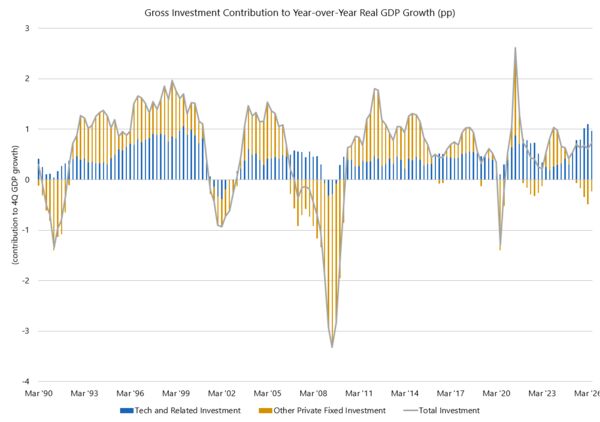
太平洋投资管理公司经济学家蒂法尼·怀尔丁:人工智能热潮引发了担忧,即可能出现其他想要在资本市场融资的公司被“挤出”的情况,这可能会加剧美国经济对科技行业的依赖,导致人工智能领域的集中度进一步上升。这张图表显示,与人工智能相关的投资在国内生产总值(GDP)中所占比重正在上升,而其他私人固定投资却在下降。
Tiffany Wilding, economist at Pacific Investment Management Co.: The AI boom has raised concerns about a potential “crowding out” of other companies that want to borrow in the capital markets, potentially increasing the concentration of AI in a U.S. economy already dependent on the tech sector for growth. This chart shows that AI-related investment is becoming a greater share of GDP, while other private fixed investment has declined.
这种模式与挤出效应一致。更高的利率和融资成本——例如,风险较高借款人的信用利差已经扩大——很可能是促成因素。曼群首席市场策略师克里斯蒂娜·胡珀:我认为财富不平等比收入不平等是一个大得多的问题,并对经济和政治稳定构成严重风险。高财富集中度对总需求产生负面影响,因为高净值人群的边际消费倾向较低,这可能导致消费支出疲软。
This is a pattern consistent with crowding out. Higher interest rates and financing costs – credit spreads on riskier borrowers, for example, have widened – are likely contributing factors. Kristina Hooper, chief market strategist for Man Group: I believe wealth inequality is a much bigger issue than income inequality and poses serious risks for the economy and political stability. High wealth concentration negatively impacts aggregate demand because high-net-worth individuals have a lower marginal propensity to consume, so that can lead to sluggish consumer spending.
此外,高财富集中度意味着许多家庭拥有的资产非常有限,因此没有足够的储蓄在经济低迷时期提供安全网。尽管后50%的家庭净值增长极其疲弱,但它们却持有大部分债务——且这些债务中很大一部分是消费信贷。随着利率上升,后50%的家庭在偿还债务方面面临更大压力。这可能对高度依赖消费支出的美国经济产生负面影响。
In addition, high wealth concentration means many households have very limited levels of assets, so they don’t have adequate savings to provide a safety net in an economic downturn. While the bottom 50% of households have seen extremely weak growth in net worth, they hold a large portion of the debt – and a large percentage of that debt is consumer credit. With rates on the rise, the bottom 50% of households are under even more pressure as they attempt to service that debt. This can have a negative impact on the US economy, which is so dependent on consumer spending.
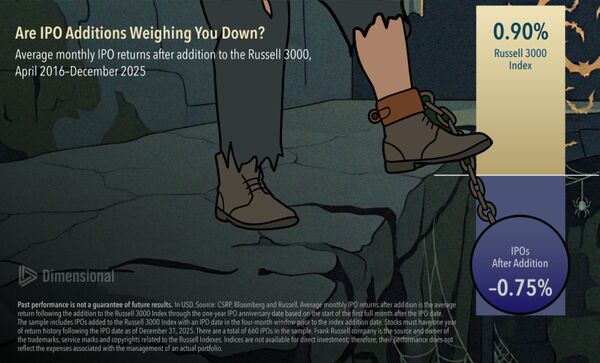
也可能对股市的部分板块产生负面影响;据FactSet数据(2026年10月23日),可选消费板块的盈利增长预计明年将下降3.4%。来源:彭博维度基金顾问投资解决方案集团副总裁凯文·格林:新首次公开募股(IPO)往往会引发投资者的热情。但一旦现实显现,IPO 似乎更像是一种拖累。研究显示,被纳入指数的 IPO 在上市后第一年内通常跑输整体指数,拖累了投资者回报。
It can also negatively impact portions of the stock market; earnings growth for the consumer discretionary sector is already forecast to drop 3.4% next year (source: Factset, October 23, 2026).Source: Bloomberg Kevin Green, vice president, investment solutions group at Dimensional Fund Advisors: New initial public offerings (IPOs) often draw excitement from investors. But once reality sinks in, IPOs may seem like more of a drag. Research shows that IPOs added to an index have generally underperformed the overall index within their first year since listing and weighed down investor returns.
CreditSights 全球策略主管 Winnie Cisar:AI 机器里藏着个幽灵。美国公用事业公司已经签下了约 153 吉瓦数据中心算力的电力容量,约为即便是最看好 AI 的预测所预期的 2030 年前新增需求的 1.8 倍。我们以前见过这出戏:1990 年代末的发电产能、2000 年代的黑光纤、2010 年代的页岩油。算力目前仍然稀缺,但随着大型科技公司将大量自有产能投入使用,高杠杆的新云服务商(neoclouds)有沦为本轮周期“黑光纤”的风险,而恐慌将在第一家眨眼削减资本支出时开始。
Winnie Cisar, global head of strategy at CreditSights: There’s a ghost in the AI machine. US utilities have already signed enough power capacity for roughly 153 gigawatts of data center compute, about 1.8 times the new demand that even the most AI-bullish forecasts expect through 2030. We’ve seen this story before: power generation in the late 1990s, dark fiber in the 2000s, shale in the 2010s. Compute is still scarce today, but as Big Tech brings massive owned capacity online, the highly levered neoclouds risk becoming the dark fiber of this cycle, and the scare begins when the first one blinks and cuts capex. Source: Bloomberg
来源:彭博社Cambria Investment Management 投资组合经理兼首席运营官 Jonathan Keetz:债券对冲股票是同时持有两者的全部理由,从 2001 年到 2022 年这确实可靠成立,但纵观记录,这种情况仅 24% 的时间成立。四分之三的市场历史看起来像现在这样,而不是像大家从中学到经验的那个时期。令人不适的不是股债相关性转为正值;它更多时候是正值。
Jonathan Keetz, portfolio manager and chief operating officer at Cambria Investment Management: Bonds hedging stocks is the entire argument for owning both, and it was reliably true from 2001 to 2022, but across the record it’s been true 24% of the time. Three-quarters of market history looks like right now, not like the period everyone learned from. What’s uncomfortable isn’t that the stock/bond correlation has turned positive; it’s positive more often than not.
而是每一次 60/40 回测、每一个基于现代数据校准的风险模型、以及大多数金融从业者的职业生涯,都处于那 21 年负相关的窗口期内。今天读数为 +0.53,为 1998 年 1 月以来最高,总债指数给出 +0.63,所以这不仅仅是单一序列表现异常。正如马科维茨常被转述的那样,分散投资是投资中最接近“免费午餐”的东西。
It’s that every 60/40 backtest ever run, every risk model calibrated on modern data, and the bulk of most finance careers sit inside the 21-year negative correlation window. It reads +0.53 today, the highest since January 1998, and the aggregate bond index gives +0.63, so it’s not just one series misbehaving. As Markowitz is usually paraphrased, diversification is the closest thing to a free lunch in investing.
投资者应着眼于构建一个跨资产类别的全球分散投资组合。来源:彭博社Bespoke Investment Group 宏观策略师 George Pearkes:目前流传着大量令人不安的图表,但最吓人的可能是2000年科技泡沫破裂与2026年年中动能和半导体高点之间的类比。两者的交易看起来与一个多世纪前由科技股主导的最后一次狂热抛售极为相似。
Investors should look to build a global portfolio diversified across asset classes. Source: Bloomberg George Pearkes, macro strategist for Bespoke Investment Group: There are plenty of scary charts floating around right now, but the spookiest might be the analogues between the end of the tech bubble in 2000 and the 2026 mid-year peak for momentum and semis. Both trades look eerily similar to the last, manic blow-off top led by tech over a quarter century ago.
市场最担心的是,这两种模式预示着与2000年相同类型的崩盘。常被归于马克·吐温的一句古语说,历史会押韵,却不会重复。股票多头应当希望这次情况并非如此!——来源:《彭博社》Interactive Brokers(盈透证券)首席策略师Steve Sosnick:整体来看,高收益债券利差正随美国国债一起上升。也就是说,高收益债券与国债的宽幅整体并未显著扩大。
The ultimate fright for the market is that these two patterns presage the same kind of collapse that they did in 2000. An old adage often attributed to Mark Twain says history rhymes, but doesn’t repeat. Stock bulls should hope that’s true this time around! Source: Bloomberg Steve Sosnick, chief strategist at Interactive Brokers: High yield spreads, on an overall basis, have been rising alongside Treasuries. That said, the spread for a broad basket of high-yield vs Treasuries has not been widening too much.
但若具体观察CCC级别的收益率,这些收益率已经飙升。这不是一个好的先例,尤其在美联储公开市场委员会似乎致力于降低货币宽松的背景下。最弱的信用正在受到挤压——问题在于这是否会波及下一层级的信用,最终影响股票市场。——来源:《彭博社》Syzygy资产管理公司(Syzygy Asset Management)首席投资官Jim Masturzo:与美国类似,新兴市场(EEM)正出现显著的整合,尤其在2026年。
But when we look more specifically at CCC yields, those have exploded. This is not a good precedent, especially with an FOMC that seems committed to reducing monetary accommodation. The weakest credits are feeling the pinch — the question is whether that affects next tier of credit and eventually equities. Source: Bloomberg Jim Masturzo, chief investment officer at Syzygy Asset Management: Like the U.S., emerging markets (EEM) are meaningfully consolidating, particularly in 2026.
韩国和台湾的配置平均占比为25%,现在已占指数的整整50%,而信息技术的配置也翻了一番。如今,新兴市场的多元化已不再是过去的样子。——来源:《彭博社》
South Korea and Taiwan, on average 25% of allocations, are now a full 50% of the index, while Information Technology allocations have also doubled. Today, emerging market diversification is no longer what it once was. Source: Bloomberg